
“The national park has been converted into a gigantic private enclosure for the super-rich”. Javier Flores (Doctor, Santa Cruz, Patagonia)
“Land is Life”. Going back to anthropologist and author Patrick Wolfe’s definition of the matter as “Land is life—or, at least, land is necessary for life. Thus contests for land can be—indeed, often are—contests for life.” Wolfe’s expansive definition can be taken beyond it’s settler colonial history and framework — evolving further as a dialectic of our age, yet staying rooted to the question of land, corresponding Nature and it’s acquisition by any means possible. ‘Means’ that manifest as the environmental, scientific, economic, political or purely exploitative, albeit bound within the planetary dominion of capitalism and those who orchestrate it’s power. Presenting three short stories, across three continents, based in Argentina, Spain and Kenya.
Globally felt is a great (and genuine) interest, at an economic, social, spiritual and scientific level, about the “anthropogenic effects on the environment” as well as “mitigating man-made ecological disasters”. What goes unchecked however for most people, is the underlying logic of capitalism, which equates to a “worship of industry, technological innovation and productivism as ends in themselves.” (John Bellamy Foster). As a consequence, the global exploitation of Nature that is based on capital’s expropriation of the “free gifts of nature” is going up at an increasing rate. Yet such a ravenous and universal logic, be it American or Chinese or Swiss or Spanish or African or Argentinian or whatever, is always in search of new grounds, new acquisition, new prospects, new reforms, regardless of the fact that there is no “new” land “available” anymore on a fixed and long colonized planet.
Since the limits to colonization were never defined, and whatever good achieved by “decolonization” albeit recolonization wields new mechanisms and new definitions, such as the emerging economy of Rewilding. A type of World-Ecology (mission) that “aspires to reduce human influence on ecosystems”. The U.N. has listed “Rewilding as one of it’s top priorities” and a range of “methods needed” to achieve the “restoration of natural ecosystems” which they say must be accomplished by 2030. A giant anti-ecological scam, to appropriate land, framed by the political and the scientific, empowered by private wealth while ensuring the eviction of the “invasive species and elements” that include not just human beings but a range of animals, varieties of plants and trees as well. The idea and the term “Rewilding” was literally robbed from the 1990's Earth First! manifesto. Yet the idea and corresponding science, did not insist on any privatization, nor expulsion of human and non-human entities.
What is Rewilding? “Restoring natural processes… core emphasis on recovering geographically specific sets of ecological interactions and functions that would have maintained ecosystems prior to human influence… Rewilding” (Wikipedia). How such “prior to human influence” will be achieved remains unresolved, yet the process reveals ugly and bizarre contradictions right from the onset, as an entanglement between what (and who) are native to the land and those who wish to “Rewild” it. A crusade that is fronted by scientists, ecologists, biologists, nature conservation specialists, dedicated institutions, backed by banks, big real estate corporations and even the U.N. — currently engaged in the Rewilding Of Patagonia (Argentina and Chile). The anti-ecological mechanisms of an economy and it’s corresponding culture that is “dedicated to expulsion in the name of conservation… effectively depopulating Patagonia…” (Sebastian Salgado, independent journalist, Data Urgente).

The principle architect of Rewilding in Patagonia was Douglas Rainsford Tompkins, who passed away in 2015. In 1995, Tomkins backed by several business interests as well as governing institutions, ecologists, nature lovers with deep pockets and politicians, together launched the “Rewilding Of Patagonia” — a movement that has rapidly transformed into a powerful NGO called “Fundación Rewilding Argentina”. Founder of American outdoor brand, North Face Inc, Tomkins was also a conservationist, outdoorsman, philanthropist, filmmaker and agriculturalist. Since the early 1970s, Tomkins and his wife (Susie) had surveyed the region of Patagonia, mapping out the wilderness and biodiversity shared between Argentina (for the most part) and Chile (for the rest) branding the region as “a land in need of deep ecology… habitat restoration and conservation biology”. Tomkin and his buddy Hans Wyss (Swiss billionaire businessman) needed a “guiding principle” to justify their motivation. They did achieve it by isolating one “endemic species” — the Maca Tobiano, a duck that was apparently “facing extinction due to invasive species and human influence”. Nothing could be more clever and misleading at the same time — the seeds of urgent conservation as well as a long-term plan to steadily depopulating the vast region, that Tomkins and Wyss began funding in Argentina and Chile during the early 1990s.
🦆 And such a duck, the Maca Tobiano, could change public opinion as well as map out the mass-acquisition of land and water bodies of the region — a project that eventually manifested as ‘The Conservation Land Trust Argentina’ in 1993. Is important to note that Tomkins had struck a fortune earlier with "Plain Jane", which later transformed into the world famous retail outlet Esprit. In 1994, Tomkins married Kristine McDivitt, chief executive of Patagonia Inc — a U.S. based outdoors fashion brand operating in 16 countries. Tomkin’s marketing vision, the eco-capitalism of converting Nature into cheap products and misleading euphemisms, converge in his documentary titled ‘180 Degrees South: Conquerors of the Useless’.
But the “conquerors” were neither benign nor did they come for the “useless”. “Fundación Rewilding Argentina” has managed to “exclude” roughly 280,000 hectares of Patagonia (since early 2000) including the region of “Cueva De Manos” with prehistoric value, caves with neolithic hand prints dating back to 15000 -13000BCE. The last 20 years more than 130,000 Argentinians and Chileans have abandoned the region due to various social and economic pressures. “For four generations we have been here working on the land and the ecosystem, without threatening any wildlife… and they come here to shame us about our lifestyle, our animals, or livestock practices… the duck protectors, the rewilding experts, the biologists, the bankers, the new-age tourists…” (Elvira Cvjetanovic, Estancia El Correntoso).
At every juncture of colonization of this part of Argentina, new billionaires show up to create new opportunity in the name of environmentalism. Take the case of Yvan Chouinard who is an environmentalist and boss of “Patagonia”. His brand hoodwink is based on the question “how to make better” whatever product. A recent book about him titled “dirtbag billionaire” is a holistic picture of the company Patagonia, that has amassed billions of dollars over the last three decades, as an outcome of exploitation of Nature, workers, as well as athletes and celebrities. The Patagonia catalogue extends from ski-kits, hiking cloths, outdoor medicine, tents, nets, shoes, shades etc etc. And the land and the people of Patagonia receive any benefits from such as a global venture? No, nothing.

Tomkin and all the Rewilding is but a symptom and not the root cause. One that was symbolized by the “sell-out of everything” in Argentina and Chile during 1975-2000. World famous figures like Milton Friedman, Ronald Reagan, Margaret Thatcher and Arthur Burns would isolate Argentina and Chile (1980s) as their “favored sites of neoliberal experimentation” (David Harvey, Brief History Of Neoliberalism). “In Chile, everything can be privatized, including the spirit of Earth, the mountains and the desert…” (Isabel Angélica Allende)
The following period (1990-2010) is a case study of “hyper-deregulation” on both sides of the “Cordillera” (Andes) that included the privatization of forests, lakes, islands, highways, even water tables under the ground sold off to mining corporations and vast swaths of wilderness leased out to European and North American banks and institutions. The ravenous economic tendencies, framed in the global north, in countries like the US, Canada, Switzerland, UK and Germany, achieved many things in Argentina and Chile. Yet specific to World-Ecology, key policies and wildlife propaganda, managed to acquire a vast territory measuring almost half-a-million hectares (and growing) now renamed as the ‘Nuevo Parque Nacional De Patagonia’ stretching into the deep-south end of the continent. Sofia Heinonen CEO of the so called “nonprofit conservation organization” Rewilding Argentina, also shows up in the 2023 top 100 female influencers of the world.
The situation gets way worse with the new messianic right-wing president of Argentina, Javier Milei. While the leader of the nation has no particular concern for conservation of Nature and nothing but denial of climate change, Javier Milei is very much concerned about the acquisition of land, freeing up Nature and conversion of resources. No shock nor shame, in declaring the Mapuché as “terrorists”. But some people fear that such a vulgar declaration is a precursor to “an incoming genocide”. Indie news-channels based in Argentina reveal Milei’s “blueprint to depopulate Patagonia” — driving out the older generation (Argentinians as well as the Indigenous Mapuché) while making space for incoming migrants, land developers, investors, hotels and tourists, especially from Israel, Germany, Canada and the U.S.
“Paramilitary forces that arrived recently, were seen wearing the Argentine and Israeli national symbols on their uniforms… and that is really shocking!” (Diputada de la Provincia de Río Negro, Magalena Odarda). Milei’s favored list includes rich Zionists fleeing Israel, IDF soldiers evading war-crimes, Israeli tourists, reservists and real-estate developers. The “strategy to depopulate in order to repopulate” also involves the demonization of the Mapuché of Chubut, by Javier Milei, when he declares “the forest fires in the region of Rio Negro and Chubut is the work of the Mapuché… operating like terrorist cells…”.
The die-hard ‘Rancheros’, livestock owners, fisheries, farmers, shepherd communities, the Mapuché alliance and solidarity groups are left with no option but organize and resist, and Juan Enrique Nauta (resident of Rio Negro) can see beyond the horizon, when he says “who knows… at this rate of expropriation and buy-out, in the future Argentina itself might cease to exist.” (Proyecto Patagonia, Documentary). Patagonia as a region, surrounded and infiltrated by various groups and their vested interests, is clearly up for destruction of many types — perhaps naive to hope the people of that land may unite, as a last resort with a declaration of independence even. The question is about land and it’s corresponding relationship, value and the age-old guarantee of life.
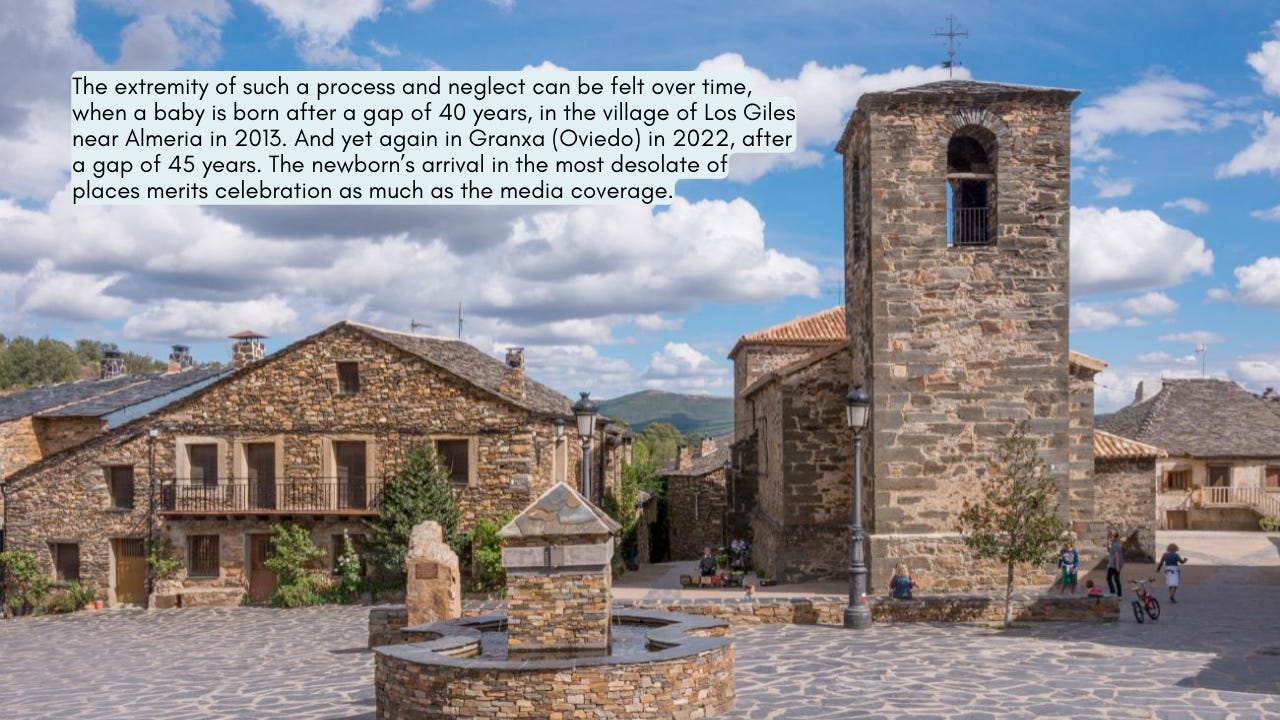
They called it “España Vacia” (Empty Spain). After nearly three decades of public pressure and endless parliamentary cycles, the government of Pedro Sanchez declared “the central region of Spain, especially deep interiors are facing a devastating crisis of depopulation. We must address this crisis immediately…” (March 2019). A country with approximately 47 million people, Spain is a very strange and sad story of abandonment and not just depopulation, the process began during the dictatorship of Franco (1945-1975). Neoliberal economic rehabilitation of the 1980s and “Spanish desperation to catch up with the rest of western Europe” (David Harvey, Brief History Of Neoliberalism) would drive millions of young Spanish out of their native regions and the country itself. Depopulating Andalucía, Murcia, Castilla La Mancha, Leon, Extremadura, Galicia and Aragon while towards the clusters of renewed economic growth and industrialization in Madrid, Catalunya, Bilbao, Santander, Pamplona and Valencia. No surprise to the average Spanish, that more 3500 villages have been identified as “Despoblada” (Depopulated) and the rate of depopulating villages has only risen since 2000s. The extremity of such a process and neglect can be felt over time, when a baby is born at last, after a gap of 40 years in the village of Los Giles near Almeria in 2013. And yet again in Granxa (Oviedo) in 2022, after 45 years. The newborn’s arrival in the most desolate places merits hope and celebration as much as proper media coverage.
Any depopulated region is weaker in terms of the remaining population’s resilience and their ability to protect their modes of production viz-a-viz modes of survival. 77% of Spanish municipalities have witnessed a drop in population (European Journal of Political Research 2022). And such abandonment provides an excellent opportunity for capital, business and industries of scale, to literally “target and attack” the interiors, unattended lands, water bodies and villages. Since 2010, following the market crash of 2008, as part of the recovery plans laid down by the EU parliament, almost every Spanish political party has exploited the ecological and social weakness of such regions. Similar things have happened in Portugal, Italy and Greece. But the champion of the race to wholesale expropriation of “España Vacia” is the energy industry. Of the many sun-kissed geographies and wind-swept regions of Spain that have been steadily recolonized, by hundreds of big and small corporations — engaged in the generation and distribution of energy, setting up giant solar-farms, windmill parks, hydro-power facilities, data centers, logistical hubs, domestic photovoltaic systems, macro and micro-grids, etc.

Spain can boast about it’s “renewable energy transition” with promising figures — wind energy production reached 22%, hydroelectric 10%, nuclear 4% and solar 19% of total energy production in 2023. Wow and well done! But numbers are not sufficient, even misleading to understand the larger energy scam going on inside Spain. On closer inspection, three principal aspects of generation and distribution highlight the involved scale of exploitation, ecological damage and incoming risks. The “geography of energy injustice” recently explained by Isaac Moreno Gallo.
Regions that account for the highest energy consumption are Madrid, Catalunya, Pamplona and Valencia. Yet clubbed together, they generate less than 15% of their energy requirement. It is Cordoba, Sevilla, Cadiz, Castilla La Mancha, Murcia, Lugo and Zaragoza that host an overwhelming majority of wind and solar farms, spread over thousands of hectares, across natural wilderness and rural expanses. Yet the people of these regions do not receive the economic benefits nor any energy discounts. The expropriation of land orchestrated by powerful energy cartels, direct the governing decisions of every region within Spain. Favoring the core centers of production, business and tourism, and not the peripheral regions of extraction. Amazing peak of the scam, that every person living in Spain is paying more every passing year, more for fossil fuels as well as all the green colored energy. Since 2020, energy prices have risen 0.2% (€/kWh) every quarter.
Centralized energy distribution networks that involve millions of meters of cables, high-tension wires and hundreds of sub-stations also reveal an “infrastructure of inequality and instability”. The flow of energy, between the big zones of generation and consumption, take up a major part of the electricity grid and it’s structurally disproportionate. The urban population of Spain takes up a staggering 82% of the distribution network while the remaining is routed back towards small towns, rural regions and the deep interiors. The recent “Iberian Blackout - El Gran Apagon” best understood as a giant grid-failure, that plunged Spain, Portugal and parts of Southern France in a state of disarray in less than 45 minutes. The grid-failure also exposed structural defects and “a domino effect” (El País) that no one was able to detect in time, even less manage the disaster from reaching it’s maximum impact. Millions of homes, shops, restaurants, offices, schools, banks, food storage units, even police stations, rural hospitals, train services and traffic control systems, were all knocked out because of one-glitch-in-the-system. Dozens of conspiracy theories that followed, makes for a whole-new-story!
Not addressed by mainstream media, not by Greenpeace, nor any interventions by MITECO (ministry of ecological transition and environment) or by the autonomous governing councils is the mass culling of birds, due to ever more windmills. Birds of all types, be they up on a “trophic level” or small sparrows, bats, eagles, vultures, kestrels, kites, etc all face unexpected death on a daily basis, unleashed by the giant blades of hundreds of thousands of windmills. Some of the birds are even enlisted as “protected species” yet their “real safeguard” as been effectively decommissioned by energy corporations, engineers, leading ecologists within Spain and the consumers alike.
For now, Spain is firmly hooked to the myth of cheap energy and never mind the mass-devaluation of Nature. For there can never be any “renewable energy” on a non-renewable, fixed planet, to even begin with.

“The utter stupidity of hawking our future to the Capitalists who destroyed our past.” Mordecai Ogada (Wildlife expert and ecologist, Kenya). Thoroughly jaded by World-Ecology and it’s corresponding frameworks (and laws) of conservation, Mordecai criticizes the impact western finance (and capitalism) colluding with Nature conservation in Kenya. The economies tied to tourism and wildlife conservation, willy nilly compound wealth inequality within Kenya, according to Mordecai. He points to a “substantial growth in protected areas in the last 20 years”— as being “rooted in violence, exclusion, eviction and disenfranchisement of hundreds of thousands of Kenyans.” Mordecai’s concern is not just about Kenya, while addressing similar wildlife funding and eviction of natives, that is working it’s way in the interiors of Congo, Tanzania, Mozambique and Madagascar.
The underlying argument is so obvious, that is able to bust a fundamental myth, that “wildlife needs to be protected from Black African locals, who have lived in equilibrium with this wildlife since humanity began”. Mordecai exposes the ecological hoodwink that has gone on for for decades, within various African nations, backed by African leaders and policy makers in favor of foreign interests and dominion. “Western tourists, wildlife experts, ecologists, film-makers, celebrities etc are encouraged to go on safaris all over Africa… even kill big game animals for sport, yet there is no paramilitary outfits that will hunt and kill these foreigners, let alone burn down their villages and disallow them from accessing their sacred forests…. as organizations such as WWF (World Wildlife Fund) have actually done alongside so many other multinational conservation organizations”.
Kenya finds itself at the crossroads of rapid economic growth, signing away swaths of jungles as “Carbon Offsets” and massive development projects spanning decades to come. Mordecai’s debunks the above trajectory as a “a long term disaster” instead framing Kenya’s current place in the global picture as part of the “poor” and the “punished”. True, that wildlife conservation as per western maxims, destroys native food systems as well as privatize (and militarize) open habitats. There lies deep racist assumptions of the West, that underpin conservation in Africa and perhaps elsewhere too. The no-brain “Disneyfied myths” also empower “western objectification of Africa, it’s nativity and wildlife”.
Severe contradictions arise within existing inequality, because of tourism and capitalism, often exacerbating the “urgency to protect wildlife”. Kenya is a prime example of a decolonized society of namesake, and Mordecai is spot-on when he says “conservation today reinforces the institutions of colonialism, and how the language of crisis maintains these dubious institutions… talk about death in the circle of life, as it relates to carnivores since the dawn of humanity… We have to include every contradiction of life that is part of Nature… If you really want conservation, you have to allow natural processes to continue unobstructed”. Wildlife and nature conservation that blocks “Indigenous interaction with the landscape” is but a bunch of homogenized rules, imposed on unfathomable complexity of systems — Nature itself would reject all such conservatory objectives and exclusionary missions.
Argentina, Spain or Kenya or for that matter any nation, with whatever pristine Nature to boast about or in dire need of conservation, globally speaking, conservation of Nature is a vanishing prospect. “Forest fires burned nearly 15 million hectares, the size of Greece” (UNDRR, Canada, 2023). Thus brings us back to the ecological virtue, with all possible urgency that “Land is life” (Patrick Wolfe).
Ever new abstractions, policies, promises and projects that evolve from the fountains of “planetary management and transition” are most often subservient to capitalism, fronted by very many disingenuous, colorful, powerful institutions and influential individuals — in the form of World-Ecology, Energy Transition, Overshoot, Rewilding, Wildlife Conservation, Gaia Worship etc etc. Is vital to remember that the “trophic level” of a ruling species and the position it occupies inside the “Web Of Life” (Jason Moore) remains as is — the organism that must eat other organisms, as well as wage a continuous war on Nature, may in turn, eventually consume themselves via what is increasingly visible as “Cannibal Capitalism” (Nancy Fraser).
Such shock inducing terminology compels us to look around, investigate and understand the entanglements of capital with the biosphere crisis and the future of all remaining species. The wholesale expropriation of land, addiction to energy, neo-colonization of remaining Nature and the mechanisms of depopulating land are all part of the planet’s ongoing “metabolic collapse”.
🌛🧒🏻🍄🌴🌵😓🌲🧒🏾🦔
In case you wish to pledge support with a paid subscription 😌 CLICK HERE 🙏🏽
(yes it helps a lot )
Comments
Nothing yet. Say the first thing.
Sign in to join the conversation.