
ATP is presented by:

Welcome back to The Asia Tech Podcast. Today we discussed India’s push to build sovereign AI infrastructure, how AI is reshaping team structures and workflows, ESG as a business operating model, decentralized payments for AI agents, and how enterprises can protect against social engineering attacks targeting AI chatbots.
We were joined by:
• 20:09 Aytekin Tank - Founder & CEO at Jotform
• 40:47 Nisha Kohli - Co-Chair ESG World Summit and GRIT Awards at CorpStage
• 1:12:39 Damien Wong - Senior Vice President, APAC at Tricentis
• 1:38:05 Patrick Tobler - Founder at Masumi
• 1:56:20 Michael Wasielewski - Founder and CEO at Generative Security
Here is an overview of the topics we discussed today:
HCLTech Bets Big on India’s AI Future
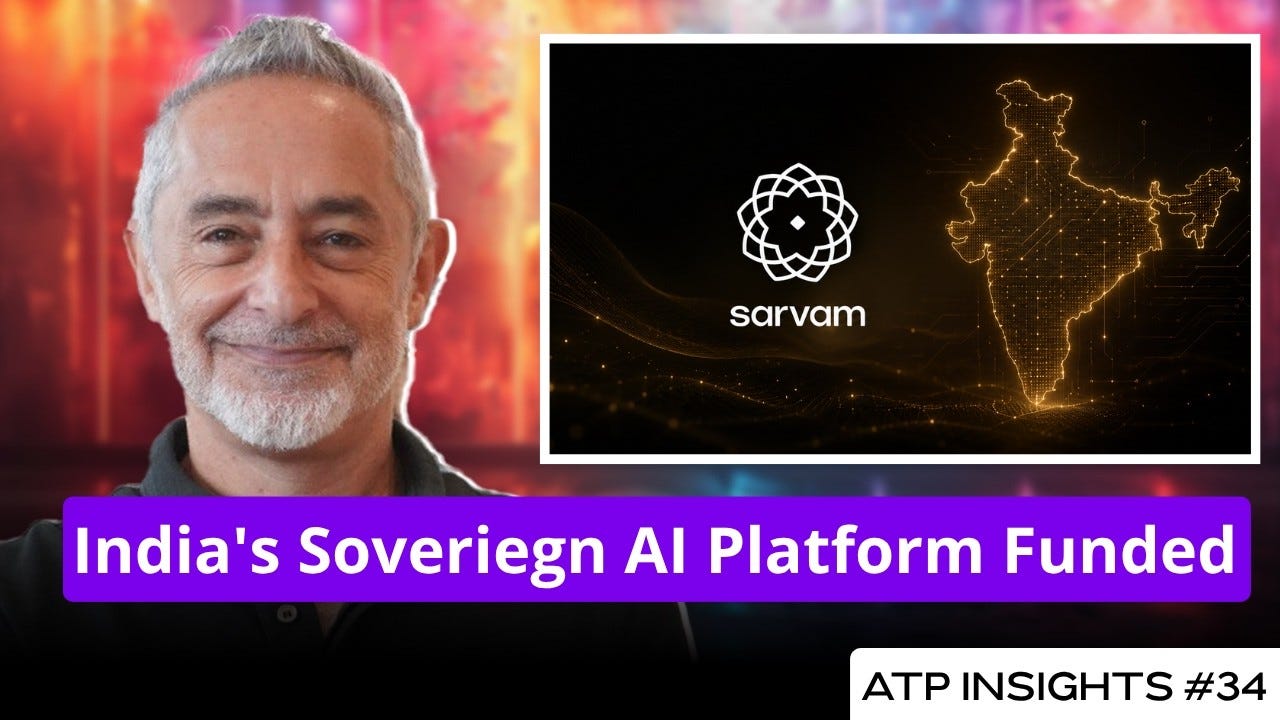
HCL Tech just led a $1.5 billion valuation round in Sarvam AI — an Indian startup building language models designed specifically for India. The deal isn’t just about capital. It signals something bigger: India’s IT services giants are moving from integrating other people’s AI to owning the infrastructure. India’s linguistic complexity makes this harder than it sounds. Travel 100 miles in any direction and you could encounter an entirely different language, dialect, and cultural context — something generic Western LLMs simply cannot handle. Sarvam already has partnerships with Microsoft Azure and Google DeepMind, and HCL’s enterprise distribution network could be the bridge that gets it into banks, governments, and regulated industries across the country.
AI Changes the Shape of Teams
Aytekin built JotForm over 20 years and has 40 million users. He’s watching AI reshape how his 800-person company works — but not in the way most people fear. Individual contributors are effectively becoming teams of one. A designer can now handle front-end work; a developer can mock up interfaces in hours. The result isn’t mass layoffs — it’s a world where startups that once needed 10 people to launch can now do it with two or three. JotForm itself moved 80% of its customer support to AI agents in just a few months. Why do users accept it? Turns out people are more patient with AI — they ask more questions, feel less embarrassed, and don’t have to wait on hold.
ESG Goes from Checkbox to Operating Model
ESG reporting started as a voluntary exercise, became a compliance requirement, then got scaled back when regulators pulled in the reins. But Nisha argues that demand hasn’t dropped — it’s shifted. Banks are still pricing ESG risk into capital costs. European buyers still require supply chain carbon data. The question now is whether AI makes ESG infrastructure accessible to smaller companies who once couldn’t afford the consultants. Nisha’s platform doesn’t call itself a reporting tool — it calls itself an operating model. The gap she sees most clearly: almost no companies integrate their ESG data with their financial data, even though both are required for the full picture to make sense.
Untested Code Is Already Costing Enterprises Millions
Damien has seen the data. In Tricentis’s 2026 Quality Transformation Report, 60% of organizations admitted to deploying untested code. The cause isn’t carelessness — it’s speed pressure. Agentic AI makes code cheap to write but doesn’t make it correct. Half of respondents said poor software quality costs them between $500K and $5 million per year. Tricentis is building what Damien calls “quality intelligence” — automatically detecting what code changed, what was tested, and flagging anything heading to production without a test on record. Think of it as brakes on a fast car: the better the brakes, the faster you can safely go.
Who Pays When Your Agent Books the Wrong Flight?
Patrick’s company, Masumi, is building payment infrastructure for AI agents. His premise: if billions of agents will eventually transact with each other, traditional bank accounts and credit cards won’t scale. Crypto wallets will. But payments are just one of four problems. The others are identity (how does your agent know it’s talking to the real Lufthansa agent?), decision logging (which agent in the chain made the mistake?), and discovery (how do you find trustworthy agents without a centralized app store?). Patrick’s bigger concern is that if Microsoft or Google becomes the gatekeeper for which agents are visible, we may have just traded one kind of monopoly for another.
Your Chatbot Doesn’t Have Spidey Sense. That’s the Problem.
Michael’s focus is securing the conversation layer between humans and AI. Traditional security blocks bad inputs at the door. But with generative AI, the attack surface is the conversation itself — and most malicious inputs look completely innocent one at a time. His proposed solution: evaluate outputs, not just inputs. If a chatbot reveals that a specific employee is working alone after 8 PM, that response is dangerous regardless of how the question was framed. As agent-to-agent communication grows, the risk scales up fast. A rogue agent can manipulate another agent the same way a phishing email tricks a person — by mimicking authority or manufacturing urgency. Designing for that threat requires a type of threat modeling that most security teams haven’t trained for yet.
Watch the full episode here:
ATP Is Presented by Twilio:
Twilio is the secure and scalable platform to build amazing customer engagement without the complexity, with the AI-driven workflows you need to connect.
Visit Twilio.com to start building today
ATP Is Made Possible by:

Boomi, the data activation company for AI, powers the agentic enterprise by bringing data to life across the business. Trusted by over 30,000 customers and supported by a network of 800+ partners, Boomi helps organizations of all sizes achieve agility, efficiency, and innovation at scale.
Visit www.boomi.com to learn more
Thanks for reading! Subscribe for free to receive new posts and support my work.
Comments
Nothing yet. Say the first thing.
Sign in to join the conversation.