
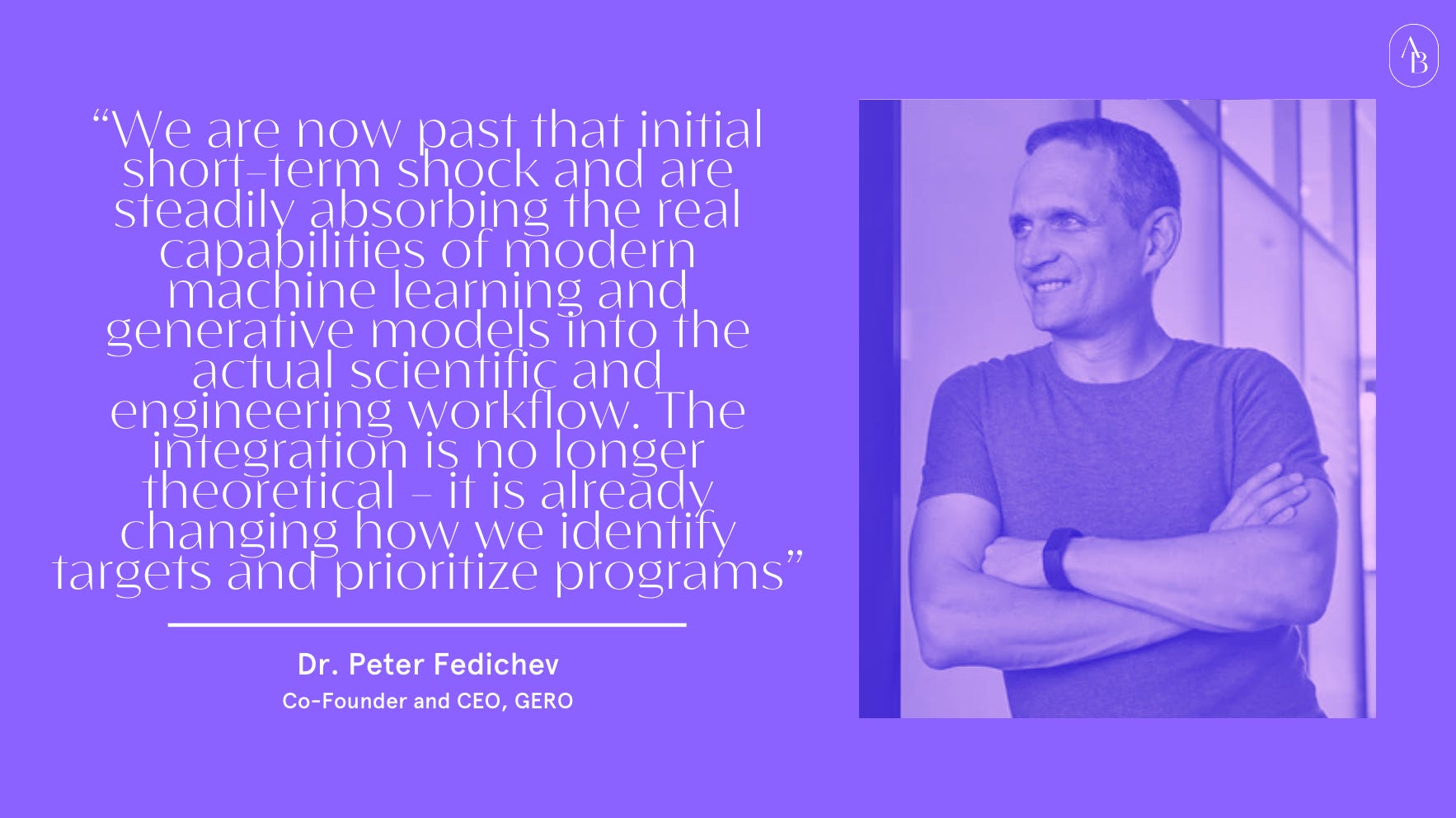
Dr. Peter Fedichev is the Co-Founder and CEO of Gero, an AI-driven biotech company focused on drug discovery. In January of 2025, AthenaBIO funded a program to focus on menopause following a fortuitous meeting with Dr. Fedichev at JPM Week the previous year. Since then, Gero inked a $250M deal with Roche’s Chugai and has raised a further $23M, with Dr. Fedichev being named a World Economic Forum tech pioneer.
Q: You are a longevity drug discovery biotech. How did you get interested in menopause?
Our interest in women’s health, and menopause in particular, actually began as a technical challenge while working with large-scale biobanks such as the UK Biobank. When we started applying our machine-learning models — trained on massive amounts of real-world clinical data — to understand aging trajectories and disease mechanisms, we kept running into a very strong biological signal: the variation in clinical and physiological markers linked to the menstrual cycle. Even in the most healthy individuals, this variation is large enough that it interferes with clean interpretation of aging and disease signatures. At first, our goal was simply to separate the reproductive-health signal from the aging and disease signals so our models would work better. The AthenaBIO project then gave us the opportunity to stop treating this as noise and instead focus on it directly as a target for drug discovery. What started as a data-cleaning problem became one of our most interesting scientific programs.
Q: You are developing many programs at Gero. What could be interesting or special about the menopause one?
The menopause program stands out because it sits at the intersection of our core mission — building transformative drugs against aging — and a unique evolutionary puzzle that is almost specific to humans. In most species that reach the top of the food chain, evolution tends to “fix” longevity genes in the population because a longer lifespan allows more offspring and greater reproductive success. In humans, however, this link between evolutionary success and longevity is broken by menopause. It is relatively rare in nature and may have been selected for through mechanisms like the grandmother hypothesis: in species with long childhood development periods, it can be advantageous for older females to stop reproducing themselves and instead invest heavily in helping raise their grandchildren. By applying the same AI algorithms we use for systemic aging to very large human datasets, we have a rare chance to study both the shared and the divergent mechanisms that control aging, chronic disease, and reproductive aging. Menopause now affects essentially all women in advanced societies and has a profound impact on healthspan and quality of life for half the population. The commercial and humanitarian case is exceptionally strong — arguably clearer than for many other conditions. It is a perfect example of how understanding aging biology can lead to therapies that are both scientifically deep and immediately meaningful.
Q: How much are we over or underestimating the process of drug discovery with AI?
I think we are following the classic pattern described by Roy Amara’s Law: humans tend to overestimate the impact of a new technology in the short run and underestimate it in the long run. There was certainly a period of hype and over-optimism about how quickly AI would transform drug discovery. We are now past that initial short-term shock and are steadily absorbing the real capabilities of modern machine learning and generative models into the actual scientific and engineering workflow. The integration is no longer theoretical — it is already changing how we identify targets and prioritize programs. The long-term effect on the speed, cost, and success rate of drug discovery is likely to be much larger than most people currently expect. We are still in the early innings of that transformation.
The 4%.
That is the share of American women on hormone replacement therapy, the only medicine ever approved to treat menopause at its hormonal root, rather than one symptom at a time.
Menopause is not a rare condition or a niche diagnosis. It is a universal, scheduled biological event, arriving on a timeline as predictable as puberty. It is a stage of life most women will spend a third of their years in. The biomedical field’s collective response is a single approved therapy, treating symptoms rather than the underlying biology.
A four percent uptake rate for the only treatment of a condition that inevitably affects half the population in their middle age feels like a missed opportunity when you consider the biggest users of GLP-1s are women, with most of them being in middle age.
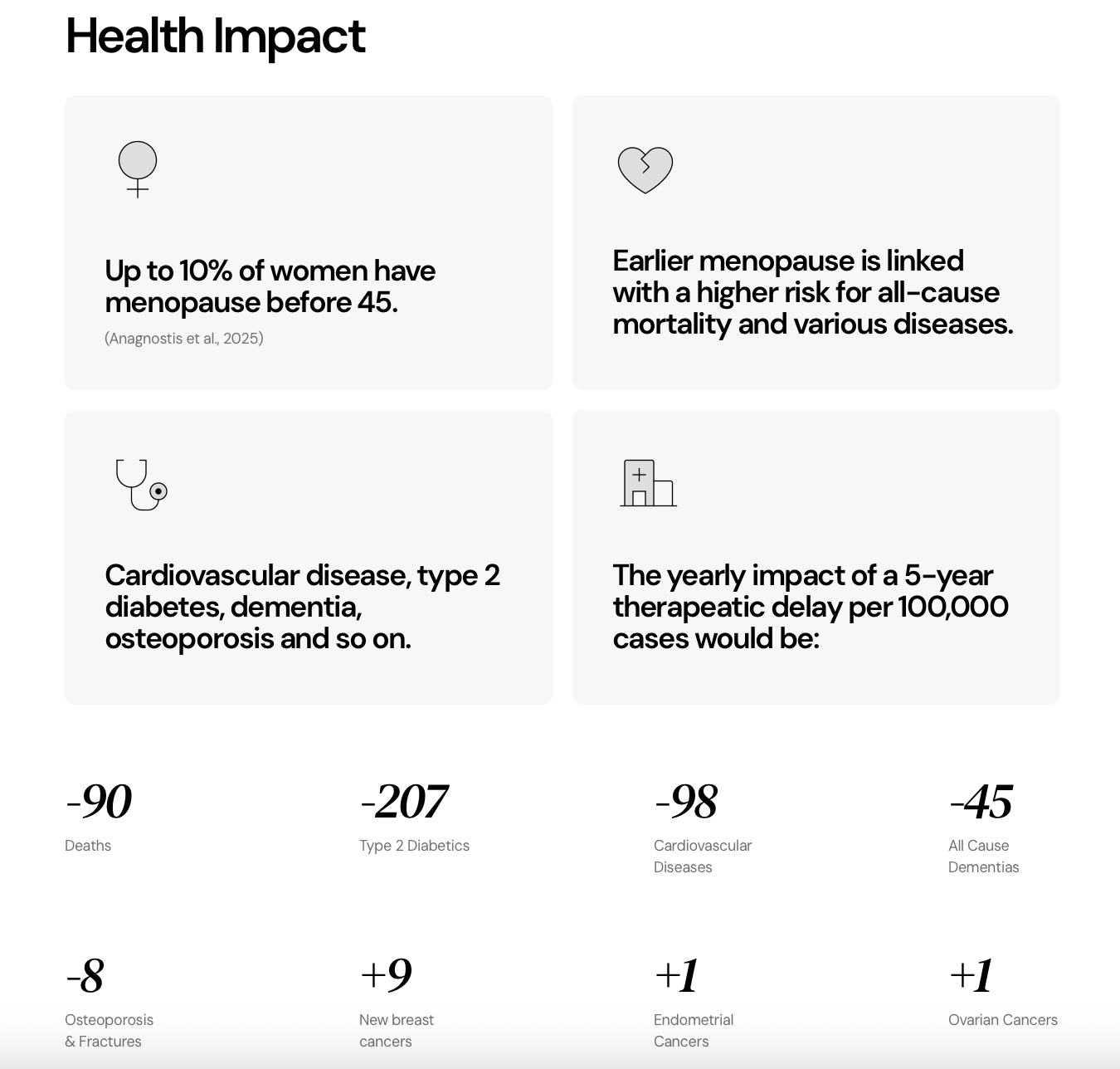
The “Menopause Later” project took the task of quantifying this late last year:
To be fair there are also two streams of thought that impact advancement:
The myth that we are trying to medicalize menopause and that pharma is trying to sell more drugs. Funny because trying to convince Pharma to develop more treatments that treat female specific conditions is a bigger task than the conspiracy theory that they are trying to dump more medicine on us.
Some find it offensive or hurtful to state the biological reality that menopause is a compromised state of health. Our stance is simple - menopause is natural, but heart disease is natural, and so is erectile dysfunction. There are currently 100+ compounds/programs in various stages of clinical development for this condition. Compare this to the 6 drug candidates specifically for menopause symptoms.
0 drug candidates to actually do something beyond treating symptoms.
Can we all agree, regardless of differences of opinion, we should do better for women?
For those who want solutions, we at AthenaBIO are trying to get more research funded so we can one day provide more options for women.
Part of the problem is that menopause has never been treated as an aging problem. It has been treated as a hormone problem, a fertility problem, a “women’s issue” to be managed, rather than one of the many biological clocks to be understood.
But of every clock in the human body, the ovarian one is the easiest to read. A woman is born with one to two million oocytes. By the time she reaches menopause, that number has fallen to roughly a thousand. In the ovary, there is a countable and measurable decline, running on a schedule tighter and more predictable than that of almost any other organ system we know of.
That precision, and the framing of menopause as a distinctly ageing topic, is why physics-first AI drug discovery company, Gero AI, decided to work on it.
By: Dr. Anaelle B Harel, MBBS
Gero’s starting premise is that aging is not one process, but two. One is reversible: physiological “noise” that builds with age and drives disease later in life. The other is not: entropic damage that sets a hard ceiling on lifespan, somewhere around 120 to 150 years.
This split, formalized by Gero co-founder Dr. Peter Fedichev alongside Dr. Jan Gruber of the National University of Singapore, sorts every possible intervention into three tiers.
Level 1: drugs chase individual disease hallmarks like senescence, inflammation, and telomere loss, the current centre of gravity for longevity biotech, moving the needle on disease more than on aging itself.
Level 2: drugs go after the noise directly, aiming to decouple disease from age altogether; Gero’s own estimate puts the reward at up to 30 to 40 additional healthy years, using tools that already exist today.
Level 3: drugs would push against the entropic ceiling itself, the far horizon.
Its platform, trained on tens of millions of longitudinal human health records, is built to hunt the tiers that the rest of the field, by its own account, has barely begun to touch.
The hunt has at last arrived at ovarian ageing.
Every aging trajectory needs a clock to measure it against; most organs unfortunately don’t have a great one. Dementia subtypes get misdiagnosed for years. Cardiovascular risk gets estimated, adjusted, re-estimated. Ovarian aging, however, offers a rare, clean signal. Menopause timing is already sitting inside decades of high-quality biobank data, recorded without ambiguity, in the UK Biobank and the Estonian Biobank alike. There is no guessing at the diagnosis and no arguing about the endpoint.
This clarity is the perfect match for a model built to separate noise from damage, a landing point before attempting a shot at biology with far messier signals.
This is the premise of OVARIA, the joint effort between GERO and AthenaBIO already underway. The plan? Train a model to flag which women face the highest risk of an early menopause transition. Then run genome-wide and rare-variant association studies aimed at surfacing at least ten new therapeutic targets in a space that has produced almost none.
Few clocks in the body are as consistently misfiled as the ovarian one. For as long as medicine has studied aging, it has been filed under fertility and hormones. While not untrue, that filing has always been partial, and it is imperative it that take a position alongside the aging processes that medicine takes seriously enough to chase. The cost of that filing error is not abstract. It shows up as a four percent uptake rate for the only solution menopause has ever truly been given.
Whether that promise holds depends less on the science, which is already moving, than on whether funding follows it there. Work this early rarely looks investable. Here, it may look like spreadsheets and biobank queries. But it is, unfortunately, at this stage where women’s health research has always been asked to wait the longest.
If you are interested in being part of this project, funding the next stage of R&D, or partnering with AthenaBIO and Gero on this work, get in touch.
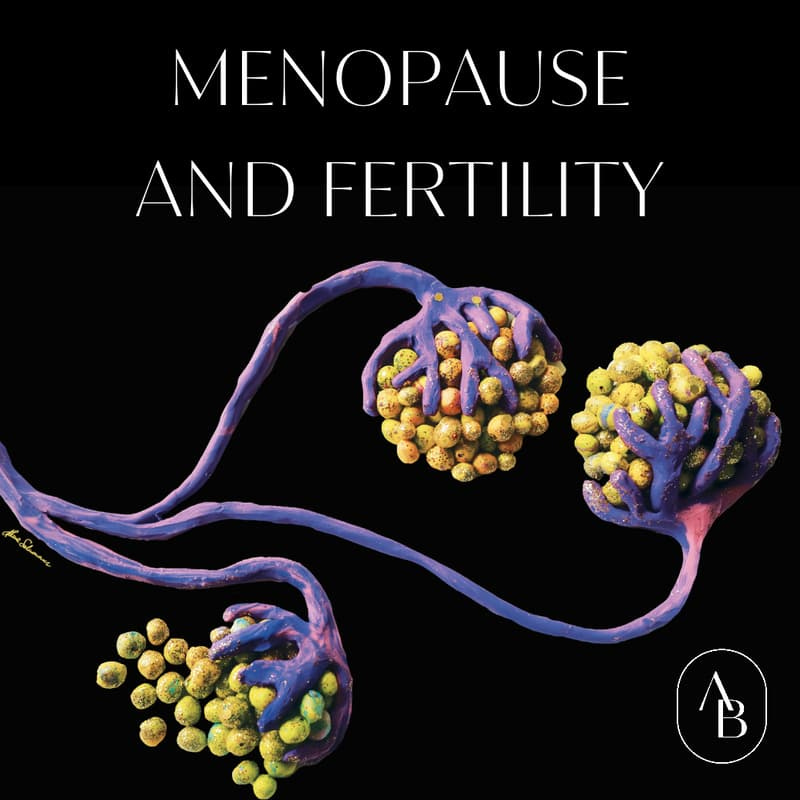
Following our popular “Menopause Today“ event earlier this month, we are hosting “Menopause and Fertility” - a deep dive into the research around extending, delaying, and potentially ending menopause.
We’ll dive into:
Ovarian Cryopreservation with Dr. Kutluk Oktay
Drugs to extend fertility with Dr. Mario Cordero
Existing tools for menopause and why HRT is not enough
Against Maximum Stimulation - Egg freezing, IVF, and the case for gentler fertility medicine by Riva Tez
This is an ONLINE Event, streaming live on the @BIOHBN X Account.
RSVP to get the link in your inbox and get notified of future events!
No posts
Comments
Nothing yet. Say the first thing.
Sign in to join the conversation.