
why I keep going back?
I’m pretty sure this will be my 4th edition of IDA’s Getting Real conference. My first time was 2018 and it’s one of those where I pick up my pass months before hand. Aside from early bird discount reasons...I get my tickets early cause it does sell out!
Every couple of years, the International Documentary Association puts on Getting Real. The biennial gathering designed for and by documentary workers, focused on the business and art of nonfiction storytelling. It happens in Los Angeles, mostly in Little Tokyo, and it draws folks from our industry from across the US and globe. I’m been constantly impressed by how global it is and more importantly how much there is a learn from filmmakers operating everywhere! We’re about a month away from the next edition that’s running July 20 to 23, 2026.
If you make documentaries, or work in nonfiction in any capacity, and you haven’t been, come correct and get your pass! Props to Abby Sun and the whole IDA team who do the diligent & field building work to put this all together.
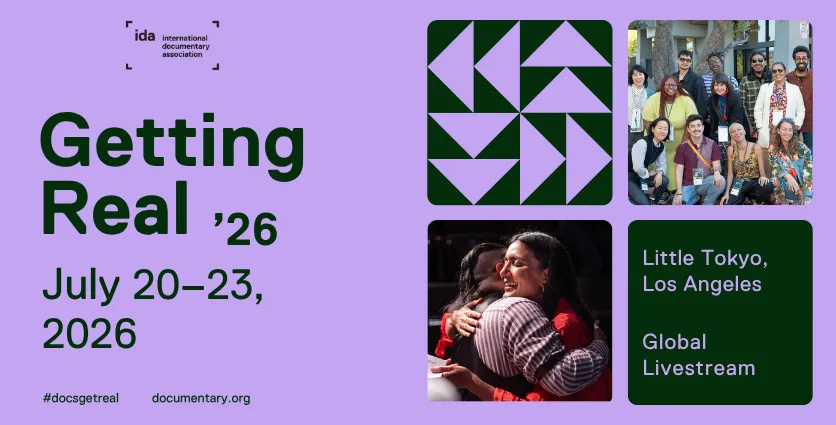
The IDA has been around since 1982. It’s one of the primary advocacy and support organizations for documentary filmmakers in the US (and expanding worldwide), offering grants, fiscal sponsorship, resources, and community programming. Getting Real is a flagship event they put on.
IndieWire called it the documentary field’s “premiere field-building gathering.”
What makes it different from other industry conferences is harder to pin down but you feel it when you’re there. There’s no pitch culture. There’s no performance of success. The press-embargoed sessions mean people actually talk candidly about what’s working and what isn’t. And the programming is built around the people making films outside the commercial system, not the executives acquiring them. I think that’s key it is about the business of nonfiction but you won’t hear much about the latest true crime success story, sports, music or celebrity silliness. Not that I don’t like those but it’s good in a town dominated by those conversations to have space for everything else.
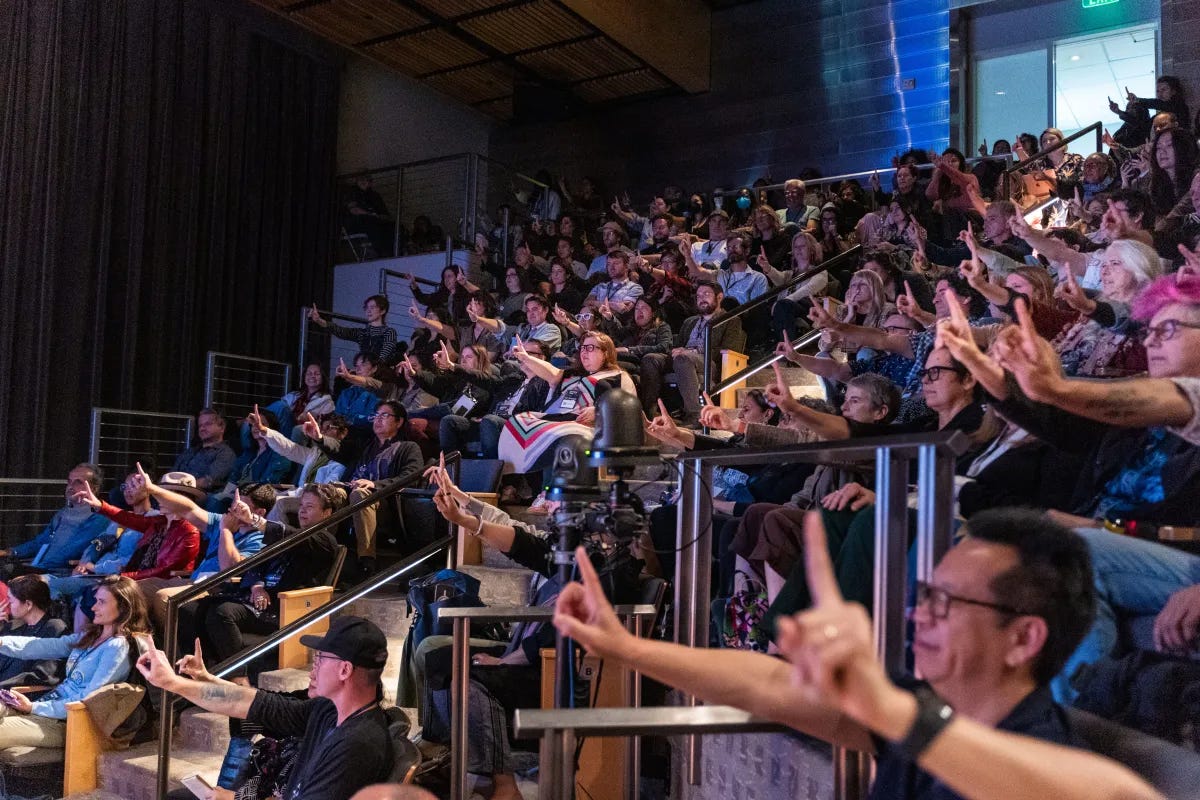
I’ve been thinking a lot lately about why certain experiences actually change how we think, and why others just wash over us. There’s neuroscience behind this. The brain builds habits through reinforcement, creating neural pathways that become more automatic and efficient over time. The problem is those pathways include the unhelpful ones: the assumption that the only path to distribution is through a gatekeeper, that festivals are the finish line, that making a great film is enough. These aren’t conscious beliefs so much as grooves worn into the brain through years of operating in a system that told us this was how it worked.
Breaking those patterns requires disruption. New information isn’t enough on its own. What actually rewires the brain is experience, being in a room with people who are doing things differently, hearing it articulated clearly, having your existing assumptions challenged in real time, and then repeating that exposure until the new pathway starts to feel more natural than the old one. The community and connection builds belief that you can do new things, and do hard things.
That’s what Getting Real does for me. Every time I go, I come home thinking differently. Not because I heard a great talk (though I usually did), but because the cumulative effect of four days inside a community that is actively rethinking everything creates new pathways. You leave with a different operating system than the one you arrived with.
From Getting Real ‘24 three moments stood out for me in particular.
Jemma Desai’s keynote was genuinely challenging. She named things clearly and without the diplomatic softening that tends to happen in industry spaces. Her line that “in the last few months, more than ever, it is clear how little integrity, in any sense of the word, the documentary or any creative field can claim in its current infrastructures” landed hard. That kind of provocation is rare at industry conferences and it’s exactly what you need to actually shift the grooves. Go watch the full keynote here.
Kirsten Johnson’s keynote was something else entirely. It was more of a performance lecture than a talk. She pushed the audience to think about what it really means to film from the specificity of your own body, about our relationship with images and what happens to them after we make them, about the stakes of making something when you are the instrument. It was alive in a way that most conference programming isn’t. People were turned and looking into each other’s eyes at one point. That kind of thing sticks. Yup the full recording of the keynote is right here!
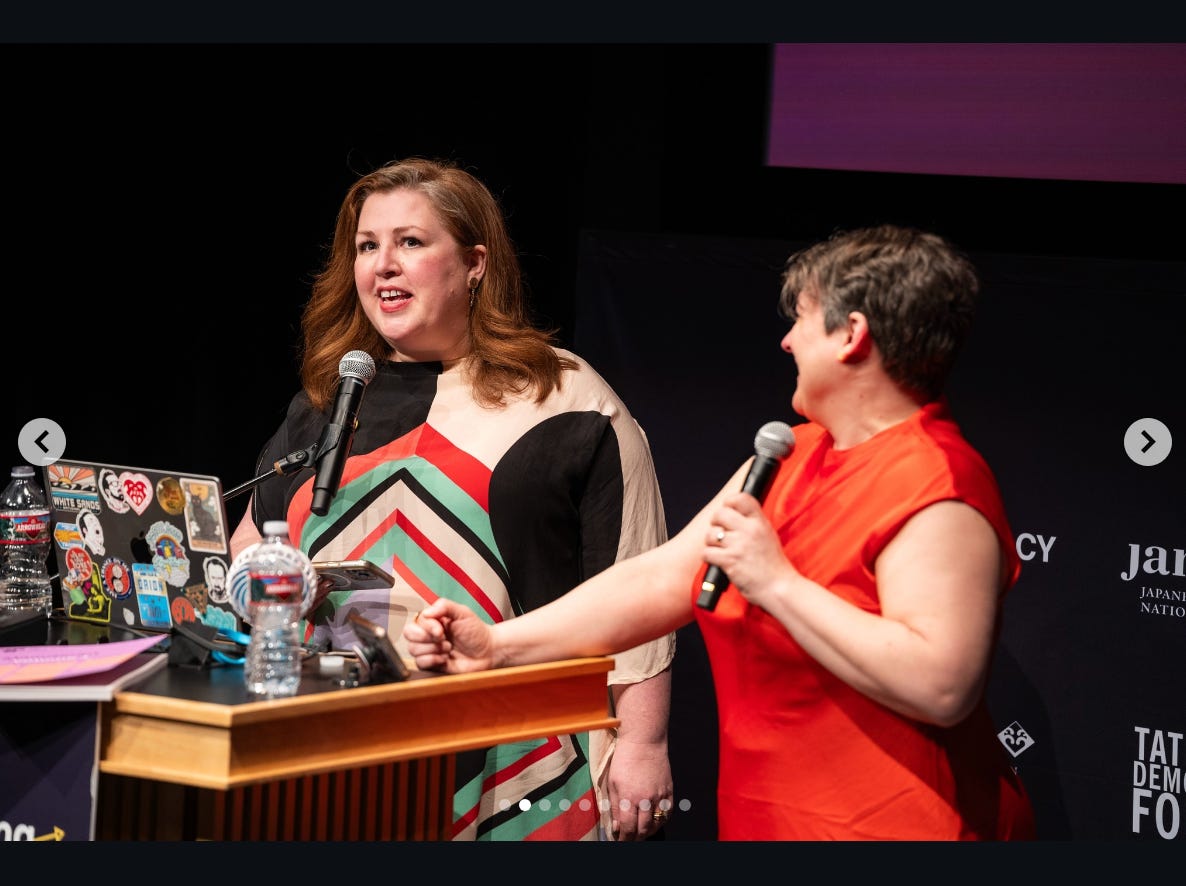
And then there was Jeanie Finlay & Suzanne Alizart’s closed door filmmaker only case study session on Your Fat Friend. I’ve written about Jeanie’s work here before, and in the context of Getting Real it galvanizing! They walked through what her team actually did with the release, the detail of it, how they used Kinema for Filmmakers to activate and build an audience, how the distribution offers they received didn’t reflect what they believed the film was worth or what it could do, how they backed themselves and chose a different path, and what they learned from it that they’re now carrying into Glimmerama and future work. It was a real case study, not a highlight reel. The granular honest version. Those are the sessions that actually change how you approach your own work. It was a closed door session to encourage “real talk” so there’s no recording but guess what you can sign up for an upcoming talk they will be doing on July 1st and surely there will be more learnings! Sign up here. Go listen to her podcast conversation with Christie Marchese and there’s a discount code for the talk.
Getting Real ‘26 looks like it will keep that energy going, maybe with more urgency given the current moment. Looking over the schedule that’s been announced (so far), these stand out.
Mandy Chang, the new CEO of the UK’s Documentary Film Council, gives the opening keynote on why independent documentary cannot be protected without protecting the idea of documentary as public service. Petna Katondolo, Congolese filmmaker and founder of Yole!Africa, gives the second keynote expanding on what sovereignty really means for filmmakers whose communities are still navigating extraction and displacement. Tikkun Olam Productions, the cooperative behind Israelism, come to talk about what a direct distribution and impact team actually looks like in practice. There’s a distribution game show where filmmakers share the deals they actually made, including the ones nobody usually talks about openly.
The full program lands in late June. Which sessions sound exciting to you?
Here’s a bit more about the stand outs so far, which I’m planning my days around.
The Tikkun Olam Productions fireside chat is the one I’d go to Getting Real just for on its own. They built the grassroots audience for Israelism before it hit number one on Apple TV’s documentary chart, and they’ve since run campaigns for No Other Land, The Voice of Hind Rajab, and others. The session is specifically about what a direct distribution and impact team actually looks like in practice, how release strategy shapes production from the outset, and what it means to build a film for more than one outcome.
The participant compensation breakout with the Documentary Producers Alliance is a great continuation of this very necessary conversation. Questions about whether and how to compensate documentary participants have been hovering in the industry for years and are now becoming more urgent. Who counts as a collaborator? What is fair? What happens to access when money enters the relationship? I don’t think there are clean answers here but I want to be in the room where people are trying to find them.
Both keynotes are ones I’ll be prioritising. Mandy Chang on documentary as public service feels particularly important right now, when the argument for public investment in documentary is under attack from multiple directions and needs to be made clearly and loudly. And Petna Katondolo on sovereignty and narrative control is the kind of keynote that tends to reframe how you think about your own practice for months afterward.
Blueprinting for Filmmaker Co-ops with Yael Bridge is one I’m genuinely curious about. What the hell is all this about and how do you do it?!? Yes I’m in to learn. The cooperative model as an alternative to the freelance treadmill is something a lot of filmmakers are talking about but few have actually tried to build. The session is specifically about the economics of it, how shared infrastructure and pooled resources actually work in practice.
And the distribution game show. Frankly it’s a great format for the kind of information that usually only circulates through the whisper network. What deals actually got made, what they looked like, what worked. Making that public and putting it in a room together is one of those things that sounds obvious and somehow almost never happens. Last time round in the “Hot Seat” session there was great convos and I expect this distribution session will be in the same vain.
There’s also a virtual option, which matters. Not everyone can get to Los Angeles in July. The virtual pass gives you live streams of most sessions and asynchronous replay for a month after. It’s not the same as being in the room but it’s a real way to be part of it.
For the full program and to register: documentary.org/gettingreal26
If you’re going and want to connect while there, reach out. Cause it’s all about connection & community!
Oh last thing to the Getting Real organizers hopefully one of you landed at the Slamdance Market Monday event curated by Ted Hope and team. All the talks were great but what was energizing was the way the talks were structured and timed, how the Q&As were run. You had to stick to your time otherwise a literal Dan Mirvish as Death would cut you off. There was a insistence on only good & necessary questions from the audience plus swag for all the good questions. It’s one the most well run conference days I’ve experienced. You can listen to how Ted set up the flow for the day here.
Welcome to the new subscribers and followers. If you want to know what this substack is all about, start here and then work through some other older posts like this one and this one. Participate with your comments and suggestions. Share things you like and get your friends to stop by. Here’s another plug for the OG case study post which I’m constantly updating, so send me any case studies I’ve missed that you found useful! I’m in the middle of creating a budget template for direct to audience distribution and looking for you to share with me your data around what you spend your budgets on. DM me!
Comments
Nothing yet. Say the first thing.
Sign in to join the conversation.