
I’ve always liked lists AND I can’t say I really use them all the time. However in work I’ve learned I need them. I have an ongoing crew list of good folks we’ve worked with and their location plus recommendations I get. For film festivals I had basically a short list that I committed to memory over the years including rough application deadlines and their extensions practices. But in 2025 I had a short doc to send out and the shorts landscape is different to feature length so I went hunting for a list and recommendations from filmmakers on which festivals they liked. I collated a fairly big a list of film festivals from around the world, pulled together from a couple of existing lists (the DAE had a excellent though doc focused list), cross-referenced and cleaned up.
I believe the list is a great resource as it stands and I want to share it with you. AND this is where you come in.
It needs updating. It needs evolving. It needs your knowledge. More on how to contribute at the bottom of this post.
In the meantime putting together this resource post got me thinking about film festivals as a whole and our relationship to them as filmmakers. So I hopped on my soapbox for a sec.
Let me start by saying I love festivals and I am not here to take them down. We need each other.
Film festivals hold a lot of power over filmmakers. Not all of it is warranted, and not all of it is real, but it is felt, and felt by filmmakers at every stage of their career, not just the ones starting out.
There’s a way of relating to festivals that I think does us a disservice. We can end up treating them as arbiters of quality, as if a selection is a verdict on the film and a non-selection is a verdict too. We give them that power. And the result is that a festival programmer’s decision, which is one decision, made by a small group of people, in a specific context, in a specific year, gets treated as something much larger than it is.
Festivals are important. I’ll make that case in a minute. But important is not the same as definitive. They are not the final word on whether a film is good, whether it will find an audience, or whether it has a future. The history of independent film is full of films that didn’t get into the festivals people expected, or got into smaller ones first, or bypassed the circuit almost entirely, and still found their people and made their mark.
So before anything else, I think it’s worth naming that. Festivals don’t define the quality of a film. They program what fits their context. Those are genuinely different things.
One of the places this shows up most clearly is in the language we use. And I think changing the language is actually one of the ways you start to change the power dynamic.
What do I mean?
When a filmmaker sends their film to a festival, we call it submitting. And when the film doesn’t get in, we call it a rejection.
I want to push back on both of those words.
I’ve started thinking about it this way, you’re sharing a film for consideration. That’s what you’re actually doing. And when a festival doesn’t program your film, it wasn’t selected, which is not the same thing as rejected. There’s a real difference and it matters for how you carry the experience.
Festival programmers are making incredibly complex decisions. They’re thinking about their audience, the shape of their program as a whole, the runtime mix, the thematic through-lines they want to pull that year, the number of slots they have, and the specific films that came in that cycle alongside yours. A film can be genuinely excellent and still not fit what a particular festival needs in a particular year. Merit is one factor among many. The film that didn’t get selected this year might be the exact right film for that same festival two years from now.
This reframe isn’t just about protecting your feelings. It’s about accuracy. And it changes how you think about the whole circuit. And yes sponsorship & funding considerations that festival programming has to take into account are real things. They need to pay their bills to keep the lights on too.
The reframing of where festivals take films
The old “indie gold” model has been we treat film festivals as a gateway to distribution. Something you do before the real work begins.
We’re moving beyond that thinking. I'm just one voice singing this tune right now, one in a growing chorus.
Playing a film festival is distribution. It’s not a prelude to it, it’s part of it. Every screening is a screening. Every audience member in that room is part of your audience. Every conversation after a Q&A is audience development. The filmmaker who goes to a festival and thinks “this is step zero” (the step before step one) is leaving a lot on the table.
Film festivals are one of the best tools we have for bringing a film to communities that might be harder to reach through conventional theatrical or community screenings. In some cities and regions, the festival is the infrastructure. It’s already done the work of building an audience that wants to see films like yours. A regional festival that’s been running for fifteen years has cultivated something genuinely valuable, not just a program, but a relationship with a community of people who show up.
So if you’re a filmmaker and your film is accepted to a festival, the question isn’t just “great, what’s the next step?” The question is what can I do while I’m here to build something that lasts beyond this screening? How do I max out this screening and how do I use this screening for more screenings in this community in the future, whether that’s next weekend or two months down the line and further.
There’s a version of this that gets really practical. You’re at a festival, there’s someone in the audience who loved the film, who wants to share it. What if you had something ready to give them? Not a link and a “stay tuned,” but a turnkey toolkit, something that meant they could host a screening next weekend, not in six months when the film is “officially out.” The energy in the room after a great Q&A is real and it is perishable. The ecosystem is slowly getting better at capturing it. But there’s still a gap.
what festivals could do differently
I’ve been following a conversation in this space for a while, and Scott Glosserman recently wrote a post worth reading that gets at some of the underlying tension, festivals create enormous value at the moment of premiere, and then largely walk away from it. He makes a case for festivals stepping into a service distribution role to extend that momentum. It’s a thoughtful piece and I’d encourage you to read it. Whether the answer is his answer or not, he opens the door for us to all evolve our thinking.
Where I land is a bit different. I’m not sure the answer is for festivals to become distributors. I think the more interesting question is how festivals can lean further into what they already are...
audience cultivators
...and find ways to connect that more deliberately with the filmmaker’s own distribution journey.
What I do think needs to happen is that the economics of the relationship need more attention. Right now, when a hundred people show up to watch a film at a festival, and fifty of those people might have shown up to a theatrical screening that the filmmaker organised and kept revenue from, the filmmaker is effectively subsidising the festival’s programming. That’s not a criticism of festivals, they do real, hard work to build audiences and create the conditions for those screenings to happen. But the relationship needs to evolve. Some form of compensation for filmmakers needs to become a standard part of how festivals think about their budgets.
And it doesn’t have to only be money. If a festival is paying for a filmmaker to travel to their city, that’s already something. The question is how the filmmaker can make the most of that time and presence. Can the festival help facilitate that? Can they make introductions, help set up community connections, give the filmmaker tools to build their list? There’s a version of this that works well for both sides.
Festivals are vital. I don’t think anyone serious about independent film would argue otherwise. But vital doesn’t mean the relationship can’t evolve.
Now, the list
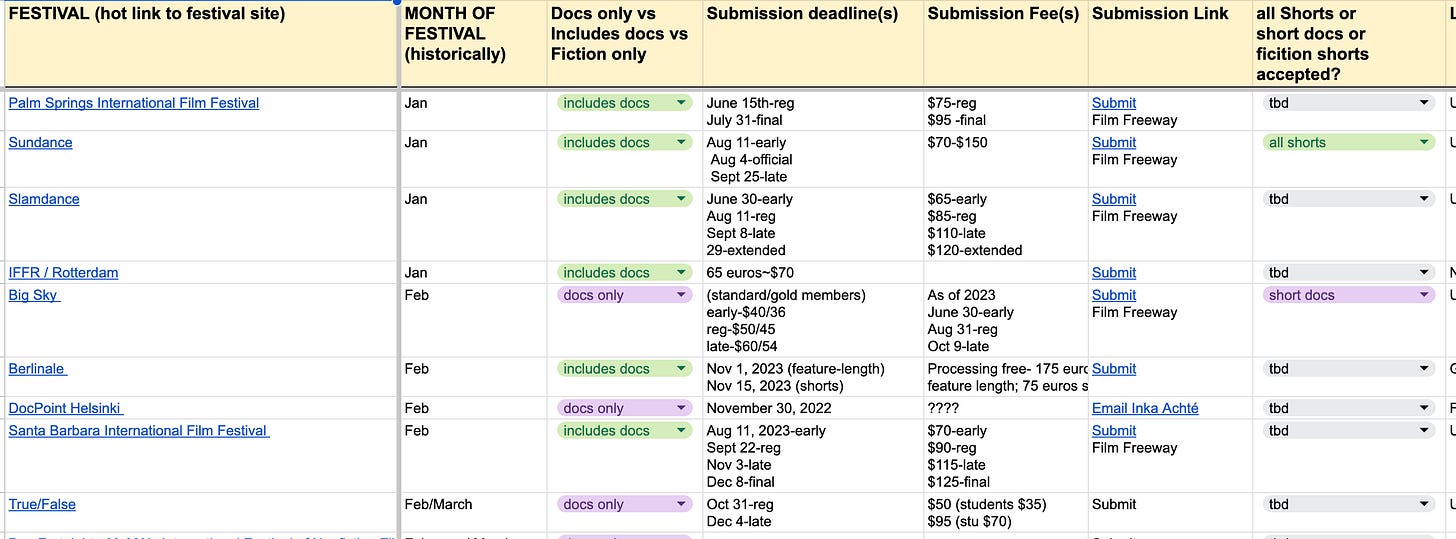
The Google Doc has film festivals from around the world. It’s pulled together from a couple of existing resources and it’s a start. But it’s not complete, and it’s not going to be useful without your input. What are the regional festivals that filmmakers need to know about, the festivals that serve under represented voices, the ones who have loyal audiences, the ones you do comedy well, or documentary, the ones that have great relationship with the local art house theater that are your next play date etc etc.
A few things I want to add over time, categories that tell you what kind of audience a festival has developed, not just where it is or what it screens. The difference between a well-resourced regional festival with a loyal community and a newer festival still finding its footing matters if you’re trying to figure out where your film fits. And eventually I’d love to map the venues, which theaters each festival screens a, because those venues are already predisposed to independent film, and filmmakers should know who they are.
There are about 150 festivals on the list so far. Clearly there are many many more fests out there and part of the list is a level of curation so it’s manageable. Film Freeway is just too overwhelming. The doc is view-only for now. If you want to add a festival, update information, or you run a festival and want to add your own listing, reach out. DM me here. I’ll add you and give you editing access. I want as many people contributing as possible, but I want to keep the formatting intact, so I’m keeping it a managed collaboration rather than a free-for-all.
This is a list for everyone. The more people who put into it, the more useful it becomes for all of us.
Last thing. I heard a good podcast last week from at who spoke to Brynne Norquist & Tyler Knohl the founders of HIIKE a platform that wants to make festival identification better for filmmakers. I haven’t used them but their approach sounds interesting and you should check them out and see if it’s right for you.
Really Last Thing. Your fun your ears moment this post is a link to my alter ego playjazzloud’s recent mix from the “quiet is the new loud” series where I go slow and relaxing with the musical selections. Great to relax before dinner, start your sun filled morning, get in the work flow zone or anything that needs focus. Click to Listen.

Welcome to the new subscribers and followers. If you want to know what this substack is all about, start here and then work through some other older posts like this one and this one. Participate with your comments and suggestions. Share things you like and get your friends to stop by. Here’s another plug for the OG case study post which I’m constantly updating, so send me any case studies I’ve missed that you found useful! This past post about audience is a good companion to today’s reading.
Comments
Nothing yet. Say the first thing.
Sign in to join the conversation.