
The neocloud trade has been unravelling, with Nebius, CoreWeave, Applied Digital and IREN having lost between 25–40% in one month.
That’s why seemingly nobody noticed what happened on July 14.
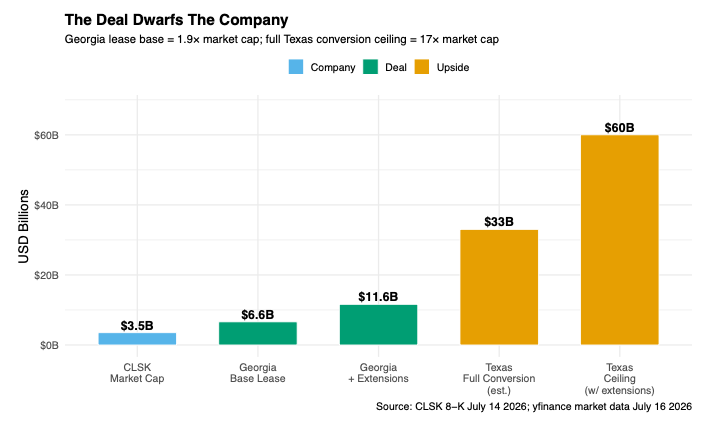
In the middle of the worst week the AI infrastructure trade has ever had, CleanSpark, a $3.5 billion Bitcoin miner with a third of its float sold short signed a 20 year, $6.6 billion triple net lease with an investment grade tech company, plus exclusivity over another 885 MW in Texas. The tenant is rumored to be Meta, which could be extremely bullish as the company is now in talks to sell compute to Anthropic with its new neocloud business model.
For scale, CleanSpark’s entire market cap is $3.25 billion. The base contract alone is nearly twice the company. The extended version is more than three times the company. And 33% of CleanSpark’s float is sold short, the heaviest bearish positioning of any large Bitcoin miner in America.
One investor appears to have seen this coming. Leopold Aschenbrenner and his Situational Awareness, which was up ~270% this year.
Leopold increased his CleanSpark stake in its last 13F by ~ 7.5X, adding over 10 million shares to his position. With the recently panicking market, CLSK’s reaction has been muted and is up only a few percent since announcing their new deal.
With the already beaten down neocloud sector, CleanSpark’s muted stock price reaction is resembling a coiled spring scenario, making it one of the cleanest neocloud rebound plays.
Before we begin, this Substack is for informational and entertainment purposes only and does not constitute financial advice. Past performance is not indicative of future results. Never invest more than you can afford to lose. Our writers may hold positions in the securities discussed and may buy or sell them at any time without notice.
CleanSpark has built itself up as a Bitcoin miner, establishing massive amounts of compute to mine $BTC. Now to understand their transition into leasing AI data centers, it’s important to establish an understanding of its base and legacy business.
→ Buy cheap electricity. CleanSpark locks in power at 5.2 cents per kWh at sites it owns outright in Georgia, Mississippi, Tennessee, and Wyoming. Electricity is the overwhelming majority of a miner's cost, so this one number decides everything downstream.
→ Plug in specialized computers. CleanSpark has 225,137 machines built to do run the Bitcoin network’s calculations, 24 hours a day. CleanSpark’s fleet adds up to 50 EH/s of computing power, which is roughly 5% of the entire global network.
→ Collect a share of a fixed daily payout. The Bitcoin network pays out about 450 new coins per day, total, worldwide. That number never changes no matter how many miners exist. Each miner earns in proportion to its computing power, so running ~5% of the world’s machines earns you ~5% of the coins. CleanSpark collected 614 bitcoin in June.
→ Every four years, the payout gets cut in half. In April 2024, the daily reward halved. Same electricity bill, half the coins. This is known as the Bitcoin halving.
→ Competitors keep plugging in anyway. Because the total payout is fixed, every new machine that joins the network shrinks everyone else’s share automatically. Miners compete against each other.
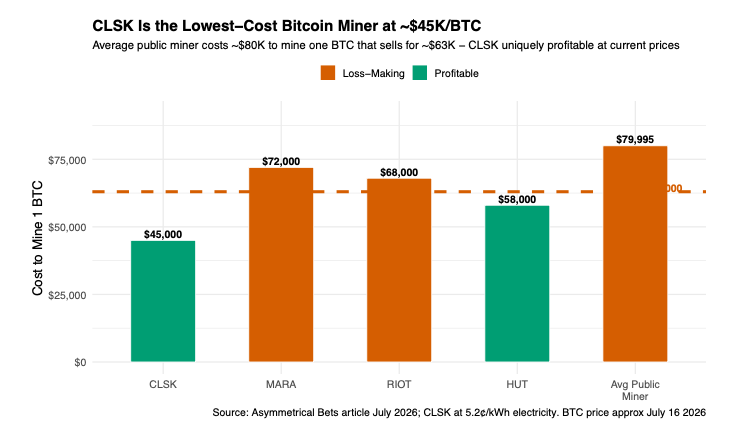
CleanSpark incurs about ~ $119K in cost per BTC it mines, which is actually much lower comparatively to some of the other miners.
With BTC currently sitting at ~ $63,000 per coin and continuously rising electricity rates, the business of mining BTC has become economically ineffecient. But the business isn’t going to be detroyed, CleanSpark and other miners are sitting on massive amounts of compute and cheap electricity.
There’s a much more lucrative opportunity staring them in the face that they’re just starting to capture.
As of this year, Bitcoin miners have signed over $70 billion in AI computing contracts, a figure CoinShares independently corroborates across the public mining sector.
This trend of a larger part of the revenue coming from AI and data centers is projected to continue, with ~90% of revenue coming from mining in Jan 2025, and 20% of revenue coming from mining in Jan 2027. A massive shift over the course of the next two years.
AI and data centers have given BTC miners a lifeline.
Bernstein’s framing when the wave started was that miners are “warm powered shells for AI data centers, considered the biggest bottleneck to execution.”
And the market pays wildly different prices for the two business models. Ones that are shifting, and ones that aren’t.
Per CoinShares, miners with HPC contracts trade around 12.3x EV/NTM sales versus ~5.9x for pure play BTC miners. Basically the same land and substations, but roughly double the multiple.
And until nine days ago, CleanSpark didn’t have AI or data center business. Which is why it’s notably lower on the comparison list.
It was, in CoinShares’ words, among the miners that “continue to prioritize mining in the near term... while gradually building out AI exposure”, a deliberate strategy management calls the second mover advantage: let the market mature, then sign at better terms.
On July 14, the second mover moved.
The announcement is worth reading in full, because the structure is what makes this interesting:
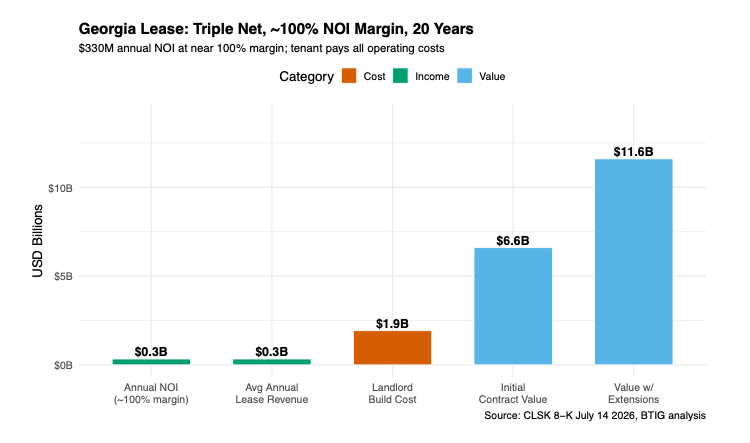
20 year triple net (NNN) lease at CleanSpark’s Sandersville, Georgia campus with a confidential “high investment grade, leading global technology company”
$6.6 billion of contracted revenue over the initial term, rising to $11.6 billion if two five year extensions are exercised
175 MW of critical IT load, first data hall delivered Q4 2027, remainder ramping into Q1 2028
~$330 million of average annual net operating income at close to 100% margin, (triple net means the tenant pays the operating costs)
Landlord build cost of $10–12 million per MW, so roughly $1.75–2.1 billion of capex
“Triple net” is the part retail will skim past, but shouldn’t.
In a normal hosting deal, the landlord eats power costs, maintenance, cost inflation. In an NNN lease, the tenant does. CleanSpark builds the shell, collects the check, and the check carries annual escalators. BTIG worked out the pricing at about $1.9 million per MW per year, a slight premium to the $1.7–1.8M range of comparable deals.
Then there’s a kicker buried in paragraph two:
The same tenant signed a letter of intent and exclusivity arrangement covering CleanSpark’s entire Texas portfolio. 718 acres and up to 885 MW across the Sealy and Brazoria campuses near Houston. That’s five times the Sandersville IT load, with a single counterparty holding first rights on all of it.
CEO Matt Schultz, in the release:
“This lease is a transformational moment for CleanSpark as we complete our evolution into a diversified digital infrastructure platform and begin monetizing our power portfolio at institutional scale... We have long believed in the second-mover advantage in this sector: grow our portfolio as the market matures, then execute with excellent terms and velocity.”

And, crucially, on the investor call, keeping expectations honest on Texas:
“I want to be clear that we are in an exclusivity window, not at a finish line.”
Two more details we like:
First, the mining doesn’t stop: CleanSpark structured the deal to keep mining Bitcoin at Sandersville until power transfers to the new facility, so the site earns money during construction instead of sitting dark.
Second, on funding the ~$2B build: CFO Gary Vecchiarelli said the company expects the overwhelming majority of construction through project level debt, adding a sentence shareholders of this historically dilutive sector have waited years to hear: our stock is our highest cost of capital currently (meaning they’re unlikely to raise capital through a stock offering).
A quick clarification, CoreWeave, Nebius and IREN sell AI compute, they buy the GPUs and run the cloud.
CleanSpark however sells the building and the power, then the tenant brings the computers, and CleanSpark collects rents at ~100% margin. So more of a landlord, not a neocloud.
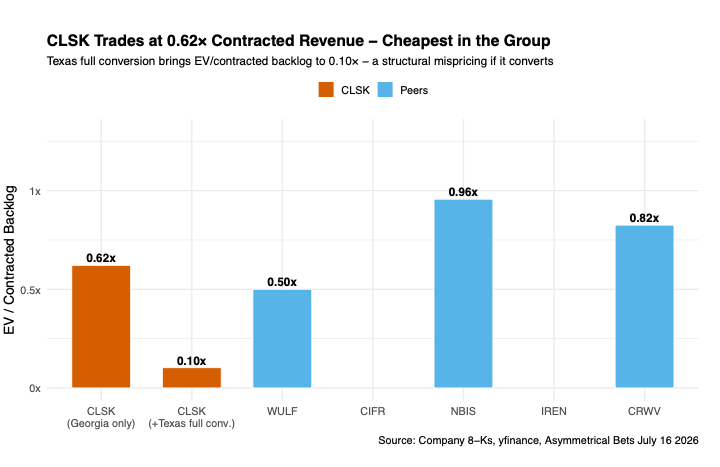
That classification tells you who the real peers are. The apples to apples comparison for CleanSpark is TeraWulf and Cipher.
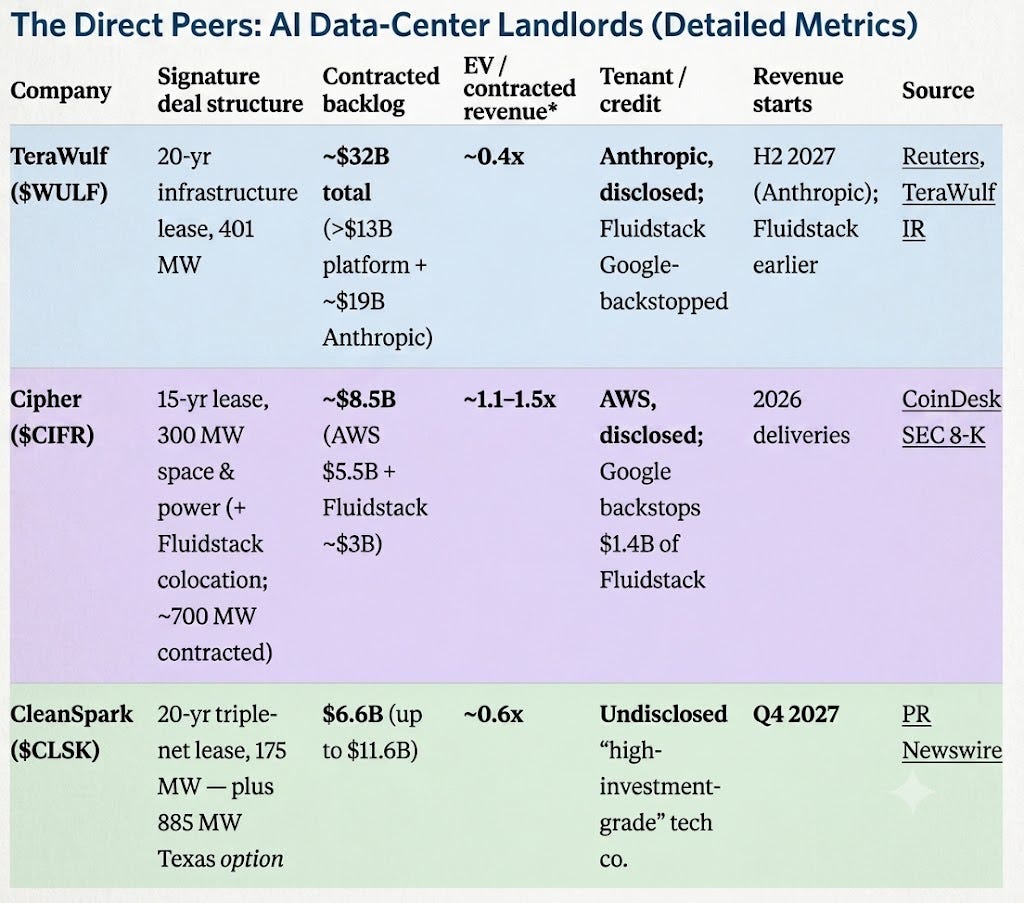
Even inside this clean peer set, the three aren't identical.
WULF and CIFR are further along with financing and construction already in motion and deliveries starting sooner. Along with having named tenants (Anthropic, AWS) or carry explicit credit backstops (Google behind Fluidstack).
CleanSpark signed its first definitive lease two days ago, its tenant is confidential, and its ~$2B build is not yet funded.
The broader valuation context: AI-cloud / compute operators (not direct peers):
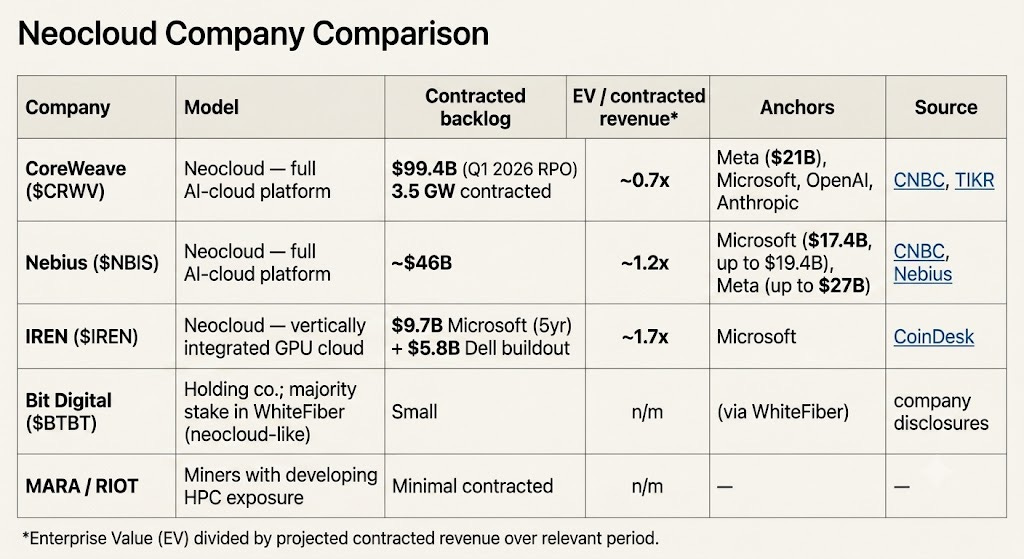
These names showcase how the market prices contracted AI revenue once it believes in it, but their backlog dollars are not the same quality as a landlord's.
The neocloud dollar comes with GPU depreciation and operating costs attached, CLSK dollar arrives at near 100% NOI margin with the tenant paying the bills. If anything, comparing them dollar for dollar understates it for CleanSpark.
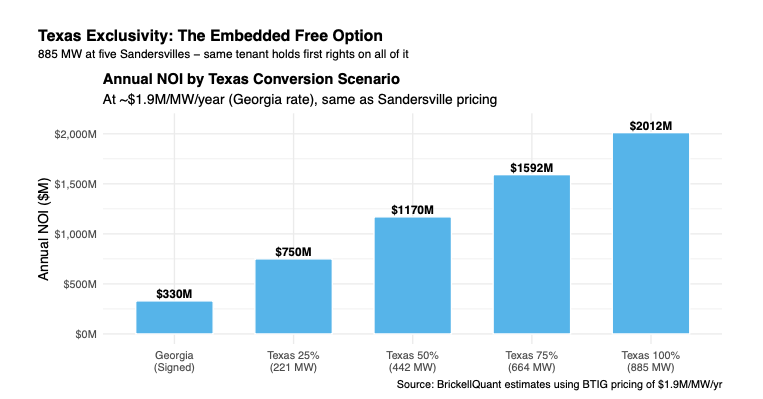
The $6.6B lease covers 175 MW of critical IT load (0.175 GW). That works out to ~$1.9M per MW per year, or roughly $38M per MW over the full 20 year term. The Texas exclusivity covers up to 885 MW, 5x Sandersville’s.
If the same tenant converts the full 885 MW on Sandersville like terms:
Annual lease revenue: 885 MW × ~$1.9M ≈ ~$1.7 billion per year
20 year contracted value: ≈ ~$33 billion
Combined contracted backlog: ~$33B + $6.6B ≈ ~$40 billion (with a theoretical ceiling above $60 billion if the extension options on everything are exercised)
Against today’s ~$4.1B enterprise value, a $40B book would put CLSK at ~0.10x EV/contracted revenue.
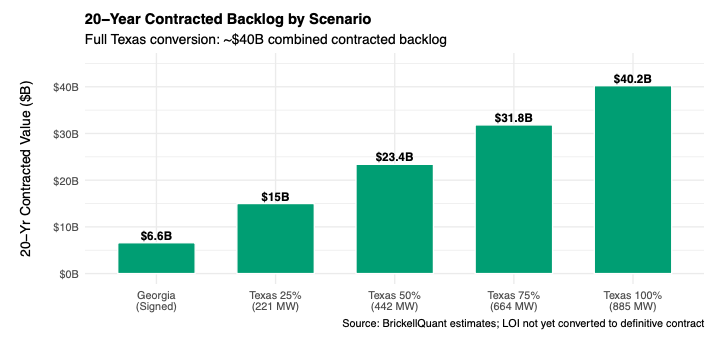
However, the 885 MW is still an LOI inside an exclusivity window, not a contract.
Schultz says it plainly:
“exclusivity window, not at a finish line.”
Conversion could be partial or phased, Texas pricing could differ from Georgia’s, and if the 885 MW figure is gross power rather than critical IT load (Sandersville’s 175 MW is explicitly IT load), the revenue base shrinks ~15–20%.
But that is the seemingly free option embedded in the current price, and hyperscalers don’t typically lock up 885 MW of someone’s portfolio for sport.
Fiscal Q2 2026 (ended March 31):
Revenue of $136.4 million, down 24.9% YoY
Net loss of ($378.3 million), or ($1.52) per share
Adjusted EBITDA of ($241.2 million)
Both sales and profit came in below what Wall Street expected, and most of the damage was a $224.1 million paper loss on the company's bitcoin stash.
Accounting rules force CleanSpark to re-price its ~13,900 coins at the going market rate every quarter, so when bitcoin's price falls, a loss shows up on the books even though no coins were sold. (It cuts the other way too, if bitcoin rises, the same rule produces a paper gain.)
But even ignoring the paper swings, the underlying problem is simple: it costs CleanSpark about $119K to mine one coin that currently sells for ~ $63K.
This a bad quarter waiting to repeat, and June showed the strain in the fleet itself. CleanSpark's machines ran at 42.6 EH/s on average, down from 46.2 in May, a widening gap between what the fleet can do and what it's actually doing (more machines are standing idle, machines awaiting repair, etc.).
Between now and then, mining carries the income statement, and mining is the business losing money. Worse, the 8-K risk language is explicit: missed financing, construction, or delivery milestones can trigger rent abatements or termination.
Although the revenue won’t come until Q4 2027, it’s solid. A 20 year lease with a hyperscaler is a Grade A credit tenant.
TeraWulf can say "Anthropic."
Cipher can say "AWS."
IREN can say "Microsoft."
CleanSpark can say "a high investment grade global technology company," on the company's own characterization. The market is discounting what it can’t verify.
Not all hyperscalers are created equal. Some are viewed by the market more favorably than others.
The treasury and interim cash flow fluctuate with BTC, a highly volatile asset. If Bitcoin revisits late June's ~$57,800 and stays there, that makes the bridge to Q4 2027 much narrower. If it falls even further, it spells major downside.
At the same time, a reversal in Bitcoin which is trading at a fraction of its ATH, could be a huge tailwind for CLSK’s stock price.
This is one of the most crowded shorts in the US market: short interest recently hit 33.04% of float.
Set that against the sell side, where coverage skews aggressively the other way. After the lease, Needham went to $23, BTIG held $26, and Citizens initiated at Outperform with a $27 target, which is roughly double the current ~$13.50 price
There’s currently 15 covering analysts on the stock, with an average price target of $22.35.
Considering CLSK has:
A 33% short float
Unanimous buy coverage
A signed investment grade catalyst
A live 885 MW option ticking inside an exclusivity window
If shorts get squeezed, the move up could get violent.
The hyperscaler gets named.
Now → ~Q4 2026: the Texas exclusivity window. The single most important undated date in the thesis. A conversion re-rates the stock aggressively.
Early to mid August 2026: fiscal Q3 earnings. We’re watching for financing specifics and Sandersville construction milestones.
First week of every month: production updates. June’s release showed the template for these updates, we’ll keep our eye out on future ones.
Any day: the financing package. Project debt against an investment grade NNN lease is a bankable product, and financing structure could be favorable.
Q4 2027: first delivery at Sandersville. Once the market realizes this is real, the stock could receive more generous multiples.
Overall, CleanSpark has a great deal of raw asymmetry when you consider the following.
AI sentiment bounces back after the worst momentum stock drawdown ever recorded. CLSK 0.00%↑ traded as high as $22/share before signing a single HPC deal. Under $13 with a hyperscaler contract in hand, and a gap up past $20 is very possible with the return of risk-on appetite around AI infra.
A new deal is announced for any of CLSK’s other 885MW of capacity, which is currently under exclusivity/LOI with a hyperscaler tenant. Monetizing even part of that portfolio would make CLSK 0.00%↑ at current prices the cheapest of its peers on EV/contracted revenue.
A bounce in bitcoin and the overall crypto sector, which has been trading at its lowest level in years, and could be in store for a reversal. This would help CLSK’s business thrive until HPC revenue hits in H2 2027.
30%+ short interest could trigger a violent squeeze if AI infra sentiment returns and the company announces more deals for their portfolio. Being the most shorted of the neocloud group makes CLSK uniquely suited to outperform if it accomplishes its goals.
The setup is of course not without it’s risks, but in comparison to the other data center leasers and neoclouds, CLSK 0.00%↑ looks to be one of the most raw asymmetrical opportunities present for AI investors at a $3.25B MC as of 7/17.
Comments
Nothing yet. Say the first thing.
Sign in to join the conversation.