
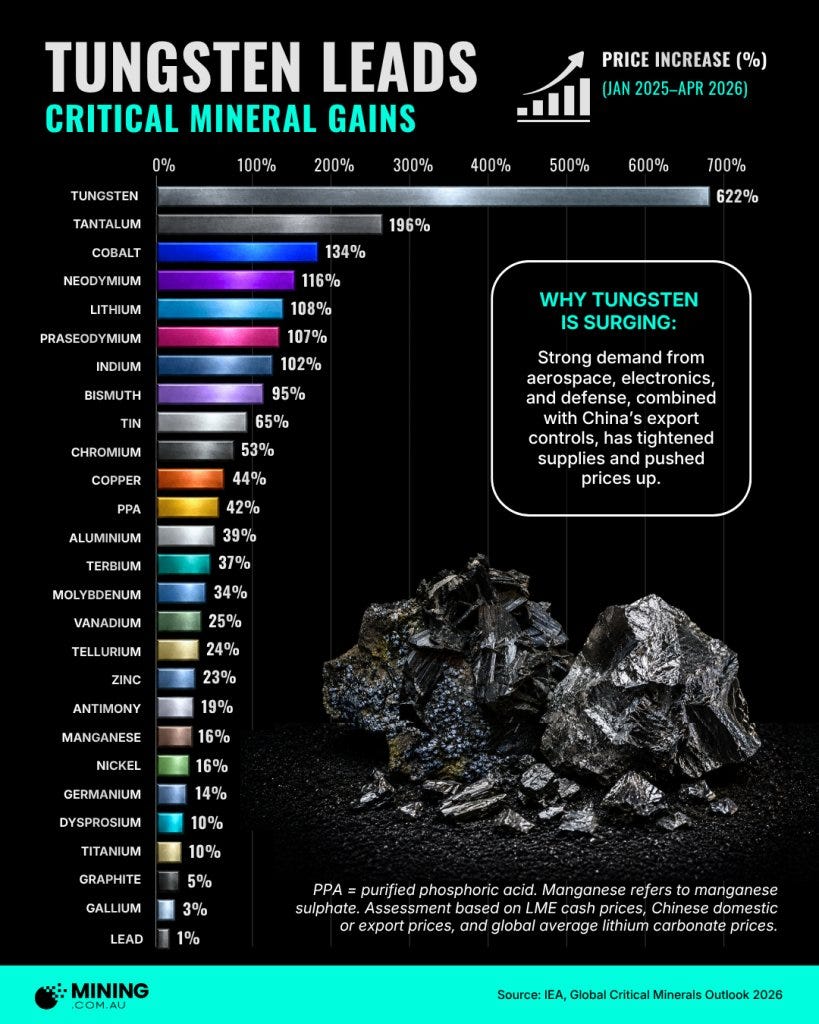
We wrote about tungsten on April 1st, when we first published our deep dive on the critical minerals trade. Tungsten prices had 10x’d, and we laid out the thesis that the supply demand imbalance was structural and wouldn’t ease for many years.
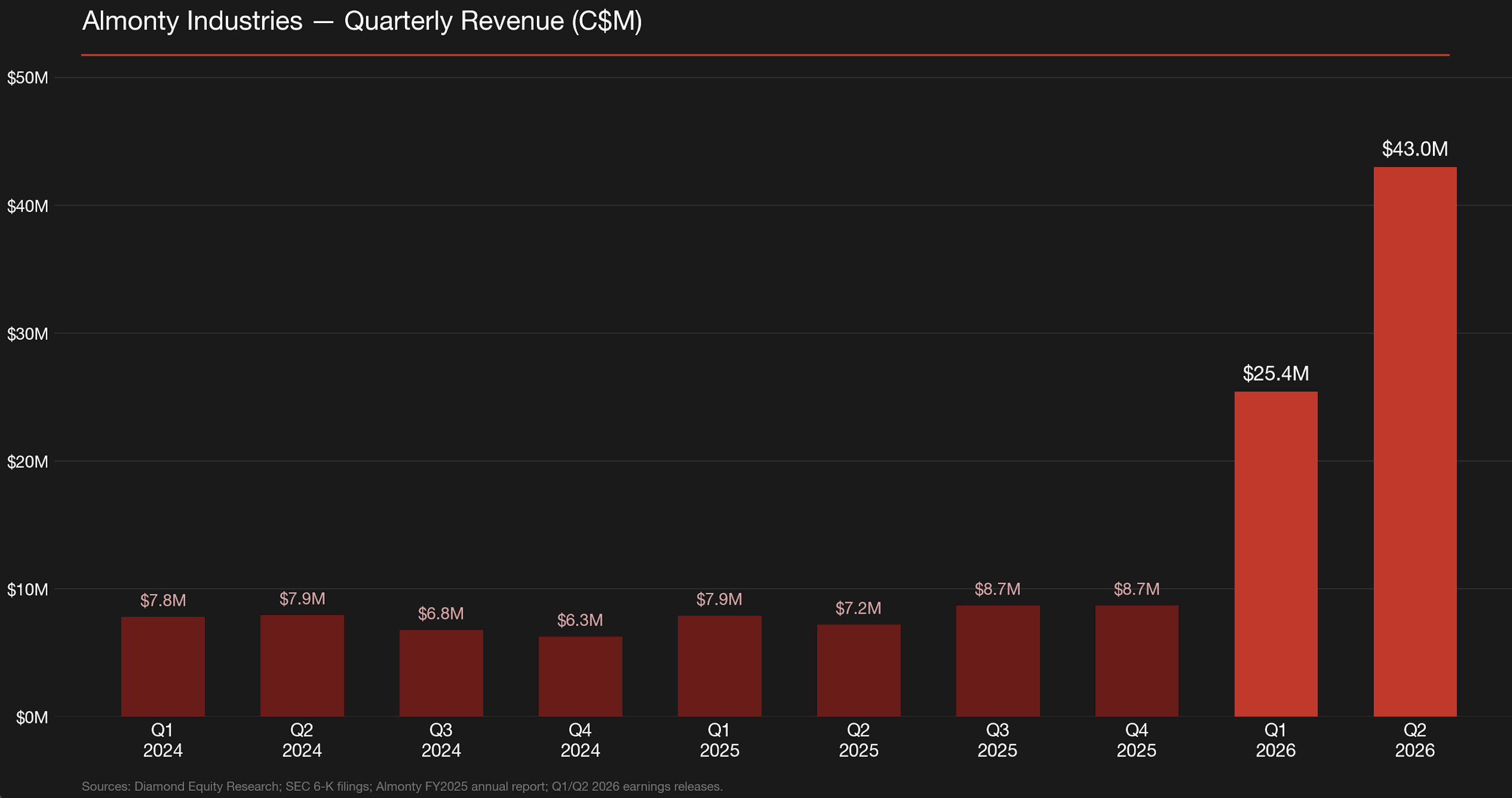
Since then, the critical minerals trade hasn’t worked the way we expected, and the sector has been weak. ALM 0.00%↑ is now trading around $16, roughly 34% off its ATHs, despite revenue growing 498% YoY, and the company sitting on C$1.2B in cash.
The fundamentals have gotten stronger, and on August 7th Trump committed another $3B to critical minerals projects, and the executive order banning Chinese tungsten waivers for defense killed remaining hope that the supply chain was going to revert to normal.
To check back in on the trade, we sat down with Lewis Black, the CEO of Almonty (ALM 0.00%↑), for 30 minutes to talk about the company and the industry directly.
This conversation was recorded before Q2 earnings were released on August 11, and interview responses are quoted directly from our call unless otherwise noted. You can also watch this interview on Michael’s channel.
At the end we’ll share where we think the stock can trade.
Before we begin, this Substack is for informational and entertainment purposes only and does not constitute financial advice. Past performance is not indicative of future results. Never invest more than you can afford to lose. Our writers may hold positions in the securities discussed and may buy or sell them at any time without notice.
As we mentioned in the LPTH interview, many defense and critical mineral names have underperformed other sectors.
Michael asked Mr Black why a retail investor should still be interested in the critical minerals and overall mining trade.
Almonty’s CEO answered:
“They’re absolutely right [about the performance of the industry]. The issue is the dreaded junior miner. The person who has the greatest thing since sliced bread, if you give him money, he’s going to change the world. And that’s really the end of it. Everyone’s making promises. They’re like meeting a guy in San Francisco back at the gold rush. Everyone’s got a gold mine, buy me a drink and I’ll give you a certificate for the greatest thing ever.”
He then followed with what investors should look for (when investing in the space)?
“Has the management done this before? Not just been in some metal, in this metal they’re now working on. Have they put a lot of their net worth into this? Are they willing to follow you dollar for dollar into it? Does the project have longevity? Does it have grade? And most importantly, is it permitted? Because if it’s not, it’s a multi-year journey.”
And then he mentioned how there’s no AI without critical minerals:
“No AI without critical minerals. It’s like being able to make the greatest birthday cake in the world. But if you don’t have any wheat, there’s no way to make the cake. Tungsten is in everything. You can’t make semiconductors without the tungsten gas. Just a tiny little bit, but without it you can’t do any of it.”
This is probably the most important quote in this entire interview, because the AI trade has always been about chips and memory (with power now catching up). However, every semiconductor on the planet requires tungsten gas during fabrication.
Michael’s question:
“Companies like Micron, we’re just living in this mania around supply demand imbalances of important things in these super cycles. How long do you see this lasting? How permanent is this supply demand imbalance and this pricing power that you’re coming into as a company?”
Mr Black’s answer, which shocked us:
“Five, six years before we find balance. Because until China really develops out their recycling there will be this continuing imbalance in the sector, and there’s nothing new coming online in tungsten except for our mine that just opened in Korea.”
The next thing that surprised us was the fact that China itself doesn’t have enough tungsten. Lewis Black confirmed they’re a net importer, chasing the exact same material his Western customers need:
“They have the same problem as us. They don’t have enough generated in China to feed their own domestic consumption, so they have to also pursue the same material we do.”
Michael asked where prices settle long term:
“Many years ago, I think eight, nine years ago, we were hired by the Chinese government to help all the Chinese mines comply with new environmental codes that came in. We got to look at the Chinese mines and they all worked with subsidies and they elicited about a 12 to 18% margin because of this subsidy. If I now factor in recycling, which is a much higher energy footprint than primary mines, we’re going to have to see a price of between a thousand and fourteen hundred. Right now it’s 3,100. So all I can really say with some authority is that the price won’t ever go below a thousand again.”
We would like you to remember that Almonty was built to operate at $250 and $350 of tungsten prices, which means with a floor of $1,000, it’s still 3x what the business was designed around.
Michael asked Lewis what revenues look like over the next few years as Sangdong comes online.
Mr Black answered:
“We should do with the current price around 100 million from Portugal this year, probably a little bit more. As Korea comes online, it’s going to add another, you know, in phase one another roughly ballpark 400 million, 400, 450 million. So I’d say that during 27 we should be pushing, you know, if the prices remain at these sort of levels, you’re going to be closer to 700 million in revenue.”
Then there’s also molybdenum, where Almonty has a fully permitted moly deposit in Korea. The second largest moly consumer in the world, Sear, is in-country and as of right now, imports 100% of its feed. Lewis already has a contract with them:
“They’ve given me a $19 a pound floor price, no cap on the upside. It will be a revenue driver. At these prices it’ll add another 300 odd million dollars of revenue to me a year.”
But when Michael started focusing on revenue, Lewis cut him off, saying that his main point was margins:
“Forget about revenue, it’s margin. That’s what’s insane. When we modeled Sang Dong and we worked to the price of $350 we had a 30, 40% net income margin on that. We’re now at $3,100. So almost 10x. I don’t even model it at this price because it looks like I’m just making the numbers up.”
Michael’s question:
“Is it too good to be true? Like these deals, there’s a price floor and you get paid spot. So every month you get basically just increased, the price keeps going up, you just get increased to spot each month for each delivery.”
Lewis on why Almonty gets these terms:
“We’ve done this a long time. We’re the only ones who get this. But we get it because we’ve always delivered, even in the lean times. And my customers, we all helped each other when things were really bad. Sometimes they would give me a fixed price contract for a year above market so that we could survive. But we kept supplying and supplying on time. We need each other. We can’t stand each other. We both want to kill each other almost on a daily basis, but we’ve worked together for so long. They rely on me and I rely on them.”
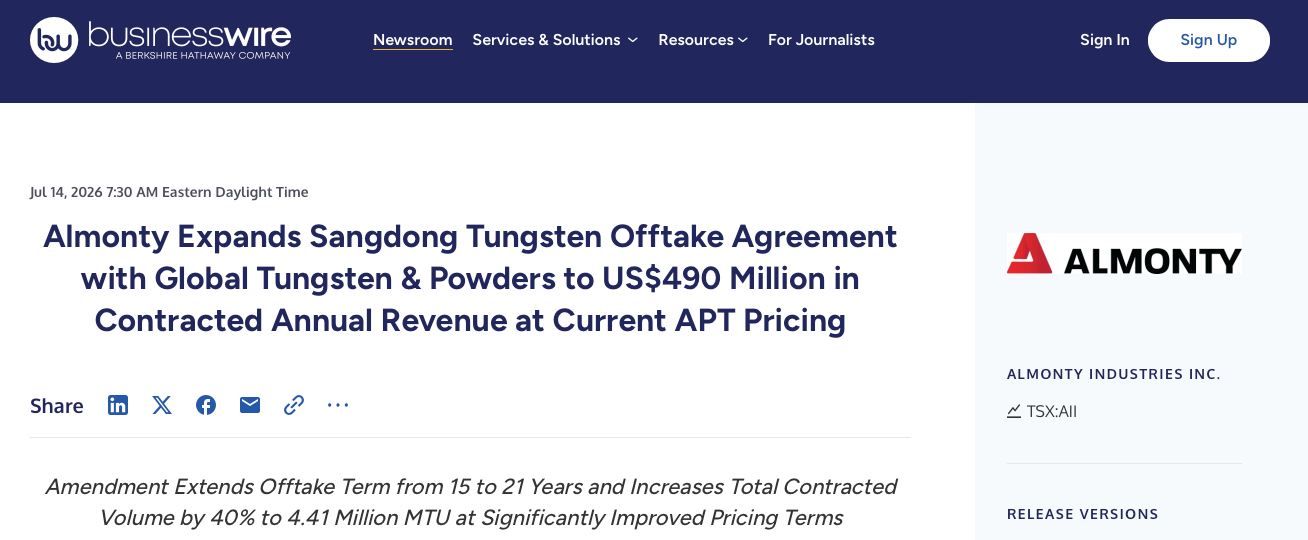
Furthermore, Almonty extended its off take agreement with Global Tungsten and Poweders (a member of Austria’s Plansee Group), by adding six years to the term and improving pricing by roughly 6.3% on all contracted volumes. The offtaker voluntarily gave Almonty more money on an existing contract he didn’t have to renegotiate, Lewis said:
“The offtaker gave me more money for an existing contract that he already had. He didn’t have to. He already had a price. He gave me actually more money because that’s the state of the market. People don’t believe there’s a huge amount of material coming online.”
Michael asked Lewis about the military applications around tungsten and how the Iran conflict changed the dynamic.
Lewis’s answer:
“You have to bear in mind that right now the defense prime in the US does not have the additional capacity, output capacity, that hasn’t been completed yet. So we’re still supplying the normal amount of tungsten that has always been consumed by the defense base. When that additional capacity comes online sometime during next year, next 12, 14 months, you will see it have a meaningful impact on tungsten consumption. The question is where does the tungsten come from?”
His answer was particularly interesting:
“The only thing you can really do is sort of borrow from Peter to pay Paul, and that means other sectors are going to have to have less availability of tungsten. My bet having been in this for a long time now is that less essential areas like the car space will see bottlenecks of tungsten components because it’s being diverted towards defense. And rather than risk recessionary implications of the car space slowing down, especially the Europeans, they will allow the Chinese to provide those components. And then China begins the drive to take market share in the downstream.”
This means that China spent 30 years feeding cheap raw materials to competitors to the West, and now they’re pivoting to finished components. Defense munitions demand creates the opening, and European auto manufacturers accept Chinese tungsten components to avoid production slowdowns, so China gains downstream market share.
Michael also asked about the recent dip in tungsten prices on certain exchanges, Lewis had a specific explanation:
“You noticed recently the Trump administration issued an executive order banning the waivers that the defense industrial base in the US were looking for, because after the end of this year you can’t use Chinese, North Korean or Russian tungsten, and they were looking for waivers. And so traders were looking to jam prices or have the illusion of lower prices in China to jam margin to go buy material and then feed it into the US. Once that executive order was actually issued, you notice the price in that particular publication started to climb back up. By complete coincidence, I’m sure.”
Michael’s question on dilution:
“You have over a billion dollars of cash available to you. How and through what mechanisms is that available to you? And with equity issuance, share count was up 32% in the last year, what is the future of liquidity for Almonty and how much more do you think you’ll have to lean on the equity market?”
CEO’s answer:
“We don’t envisage going back to market because there’s no need to. What we are looking at right now is what Warren Buffett always used to say, wait for there to be blood in the streets. Better to have cash in the bank and just wait. It’s getting more and more difficult to raise funding for entire projects in critical metals.”
We always talked about Fidelity, which over the weekend updated their size in Almonty’s to 31.8M shares, calculating to just over 11% of the company. Mr Black talked about who let in during the NASDAQ IPO last year:
“I was very careful when we did our IPO on the NASDAQ last year not to get the cats and dogs involved. Just go for the most difficult people to impress. I always believed that if you lift the kimono and someone kicks all the tires and they are a reputable blue chip very fastidious institution, others will follow.”
And fast forward, Michael asked about the $1.6B Cove Cause tungsten project in Kazakhstan that the Trump brothers may be involved in, Lewis replied:
“I’ve seen over the years an enormous amount of capital destruction in tungsten. Every mine that’s open that we haven’t owned has failed because processing is a very difficult metal to process. Kazakhstan, one of the requirements and one of the problems China has found is that you can only use Kazakhstani workers. But there’s no tungsten sector in Kazakhstan. So you’re having to recruit people that have no knowledge.”
He then quoted someone else’s framework:
“Someone said to me the other day that when you’re assessing the viability from a critical metal standpoint of any project, in the event of World War Three, would it still supply the United States? I think that was actually a very simplistic but eloquent way of looking at the geopolitical viability of a project.”
This question appeared for the second time in a row, following the question which was in our LPTH article. Michael asked:
“It’s 2030 and Almonty failed. What happened?”
At first, Lewis ran through everything that can’t kill the company. He explicitly pointed to hard floors on all contracts that protect against a price collapse and he also mentioned that China isn’t going to start supplying raw materials again because they’re moving downstream.
Then he actually gave a us a reason why Almonty could collapse:
“I suppose the only thing that can really happen is if my customers, who I hold an equal disdain because I blame them in part for this mess because they were seduced by cheap materials, if they go out of business because I don’t know, they just couldn’t work out how to put their own pants on, that would be the only reason I didn’t exist. And I probably wouldn’t exist as Almonty. I’d probably have a Chinese name above the door. China would have bought me. So my shareholders will be okay.”
He also added that the downstream customers who do have vertical integration like Plansee Group or Sandvik, are already taking market share from the ones who don’t. The ones without secured supply are still in what Levis called a “deer in the headlights” phase. They spent last year in shell shock, and only now they’re starting to realise the situation is permanent.
Comments
Nothing yet. Say the first thing.
Sign in to join the conversation.