
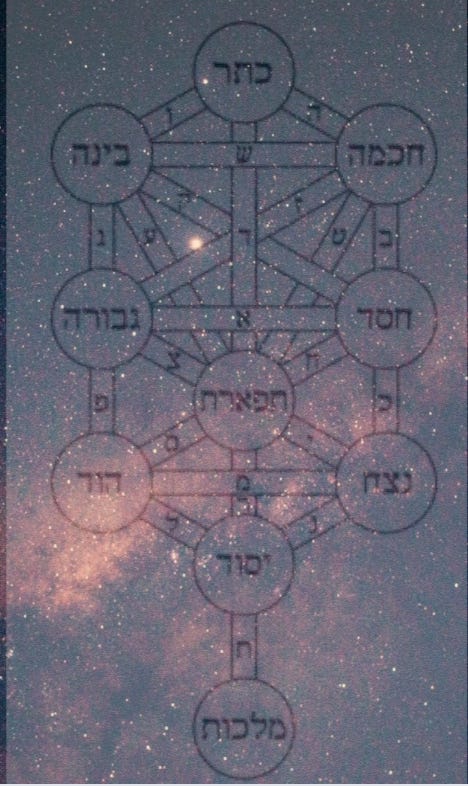
Pesach ends and we enter the hidden, less-celebrated season of inner work guided through Sefirat Ha’Omer which takes us to the holiday of Shavuot: the Receiving, 50 days later. Sefirat HaOmer is the spiritual bridge between liberation and revelation: the journey from Egypt (Mitzrayim, the narrow place) to Sinai, where we receive the Torah.
The journey begins with lovingkindness which is immediately paired with: Gevurah, defined as restraint, judgment, severity and discipline .
To many, Gevurah feels threatening. We fear boundaries. We associate judgment with punishment, discipline with harshness, and strength with violence. In an age of hyper-individualism, Gevurah is often cast as the villain in the story of personal freedom. In spiritual terms, however, the opposite is true. In Jewish mysticism, Gevurah is not meant to repress, but to focus and direct energy. Without boundaries, there is no vessel to hold Divine light. Gevurah is what enables form to emerge from chaos. It gives structure to love (Chesed), and without it, love becomes either overwhelming or indiscriminate.
Gevurah, teaches Kabbalah is governed by the planet Mars, which was created with the Hebrew letter Dalet. The fourth letter, Dalet means door in Hebrew. Gevurah, Kabbalah teaches is the doorway, the portal. The right restraint will open you, not block you. Limitations are essential to initiation.
Miriam the Prophetess is the feminine archetype of Gevurah. Miriam's very name begins with Mar (מר), “bitterness.” She was born just as exile began to settle. But rather than be consumed by the bitterness of galut (exile), Miriam alchemized it.
When Pharaoh was killing all the male babies, Miriam’s father Amram divorced his wife Yocheved in despair. Miriam, still a child, confronted him. “Your decree is harsher than Pharaoh’s,” she said. He reunited with Yocheved. And from that reunion came Moshe, the Aquarian redeemer of Israel.
Miriam is Gevurah at its finest: strength that channels life. She is the womb that contains, the prophetic vision that says not yet so that the yes may be even more powerful. Mars, the red planet, rules over the sefirah of Gevurah, as well as the zodiac signs of Aries and Scorpio. These signs hold the keys to holy severity. Aries, the fiery head of the zodiac, initiates with boldness, when Scorpio, the watery shadow, masters transformation through depth and truth.
The first act of redemption, the Korban Pesach (Passover sacrifice), is steeped in Gevurah. Blood on the doorposts. Slaughter at twilight. It is a rite of cutting away: cutting off the bondage of Egypt through covenantal blood.
Blood is not evil. Blood is life. Freedom does not begin with comfort: it begins with discipline. The act of separating from Egypt involved clarity and courage and it also set the stage for the larger spiritual project of Jewish peoplehood.
One of Miriam’s most significant roles is after the splitting of the Sea of Reeds. After the Israelites pass through, she leads the women in song and dance (Exodus 15:20). The Midrash states that the sea split due to the “faith” and “song” of Miriam.
Theologically, the sea’s splitting represents an act of Divine Gevurah: separating waters to reveal dry land. In Kabbalistic terms, this is the creation of a vessel—the formation of space where spiritual growth can take place. It is no coincidence that this event aligns with Taurus season, corresponding to the Hebrew month of Iyar, which is associated with healing: Exodus 15:26: “I am the Lord, your Healer”.
Kabbalah teaches that this physical world was created through contraction (Tzimtzum), a form of Gevurah. In other words, Gevurah is the mechanism by which this world becomes a vessel for the Divine. Rather than being the enemy of love or light, Gevurah enables them to manifest in a meaningful and sustainable way. Miriam’s strength—her prophetic clarity, her moral courage, and her disciplined response to suffering—is a model for how Gevurah should function. She is not harsh, but firm. She is not punitive, but principled. She does not shrink in the face of crisis, but channels strength toward constructive ends.
Miriam is deeply linked to Gevurah, and through that, to the Omer journey itself. Gevurah is not only a spiritual quality—it is expressed in the agricultural reality of barley, the grain brought as the Korban HaOmer (Omer offering) during this time. Barley is the second of the Seven Species (Shiv’at Haminim) of the Land of Israel, following wheat, and it represents the beginning of self-refinement. While wheat is often seen as a symbol of human maturity (bread is considered “food of humans”), barley is “animal food”, representing our base instincts. The Omer process is about elevating this “animal soul”—refining desire, discipline, and instinctual power.
Miriam leads us in this journey. Her strength gives us permission to be whole—to lead, to resist, to speak out, to say no, and even to judge. Her role in the Torah is not confined to support or song; she challenges, critiques, and acts decisively. When she criticizes Moshe, she is struck with tzara’at, the biblical affliction often translated as leprosy. But even in her sickness, she teaches us something profound: the community waits for her, and prays for her healing. We learn that communal prayer has the power to heal not only the individual, but the collective.
And while Gevurah is her essence, her legacy also includes water—the well of Miriam, which accompanied the Jewish people
and provided life-sustaining chesed (lovingkindness) through the desert. Gevurah creates the vessel; Chesed flows through it. Miriam teaches us how to hold both: to be strong and soft, to set boundaries and to nourish, to be disciplined and to love.
Rather than viewing Gevurah as restrictive, we must see it as the essential doorway into freedom. It is the boundary that protects. The discipline that enables creativity. The structure that holds the soul.
As we move through the Omer, and particularly through this second week of Gevurah, we are invited to reassess our relationship to strength and limitation. Gevurah is not an obstacle; it is the framework through which freedom becomes real.
May this week of Gevurah be for you a portal of discipline, clarity, and healing. May you find the strength to hold yourself with dignity, to hold others with care, and to hold the Divine presence in the vessel of your life.
Comments
Nothing yet. Say the first thing.
Sign in to join the conversation.