
Dear Astrid, 1
Thanks for reading Dear Astrid! Subscribe for free to receive new posts and support my work.
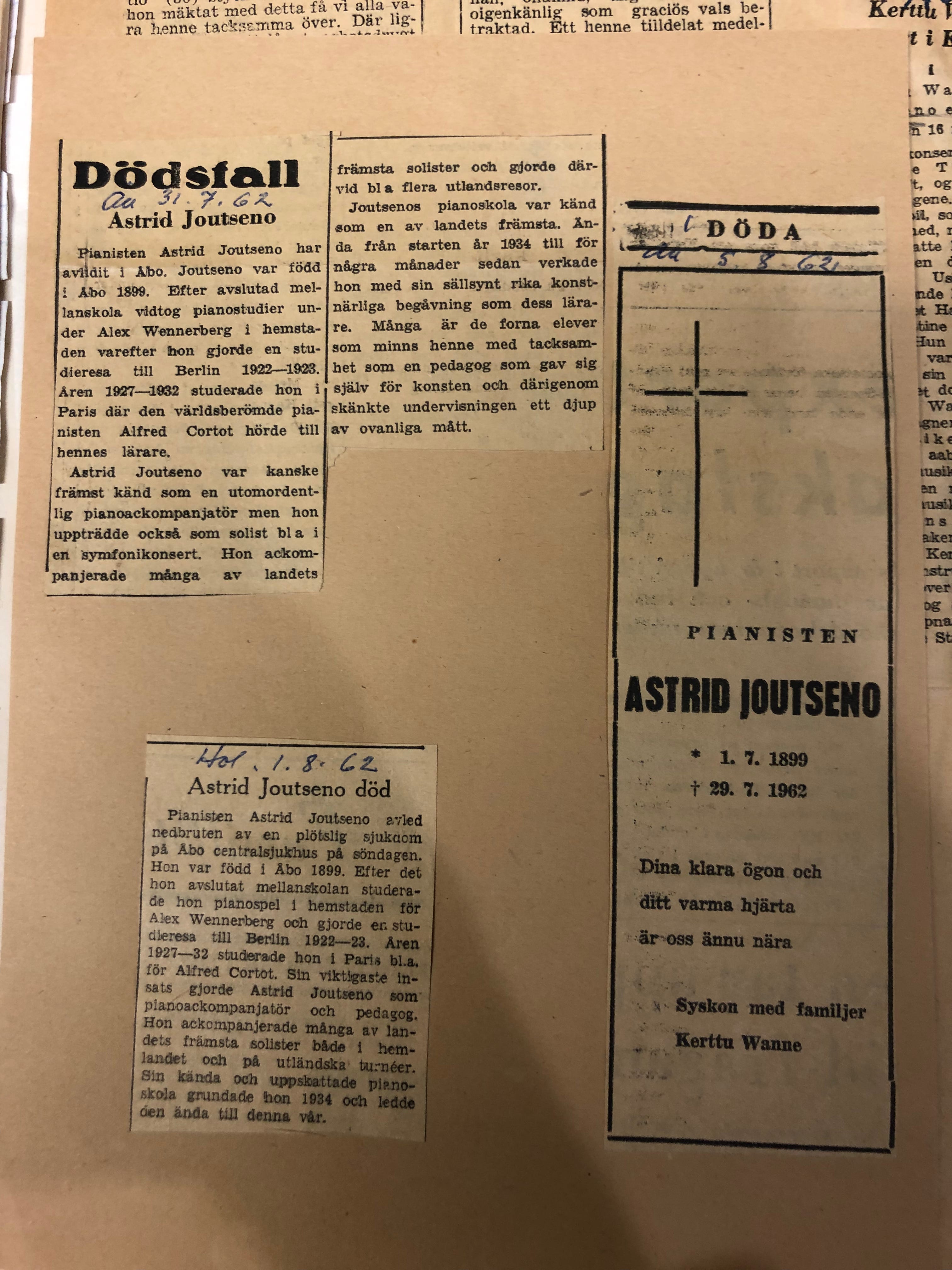
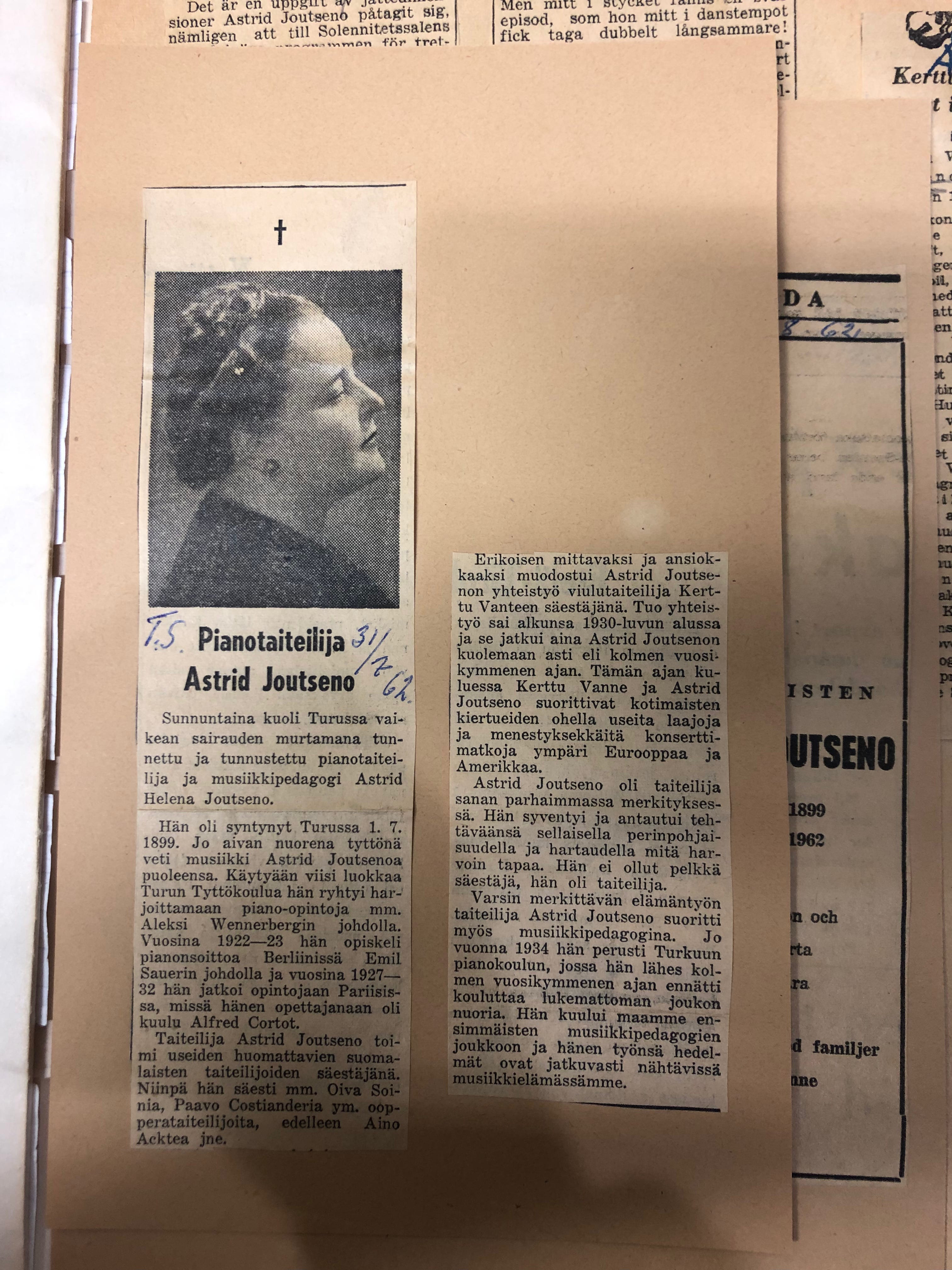
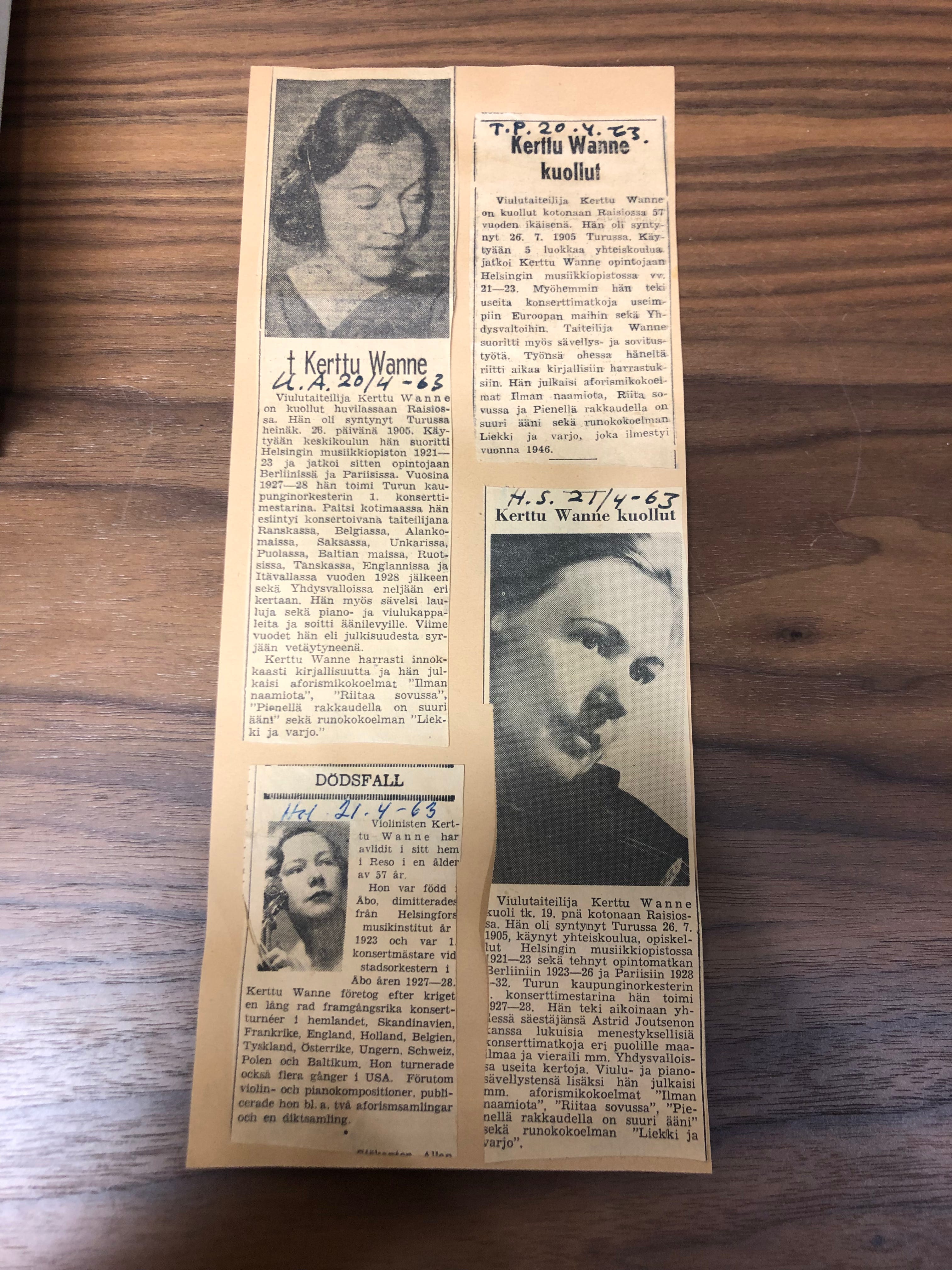
Between your death in July 1962 and 1982 a lot happened. A revolution. Bob Dylan went electric. The world attempted to disarm itself from the brink by going commercial. What was loud got louder with the amplifiers that plugged into the electrical grid and the buzzing of the media. Meanwhile an astral swirl spooned your life into its abyss and spat out disparate remnants. They languished without a sound here and there. Kerttu Wanne died in April 1963. Just eight months after you. Suffice it to say that after that a turtle in the pocket of your brown fur coat, a crackling recording of you and Kerttu playing in New York or the hundreds of newspaper articles that had been written about you two in the previous decades were not enough to remember you by. Dust gathered on your music sheets. Your grand pianos fell out of tune.
Last spring I stood in front of your grave in the Old Cemetery of Turku on top of a thick layer of snow and read your name on a thin grey slab. The gravestone is worn out, transmuted into a sign of forgotten ness, of time gone by, of fading. It stands facing the grass patch with lots of other old graves. Nothing screams for attention. This is a peaceful place to rest. Not far from your grave, there is a more prominent gravesite facing one of the wider walking paths. A tall reddish granite stone gleams in the sun and unfaded gold letters spell viulutaiteilija Kerttu Wanne 1905-1963. She is your love. This is how close to you she was laid just eight months after you. But not next to you, not near enough. Do you know this, Astrid? I feel like you should.
In another time (mine, I hope) you two would have been buried together. One skeleton over the other. Forever together, forever mixing your material endings. It’s called love. The space between you two at the cemetery is an undermining of your earthly bond. It is filled with other people’s endings and a short distance of a gravel path, the mossy headstones and trees. They obscure your entanglement in that location. On this plot of land there is no way to know how connected you two continue to be. I cannot tell your story Astrid, without Kerttu at every turn.
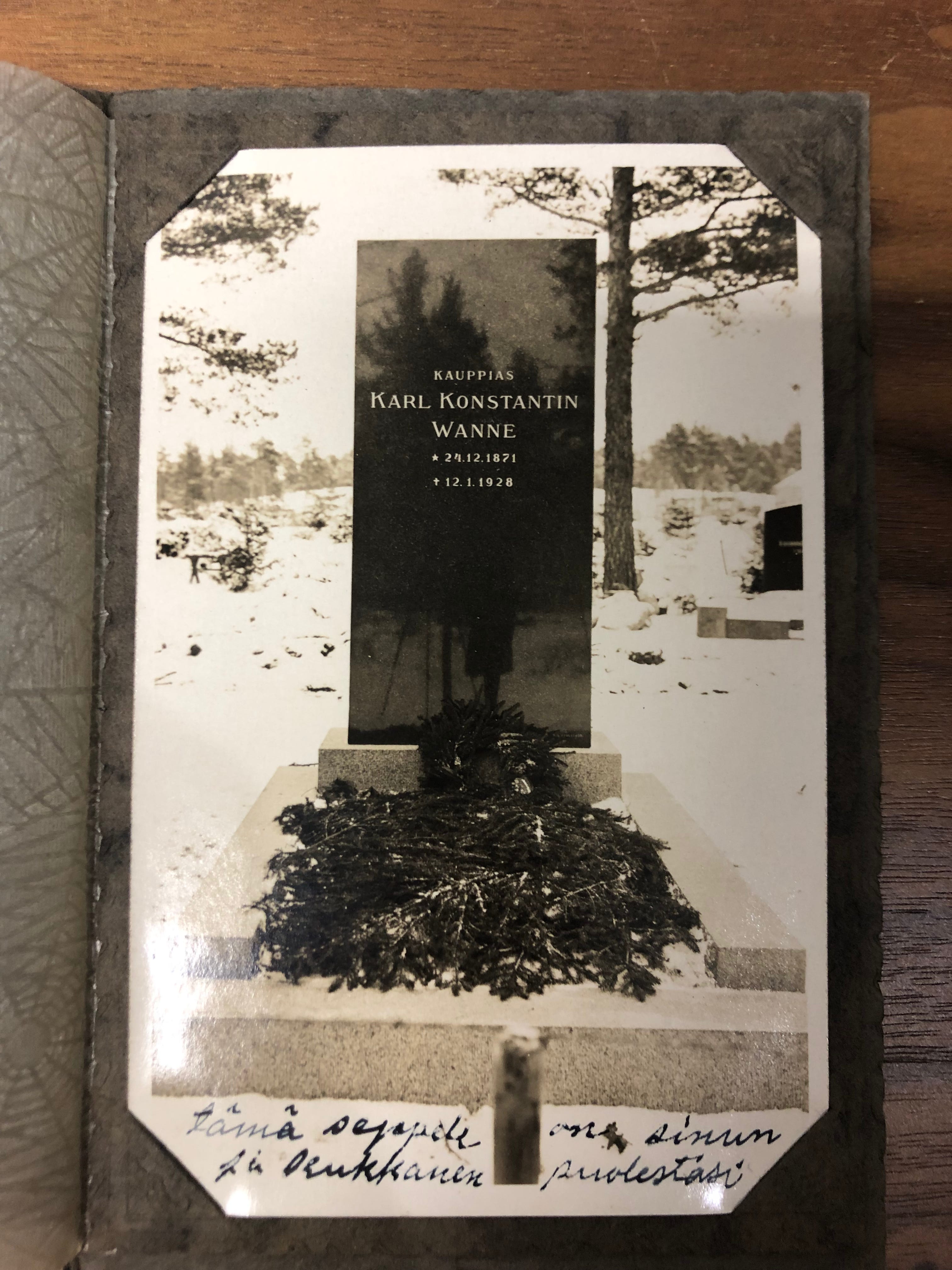
Kerttu is there with her daddy, Konstantin. Her name under his in large lettering, hacked onto a formidable granite headstone. Money, says the slab. New money says this picture of the grave after Kerttu buried her father in 1928. This gravesite is on the “new side” of the cemetery, so new that in this photograph there is just one other headstone visible and the rest of the cemetery hill (now full) is almost empty. Father Konstantin was a merchant who became rich through his business ventures. The size of the granite reflects that. It is utterly different from the elegance of the thinning stone marking yours, Astrid. Which no doubt is also the time talking – a change in style – but also, your economic situation. When you buried your father at the age of 13, your Emma mother’s household was probably left no large sums to survive on. And this must be when the headstone was bought, with space for some additional family members.
The photograph of Konstantin’s grave in 1928 is electrifying. As I have stared at it I have come to think that it is a self-portrait by Kerttu. Look at it again, Astrid! The headstone reflects the three legs of a camera and the hem of a coat and the merging of two legs of what I believe to be Kerttu’s 23-year-old body. Kerttu’s archive shows to me that the family had a camera from the early 20th century and it is possible to imagine that in the three-girl household, the father taught Kerttu not only to play the violin, but also, to take photographs. As her parents divorced in the early 1920s, it is also likely that it was Kerttu with her sisters who decided on the headstone for their suddenly dead father. In her archive the death of her father is amply documented and her bereavement appears constitutive. I will write much more on grief in my letters to you, I am sure.
On the cold early spring evening nearly a year ago, a wilting bush of heather sat leaning against the immaculate headstone of Kerttu’s. Your headstone grows its own decoration: lichen and moss. The gold on our family names has mostly disappeared. A thin layer distressed by the weathers of the last 100 and 12 years.
At the cemetery I felt grounded. The grief I had carried tethered me to this place and made you more approachable there. A crash of impermanence and permanence, the graveyard. Although you were not any more alive than a moment ago, the site carved us into the same story and confirmed our connection. Just like I had seen your pictures in the archives of Kerttu Wanne, I had found you here. Name on stone as confirmation. There, listening to the humming of the nearby motorway and the harsh wind that played the branches of fir and yew trees and bare boned birches, I was open to the obvious: it was my job to remember you; to find your place and Kerttu’s. To tell your story. It would be my task to go through the evidence. To write down timelines, to attempt to give meaning to disparate materials.
Thanks for reading Dear Astrid! This post is public so feel free to share it.
Watercolor
I was named after you before I was even born. Astrid. What more did I need? My whole name, an exclamation: look for her! Somewhere in my messy unorganized archive, I have the painting my father painted of me when I was in my mother's womb. The watercolor featured a fetus in faded greens and yellows and the name Astrid. When I was an infant, my parents could not decide on my name after all. Suddenly Astrid sounded too fancy and difficult for a baby. Other names were written on pieces of paper which were then put inside a hat in order to perform a lottery. What should be her name… This turned into a childhood diversion with a first name I never liked. And that name was no conformist picnic either. I was bullied and questioned: children asked about my gender, my grandfather recalled a horrible teacher by the same first name. Most uncomfortably, I felt that this given name was a color I hated, red, but I was yellow, an Astrid. As a teenager I claimed my name back. The inconvenience of others was no longer my primary concern. I am Astrid.
Not everything comes to order with a name. Not nearly. Names are bound to times and they change. It’s the whole mess of signs and signifiers. And that which cannot be given a name. Often, what is unspoken becomes disfigured. Little by little form gives way to the elements, and they cannot be separated anymore. So much is unknown. What is the story? What is your story, Astrid? I feel impatient when I suggest to myself the idea of starting from the beginning. Yours. Linear time. 1899. Still, it is something. Anchor in the waters of a life that by definition will not be held within a pool.
I am in middle age now. I have been teetering on the edge of my own life’s ending (too soon) for over a decade. In this uncertainty I feel close to you, my great aunt, and I will try my best to hear your dispatches from the past.
Your junior shadow
Thanks for reading Dear Astrid! Subscribe for free to receive new posts and support my work.
The photographs in this letter are from Sibelius museum archive of Kerttu Wanne. I have taken the photographs in 2023 during my research visit. Link to the museum in Turku is here: https://sibeliusmuseum.fi/fi/
Comments
Nothing yet. Say the first thing.
Sign in to join the conversation.