
If you like my writing, feel free to click the ❤️ or 🔄 button on this post so that more people can discover it on Substack. 🙏
The solstice is almost here! For those of us who live in the northern hemisphere, the glorious summer solstice and beginning of summer will occur on Sunday.
The solstice will occur precisely on June 21 at 4:24 AM EDT (8:24 AM UTC). Use World Time Buddy to find the exact time if your location is different. For our friends in the southern hemisphere, this day will be the mystical winter solstice and the beginning of winter.
Because I live in the northern hemisphere, I will focus mostly on the summer solstice in this article. Yet, both the summer and winter solstices are deeply profound occasions. On these days, we celebrate and embrace the light that is the highest expression of the divinity in all of nature.
Understanding the Summer Solstice
The term solstice is derived from “sol” (Sun) and “sistere,” to stand still. At the solstice, the Sun has no apparent motion. This is a turning point when we, like the Sun, are meant to pause, so that we may appreciate and enjoy the fruits of our past efforts.
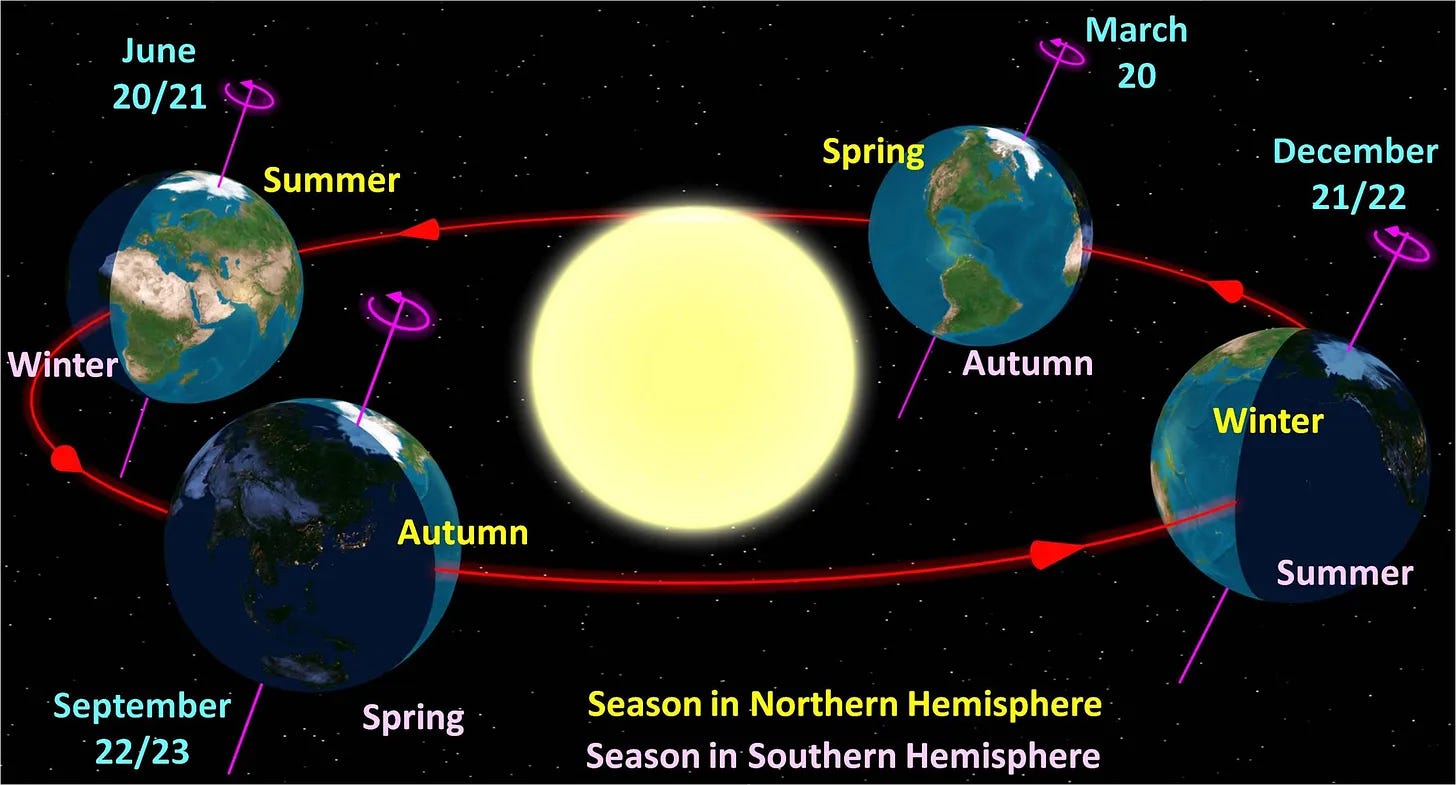
The summer solstice marks the moment when the apparent path of the Sun reaches its zenith in the Tropic of Cancer, before it appears to turn and move south again. It is the longest day of the year and the time of maximum light.
The astronomical still point of summer solstice is also known as Midsummer. This potent event has long been observed throughout the world as an important time to celebrate and give thanks for the magic of life! It gives us an opportunity to purify ourselves, let go of the past, renew our life force, and affirm our highest purpose.
A Sensitive Time of Psychic Adjustment and Renewal
Solstices generate subtle magnetic changes within us and in the world at large. Those who are especially sensitive may start to feel these shifting energies three days in advance of the solstice standstill, and for three days afterward, as well. During this time, our mental activity may become amplified, which may be inspiring for some. Yet in other cases, this energy may trigger psychological imbalances or relationship conflicts. Our physical health may be vulnerable, so it’s important to be extra mindful and vigilant.
According to Classical Muhurta (Vedic elective astrology), during the three days before, the day of, and three days after the solstice, we should not initiate important matters of long-term consequence. These include signing a contract, moving into a new home, getting married, launching a new project, having an elective medical procedure, or starting a new business or educational venture. This is because the Sun, which represents our life force and the power of manifestation, is in a transitional state during this time. Thus, events begun at this time will likely not reach their expected conclusion, especially in terms of their lasting value, success, and impact.
The Sun, the source of divine illumination, achieves tremendous strength when it reaches its highest declination point north of the celestial equator on the summer solstice. Around this time, our self-confidence receives a boost, and spiritual and healing practices will be well supported.
The Solstice Horoscope: Examining the Collective Karma of the World
It is important to consider a solstice horoscope in mundane astrology, as this chart is one of many used to examine the collective karma of the world. The June solstice chart will be active for the next six months.
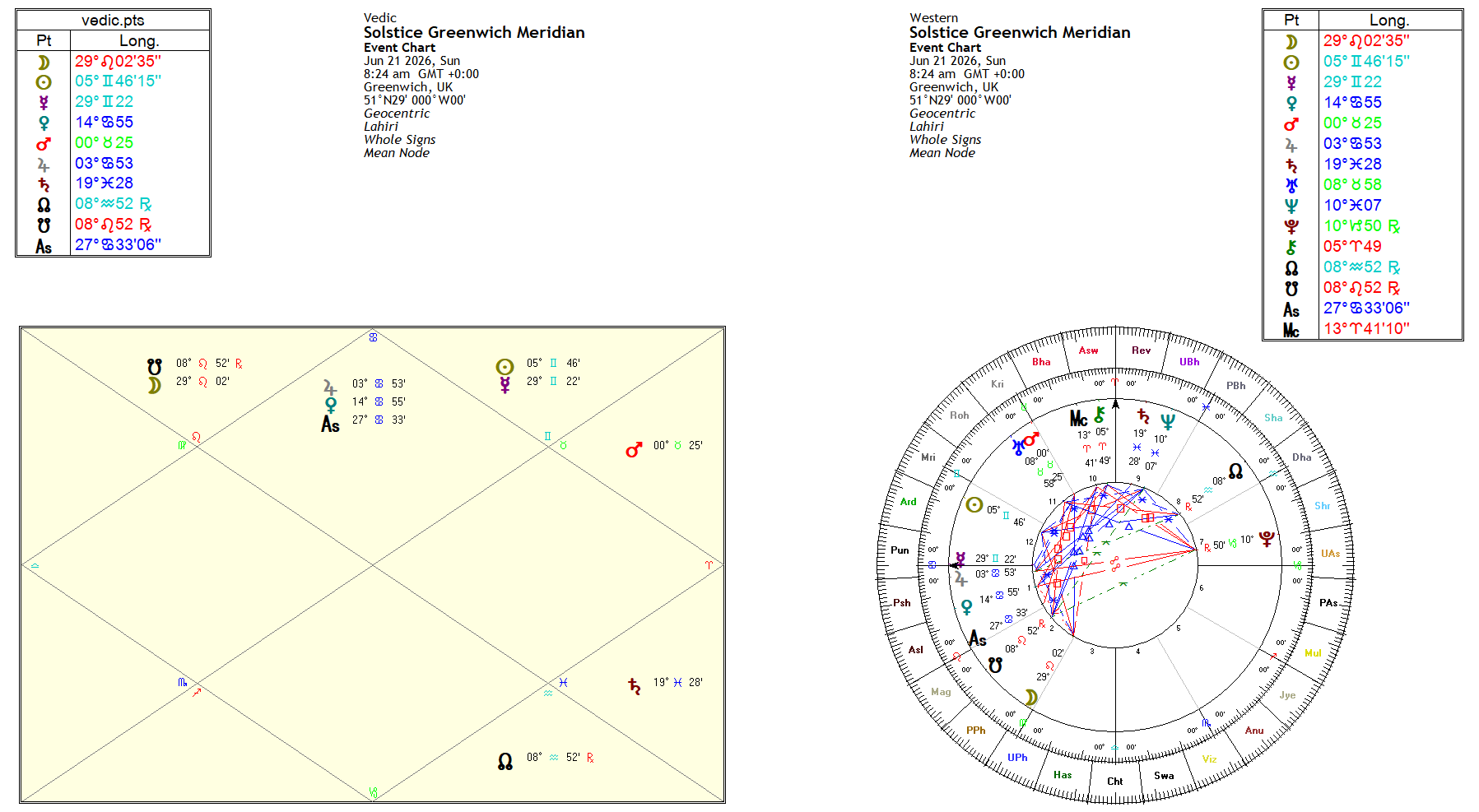
The solstice chart for the world is calculated for the prime meridian in Greenwich. This chart reveals some of the major themes playing out on the world stage in the second half of the year.
In the chart for the upcoming solstice, the Ascendant occupies late Cancer in Ashlesha nakshatra, which is symbolized by a coiled serpent. It’s interesting that the upcoming total solar eclipse of August 12 also occurs near the same degree in Ashlesha. With Ashlesha in charge, we should expect to see sudden transitions of power, resource redistribution, and the revelation of truths as the old world order continues to be transformed.
Cancer is ruled by the Moon, and Ashlesha is ruled by Mercury. The Moon and Mercury each at the 29th degree of their respective signs further indicates climactic global turning points. There are also several indications in this chart based on multiple factors (including the Ashlesha ascendant) for heightened meteorological events. earthquakes, and other major natural disasters in the coming six months.
This makes sense in that we have just entered a very strong El Niño event which affects global weather patterns. It is expected to reach maximum intensity between November 2026 and February 2027. El Niño events are natural weather patterns associated with high heat, floods, droughts, and fires.
I can analyze all these developments in connection with your own birth chart to see what the upcoming six months may have in store for you.
Understanding the Solstices According to Vedic Astrology: Uttarayana and Dakshinayana
According to Vedic astrology, the first waxing half of the solar year from winter to summer solstice in the northern hemisphere is known as uttarayana. This is the Vishnu half of the year that represents the expansive cycle of conscious energy projecting upward and outward into the material realm.
Uttarayana is the most auspicious half of the year in which to establish new enterprises. For those in the northern hemisphere, this part of the yearly cycle will end at the summer solstice on June 21, and will begin again at the winter solstice on December 21, 2026.
Dakshinayana is the second half of the solar year extending from summer to winter solstice in the northern hemisphere. This is when Lord Vishnu takes his rest and Lord Shiva steps in. During this part of the year, the Sun’s power will gradually wane as it moves southward in its declination cycle.
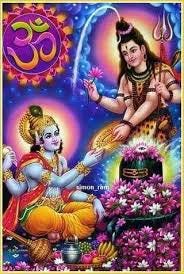
In dakshinayana, we hope to reap what was sown during uttarayana. That is to say, dakshinayana is generally the time for winding down and finishing what was set into motion in the first half of the year. (And of course, all of this is reversed in the southern hemisphere).
As the natural flow slowly moves back to Source during dakshinayana, this is the hemicycle in which to focus more deeply on health, healing, and spiritual practices and rituals.
How to Celebrate the Summer Solstice
At the time of the summer solstice, it is so important to stop, give thanks, enjoy, and share the bounty of nature’s blessings. I usually preform a sunrise meditation and have a sunset picnic on this longest day of the year! Spiritual rituals and ceremonies like this can help us access and align with the profound love and light generated in this powerful seasonal still point.
I wish everyone joy and happiness on the solstice!
Divine Mother Nature, I offer my thanks for the gift of the Sun. For its light that wakes the morning. For its warmth that stirs the soil. For its golden glow that dances on the sea.
Through the Sun, you breathe life into the world. You call the flowers to bloom and the harvest to ripen. The rays of the Sun touch my skin and remind me I am alive and part of your great cycle, rooted in your care.
Today, I stand in stillness to receive the gift of the Sun’s light. I honor the energy it gives. The clarity it brings. And the fire that stirs in my own spirit.
With open heart and quiet mind, I thank you for this blessing. May I walk with awareness of the light Within and all around me, always. (Summer Solstice Prayer, Anonymous)
Comments
Nothing yet. Say the first thing.
Sign in to join the conversation.