

Many people, including myself, have written many, many words about how quickly (or slowly) the world will change if and when we invent artificial general intelligence. But all this ink doesn’t seem to have been very persuasive. People who expect a radical discontinuity in history have failed to convince the skeptics — including myself — and we haven’t had any more success convincing them. Why?
The economist Tom Cunningham recently put together this chart of forecasts of the economic impact of AI, which he divides into two groups: “AI Insiders” and “Economists and Institutionalists.” These two groups have been disagreeing about what the impact of AI will be for the past several years. Economists almost uniformly expect the effect on economic growth to be below 3% per year, while AI insiders — who I’ll call technologists — just as uniformly believe it will be much higher, possibly as much as 30% per year. The lack of agreement isn’t because either side has been reticent to make an argument — indeed, all of these forecasts are generally pulled from documents that make the case at length.
The intractability of this disagreement was prefigured back in 2022, in an unusual tournament run by the Forecasting Research Institute. They gathered 89 superforecasters and 80 AI experts, and asked them to forecast the probability of dozens of different scenarios related to how the world might change as a consequence of technological progress. One of these questions was the probability that the global economy would grow by more than 15% in a single year before the year 2100. Given the uncertainties of forecasting the consequences of unknown technologies many decades into the future, these forecasts varied widely. However, there were two major clusters: The median superforecaster put the odds of transformative growth at 5% by 2100, while the median AI expert put it at 25% — five times greater.
For our purposes, what’s interesting is what happened next. The Forecasting Research Institute designed this tournament to facilitate agreement. Participants were incentivized to clearly explain their reasoning, and their arguments were shared with each other. Additionally, the tournament featured rewards for accurately forecasting the probabilities the other group would report, on the grounds that this would require understanding the most persuasive arguments for the other side. But despite all this effort, by the end of this process, little convergence in beliefs had occurred. The median superforecaster’s probability of transformative growth by 2100 fell from 5% to 2.5%, and the median AI expert forecast was unchanged at 25%. The difference between the two camps had widened to 12 times. This was perplexing. Why wasn’t either side able to persuade the other?
One hypothesis was that neither group engaged with their opponent’s arguments enough, despite the incentives to do so. After all, participants were asked to weigh in on dozens of topics. So the Forecasting Research Institute conducted a follow-up study: an Adversarial Collaboration in which a group of 22 participants with initially divergent beliefs on AI would engage more intensively with each other’s arguments. Participants spent 20-80 hours over two months “understanding and accurately summarizing each other’s key arguments to the satisfaction of the opposing side”. But even this process failed to lead to any convergence in forecasts.
Our beliefs instead come from a lifetime of evidence that shapes our starting beliefs, almost none of which is directly related to AI.
All this matches my own experiences. For years, I have been involved in discussions about whether AI will lead to explosive rates of technological and economic growth (that is, growth at least 10 times faster than what we see today). I participated in a dialogue on this question for Asterisk in 2023, and we’re still having the same debate with the same arguments today: bottlenecks, diffusion, the limits of intelligence, and so on. In my experience, these debates echo what the Forecasting Research Institute has found: Both sides have arguments they find convincing, but which fail to persuade the other side.
Why hasn’t all this debating led anywhere productive? I think the answer is simple: Our arguments are weak. Ideally, persuasion looks something like this: People start with prior probabilities, receive new evidence, and then update their beliefs accordingly. But when the evidence is weak, we don’t (and shouldn’t) change our minds too much.
In one sense, this argument is tautological. If we define the strength of an argument by its power to change minds, then an argument that fails to do so must have been weak. In this case, however, I think looking at the arguments themselves can show us how they might not be persuasive.
Let’s start with the economic models. A recent paper on this topic is Jones and Tonetti (2026), which builds a model of economic growth based on the assumption that AI is capable of performing an increasing share of the tasks humans do in the economy — including the tasks of inventing new ideas. In their paper, they calibrate the model with data on the last several decades of automation, and end with several simulations of growth under different assumptions about AI. The upshot is well represented by the following figure:
The paper shows that under some sets of assumptions, economic growth rockets past 20% and towards infinity. It also shows that under other assumptions, business-as-usual economic growth persists. How do we know which world we’ll end up in? In Jones and Tonetti’s model, one of the most important factors is the share of tasks that can ultimately be automated by AI and robots. Unfortunately, we have remarkably poor evidence on what this will be.
If you already believe that explosive economic growth is plausible, this paper tells you that such an outcome is consistent with a mathematical model (given some assumptions that are hard to verify). But if you think otherwise, well, the opposite is equally true.
This dynamic goes beyond this particular paper. Most research that investigates the potential impact of AI on growth similarly depend on assumptions about specific parameters for which we have little or no precedent — the speed of automation, the number of tasks we will automate, the elasticity of substitution between the tasks that haven’t been automated and the ones that have. Even when we can get evidence on the value of these parameters in today’s world (for example, Jones and Tonetti measure how quickly automation proceeded over the 20th century) their applicability to future worlds with advanced AI is highly uncertain.
And of course, the evidence from these models is further weakened when we recognize that all economics models are simple approximations of reality with a poor predictive track record. In general, economic models of AI and growth help us better understand the mechanisms through which explosive growth or business-as-usual might obtain, but they are ill-equipped to help us diagnose which is likely.
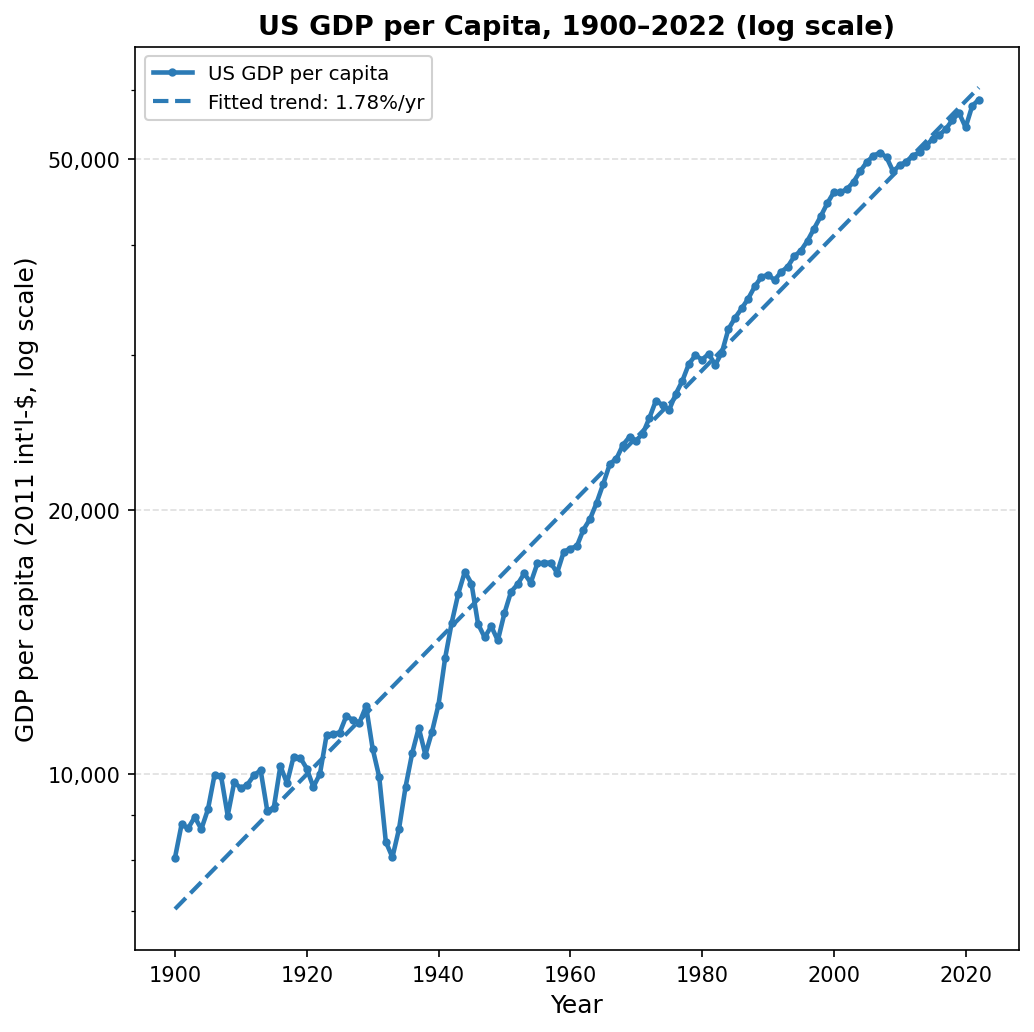
We have a similar problem with other lines of evidence. For example, we could turn to historical data. On the one hand, economic growth in the U.S. has held remarkably steady at 1.8% annually for over a hundred years, despite all the technological and social upheaval the last century brought.
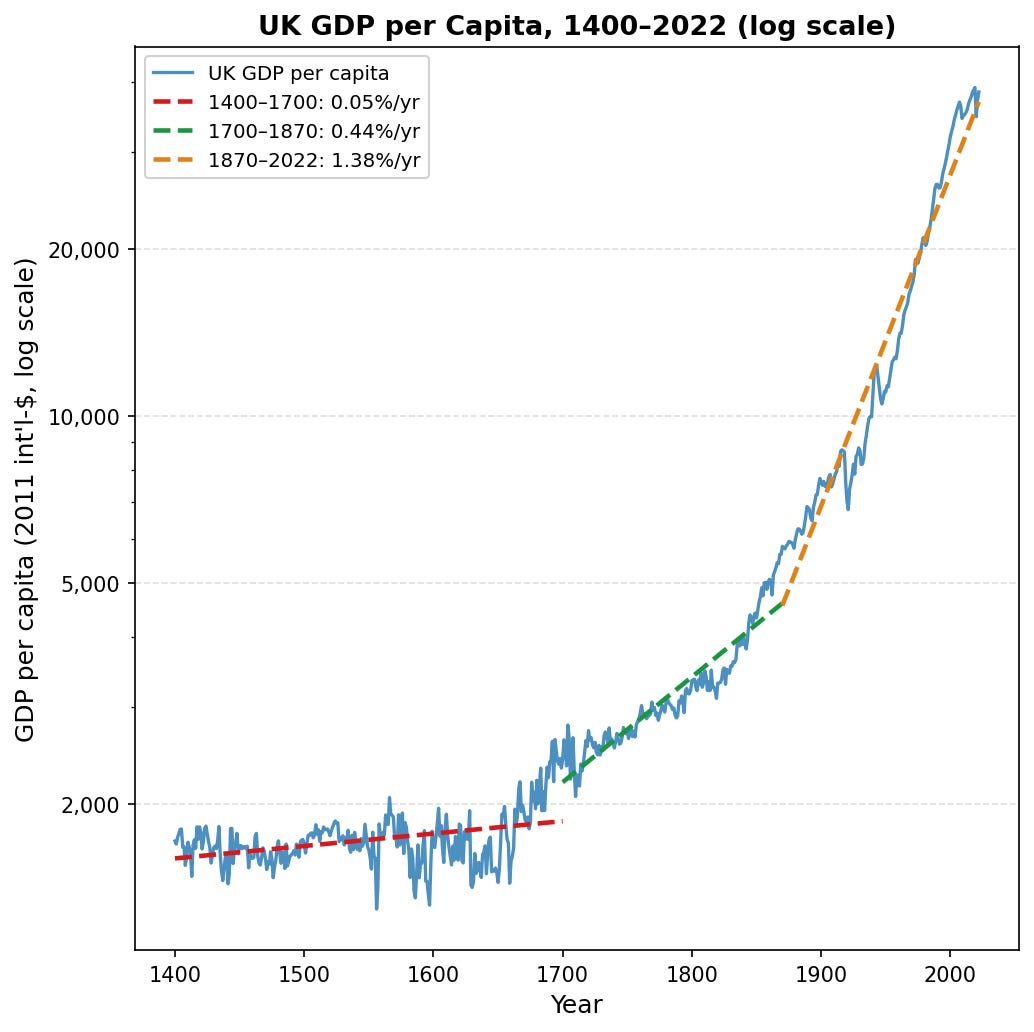
But if we look back farther, we find precedents for rapid acceleration. The UK, for example, probably grew by about 0.05% per annum between 1400 and 1700, then accelerated by roughly 10 times to 0.5% per annum between 1700 and 1870, and by another three times after that. But on the (third) hand, the acceleration of economic growth during the Industrial Revolution was mostly about increasing the frequency of high growth years (which were often well above 0.5% per year) and decreasing the frequency of economic contractions. A similar acceleration today can’t be achieved merely by increasing how often the U.S. grows on the high end of its range and decreasing how often it grows on the low end (the U.S. never grows at 20% per year). It’s not clear which framing is the right one.
We can look at much more recent empirical data, but it is also not very helpful. As the economist Kevin Bryan recently tweeted: “If you know one thing about AI, the ‘lines on the chart’ from scaling laws on tech capabilities have been right on for six years, and objections on diffusion frictions/production bottlenecks to their effect on growth have also been.” To a skeptic, the muted aggregate productivity gains achieved so far by AI are unsurprising. But if you already believe that AI will lead to rapid economic growth, the fact that it hasn’t done so yet is not that persuasive either: The whole point of the acceleration in growth is that it happens relatively rapidly, but after we attain sufficiently advanced AI.
Is there anything we can look to to help us resolve this question? Maybe not. A key part of the Forecasting Research Institute’s adversarial collaboration study was an attempt to identify near-term resolvable forecasts that would lead to the most convergence in beliefs across the two groups. Essentially, the participants were asked to identify the kinds of things that would have to happen for them to change their mind. But this proved quite hard to do: The two groups could not come up with any near-term resolvable forecast that would substantially convince them.
The Forecasting Research Institute’s adversarial collaboration paper ultimately concluded that their participants failed to converge because they couldn’t agree about which kinds of evidence were relevant to the question, and had conflicting priors about how complex social systems work. This makes sense. If our evidence is weak, then it is no surprise that people with different starting beliefs fail to converge to a common set of updated ones.
Two questions remain. First, in my experience of these debates, each side finds the other side’s arguments weak, but not their own. Why can’t we agree that even our own arguments are nondiagnostic? Second, why do we have such different starting beliefs in the first place?
I suspect the common cause is that we don’t generally understand where our own beliefs come from. We assume our beliefs about AI are caused by the arguments about AI. But this is incorrect. Our beliefs instead come from a lifetime of evidence that shapes our starting beliefs, almost none of which is directly related to AI.
What kind of evidence am I talking about? As I noted at the start of this essay, two groups who have persistently disagreed on this question are economists and technologists. So I’ll illustrate by describing some of the arguments and evidence that PhD economists, as a class, have largely been exposed to, and which I think help explain their general (not universal) tendency to think AI will not lead to explosive economic growth.
Growth is hard to change
Economists encounter countless examples in their graduate training and professional careers which suggest that economy-wide growth is hard to move. This is about much more than the persistence of 2% annual U.S. GDP growth. It’s also about the failure of policy-focused economists to identify and advocate for simple policies that can sustainably increase growth by a substantial amount, whether in tax policy, healthcare, education, industrial policy, or any other field. Economists know that the subfield of economic development has struggled for decades to find a reliable recipe for faster economic growth in poor countries.
The gap between the feasible and the achieved
The gap between what is technically feasible and what actually obtains is a dominant theme in economics. Economic development is a prime example here — why don’t poor countries simply copy what rich countries do and become rich themselves? Even among rich countries, economists appreciate that technology diffusion is slow and painful, with the productivity of firms operating in the same market and industry often differing by orders of magnitude. But the gap between what is feasible and what is achieved is much more general and deeply embedded in how economists think about the world than these two examples. Indeed, one could do worse than to frame the entire project of economics as the study of why we fail to achieve the best outcome, given what is technologically feasible, and how we might get closer. This is an idea lurking behind concepts like externalities, market power, coordination failures, non-rivalry, irrationality, extractive institutions, and more.
Perfect information, rationality, and computational power are not enough
The modeling practices economists normally engage in also embed implicit assumptions about the limits of intelligence. The convention in economics is to model people as perfectly rational, perfectly informed about their economic environment, and blessed with unbounded capabilities to solve the necessary math to behave optimally. And yet, the gap between the feasible and the achieved persists.
Superintelligence is already here
Economists spend a lot of time thinking about markets that are collectively smarter than any of their participants. For instance, most economists understand markets can be inefficient, but still harbor a belief that very few traders can sustainably beat the market (indeed, they probably think the market is efficient enough that they personally invest in index funds). Moreover, the first and second welfare theorems establish that under some conditions no amount of cleverness can improve on the allocation of resources achieved by markets. While much of economics is devoted to understanding how markets fail to achieve this ideal, many economists probably think there are settings where markets get pretty close to it.
Focus on marginal effects
In many ways the methodology of economics also pushes economists away from making forecasts that are dramatically different from the status quo. We are trained to think “on the margin” — that is, in terms of small changes to the status quo. Examples abound: a large share of theoretical work involves “taking derivatives”, a mathematical technique for studying the effect of very small changes on an economic system; a common trick to solving intractable problems is to take a local linear approximation, where a complex system is reduced to a system of tractable equations that are predictive only near a particular point; our preferred empirical approach focuses on what happens to a complex phenomena when just one variable changes at a time.
The focus on marginal effect is not an unthinking bias but rather a hard-won insight into the practicalities of studying complex systems. There was an era in economic modeling when we built large complex models of the economy. That effort is now largely seen as a failure (see Economics Rules by Dani Rodrik). Similarly, empirical economics has turned its attention to the rigorous identification of specific causal mechanisms in part because earlier efforts that were more ambitious did not work.
None of these kinds of evidence are directly related to AI, but it’s easy to see how they would shape someone’s prior beliefs about the prospects of explosive economic growth. An economist, before even seeing any arguments about AI, starts from a place of skepticism about the leap from technological feasibility into real world impact, the power of intelligence to close this gap, and the possibility of substantially shifting economy-wide growth. On top of that, they believe that forecasts about large changes to the economy are very hard to get right. In short, they start the debate predisposed to be sympathetic to the conclusion that AI may lead to faster growth, but only on the margin. And then, when they then engage in the debate, they find the current empirical data and models are perfectly consistent with this stance, even if they do not decisively rule out other possibilities.
It’s not that we don’t have arguments; rather, it is that the arguments that really drive our forecasts are the ones that form our priors.
Contrast this with the experiences of technologists, who are in an ecosystem full of people who work in the software and computing industry. Here are some experiences that I think might shape how a technologist approaches the explosive growth question (That said, I am not a technologist, so consider the following a speculative illustration of how different priors might arise.)
Growth rates are volatile and can be very rapid
The growth rate that the technologist is familiar with will be the growth of their peer companies, rather than the economy as a whole. This growth can be very volatile; a company might fail and fail and then find the right idea and take off — or go bust. When a company does take off, growth can be extremely rapid: A unicorn might go from $1 million to $100 million in annual recurring revenue in seven years, which is more than 90% annual growth.
Growth dynamics are driven by technology
The rapid growth and volatility of companies and industries are a fundamentally technological phenomenon. The technologist operates in an environment where technological disruption of the status quo is the norm (even cliche). Capabilities advance rapidly, with older products and services being made obsolete and new ones becoming feasible.
Intelligence is powerful
The rise and fall of companies, the reordering of industries and practices, and the growth and decline of fortunes are ultimately created by code, which is itself the fruit of cognitive effort. Moreover, in the experience of technologists who work primarily with software, the world is suffused with hacks and exploits, places where being slightly more clever can yield outsized impact. The power of intelligence is also manifest in the concept of the “10x engineer,” whose superior fluency with software makes them discontinuously better than their peers.
Focus on the discontinuous
Technologists (or at least founders) are, by default, not people who think on the margin. Peter Thiel emphasizes the breakthrough 0 to 1 innovation that does something that has never been done before. The goal of a startup idea is not to be marginally better than the incumbent, but dramatically better, with good prospects for taking over a large share of the market.
It’s clear that this set of beliefs push someone towards a very different set of probabilities from the economist. Such a person would be predisposed to find sudden shifts to rapid growth, driven by technology, quite plausible. They would be primed to see intelligence as having the kind of power to bring about such a shift, and more comfortable making predictions about major changes. And when they engage with the arguments about explosive growth, they will find that the evidence is consistent with their priors.
When I reflect on my own experiences in these debates, it doesn’t feel like I’m falling back on the assumptions I’ve developed as an economist. When asked to give a forecast, one usually jumps straight to considering the directly relevant arguments. With that process, it’s easy to conclude that the justification for your judgment is the arguments you considered.
Perhaps we would be more clear-eyed about the sources of our beliefs if we followed a different process. First, write down a forecast based purely on vibes and intuitions, without any effort to engage with arguments about the topic. Then, think of relevant arguments, read the literature, and argue with friends. When that’s done, write a second forecast. If there is little change between the first and the second, then you might conclude that it really is your intuition — which I think of as our priors — that drives your thinking, and that the arguments are weak.
If this story is right, then how might we move these debates forward? We might conclude the situation is hopeless, because all our arguments are weak. But I don’t think that’s quite right. It’s not that we don’t have arguments; rather, it is that the arguments that really drive our forecasts are the ones that form our priors. These might not be closely connected to AI at all, but perhaps they are what we should be discussing.
If we wanted to shift the debate to the factors that shape our prior beliefs, one path we could follow is to take special interest in the forecasts of people whose priors are shaped by multiple communities, trusting them to synthesize and integrate the evidence from different typical life experiences. For example: What odds do PhD economists who work at technology companies (or at least, are embedded in their culture) give to explosive growth from AI?
But this approach will only take us so far. To begin, there is a selection issue — possibly the economists most sympathetic to explosive growth will be most motivated to move to Silicon Valley. Second, it is almost certain that even this group will have a wide range of forecasts. Third, there are more perspectives than these two communities. What about superforecasters, life scientists, physicists, civil servants, policy wonks, national security experts, and so on? They have perspectives that would shed light on these questions too, but we’re never going to find someone who has lived all those different kinds of lives and can give us the summary view.
An alternative path would be for participants from different backgrounds to introspect and try to articulate the lifetime of evidence that informs their own background beliefs, as I have tried to do for economists. This could include technologists, for real this time. After all, if we share all the evidence that informs our beliefs, but are born with the same priors, then we should converge to the same posterior. I’m not sure this will actually work — if it really is about a lifetime of arguments and conversations and personal experiences, then condensed summaries may not have the power to persuade. But it would at least help us understand each other better, and we may just make some progress on the questions we care about.
Matt Clancy is the Program Director of the Abundance and Growth Fund at Coefficient Giving. He writes at the Abundance and Growth blog and What’s New Under the Sun, a living literature review on the economics of innovation.
Comments
Nothing yet. Say the first thing.
Sign in to join the conversation.