

In the Beijing Capital Airport, floor-to-ceiling columns glow with ads for Alibaba’s AI cloud platform and ByteDance’s chatbot, Doubao. Swap the Chinese for English, and the scene could pass for SFO — another airport with corridors lined with promises of an AI future.
The conventional wisdom among policymakers and industry executives is that America and China are running different AI races: China cares about translating AI advances into economic and military power (diffusion), while America cares about developing the most advanced AI models at the frontier (innovation).
But this narrative is misleading and overstates the differences between the two countries. After speaking with Chinese investors, researchers, and policymakers, we think they have the same goals as their American counterparts: to build the best models and deploy them widely.
The idea that China is running a “different race” is often based on four claims, which we will discuss, about its AI ecosystem. Some differences do exist, but they are not evidence of diverging long-term goals or of a philosophical commitment to diffusion over innovation.
They are a pragmatic response given that Chinese officials, labs, and companies operate in a different environment: compute is scarcer due to export controls; the state plays a larger role in setting the direction of economic activity; and Chinese consumer platforms and industrial firms have unusually strong channels for deploying technology into daily life and the physical economy. Even so, many of these differences are already fading.
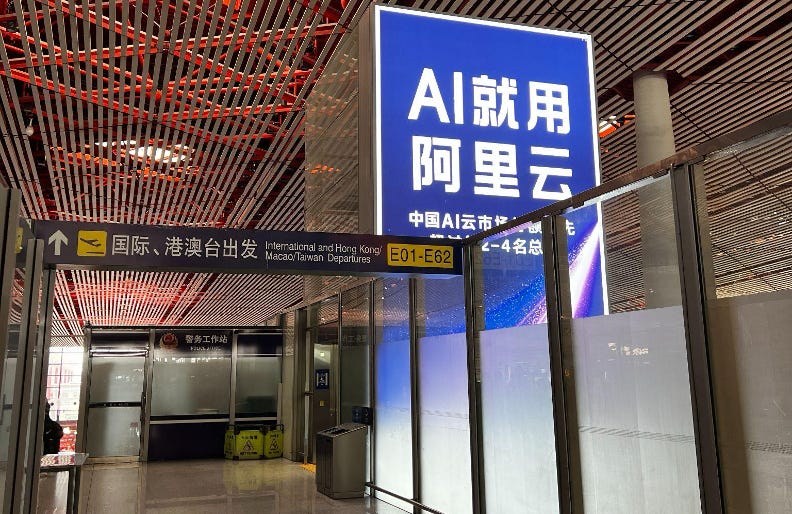
Beijing Capital Airport. Courtesy of Justin Curl.
For each claim below, we make three points: differences between China and the U.S. are often overstated; where they do exist, they reflect the environment in which Chinese labs and officials operate rather than a fixed Chinese theory of AI progress or distinct long-term strategy; and there’s evidence that these differences are already diminishing.
Claim 1: Chinese AI labs build cheap open-weight models because they prioritize diffusion
Chinese AI labs build some of the best open-weight AI models, including DeepSeek, Qwen, GLM, and Kimi — all among the most popular options on HuggingFace, a platform for downloading AI model weights.
A popular view is that this reflects a different, diffusion-oriented theory of AI progress. While American AI labs spend billions to push the frontier with training runs requiring ever-larger amounts of compute, Chinese labs “fast follow,” allowing them to stay within 6-12 months of the frontier while spending far less.
Chinese developers optimize their models for cost efficiency before releasing the weights to the public. Under the “different theory” view, they do so because this promotes diffusion: Cheaper open-weight models means more developers experimenting, which first leads to more products that are more useful and then eventually to economic growth.
Two things complicate this claim. First, releasing open-weight models, as some supporters of the “different theory” view acknowledge, is downstream of compute constraints rather than upstream of different goals. And second, an open-weight strategy may not be a clear pro-diffusion choice at all.
Let’s start with the first complication. For compute-constrained AI labs off the frontier, open-weight releases may just be a competitive strategy.
Chinese AI leaders are not shy about wanting to build frontier models. DeepSeek CEO Liang Wenfeng has described the company’s mission as “unraveling the mystery of AGI with curiosity” — hardly the rallying cry of a company content to optimize for cost efficiency behind the frontier forever.
Yet Liang has also said that “money has never been the problem for us; bans on shipments of advanced chips are the problem.” So long as larger training runs continue to translate into better model capabilities, compute constraints will restrict Chinese labs’ strategic choices.
Releasing cheaper open-weight models seems more like a temporary strategy for surviving with limited compute access. They help Chinese labs build name recognition and attract users, talent, and capital — all of which are necessary to innovate and compete at the frontier. Z.ai (formerly Zhipu) and MiniMax, two companies with high-profile releases, listed on the Hong Kong Stock Exchange in January. Moonshot AI, the maker of Kimi, also reportedly has an $18 billion valuation.
This also explains why open-weight releases may not remain the dominant strategy for Chinese labs. As labs approach the frontier, the business logic shifts towards closed models. Frontier models are expensive to train, and it’s easier to recoup that investment through closed APIs and enterprise contracts. For example, Meta, long the American leader for open-weights due to its Llama models, pivoted with its Superintelligence Labs’s first model release, Muse Spark. Many view this change as recognition that competing at the frontier requires proprietary systems.
Some Chinese labs have already made this shift. Alibaba, MiniMax, and Z.ai, have all shipped closed-weight AI models in recent months. And the remaining open-weight labs may not stay the course once they can produce a Mythos-level model, at least according to one anonymous AI boss. Chinese regulators have not yet had to confront a truly frontier Chinese model with these capabilities, but it’s hard to imagine Beijing wanting such a model released openly.
And for the second factor: Open-weight development might not be much of a pro-diffusion choice at all. We often assume “open source” models encourage diffusion because that was true for open-source software. But analogizing to software may lead us astray with AI.
Open source software spurred adoption by promoting trust and experimentation. Trust because anyone could inspect the code to monitor for security vulnerabilities and verify it did what it claimed. And experimentation because developers could directly edit code, adding or modifying features that, if valuable, would be integrated into the codebase to the benefit of all.
AI is different in both respects. Model weights aren’t human-readable the way code is and do not provide guarantees about what a model can or will do. Nor is access to model weights required for developers to experiment with AI. A model is one component in a larger system that most developers interact with through APIs. OpenClaw, the latest viral AI application, was designed for use with Anthropic’s proprietary model Claude (though it’s been updated to work with any AI model API). The related argument that you need open-weight models to fine-tune for specific applications also doesn’t hold: OpenAI allows developers to fine-tune its closed models.
In a 2025 survey of American companies, Menlo Ventures found that 76% of AI use cases were purchased rather than built internally, up from 53% the year before. It also noted that open-weight models account for just 11% of enterprise LLM spend (though this wouldn’t capture the fraction of companies hosting their own models), down from 19% the prior year.
While the survey didn’t explain why these shifts happened, if cheap model weights truly increased adoption, we’d predict more companies building internally with cheap open-weight models instead of buying expensive proprietary models that they have less control over.
This isn’t to say that open-weight models have no benefits. Some enterprises and governments will only adopt AI models they can own outright, perhaps concerned a third party will cut off access or change its terms. In the extreme case, this is the driving force behind sovereign AI deployments. And in some contexts, cost is the limiting factor, so a cheaper model may make all the difference. Still, “open-weight models are sometimes valuable” is a far cry from “open-weight models are the diffusion strategy.”
Open-weight releases are thus only weak evidence of the “different race” thesis. They may promote diffusion, but they also help compute-constrained labs racing towards the frontier. And if Chinese labs truly valued diffusion over frontier innovation, we would expect it to remain diffusion-first even as models become more capable. Yet the evidence so far is to the contrary as some Chinese labs shift away from open-weight development and adopt strategies resembling their American counterparts.
Claim 2: Chinese government initiatives talk more about diffusion because Beijing cares more about diffusion than Washington
It’s true that the government does loom larger in China and that a policy gap exists. Chinese government documents talk about applications, consumption, and integrating AI into the physical economy, while American ones talk about frontier models, data centers, and global dominance.
But this gap largely reflects the role of each government rather than competing priorities. In China, the government guides economic activity through credit, subsidies and state-owned enterprises. So Beijing naturally talks more about diffusion. If it wants AI in factories, hospitals, and schools, it has to tell ministries and SOEs that’s what success looks like.
The American government, by contrast, mostly leaves technological diffusion to markets. The Trump Administration’s attempt to preempt state AI regulation via executive order encapsulates Washington’s current view of its role in AI diffusion: to get out of the private sector’s way.
That said, much like with open-weight models, there’s evidence the policy gap is narrowing.
China’s latest Five-Year Plan cautiously mentions AGI and calls for industry to pursue general-intelligence and industry-specific models in parallel. (As noted by Zilan Qian, by distinguishing between AGI and general models, the plan also challenges an often-repeated claim that the Chinese term for AGI, 通用人工智能, carries a different, diffusion-oriented meaning, “general-purpose artificial intelligence”.)
The Chinese government likely lacks consensus on whether AGI is imminent or whether scaling compute can produce it, but China’s plan makes clear that beating America in frontier innovation is an essential strategic goal, regardless of whether Beijing is “AGI-pilled.” Indeed, Beijing’s major project for next-generation AI is explicit that China’s strategy is both deep integration and frontier innovation, in which it intends to keep pace and overtake (并跑、领跑两步走战略) to “seize the commanding heights of AI” by 2030.
America’s government is talking much more about diffusion too. In July 2025, the White House released America’s AI Action Plan, which outlined an AI-for-science initiative called Genesis Mission and the AI Export Program — two initiatives for promoting the adoption of American AI systems at home and abroad. (Sure enough, Beijing released its own action plan and AI-for-science agenda within weeks of its rival.)
Claim 3: Chinese companies integrate AI into the physical economy and consumer apps faster because they are more committed to diffusion
Chinese companies have excelled in consumer and industrial adoption of AI, but this does not mean they are more committed to diffusion than their American counterparts. It instead reflects the relative advantages of each country’s companies.
Chinese firms have a proven playbook for scaling new tech in the physical economy (think robotics, electric vehicles, and solar manufacturing). Integrating AI into those sectors is a logical next step. And since superapps like WeChat and Douyin (Chinese TikTok) have hundreds of millions of users, rapidly deploying AI for consumer applications should similarly be easier.
But Chinese companies have lagged in enterprise software adoption, in part because their cheap labor makes manual workflows more economical, and in part because a history of piracy left firms unwilling to pay for productivity tools — China’s SaaS market was $5.2 billion in 2020 versus $120 billion in the US.
While the U.S. has been slower to integrate AI into its physical economy (American factories installed just 34,200 industrial robots in 2024 versus China’s 295,000), it has a different advantage: enterprise adoption. Embedding AI into Excel, AWS, or Slack will instantly make AI-for-enterprise applications available to millions of businesses. Given American companies’ willingness to pay for productivity software, it’s no surprise America is, by many estimates, ahead on enterprise AI adoption.
Countries diffuse AI fastest where they already know how to integrate new technologies. This can make faster adoption in some areas look like deliberate strategy when it simply reflects an economies’ prior strengths.
More tellingly, companies in both countries are racing ahead in areas that aren’t viewed as their priorities.
One Chinese investor said his portfolio is filled with AI labs chasing superintelligence and AI companies building for enterprise. Meanwhile, Silicon Valley is pouring money into AI for the physical world (the “American dynamism” thesis) and consumer products (Grok integrated with X, Meta’s latest model shipped exclusively on Meta products).
A Chinese policymaker told us the “different race” narrative underestimates America’s capacity to diffuse technology, and we agree.
Claim 4: Chinese policymakers take frontier AI risks less seriously because they don’t believe in rapid progress or superintelligence
China’s approach to frontier safety can look lackluster. In 2023, as the White House mandated reporting on chemical and biological weapons risks, China’s government was more concerned with models saying the “wrong” things about its leadership. And while leading American labs were founded with an explicit mission to build AI safely (though this has changed for some), DeepSeek released its v4 technical paper without any mention of safety. But China does care about frontier risks, and increasingly so.
Many analysts underestimate the range of Chinese views on frontier AI risks. Government advisers have advocated for stronger safeguards for years. Yi Zeng of Beijing’s AI-safety institute, once wrote that humans would be made to feel like ants if AI reached its potential.
Chinese labs also reference AI safety risks, though they often lack urgency and the resources for meaningful safety testing and evaluation. Concordia, a Beijing-based think-tank, released a 2025 report that found Chinese work on frontier AI risks — including dangerous misuse, accidents, and loss of control — has grown as Chinese models have moved closer to the leading edge.
The government discusses frontier risks too. “AI safety” (as opposed to “AI security”, though both are “安全” in Chinese) first appeared in a national-level party document in 2024 after the Third Plenum meeting. An internal “study guide” prepared for cadres listed AI safety alongside other extreme risks, including chemical and biological events. The document, apparently edited by Xi Jinping himself, said that China would regulate in advance of risks posed by AI (though, policymakers we spoke with suggested that regulations will naturally lag AI development).
But even if Chinese labs and officials focus less on frontier risks than leading American labs and the White House, that difference may have a simple explanation: Chinese AI is not at the frontier. Many Chinese students and policymakers we spoke with said models still hallucinated too often for catastrophic risks to feel urgent, which suggests some disagreements about safety may really be disagreements about capabilities (though of course some argue AI capabilities and its societal impacts are separate questions).
And as Chinese models have improved, there’s evidence the discourse is changing.
Ordinary Chinese are increasingly alive to AI-related harms. Polling released late last year showed the share of workers worried about AI taking their jobs had jumped to 70%. Younger people were more likely to worry about being replaced; and the more one used AI, the more anxious they became about its potential impact. The rollout of robotaxis in Wuhan has triggered backlash from angry taxi drivers, while high-profile autonomous-vehicle accidents have sparked outrage on Chinese social media.
Likewise, the Chinese government is devoting more attention to frontier safety risks. In September, the state published an updated framework on AI safety acknowledging a raft of frontier concerns. These included risks to employment and fertility, as well as chemical and biological weapons, and technical loss of control over models.
Discussion of these risks goes beyond the public conversation in China, which is more positive on AI than in America, suggesting that the state is not merely performing concern for public approval.
The Communist Party is overwhelmingly concerned with “bottom-line” thinking and planning for worst-case scenarios. Safety concerns have been aired at the highest echelons of the system. In a January speech, Xi Jinping himself called AI an “epoch-making” technology that carried risks of misinformation, data theft and — for the first time — technical loss of control (though the state has long emphasised the need for sovereign control). Li Qiang, the premier, has raised similar concerns.
In April, government ministries issued new AI guidelines on age-based content restrictions, parasocial relationships for children, and bans on inducing self-harm. Later that month, Professor Xue Lan, a senior government advisor on AI, told an American audience we need global co-operation to regulate AI. Finally, earlier this month, three agencies jointly issued guidelines for AI agents that features safety and frontier innovation as prominently as AI diffusion.
So while it’s true that this concern may not yet be reflected in the behaviour of China’s AI labs, and that the government may shy away from regulation when it obstructs innovation (which it cares about greatly), American officials should be careful not to discount China’s safety discourse too much. Concerns raised by top Chinese leaders, soon after reflected in actual government guidelines, are unlikely to be mere optics.
In both countries, scientists warn of frontier AI risks, officials openly acknowledge those risks, and the public is uneasy about what AI means for their lives. More importantly, these differences seem to be diminishing with time.
Why does this matter for U.S.-China AI policy?
If America and China are running (or will soon be running) the same AI race, both “doves” and “hawks” should update their approach to U.S.-China policy.
Doves should be heartened that the window for cooperation on AI safety is opening or expanding as both sides see the other take frontier risks more seriously. Cooperation could include shared evaluations for cyber and CBRN risks, incident-reporting channels, or new norms around AI use in military contexts. And it could be done through formal agreements between governments or informal partnerships between leading labs concerned about safety. During President Trump’s visit to Beijing, Scott Bessent said that both sides had agreed to “set up a protocol” to limit model access to non-state actors.
This doesn’t mean trust is suddenly possible. Successful agreements will require verification mechanisms so each side can be confident the other is complying. Nor does it mean Chinese and American policymakers will soon agree on speech, surveillance, or military applications of AI. But it does provide a basis for cooperation grounded in the recognition that similar interests exist.
Hawks, meanwhile, are right that a large or growing gap in capabilities could be destabilizing. The “different race” thesis may lead American officials to assume China cares less about capabilities gaps because it’s focused on diffusing AI into the economy. If American AI labs continue widening their lead over Chinese counterparts or begin showing signs of recursive self improvement, China may respond more aggressively than the “different theory” view would predict.
Export controls, if enforced well, remain a mechanism for limiting China’s access to the compute that would help its labs compete at the frontier. These controls constrain its ability to pursue its strategic objectives in AI and should not be eliminated lightly.
Both hawks and doves should prepare for a world in which China no longer prioritizes open-weight models. We expect more Chinese labs to shift toward a closed approach that allows labs to capture greater profits from models served over an API. As models become more capable or as China’s compute capacity grows — either because export controls are relaxed or Huawei and SMIC catch up to Nvidia and TSMC in producing advanced chips — Chinese labs’ desire to compete at the frontier will grow. Indigenous frontier capabilities will present Chinese officials with a choice similar to the one that faced the Trump administration after Mythos, and make the shift toward closed models even more likely.
The prevailing “different race” narrative can mislead American officials. It incorrectly treats China’s strategy as fixed on diffusion and thus unlikely to shift if environmental factors change. In doing so, it exaggerates the differences between American and Chinese AI strategies, undermining efforts to find common ground.
If we keep treating China’s AI strategy as philosophically distinct rather than as pragmatic and familiar, we will neither cooperate nor compete effectively. The result will be a series of missteps in a race that crowns no victor.
Asterisk Magazine is a reader-supported publication. To receive new posts and support my work, consider becoming a free or paid subscriber.
Comments
Nothing yet. Say the first thing.
Sign in to join the conversation.