
Welcome to the latest edition of ASPI’s Fault Lines.
Each fortnight, ASPI’s Defence Strategy Program monitors the moves and countermoves shaping the regional order and Australia’s security.
This edition covers the period 26 June 2026 – 9 July 2026.
Follow the Australian Strategic Policy Institute on X, on LinkedIn, and on Bluesky.
In a sieve we’ll go to sea
Spare a thought for North Korea’s naval shipbuilders. Decades of sustaining a low-tech, low-tonnage brown-water fleet with ambitions no higher than coastal defence and laying the occasional mine—then one day Kim Jong Un shows up and demands a guided-missile destroyer. Nuclear-capable? As if you needed to ask. Yet with all the odds stacked against it, from COVID aftershocks to the Western-led sanctions regime, Pyongyang’s surface fleet modernisation has shown remarkable albeit irregular progress since the 8th Party Congress put it on the agenda in 2021. Last May the Kang Kon—their second 5,000-tonne Choe Hyon-class destroyer, making the two the largest North Korean surface combatants to date—was launched at Chongjin shipyard and capsized immediately in one of the regime’s most notorious procurement fumbles. But that was then, this is now. Last week the Kang Kon was somewhere off North Korea’s east coast for sea trials, including what’s claimed to be a test-launch of a ‘strategic cruise missile’—the same thing its sister ship, the Choe Hyon, did back in March and April this year. A third destroyer of the same class is understood to be under construction. At a speech delivered at the Choe Hyon’s commissioning ceremony on 23 June, Kim indicated plans to build out naval basing infrastructure for a larger surface fleet. That fleet is planned to include still larger warships (in the 10,000-tonne range, about the size of a US Arleigh Burke-class destroyer) and engage in operations beyond North Korea’s immediate region.
Like many of Pyongyang’s major military equipment acquisitions, it’s hard to tell how much of this responds to a genuine strategic need and how much is being done for the prestige. The North is certainly shifting away from its traditional army-first, land-based force structure, but without a dedicated screen of ASW frigates and maritime patrol aircraft, a destroyer has pretty slender odds of surviving the opening salvo of a serious fight with the South’s high-tech navy. Mind you, if all it needs to be is one more hard surface from which to launch nuclear-armed cruise missiles, it might have done its job by then.
East is east and west is west
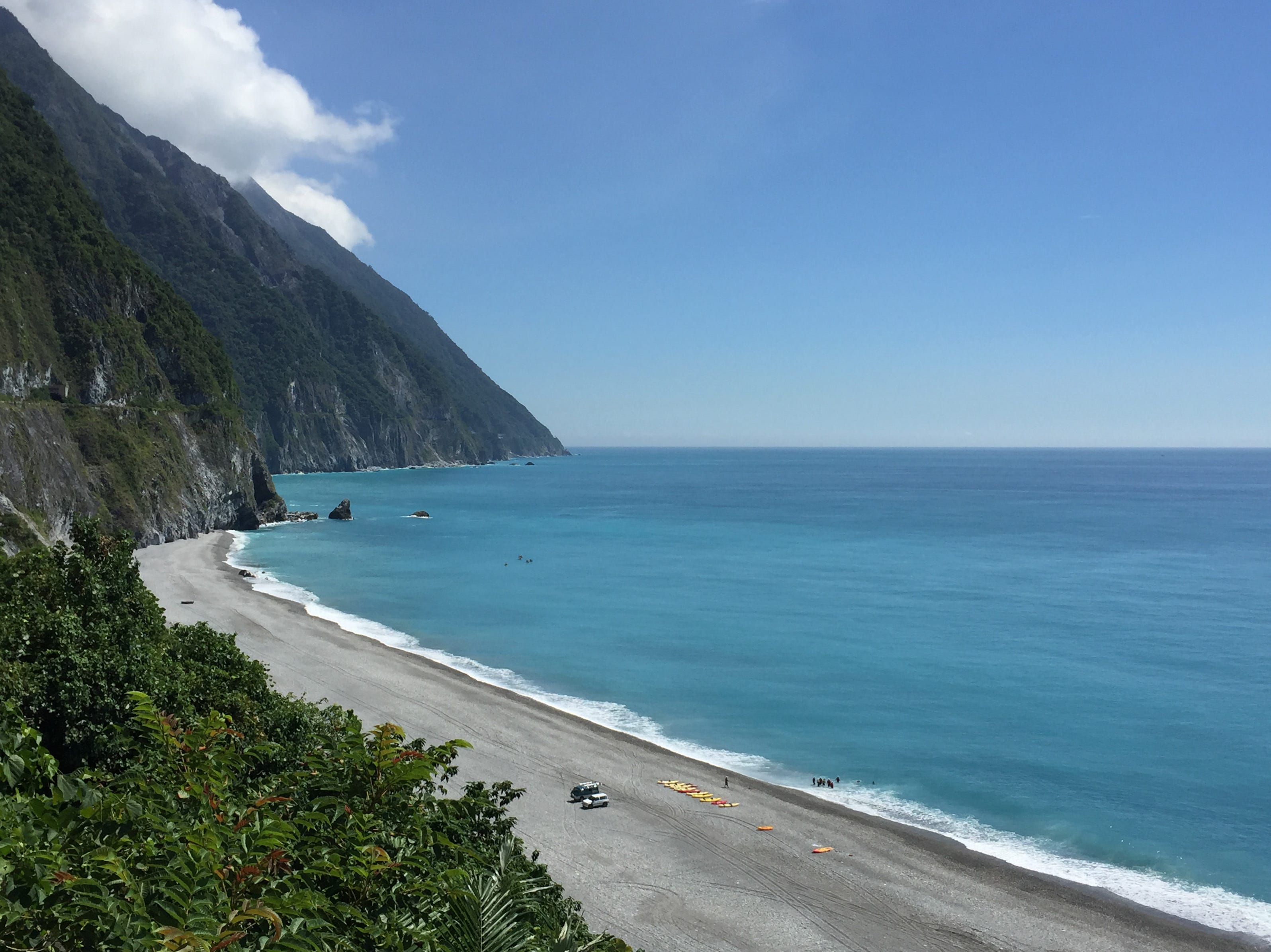
On 4 July, the China Coast Guard announced that a task group led by the cutter Xiushan had replaced the task group which deployed to the waters east of Taiwan back in early June. Like its predecessor, the CCG Daishan, the Xiushan is now about a hundred kilometres off Taiwan’s east coast—with a view to continuing ‘routine law enforcement patrols’ in the area.
Routine is precisely what these patrols weren’t until a few weeks ago. The original Daishan task group was presented as part of China’s response to Japan and the Philippines’ decision to progress delimitation of their exclusive economic zones, which—as luck would have it—potentially overlap just next to Taiwan. Rotating a new patrol in after a month suggests something more permanent, though the basic logic behind it hasn’t changed: the PRC asserts its territorial claim by performing what having it legitimately would entail, namely ordinary everyday maritime administration. That’s a familiar sight around China’s claims in the South China Sea, becoming more familiar by the year—Scarborough Shoal, for instance, has seen more concerted CCG activity in the last six months than at any time since 2019. Those tactics—including the use of hydrographic research vessels—are now beginning to show up in the waters east of Taiwan, on the far side of the first island chain.
News from abroad
Russia and China conducted their first joint bomber patrol of the year on 27 June. Two Chinese H-6 and two Russian Tu-95 strategic bombers accompanied part of the way by maritime patrol aircraft and a fighter escort traversed Japan’s air defence identification zone on a patrol path stretching from the Tsushima Strait into the East China Sea, around Okinawa, and out into the Pacific. The Japanese and South Korean defence ministries lodged diplomatic complaints, both countries having also scrambled fighters (in undisclosed numbers) in response.
While provocative ADIZ overflights from the PLAAF and RuAF have become pretty common around Japan in recent years, activities like this haven’t. This is only the eleventh joint bomber patrol since they began in 2019, and the last was back in December.
Putting nuclear-capable bombers in the air is a delicate matter. Having them rehearse the functions you’d expect of a real long-range strike mission, still more so. The timing put this rehearsal quite clearly in conversation with this year’s VALIANT SHIELD—the annual US-led multilateral exercise, centred on Guam and the Mariana Islands, which ran from 22 June to 1 July. China and Russia’s own major annual maritime exercise, JOINT SEA 2026, began on 6 July.
On 2 July, artillery gunners of South Korea’s Marine Corps conducted live-fire drills from Baengnyeong and Yeonpyeong—outlying islands off the country’s west coast, both about thirteen kilometres from the North Korean coastline. Drills of this kind are done a few times a year, and the setting is quite deliberate. The Northwest Islands Defense Command, which runs them, was set up back in 2011 in response to the shelling of Yeonpyeong a few months earlier—the first North Korean attack on a civilian settlement since the Korean War, and something of a turning point in the recent history of Seoul’s defence planning.
The drills were suspended in 2018 during the brief thaw under Moon Jae-in, but restored in 2024 under the conservative government of Yoon Suk Yeol. Early expectations that Lee Jae-myung would suspend them again proved unfounded; as with so much of his foreign policy, there’s more continuity with Yoon than you’d expect from a progressive administration.
Look on my works ye mighty
A week of protests, in Bangkok and across fourteen southern provinces—plus a hundred thousand petition signatures, give or take—turned out to be just enough to bring Thailand’s government to the negotiating table. Talks with the civil society group SEC Watch on 30 June led to a significant concession: the transport ministry agreed not to submit its draft Southern Economic Corridor (SEC) bill for the Cabinet’s consideration, pending a new planning process with more public consultation. The ministry also agreed to pause implementation work on the Landbridge project while the multiple ongoing impact reviews play out.
The struggle between state-sponsored megaprojects and local interest groups springs eternal. In Thailand, civil society is animated by the recent precedent of the Eastern Economic Corridor—sort of a mega-SEZ created out of three provinces by the military government in 2017, which, as you might expect, wasn’t overly encumbered by concern for public feeling on the road to a high-tech, high-growth industrial future. The EEC has been great news for foreign capital (Japanese and Chinese, mostly; go ask BYD’s shareholders) but less so for the locals, and residents of Thailand’s southern provinces around the Kra Isthmus understandably want a seat at the table before the bulldozers rev up.
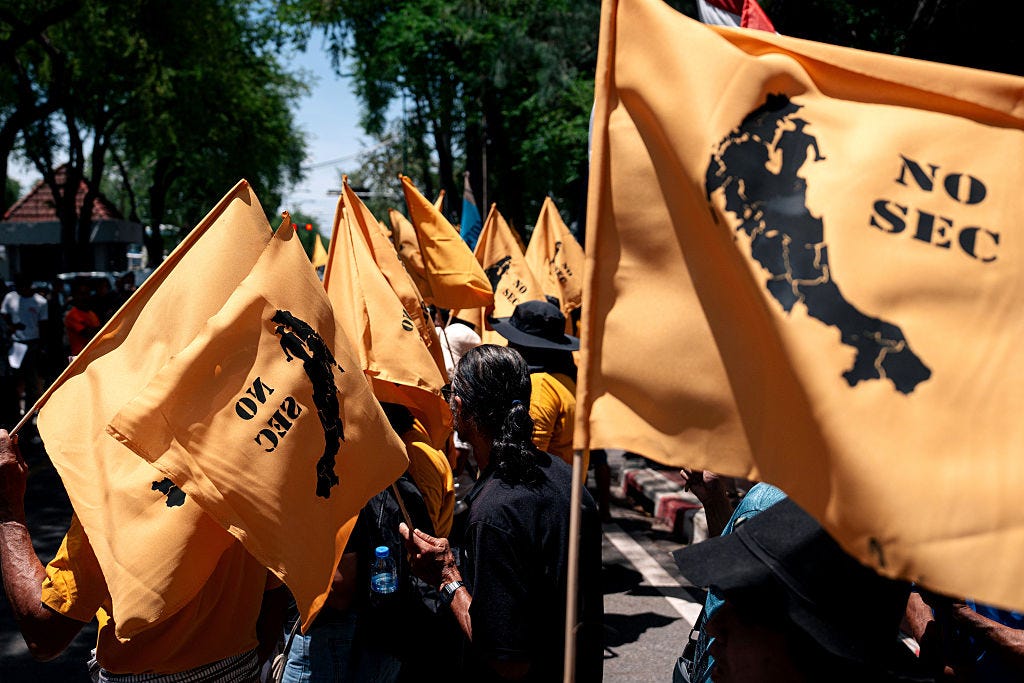
All the more so because the proposed SEC and its centrepiece, the Landbridge, is no ordinary megaproject. More than two decades in the making, the US$31 billion plan for two massive deepwater ports on either side of the isthmus—with a ninety-kilometre stretch of road and high-speed rail to join them—is among the most notable fits of infrastructural megalomania provoked by the narrow, congested, dangerous, egregiously blockadable Strait of Malacca. Just look at a map and you’ll see the vision. On the one side there’s the Gulf of Thailand, by extension the South China Sea and by further extension the voluminous world-GDP pie-slice that is East Asia. On the other side there’s the Andaman Sea, the Indian Ocean, South Asia, the Persian Gulf, eventually Europe. The Malay Peninsula, a mere 44 kilometres at the thinnest, adds an extra thousand kilometres or so onto every trade route forced to skirt around it through Malacca. Visions of a Suez-style canal have captivated Thai rulers for centuries, but the rugged intervening geology has never proven amenable. A land bridge is the next best thing, though with the added inefficiencies from unloading and reloading cargo it’s an open question whether the economics work out as nicely as Bangkok hopes—particularly with Malaysia’s competing East Coast Rail Link running ahead of schedule to link Port Klang near Kuala Lumpur with Kuantan on the peninsula’s east coast by early 2028.
Still, the geopolitics of getting trade to circumvent Malacca remain seductive. Witness in parallel the interesting turn taken during Bangladeshi prime minister Tarique Rahman’s visit to Beijing on 26 June: the China-Myanmar Economic Corridor is still almost entirely unbuilt due to Myanmar’s civil war, but that didn’t stop China generously offering to extend it into Bangladesh. Much as they’d love a good old-fashioned BRI capex bonanza to build out Chattogram, Dhaka’s treating the proposal with due caution. If they agree, it would resurrect—with one very revealing exclusion—the original concept of a Malacca-bypassing Bangladesh-China-India-Myanmar corridor that preceded CMEC back in the 1990s, before China-India relations soured to where they are today. But it’s hard for Bangladesh to look over the border and see a security situation worth the bet. Any credible overland route would have to run through the northern borderlands of Myanmar’s Rakhine State, where the central government’s authority has mostly disappeared and the unresolved Rohingya crisis could turn Beijing’s Belt and Road into Dhaka’s border-security headache.
Inclined planes
Indonesia’s defence ministry confirmed on 26 June that plans for local co-production of the South Korean KF-21 fighter jet have been cancelled. Word from the ministry is that they’re still intending to buy KF-21—which would make them the first export customer for Korea’s homegrown 4.5-generation fighter, a significant technical milestone in its own right—but they’ll buy from Korean production lines, and they’re not sure how many.
Thus ends a lengthy saga. Indonesia agreed to cover a fifth of the KF-21 development costs back in 2016, in exchange for technology transfer and the right to manufacture them locally. Which would have been industrially significant for the region: while many ASEAN member states operate and sustain high-end supersonic combat aircraft, they don’t build them. Trouble was, Jakarta didn’t front up the cash. (That incident in 2024 when several Indonesian engineers in Korea were accused, later acquitted, of stealing sensitive data was also a sore point.) After many missed payments, Seoul agreed last year to cut about 60% from Indonesia’s expected contribution, with the scope of technology transfer to be reduced accordingly. That’s now been paid. A procurement deal for 16 Korean-made KF-21 jets is apparently also on the table, but it’s hard to say how realistic that is. Next year’s budget is in the works in Jakarta, and while the finance ministry has given defence a ceiling of Rp139 trillion (A$11.1 billion), defence minister Sjamsoeddin has asked for more than twice that—and even this is a far cry from the Rp667 trillion (A$53.5 billion) he thinks his portfolio actually needs next year. Achieving either without blowing past Indonesia’s legislated 3% GDP cap on deficit spending would strain not only fiscal but mathematical credulity.
This isn’t the first time Indonesia’s defence procurement strategy has had to face down budget realities, and it won’t be the last. On top of any potential KF-21 purchase from Korea, Jakarta is buying high-end jet fighters from France and Türkiye simultaneously, with serious interest in China’s J-10, and concurrent plans to acquire US-made F-15EX fighters only abandoned a few months ago. This is, mildly put, an extraordinary way to recapitalise your air combat fleet, and there’s an inefficiency premium you pay for it. Each platform has its own bespoke training ecosystem, its own munitions stocks, its own maintenance pipeline, its own export-control laws to comply with—the list goes on. Avoiding dependence on any one supplier may be consistent with a non-aligned foreign policy. The unenviable task of the defence ministry’s budgeteers is now to work out how much policy consistency they can afford.
News from the neighbourhood
On 6 July, Vietnam’s foreign minister Le Hoai Trung led an official delegation to inspect the construction works at the US$4 billion port project on Hon Khoai—a small island about twelve kilometres off the southern tip of Vietnam. Since general secretary To Lam’s visit last November the port has been elevated to a ‘critical national priority’, and the military engineers building it (as well as what will be one of Southeast Asia’s longest sea bridges, to connect Hon Khoai to the mainland) have accelerated work accordingly.
The Mekong Delta furnishes a significant portion of Vietnam’s exports, but its coastline is too heavily silted to allow a deepwater port. Hon Khoai solves that problem, but as you might expect from the military involvement, that’s not all it’s for. The port will allow Vietnam’s navy to sustain a more persistent naval presence on the country’s southwestern flank, counterweighting what Hanoi sees as the problem of Cambodia’s China-backed infrastructure at Ream Naval Base.
Not to mention providing more options for projecting power out across Vietnam’s nearby territorial claims in the South China Sea.
Kind of a big deal
Australia’s prime minister Anthony Albanese was in Suva on Monday to sign the Vuvale Union Treaty with his Fijian counterpart Sitiveni Rabuka. This one’s been in the oven for a while; it’s a broad-ranging deal with an eye to deepen cooperation across many policy areas, naturally including economic development, people-to-people links, and security. On security, you’d be forgiven for thinking Australia bought one and got one free: signed alongside was the Ocean of Peace Alliance, which commits both countries to defend one another in the event of an armed attack. This is the second treaty Australia’s signed in as many years with one of its Pacific partners bearing that curiously ANZUS-like language—the Pukpuk treaty with Papua New Guinea, which came into force on Wednesday, being the other.
There is, however, one line in the Ocean of Peace Alliance you won’t find in Pukpuk: a clause which, with mutual consent, permits other Pacific states with militaries to join the alliance. Bit of an odd choice. Militaries aren’t common in the Pacific islands; the only other countries that have them are New Zealand, PNG, and Tonga. Of those, Tonga’s the only one with which Australia doesn’t already have a mutual defence pact. Potential redundancy aside, if Ocean of Peace does accept new members down the track it would create a genuine multilateral alliance in the Pacific islands—perhaps not quite the pan-Pacific security architecture again advocated for by Solomon Islands prime minister Matthew Wale last week (by sheer coincidence, in Fiji) but moving in that direction.
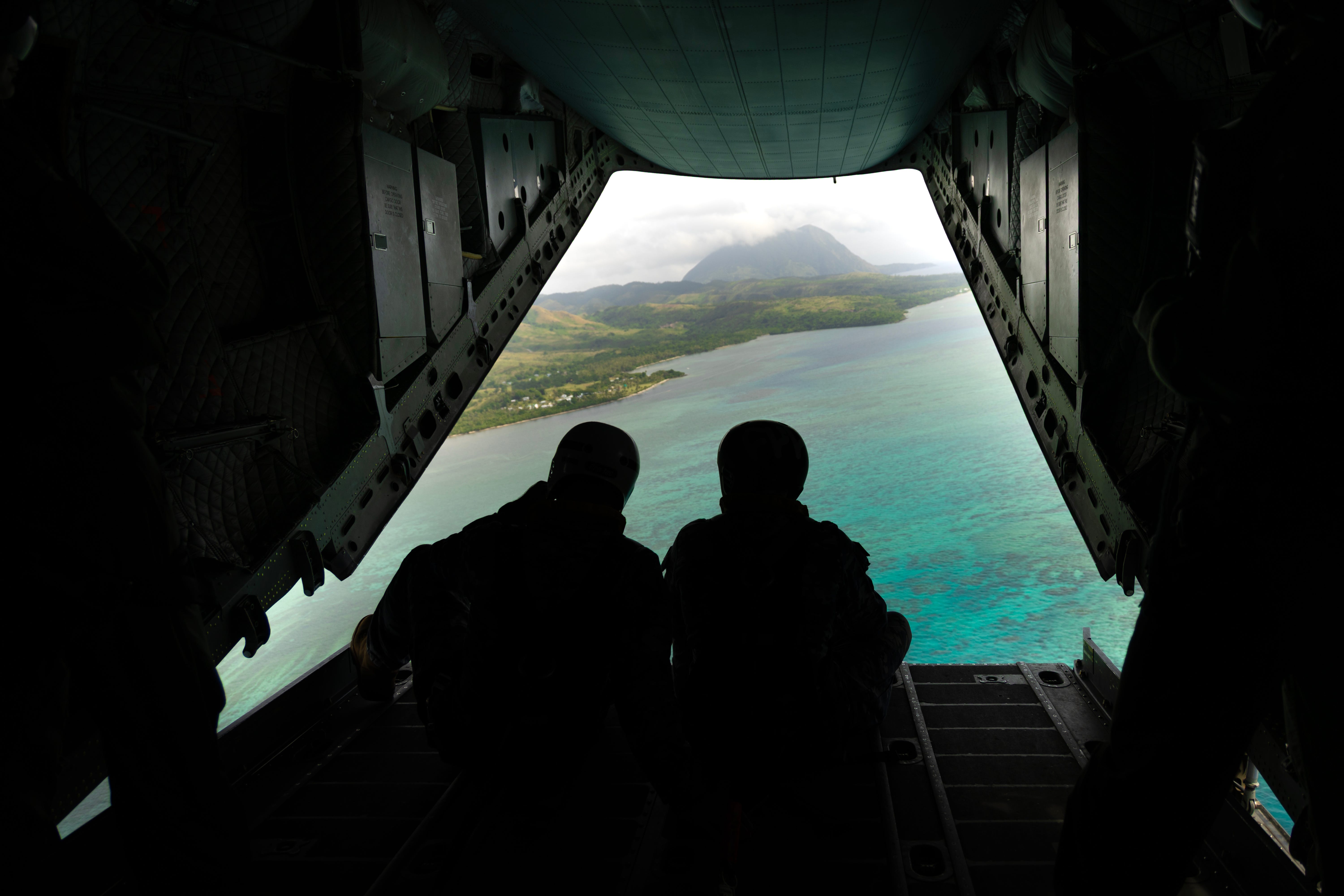
With the ink scarcely dry on Vuvale and Ocean of Peace, it was somewhat difficult to treat as totally coincidental China’s decision to test-fire a nuclear-capable submarine-launched ballistic missile over the South Pacific that same day, with the rocket and dummy warhead splashing down somewhere between Nauru and Tuvalu—both close Australian partners, by the way. Tests of this kind are unusual for China, and this is only the second since the Cold War—the first near Kiribati in 2024. As a demonstration of a nuclear-capable delivery vehicle on a realistic attack flight path, it’s clearly targeted at audiences far beyond the region. But the region got the message anyway. Albanese’s meeting with Matthew Wale in Honiara the next day saw both condemn the test as provocative, with Wale taking the view that it reinforced the need for a pact with Australia within a broader regional security architecture—a pact that Australia now intends to ‘fast-track’.
It’s quite the pivot for Solomon Islands, whose security treaty with China—brokered in secret under the previous government in 2022—has loomed ominously in the eyes of Australian strategists ever since. Canberra’s grand design for the Pacific seems to be slowly taking shape, though not without setbacks. This latest batch of talks and handshakes rounded out the signing of the Nakamal Agreement with Vanuatu last week, long delayed through successive renegotiations. Nakamal’s initial ambit for a functional Australian veto over Vanuatu’s critical infrastructure and security arrangements—like those Canberra enjoys with Nauru and Tuvalu—didn’t make it into the final text over Vanuatu’s objections. China’s parallel pursuit of its own Namele Agreement with Vanuatu, accompanied by an unprecedented level of grant funding to the government in Port Vila, may have had something to do with that. Relative lack of concrete security commitments aside, Nakamal does require Vanuatu not to host any foreign military bases—placing a check, at least, on long-held Australian anxieties over a potential PLA footprint in the Coral Sea.
News from the family
The killing of an American pilot in West Papua last week has sparked fears of an uptick in conflict between the West Papuan separatist militia and the Indonesian government. The separatists said the killing was payback for the US, Indonesian and Dutch governments’ roles in the transfer of West Papua to Indonesian control in the 1960s.
Meanwhile, a recent report has stated that under Prabowo, the number of Indonesian troops deployed to West Papua has increased to nearly 60,000—six times more per capita than the national average. This is in comparison to 1,500 separatist fighters. Some have suggested the increase is part of a strategy to render Papuans a minority in key parts of the island.
New Caledonia’s provincial election has returned a clear victory for the anti-independence parties. It’s also shown how the political boundaries have hardened. Support for the anti-independence coalition has consolidated in the vicinity of the capital, Nouméa, while the more rural areas—which are predominantly inhabited by indigenous Kanaks—have shifted further towards the hard-line FLNKS over more moderate pro-independence groups.
That’s all for this fortnight. For more timely analysis and commentary, check out The Strategist and ASPI’s Stop the World podcast—or elsewhere on Substack:


Thanks for reading! This post is public, so feel free to share it.
No posts
Comments
Nothing yet. Say the first thing.
Sign in to join the conversation.