
Welcome to the latest edition of ASPI’s Fault Lines.
Every fortnight, ASPI’s Defence Strategy Program monitors the moves and countermoves shaping the regional order and Australia’s security.
This edition covers the period 22 January 2026 - 5 February 2026.
Follow the Australian Strategic Policy Institute on X, on LinkedIn, and on Bluesky.
Northeast Asia
Two’s company
As of 24 January, the Central Military Commission of the Chinese Communist Party—the highest command authority over China’s armed forces—consists of President Xi Jinping, General Zhang Shengmin, and five empty chairs. Successive purges since 2023, culminating with the removal of two generals two weeks ago, have left the senior leadership of the PLA greatly reduced for reasons which are, in fine CCP style, opaque. Corruption? Could be. Factional strife? Possible. Sold nuclear secrets to the US? Doubtful, but a solid cover story. Whatever the pretext, it’s a relatively safe bet that Xi will continue to do what he’s been doing for many years now: centralise as much power as possible in his own person. Eliminating the bulk of the senior sources of military advice may signal the CCP’s becoming more prone to miscalculation; it might just as well signal Xi’s lack of confidence in the PLA. Needless to say, Taipei’s trying to figure it out too.
High pressure areas
On 1 February, Japan Coast Guard officials observed four China Coast Guard ships—including Haijing 2502 and 2503, each a 5,000-tonne platform armed with a 76mm deck gun—in the contiguous zone outside Japan’s territorial waters near the Senkaku Islands. It’s an unusually large CCG commitment, officials said, even by recent standards. Larger hulls are better able to cope with rough seas or tropical storms, allowing them to remain on station near the disputed islands for extended periods of time. That seems to be the play: in 2025, CCG ships were present around the uninhabited Senkaku Islands for 335 consecutive days until October, surpassing the previous record by over 100 days. China’s maritime posture at the Senkaku chain is increasingly persistent, larger in scale, and armed.
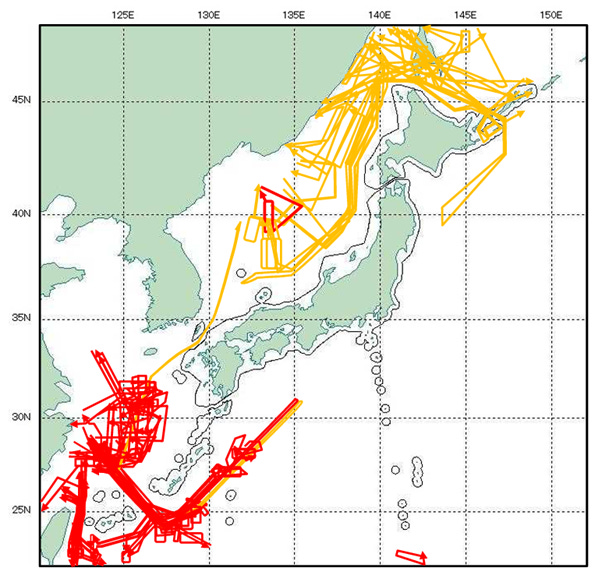
In the air, it’s a similar story. For more than a decade Japan has reported scrambling fighter jets to secure its airspace around seven hundred times a year, usually more. These levels of activity haven’t been seen since the late Cold War. The tempo is impressive: in the nine months from 1 April to 31 December 2025, the JASDF scrambled 448 times, two-thirds of which were in response to Chinese military aircraft entering Japan’s Air Defence Identification Zone (ADIZ) over the East China Sea. In the last fortnight alone the JASDF has scrambled in response to Russian nuclear-capable bombers, fighter escorts, and surveillance aircraft.
These incidents in themselves aren’t too consequential. But that’s precisely the point. In the sea and in the air, it’s this sustained, routine pressure that incrementally normalises Chinese or Russian presence and tests Japanese responses, without ever appearing to achieve anything decisive. That’s grey-zone activity for you: repetitious, almost boring, a constant drain on the defender’s time, fuel, and attention.
For more on these topics, we suggest:
The People’s Liberation Army: modernised but still mistrusted (ASPI, 2025)—How confident is Xi in the PLA, really?
China’s Military Activities in the East China Sea: Implications for Japan’s Air Self-Defense Force (RAND, 2018)—Why constant challenges to Japan’s ADIZ matter.
Why Did China and Russia Stage a Joint Bomber Exercise near Alaska? (CSIS, 2024)—Well, why did they? A ‘new era of joint operations’ has implications far beyond Japan.
Southeast Asia
It’s not who votes that counts...
Myanmar’s general election—the first since the 2021 military coup—wound up on 25 January with a landslide victory for the Union Solidarity and Development Party. Since the USDP is the military junta’s parliamentary proxy, this was unsurprising. With major opposition parties banned, widespread reports of coerced voting, and criticism of the electoral process itself criminalised, UN Special Rapporteur Tom Andrews has described it as ‘an empty parody of an election.’ (And that’s him being polite.)
Unfortunately, in trying to legitimise itself abroad, the junta has partners willing to meet it halfway. Myanmar is rich in heavy rare earth elements—dysprosium, terbium, and other elements used in the manufacture of high-performance magnets. It’s China’s largest external supplier. The Trump administration has in past months shown signs of being tempted by a rapprochement with the junta to secure these minerals. China meanwhile not only depends on Myanmar’s resources, but has billions of dollars tied up in BRI projects throughout the country. That gives Beijing a strong incentive to see ‘stability’ restored on terms the junta can live with. No matter how paper-thin the narrative of free and fair elections, as long as the international community gets an alibi out of it to re-engage Myanmar per ‘business as usual’, it’ll find an audience.
Fair-weather friends
On 23 January the Devon Bay, a Singapore-flagged cargo ship, capsized about a hundred kilometres northwest of Scarborough Shoal in the South China Sea. The Chinese and Philippine Coast Guard, so often at odds with each other, cooperated in the ensuing search and rescue operation. By the end of the first day, 17 of the 21 all-Filipino crew had been recovered; two later died, and four are still missing. On 25 January, the CCG turned over the survivors and the remains of two crew members to the PCG during a ship-to-ship transfer. It was an unusually cooperative moment in waters more often associated with ramming, water cannons, and megaphone diplomacy.
But don’t expect too much. When the grey hulls show up, everyone’s back in their usual spot. On 25-26 January, the US guided missile destroyer John Finn and the Philippines frigate Antonio Luna conducted a maritime cooperative activity—a joint military drill, the eleventh of its kind since 2023—near Scarborough Shoal. Philippine sailors spotted the Chinese frigate Xianning nearby; it didn’t take any action, but PLA Southern Theater Command later issued a statement characterising the joint drill as disruptive to regional peace and security.
Over the hedge?
Fears that Cambodia’s Ream Naval Base—rebuilt these past few years with substantial Chinese funding—might become a PLA-N foothold on the Gulf of Thailand got a notable (albeit carefully stage-managed) rebuttal this fortnight.
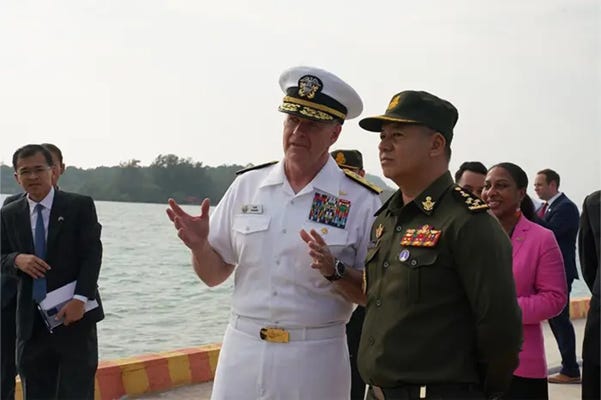
From 24 to 28 January, the USS Cincinnati made a five-day port call at Ream, the first US warship to dock there since the base expansion was completed in April. USINDOPACOM chief Admiral Samuel J. Paparo was along for the ride; he used the visit to publicly affirm Cambodian assurances that Ream was a sovereign port open to partners, while both sides flagged an expansion of military cooperation. That cooperation could soon include the revival of the long-paused ANGKOR SENTINEL exercise: Paparo said planning would restart in late February or early March with a view to conducting the drills around 2026-27.
It’s probably too early to call this a ‘reset’ in the relationship. The facts on the ground haven’t changed: Beijing’s investment has materially increased Ream’s capacity and Chinese naval vessels have reportedly maintained a rotating presence there. But Phnom Penh is clearly trying to send the message that Ream isn’t a Chinese exclave.
For more on these topics, we suggest:
Rare Earth Mining in Myanmar: A Primer (University of Warwick, 2024)—What gets mined in Myanmar, where, and why it matters.
Marcos in the middle (Lowy, 2025)—Joint military drills as a tool of Philippines statecraft: how and why?
Strategic Crossroads: Navigating diverging perspectives to enhance Cambodia-US ties (Pacific Forum, 2025)—Washington’s stake in rebuilding the bilateral relationship with Cambodia.
Oceania
Minding the gap
What would Tom Uren say? You might remember September 2024, when Timor-Leste’s President José Ramos-Horta opined that the late Labor luminary would tell his protege, now-Prime Minister Anthony Albanese, to ‘stop the crap’ and ‘go and visit Timor-Leste and increase support.’ Well, here we are. On 28 January in Dili, the leaders of Timor-Leste and Australia signed a joint declaration spelling out the intent to further cooperate along a variety of policy axes. The nuts and bolts (which include defence cooperation) will have to wait for a Joint Plan of Action to get worked out between the two countries’ foreign ministries, but what we have now is strongly suggestive of an Australian value proposition designed to do two things at once: meet immediate development needs while reducing the temptation to ‘shop around’ for other strategic patrons. ASEAN centrality is affirmed as a matter of course for ASEAN’s newest member, with an $8.2 million package to support Timor-Leste’s membership. That’s in addition to $220 million to support education and healthcare, and a ten percent cut of the revenue from the Greater Sunrise gas field earmarked for a dedicated infrastructure fund. Read in context, the joint declaration comes across like a bid for institutional stickiness, tying Australia to Timor‑Leste’s long-term trajectory.
All at sea
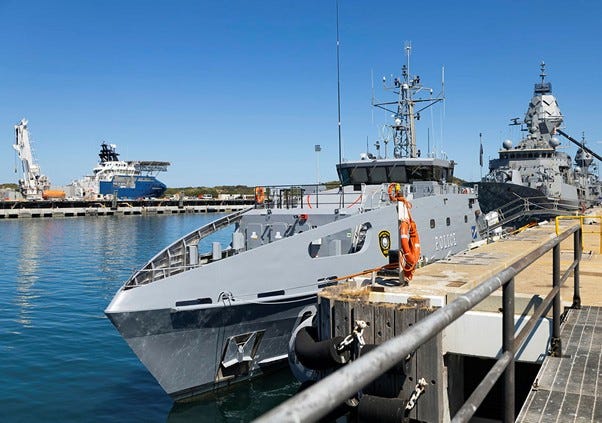
On 30 January the Republic of the Marshall Islands, represented by Foreign Minister Kalani Kaneko at Stirling, WA, took delivery of a new Guardian-class patrol boat: the RMIS Jelmae. This is the last of the patrol boats—24 in total—to be donated to Pacific Island countries under Australia’s Pacific Maritime Security Program since the commitment was made back in 2018. Through-life sustainment for the Guardian-class is guaranteed by Australia out to 2048, with an overall price tag of about $5.9 billion for the whole fleet—making it one of, if not the biggest capability transfers to the Pacific from any aid donor.
For more on these topics, we suggest:
Local impacts of foreign interests in Timor-Leste (Xcept, 2025)—There are many players in T-L, and Australia’s only one of them.
Kangaroos and crocodiles: the Timor Sea Treaty of 2018 (UNSW, 2018)—There’s a lot of history (some of it ugly) behind the maritime boundary between Australia and Timor-Leste.
Australia’s Contributions to Pacific Maritime Governance (East-West Center, 2025)—Australia’s been donating patrol boats to the Pacific for decades. What’s the strategy?
That’s all for this fortnight. For more timely analysis and commentary, check out The Strategist and ASPI’s Stop the World podcast—or our other Substack newsletters:


Thanks for reading! This post is public, so feel free to share it.
Comments
Nothing yet. Say the first thing.
Sign in to join the conversation.