
I was looking through the archive catalogue at the Merril Collection of Science Fiction this week, and ran into a kind of personal white whale: a copy of the Rhand / Spectrum Small Arms hand-to-hand supplement listed under an innocuous title (“Rhand damage tables”). When the librarian brought it out for me I just about jumped for joy.
See, this supplement was printed in a very small run in 1984 or 1985. Together with the (less rare) core games, it’s a critical part of the second historical strata of Barry Nakazono’s meat-cube based hyper-detailed combat system — today mostly known for its final revision, Phoenix Command. The supplement has never been digitized, and does not appear on piracy networks. Moreover, it includes details not present in any later strata of the system, which are otherwise basically lost. But this is all very inside-baseball; let me explain myself.
Here’s a simplified diagram of the Nakazono game genealogy:
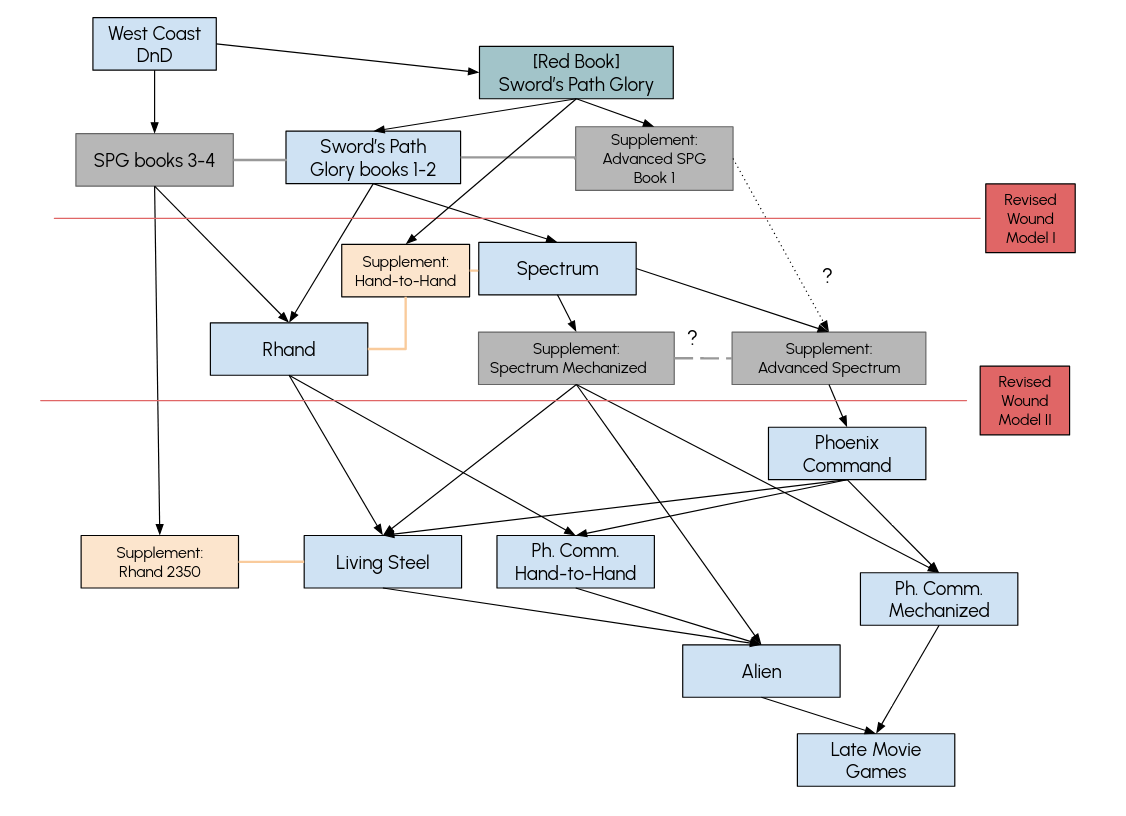
Arrows are derivatives. Lines are supplements. Red lines separate strata of incompatible revisions in the wound model. Grey games were mentioned in other products but never actually released, so their relation to everything else is somewhat speculative. Red Book Sword’s Path Glory is the original first (and second?) print run(s), which included the content later split from Sword’s Path Glory to create the never-released Advanced Book 1; it has also never been digitized, and is even more impossibly rare.1 I know this is all a little deranged: just stick with me for a second, and look for the hand-to-hand supplement in the middle. You can see how important this booklet is as a link back to the work in the original Red Book. Unless and until a copy surfaces, the supplement will naturally be a great help to anyone trying to reconstruct the first SPG system — the ur-text from which all Nakazono games trace their complicated heritage.2
Since absolutely nothing about this book is known online (and the physical copies that crop up periodically are pretty expensive), I thought I ought to document my preliminary ‘findings’ for the next person going crazy over Nakazono’s corpus:
1) The supplement is in fact derived from red book SPG. I know I lead with this, but it wasn’t clear to me until I looked inside. As far as I knew this time last week, the supplement was just an early version of Phoenix Command’s Advanced Damage Tables. That would have been cool (and ultimately also derived from the Red Book, like all of Nakazono’s work), but hardly groundbreaking. If I had known exactly what this was in advance I could have bought a copy of the pamphlet for ~$100 when one appeared: but I didn’t know, and now I don’t have to spend $100. Yay!
2) The supplement contains separate hit-location selection tables for targets that are sitting or standing, with or without a shield, being accosted with a stabbing or slashing weapon (eight selection tables total). This is classic Sword’s Path Glory stuff, which appears nowhere else.
3) The supplement uses separate by-location by-impact ‘shock point’ damage (instead of just physical damage, which in later games pulls double duty). This abstraction is also in Spectrum Small Arms and SPG. Its appearance in something marketed primarily as a Rhand supplement is interesting, and suggests it was always a core part of the system. [Edit: In the hasty original version of these notes I suggested that late-printing SPG didn’t have shock points. This was a very sleepy error. Apologies!]
4) The supplement suggests an AD&D conversion, in obfuscated don’t-get-sued language. To convert a character’s hitpoints, add HP to Constitution for a new higher score (a very common house rule). Then, use the shock points in the supplement as HP damage directly. A fascinating window back to proto-SPG and the Berkley D&D culture that created it. Impossible to say how far back this goes, but there are some critical (hehe) remarks about critical hit systems in the supplement, which were a huge part of Bay Area D&D culture in the 70s. We always knew SPG grew out of this culture, but this really helps fill in a kind missing link.
5) In the copy at the Merril Collection, there are red pen annotations on each damage table, marked e.g. x30, x11, x06, and so forth. I’ve seen very similar annotations in scans of Nakazono games before, but they’re completely esoteric to me. If you know what’s going on here, hit me up.
The injury tables are otherwise unremarkable. If you know the conversions, you could reconstruct the physical damage from the Phoenix Command hand-to-hand tables. The AD&D conversions, and to a lesser extent the variable hit locations, are really the most interesting bit. In any case, I hope I haven’t bored you too much; I know this is all incredibly strange and obscure. If anyone finds a copy of red book SPG, please do send me a message.
There are two known covers so I’m assuming two print runs, but we’re talking about spiral-bound books, sold maybe fifty copies at a time. Also, it may have been digitized by a Russian in 2021, but I sincerely think he might have died during the Ukraine war. He never responded to my email, and his online presence has since gone dead. I swear to you, I am having a protracted Ahab moment over this red book.
Actually the ur-text is probably the ARRADCOM computer man model — but that’s a whole other story.
No posts
Comments
Nothing yet. Say the first thing.
Sign in to join the conversation.