
“We hold life to be sacred, but we also know the foundation of life consists in a stream of codes not so different from the successive frames of a watchvid. Why then cannot we cut one code short here, and start another there? Is life so fragile that it can withstand no tampering? Does the sacred brook no improvement?”
– Chairman Sheng-ji Yang, “Dynamics of Mind”
I had some notion starting this project that I’d only deal with texts which were at the outset new or basically unfamiliar to me. You know, to stay in the spirit of the thing: it’s hardly a Let’s Read if I’ve read everything already. This is an exciting way to proceed and certainly evades the problem of over-determination. Unfortunately, there are practical difficulties. It’s tricky to move forward when you don’t know where you’re going. So I began to scout ahead, with my textbooks and monographs; and suddenly, I’d lost six months to occult cybernetics. Forgive me?
Well, anyway —
Ten years have passed since Planetfall. They have been hard years. According to the datalinks, “the alien environment on Planet brought a host of unforeseen health problems for the colonists”. Our Gaian scientists therefore make “early inquiries into Biogenetics” which “center on the prevention and treatment of these problems [and] seek an understanding of the entire genetic code”. In time, such advances will allow our Planetary scientists to reconstruct Earth’s Human Genome Project. For now, they apparently represent rather prosaic developments in biomedical technology and infrastructure. Nonetheless, such advances substantially broaden the discursive domain of our project. Whereas previously we were operating on basically philosophical ground, we must now engage an entirely different body of knowledge. Biology is the first natural science to enter our repertoire. Whereas in the last post we were speaking of ontological abstractions, we now must learn to speak of blood and guts.
There is an one particularly salient problem of biology on Planet, which our colonists will have to confront immediately: the problem of human reproduction. Let us conduct a little survey to see the shape of things. According to assorted companion media (the website, GURPS text, &c.) around 1000 people make Planetfall in each faction’s escape pod. Keeping with the basically gender-equal faction leader split, we should probably expect approximately 500 women. The initial colonists are supposed to be experts in their field, so it’s hard to imagine anyone under twenty-five tagging along; on the contrary, we know that certain key crew members were getting into their seventies at launch (Zakharov, Yang). That suggests a population spread across ~50 years of life, probably normally distributed, probably clustering around age fifty. Optimistically, this yields some 250 women in each colony at reproductive age, with enough time left to have somewhere between one and ten children relatively safely. Even with maximum ‘utilization’ (one shudders to speak of humans this way) it is therefore hard to imagine anything much better than ~2% population growth (per anum) in the first twenty years, and very easy to imagine a shrinking population (incidentally, the GURPs book also mentions 2% as an upper bound on p. 12). The acute crisis will eventually pass: by mission year twenty a new generation will reach reproductive age, and Planetary demography will gradually smooth to an equilibrium. Nevertheless, it will take decades to escape the reverberating boom-bust cycles echoing off the first generation — as the post-war baby boom beget an oversized cohort of Millennials, themselves now begetting a modestly oversized Gen Alpha.
Surely this has a profound influence on the psychology and sexual dynamics in each colony? On such matters, the game falls unusually silent. In SMAC, population is merely a score ascribed to each faction base, loosely convertible to some approximate number of civilians (GURPS p. 122). There is no special concern for social effects or demographic peculiarities, and certainly no concern for gender, sex, pregnancy, &c. We can surely here detect the predominance of heterosexual men in the game’s design department, who (one suspects) seldom encounter sexual difference as a locus of anything except personal pleasure. We will certainly attend to such problems in time, especially those which orbit around the division of reproductive labour and the process of primitive accumulation on our new planet. First though, I’d like to take Alpha Centauri as it is, engaging the problems of biology from the angle it approaches them. That is to say, as pieces of information generated and regulated by scientific institutions: the “stream of codes not so different from the successive frames of a watchvid” which Chairman Yang apprehends.
Remember, SMAC is not here dealing with biogenetics as a set of material occurrences, social problems, or even social practices. It is engaging with biogenetics as a “technology” in-itself, an independently researched body of scientific knowledge and information which renders-legible the apparent information in the human “genetic code”. There’s no concern with ribonucleic acid here, as-such: the discursive focus is on infogenomics alone, without a material referent. This is not always how the game confronts the human-biological (it later complicates this conception, rather beautifully), but is the ground it founds itself on, for contrary to the real world Alpha Centauri is a system where demographics precede the objects they describe. There are no agential humans in this world, having sex and children, except insofar as we extrapolate such creatures from the +10% population growth we see listed next to our Social Engineering score. We are dealing with supposed lives which do not constitute, but rather are derivative approximations of, the social field which conditions them. We therefore engage with our colony as a late-imperial governor might have engaged with Algeria — an already regulated collection of units and mechanisms to keep in good order. This is one of the oddities of Alpha Centauri: a game so very nearly self-consciously ecological, nonetheless bizarrely attached to an understanding of the world which is quintessentially arborescent, totally bound up in the tendencies of a (today rapidly withering) modern-industrial disciplinary milieu. SMAC is an accordingly poor oracle. Conversely, it very good at exploring possibilities from our own imperfectly-realized perspective, with one foot in the future and one in the past.
Let us therefore return to our imagined colonists. Like most civilization games, the population conversions given for SMAC scale exponentially, so that every citizen is worth less and less state-accessible labour as the population at a base grows larger. Is this an accident of development or a considered statement on urbanization? Probably a little bit of both. Although I doubt the conversions given in the GURPS sourcebook (p. 122) are especially well thought-through, an exponential conversion is the only way to make sense of the game’s linear growth model (where i.e. bases grow at the same rate no matter the population). In SMAC, dense cities are dramatically less efficient on a per-fictional-person basis. In fact, even on a per-population-point basis, the smallest bases are by far the most efficient: all bases are able to harvest resources from one tile per population point, plus the initial tile the base stands on for free. One cannot help but wonder about the exceptional centralization of this strange social milieu, where the first citizens (the most critical professionals?) count double.
With Biogenetics we unlock a new base facility, termed Recycling Tanks. When constructed, Tanks produce extra resources, minerals, and nutrients in a base’s home tile. From the datalinks, one at first gets the grim impression that the tanks denote a sort of soylent green scenario:
“It is every citizen’s final duty to go into the tanks, and become one with all the people.”
– Chairman Sheng-ji Yang, “Ethics for Tomorrow”
Yang is a faction leader, head of another colony, with a particularly open and forthright disregard for human life. He has come up repeatedly in this post, in part because his imperial-pragmatic approach to problems of human biology neatly mirrors the game’s own. Does this mean all the recycling tanks on Planet are soylent-green horror-machines? On the contrary, I suspect that base facilities are better understood through their systemic expression. Probably, the tanks are an abstraction: not a literal single set of tanks for however many millions happen to inhabit some late-game base, but a general tendency towards urban development and infrastructural centralization, which improves the efficiency of the core cadre notionally-harvesting the home tile. On the level of the most primitive mechanical-metaphors, it is those first citizens who benefit most profoundly from the development of recycling facilities. Whatever the tanks actually are, we know who they are helping.
Later, in SMAC’s literary interludes, we learn that the faction leaders are practically immortal, undergoing intensive gene-therapy (likewise in a “tank”, see Interlude three) starting in the first years after Planetfall. We might read the “recycling tanks” base facility in this context, particularly following (as it does) apparent developments in biogentics, as an expansion not only of literal recycling operations, but also of (e.g.) assorted biomedical technologies to a growing class of technocratic administrators, managers, and ‘urban’ professionals. Surely, not everyone is going down to the mineral fields with a pick-axe, or trying to raise a half-dozen children. Intellectual developments are apparently continuing with speed: there are evidently still intellectuals in charge, in cadres that seem to benefit most-profoundly from development of each new base. Conversely, every person exceeding the first thousand in each base (the first in-game citizen, per the GURPS conversion chart) is in a kind of mechanically defined surplus labour-class, only partially mobilized. The labour power of a base in tiles harvested is approximately equal to:
\(\log_{1.6}\left(\frac{p}{1000}\right) + 2\)
Where [p] is population. In essence, the contribution of each citizen scales logarithmically. As the colony grows larger, the utility of every excess individual becomes ever-more negligible. In this context, ‘Yangism’ is perhaps not so obviously monstrous. The success of the Planetborne civilizations seems to hinge on a tiny caste of elite leaders: finding some way to ‘utilize’ everyone else — well, from the imperial bureaucrat’s perspective, it’s really only natural…
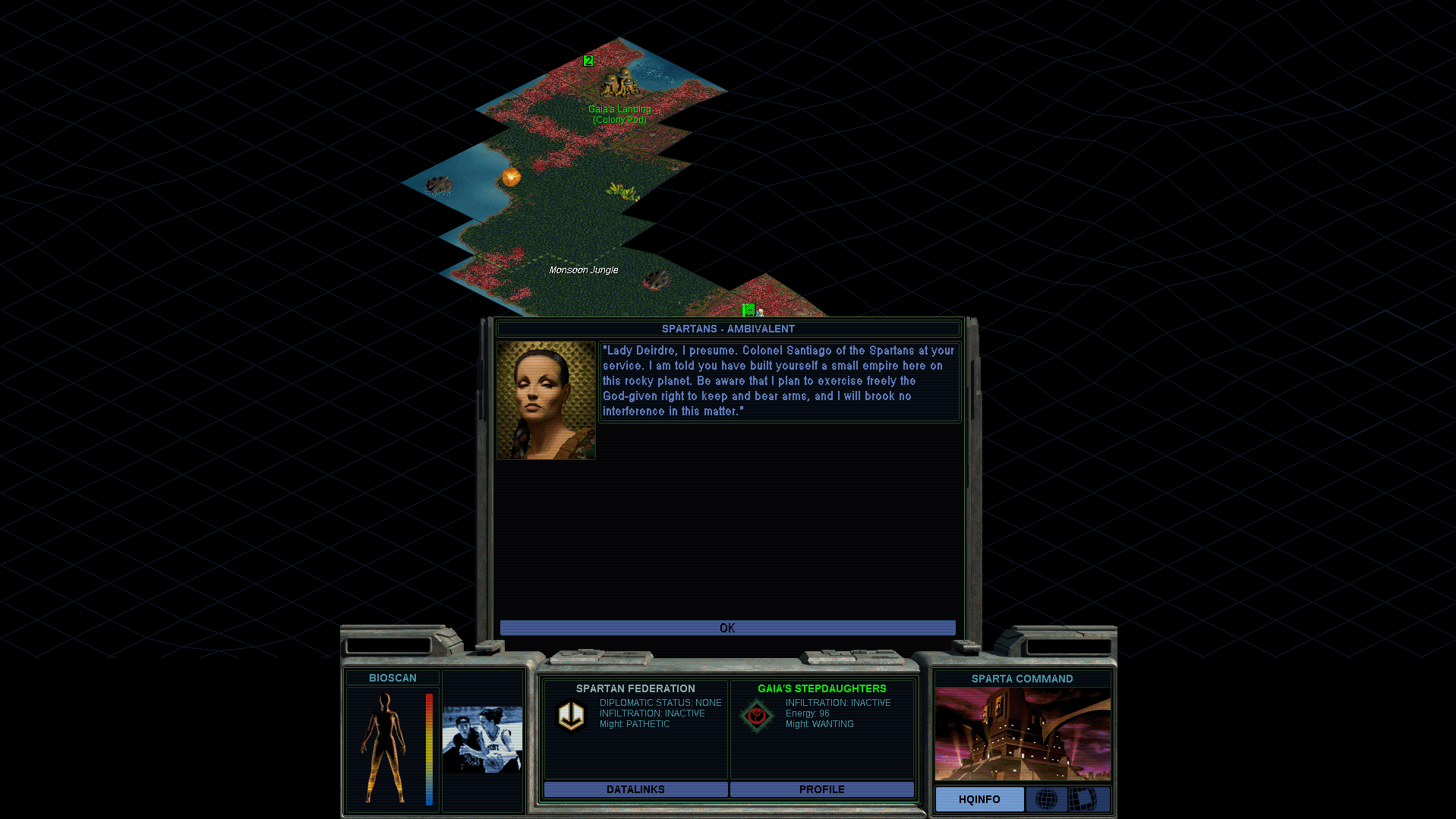
We will have to talk more about Yang and the technocrats later. Presently, our Gaians have more proximal concerns. From south of the Monsoon Jungle scouts from the Spartan Federation approach: survivors under the command of Unity Security Officer Colonel Corazón Santiago. The Grecian shtick is silly, but broadly representative: per the datalinks, the Spartans are a “well armed survivalist movement” (+2 Morale) with “highly disciplined followers” (+1 Police) and substantial industrial deficiencies (-1 Industry). While our Gaians tend to approach Planet as an ecological system, the Spartans approach it as a puzzle to be solved. Ideologically, they recall the Prussian general staff, training their officers on sets of established scenarios, each presenting a fixed problem-sets with an associated answer key. There was no room for interpretation or special ingenuity in Von Moltke’s military: just more-or-less correct answers to concrete, practical issues. The Spartans seem to operate in this spirit. They have encountered a challenging world, and want to resolve it perfectly. Competent and dangerous, they are likely to be a perennial threat in the decades and centuries to come. For now, they decide to leave us be.
Our compliment for this first decade is Francisco J. Varela’s Principles of Biological Autonomy, a foundational 1979 work in the untimely nomad science of cybernetic biology. That does not mean ‘cyborg biology’, precisely: rather, cybernetics here means something like ‘the science of self-iterating systems’. Emerging out of the Second World War, cybernetics tried to give a coherent account of the multidisciplinary feedback loops which presented themselves in that whole-of-society effort. Consider the peculiar relationship between a tank crew and their vehicle, both in some sense requiring and anticipating the other. Or else, the horrendous complexities of wartime logistics. The social field changes the factory, and the factory changes the tank; the tank changes the battlefield, the battlefield changes society. For a while, everyone thought this sort of thinking was the future. The Soviet, the Americans — even Maoist China. A really staggering array of post-war scholars were positively taken by the potential of self-iterating systems as a conceptual object of analysis. The information age has probably proven them right.
Varela’s work is an late and essentially pragmatic text in this tradition, published just as cybernetics went out of academic fashion. The first edition insists it is a text in the “North Holland Series In General Systems Research” — but Principles is the last book in this “Series”, which published just two texts. So far as I can tell, Varela got in just under the wire, as the prevailing concern with systems turned into a concern with data, information, value, &c. By the 1990s, words like Cybernetics and Systems Science mostly attracted highly credentialed cranks operating outside their area of genuine expertise, looking for a dilapidated corner of pseudo-academia to homestead. Occasionally a serious scholar will return to salvage something of interest, but the project writ large is basically dead. We’ll return to this unfortunate decline in a later post. For now, let us focus on Varela’s untimely monograph, which arrived already out of context: too scientifically technical to properly call Philosophy, but far too conceptual to really work as Science.
Probably, Principles is best understood as part of this living (dying) tradition. It is a kind of Cybernetic Lab Book, in conversation with a particular academic milieu, “offered in the spirit of synthesis and exploration, not of treatise, dogma, or set opinion” (p. xvii). It proceeds experimentally (like our project with SMAC), developing a peculiar set of problems from various different angles. Per the foreword:
“The text unfolds in three parts. These cover, respectively: autonomy of living systems as a source of characterization of autonomy in general; forms of representing complementarity and circulardes; and the cognitive capacities of autonomous system and their codependent information. Each one of these parts can be read somewhat independently of the rest, according to the reader’s inclination” (p. xvii).
Despite its tripartite construction, the whole of Principles orbits around “two themes, in counterpoint[:] the autonomy exhibited by systems in nature [and] their cognitive, informational abilities”(p. xi). By autonomy, Varela means something like self-control, a notion we might elaborate in terms of failure-mode. While externally-controlled systems can produce “errors” in moments of deficiency, autonomous systems might instead produce “breaches of understanding” — situations where the system does not seem to be adequately anticipating or responding to itself (p. xii). Accordingly whereas “the fundamental paradigm of our interaction with a control system is instruction [conversely] the fundamental paradigm of our interaction with an autonomous system is a conversation” (p. xii). An autonomous system considered as-such is something we are trying to engage with, not manipulate precisely: it is in some sense closed to interference. Nevertheless, we are still proceeding from the standpoint of systemic analysis, so “our interest [is not] in properties of components, but in processes and relations between processes realized through components” (p. 6) — as it might likewise be in a broad-strokes ontology of externally-controlled systems (a broad-strokes analysis of aerodynamic controls, for example).
All of this hinges on the notion of self-control. How might a physical system ‘control’ itself? Varela answers quite simply: by its conformation. After all, a “cell defines its physical boundaries through the production of constitutive relations that specify its topology” (p. 25). In actually-existing cells, this self-regulating structure emerges “on the one hand, by relations of specificity between DNA, RNA, and proteins, and on the other hand, by relations of specificity between enzymes and substrates” (p. 25). Yang’s genetic code is, in the final analysis, a physical structure principally made of acid: the physical properties of this structure are what define the development of the organism. Nonetheless, there is a fundamental homology between these physical processes and the information they encode. In cells, these emergent properties are “established mainly by the production of components (metabolities, nucleic acids, and proteins) that control […] a network of parallel and sequential relations of constitution, specification, and order that constitute the cell as an invariant dynamic topological unity” (p. 25). Structure is data: in cells, that data is encoded with a particular set of interrelated physical-chemical substance-structures.
It might be otherwise, though. That life has turned out as-such is an empirical finding, quite outside Varela’s domain of primary concern. For Varela is concerned with life-like autonomous systems as-such, i.e. as bundles of self-iterating information. He is trying to produce a systems-ontology that can handle such objects robustly. The actual objects (cells, proteins, &c.) expressing such systems in the world are of secondary importance, so long as Varela’s ontology is theoretically able to describe them. In this way, he is hoping to get at something essential about life-as-such, which he terms autopoiesis (self-making):
The idea of autopoiesis capitalizes on the idea of homeostasis, and extends it in two significant directions: first, by making every reference for homeostasis internal to the system itself through mutual interconnection of processes; and secondly, by positing this interdependence as the very source of the system’s identity as a concrete unity which we can distinguish. These are systems that, in a loose sense, produce their own identity […] (pp. 12-13)
Varela thus separates those qualities I have called conformation between “structure” on the physical-chemical level and “organization” on the systemic-functional level (p. 12). Following Guattari in his work with Deleuze, we might think of these as distinct “strata” (p. 40). Again, the two qualities are fundamentally homologous: it is impossible to change one without changing the other — but this is also true of the objects of analysis in e.g. physics, chemistry, and biology. That something might be figured in a certain way does not mean this is the only way to figure it. So Varela says: sure, structure is biochemical, but ‘organization’ is information. We can work with it (and this notion of autopoiesis) as such.
Much of Principles’ first section follows this line of argument, setting up a theory of organization that can well-describe complex features in terms of the functional inter-relation of their constituent elements, at first using tools from the study of celluer automata (c.f. Conway’s game of life) (pp. 19-23) and then generalizing to more complex systems. From this direction, Varela builds to a theory of “organizational closure” (p. 58) — the way certain features can order and regenerate the boundaries of a system (like cells walls, reproductive apparatus, &c.), which separate it from the environment, and make-possible or render-stable its autonomous unity. Varela thinks these features are critically salient, since they let us consider the system as a phenomenologically gestalt apparatus which in some sense ‘experiences’ its environment. Such ‘closing’ features are not exclusively biotic — suggesting an extensive account of such (quasi-) phenomenology extending to abiotic domains:
The practical consequences of this view of social situations are, I believe, quite dramatic, for it forces on us to distinguish very clearly between the organization of, say a corporation, and the purpose that is ascribed to it. If the corporation exhibits closure, no matter what our description of the system’s purpose is, its behavior will be such that all perturbations and changes will be subordinated to the maintenance of the system’s identity […] It is just as well to realize, with these considerations, that this revision of control and information has ethical and political implications that are very concrete and cannot be avoided. I will not discuss them in this book at any length. I do want to make it clear that the idea of autonomy and its consequences are not restricted to biological, natural systems, but can encompass human and social systems as well. (pp. 58-59)
Here, Varela’s project comes into full view. In Principles, ‘order’ really means something like: the capacity of one aspect in a closed-system to relate coherently with another aspect without producing a rupture that forestalls the mechanisms of constitutive closure binding the system together. An orderly system has an external world to relate to, and therefore encounters the world from a certain point of view or position. Moreover it ‘experiences’ itself, with more or less coherency and organized self-anticipation. A system is orderly and therefore self-controlling insofar as anticipates and encloses itself: a kind of order perhaps properly called phenomenal order, operating on the level of experience or mobilized-information — but therefore readily generalized to other fields of endeavour. We might consider problems in social life, governance, the firm, and so on, with the same mathematical and logical constructions we use to consider biotic material. So long as we are working on the right strata, can transfer tools back and forth, advancing mechanisms of analysis in one apparent domain which we might later borrow for another.
The second part of Principles develops such tools, which engage with the symbolic-informational dimension of autopoetic systems. We should be very clear that Varela’s phenomenal-information is quite distinct from the objective-informational ‘code’ we have been heretofore speaking of in a basically “naive” way (p. 70). On the strata of phenomenal order information is always information to someone or something, as experienced and encoded from some perspective, in a state of approximate closure. We are not talking about the genetic ‘code-in-itself’ but rather the code self-apprehended from a certain internal position. Two symbolic operations are therefore of paramount importance:
The operation by which closure is self-apprehended, i.e. by which an ordered system comes organize itself as something distinct from its environment.
The operation by which some aspect inside a closed system becomes ‘meaningful’ or comprehensible to other aspects of the system as (symbolic) information, as in the case of e.g. DNA ‘encoding’ the structure of an organism.
What we are really after, then, is some way of dealing with the logic of distinction. Nature might be mathematically formalizable, but it is hardly built out of computer circuits: the sort of symbolic information at work in biotic systems does not present itself in ready-made true or false propositions. There is no codebook on high. The organism-DNA system somehow encodes the form of an organism that renders DNA autonomously legible. A mechanism to establish difference as-such (a material logic?) must somehow proceed the meanings which are distinguished from each-other.
For a while Varela continues on with familiar mathematics, drawing from graph and set theory. Then, rather strikingly, he introduces a new tool: George Spencer-Brown’s calculus of distinction, from his book Laws of Form. The details here are not so critical, but I will attempt a brief summary. Speaking generally, Brown’s calculus is built out of imperatives, which tell us to “draw a distinction” (or several distinctions) according to certain rules (p. 3). Unlike ordinary arithmetic, this calculus only ever admits a single category: distinctions (a kind of operator or function) working on other distinctions, or the absence of such distinctions. A mathematician would probably have an interesting word for this, but I am not a mathematician and always get their terms muddled up. Here is the logic as I understand it: first, Brown names some function f distinction. Then he defines f(f) as equal to some value ordinarily represented as blank space. We’ll mark it as [0] for ease of writing. Brown next defines f(0) as equal to f, so that i.e. a distinction over nothing is simply a distinction, and vice versa. With this, he salvages a quasi-boolean logic. Any admissible expression can now be reduced to one of two values: f, or [0]. Marked, or unmarked. Finally, he lets f(a, b, . . .) of multiple values equal something like a sum of f(a) + f(b) + … Such sums always resolve to f, unless all values are [0]. So f + f is equal to f. [0] + f is equal to f. [0] + [0] is equal to [0]. An OR gate, more or less. For example, let’s start with the expression f(f(f, f)), which is equal to f(f(f) + f(f))). We then resolve:
\(f(f(f) + f(f)) \to f(0 + 0) \to f(0) \to f \)
Building off this basic formulation, Brown adds two critical complications. First, a way to notate and resolve infinite chains built out of f and [0], which mirror the ordinary techniques for dealing with series in real analysis. Second, a peculiar notion he calls re-entry (pp. 56-57). Re-entry allows something like a programmatic ‘pointer’ to a function, in place of a full function instance. Suppose we have a expression, and represent some segment with the symbol [x]. Then elsewhere, at a different level in the expression, we place a function operating on [x*]. This introduces problems of recursion, but is basically resolvable if we simply treat the pointer as a higher priority control on the ‘resolution flow’ over the parenthesis. Resolvable, except in the case of infinite chains flickering back and forth between f and [0] — which are naturally unresolvable, unless one value is selected. This is pretty close to Grandi’s series (1-1+1-1+1-1…) and is accordingly divergent; when we start ‘looping back’ to such chains, indeterminacy propagates. Readers might be familiar with the techniques sometimes used to assign values to divergent series, but Brown takes a different path, treating the entire expression as a single function which maps to (his version of) the complex plane. Taking the first value for all series gives you the (f or [0]) real value at i, taking the second the value at 2i, and so on.1 Now he has an oscillating function describing the ‘state’ of the expression over time. To this he finally adds a second level of re-entry: re-entry of one oscillating expression onto another. The building blocks for a transistor, and therefore every logic gate inside a computer.
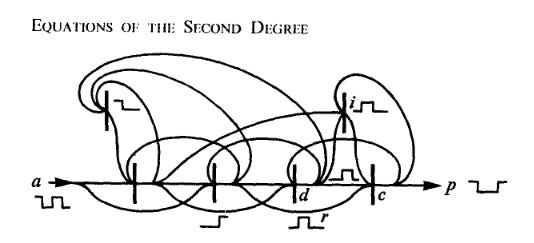
In the final analysis Brown’s notation is really not so important, and terribly unwieldy; I have elided it here in favour of something more conventional, so we might focus on the underlying idea (which is really awfully interesting). The logical system in Laws of Form is built out of imperatives acting on other imperatives. One recalls J. L. Austin’s performative utterance. The judge says the court is order, or pronounces man and wife. Then the court is really in order; the couple is really married. The system around the judge anticipates a certain announcement and reacts in a predictable way, so the utterance becomes true (see Lecture I in How to Do Things with Words). Everyone agrees this class of utterance exists, here or there, but with his (single-type, single function) logic Brown builds incredibly complex info-machinery out of such imperative demands-to-distinguish. He accordingly figures meaning as such — or at least the sort of meaning that fits inside a Turing machine — as something which exists locally relative to a certain phenomenal (i.e. perceptual-experiential) system of reactions, or counter-indications anticipated by a related system of distinctions. In this conception, the symbols [dog] means ‘dog’ because we react to it as we would react to a symbol that meant ‘dog’. If we were to react to the symbol [fuh] precisely as we react to [dog], we would say that [fuh] means ‘dog’.
Developing Brown’s argument, Principles of Biological Autonomy hopes to escape the tendency to reformulate observations in terms of atomic types and elements. Instead, Varela is trying to describe process and relation on the basically-pragmatic level of imperative signal-production and phenomenal meaning-making. He concludes the second second as such:
I contend that the reluctance to concede a central role to circularity per se in system’s organization is basically a heritage from positivism, or what I would like to call a Fregean viewpoint. The basic assumption here is that we can look at a system and identify initial or atomic elements with which a larger system can be constituted, and so on until an output is reached. The idealized form of this logic is the Whitehead-Russell theory of types, where some atomic elements are given, and do not affect operations of higher types. The mental picture is that of a tree with roots and branches. But, this view is awkward for describing whole systems, where the picture is more that of a closed network with roots and branches intertwining, and where the describer is eminently present. It resembles the network of language that the late Wittgenstein was concerned with. No type distinctions are possible in such a network. (p. 167)
For Varela, something like (e.g.) DNA is meaningful because it prompts a certain internal reaction; it encodes information relative to the biological system with anticipates and encloses it. The third section of Principles proceeds further along these lines, sketching out an account of various systems in the human body considered as autonomous systems with internal phenomenology: the immune system, nervous system, and last of all human cognition itself. I shall not go through them in detail, since by this point you can probably anticipate the shape of the argument. In any case, it would draw us further away from our consideration of biogenetics in particular, from which we have already wandered quite a distance.
Instead, let us refer back to our discussion of reproduction and demography. In SMAC, we encounter a virtual world which already-distinguished, always operating from an imperial point of view. There are baseline metaphorically-material facts we can recover from the special logic of this world (say, concerning the number of citizens), but only by engaging with the logic as it is presented to us — with minerals, nutrients, citizen-points, and so forth — which necessarily grounds our speculation. We could say that this is all over-determination, that the game is forcing us into a colonial point of view, that its aversion to the nuts and bolts of pregnancy is a kind of masculine chauvinism. All of this is true: really, I have no objection. Yet on another strata this line of thought is missing something critical, proceeding entirely from the player’s point of view. I have an alternative question. What does the game think: I mean, what does Alpha Centauri think it is?
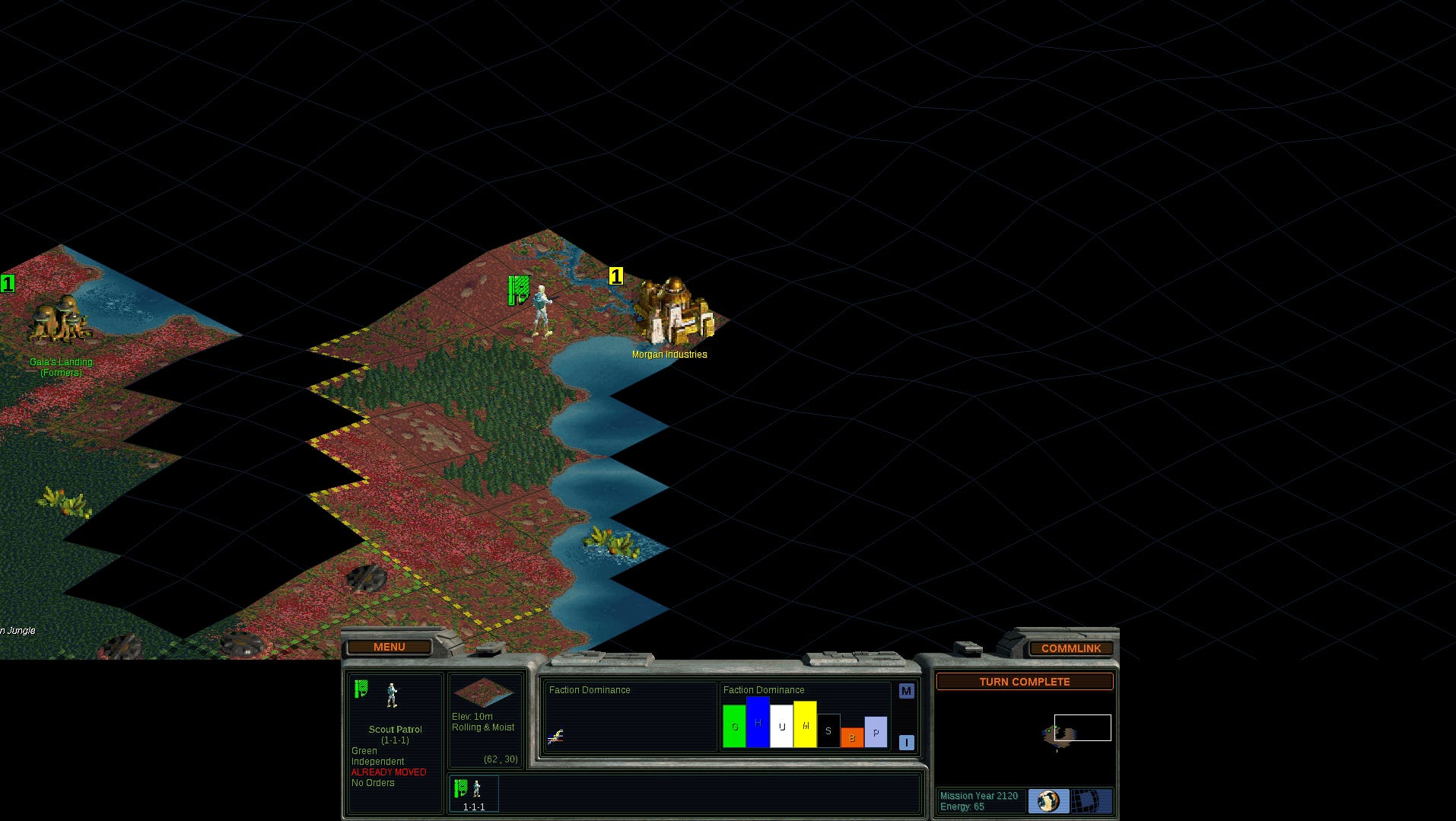
On Planet, our colonists encounter another competing society. Traveling eastbound Gaian scouts discover the Morganites, a quasi-corporation under the mentorship of billionaire stowaway CEO Nwabudike Morgan. According to the GURPS guide, Morgan will later reorganize the colony as a bonifide joint-stock enterprise (p. 38-39). For now, it is still a collection of rag-tag survivors with mercantile proclivities. His followers receive a bonus (+1) to their Economy score, a substantial initial energy budget, and increased income from inter-faction agreements. In exchange, they suffer penalties to military Support costs (-1) and maximum base size — ordinarily capped at 16000 (Size 7), but for the Morganites a paltry 4000 (Size 4). Like other factions, the Morganites can eventually raise this cap with high-tech base facilities; still, it’s a serious increased cost to urban intensification. Notice that all three factions we have so far encountered (including our own) raise the problem of surplus population in different ways. Spartans have ordinary levels of surplus population, but are mechanically well-positioned to employ them in their war machine. The Morganites can only sustain a limited surplus, and are therefore incentivized to sprawl, developing innumerable bases with ever-more urban professionals. Conversely, our Gaians (recall the Growth penalty) try to evade the issue, imposing ecologically-motivated constraints on reproduction.
Again, the interesting thing here is not so much the response which this or that faction undertakes, but rather the problem itself. Just as actual persons emerge in our picture of Alpha Centauri only though the already-organized demographic descriptions which figure them, SMAC’s mechanical problems only exist in relation to already-extant soloutions, or systems of solutions, which already anticipate or somehow resolve them. This gets at something critical. There is, after all, a tendency to consider Alpha Centauri as a game first and foremost concerned with the tension between competing factional value systems, assuming the problems these systems contest as a value-neutral ground. As lead designer Brian Reynolds writes in his appendix to the manual:
Whereas we can, for instance, look back on the past and say “well obviously that system of government worked and that one didn’t,” it’s a lot harder to make cogent predictions about future society. We don’t even know what future governments will be like, let alone whether or not they will work. So in our Social Engineering section we’ve tried to challenge players to imagine the future for themselves — to create their own future utopias and try them out against other competing visions. Thence also came the idea of “factions,” rival groups to challenge players with opposing and contrasting ideologies. (237-238)
Having now established some ‘principles of autonomy’ in a foundational logic of imperative distinction, this approach must sound awfully suspicious. Certainly, SMAC is excellent at creating imaginary futures, putting those futures into conversation, &c: but are these imagining-machines really at work only in the factions and social engineering choices, which are basically extant in a determinate form before we start up the game? Such a view reduces the game systems to a kind of impartial terrain upon which competing tendencies might happen to do battle, therefore eliding the game’s own subjective position. On the level of phenomenal self-engagement, the faction systems and social engineering choices are genuinely inseparable from the game’s other metaphors. They are mechanisms of self-perception, with which SMAC anticipates itself, and responds reflexively to its own possibilities. To wonder if the game is ‘fair’ or ‘biased’ in its treatment of these features, its understanding of those governments which “work” and those which don’t — to make judgements, in other words, on the level of ideological competition — would miss every feature worth caring about. The game is on the contrary simply a present-happening, all the time enacting itself in play. Its point of view emerges not so much from the contest itself, but from the symbol-system that makes that contest possible.
I suspect you see my point: Alpha Centauri is a basically autopoetic system. Without player input, the world would keep ticking just fine, reorganizing itself according to its simulated logic and meaning-making metaphors. That we need to hit the end turn button — well, that strikes me as a totally contingent objection. Suppose I put a heavy paper weight on the enter key, and put that aside for a moment. Consider: The game exhibits self referential closure. It has a certain schema of meaning-making, certain internal symbols and metaphors. It is orderly, in Varela’s sense. It therefore has a distinct phenomenology: a point of view, which it can express in “conversation” (p. xii). We needn’t treat it as an empty vessel, mediating an encounter between player and designer, or different socio-political values. We can ask it to think-itself-through, and consider its process of valuation as such.
In this post I have therefore been trying to set out a basic set of techniques for working with (talking to, or thinking through) autopoetic systems, by way of example and analogy. All of these techniques are work on the level of metaphor and symbology, since autopoetic systems are symbolizing systems. This does not make them signifying systems, in the old Sauserian sense, depending on dyads of signifier and signified. Sauserian systems presuppose a whole discursive order (observers, and other signs) outside the symbol in itself. Conversely, Autopetic systems are autonomous: they symbolize only insofar as they understand themselves, and come to operate on themselves materially in the process of constitutive self-understanding. Sauserian systems ‘means something’ insofar as they exist. Autonomous systems ‘mean something’ insofar as they act.
Here are three techniques we’ve used. We’ll give them names, for fun:
Cross-strata comparison, i.e. analyzing a metaphor which the system deploys across multiple domains — like population on the level of mechanics contra population as actual persons in the fiction — looking for homologies (i.e. evidence of cross-strata closure).
Loose formalism, for instance, when we relate the population of a base to its apparent labour power in terms of tiles harvested according to an approximate formula. In this category, we can also put some of Varela’s higher-order tools. We should be careful with this sort of impressionistic sketch, lest we take some primitive unit (e.g. mechanical ‘tiles’) as an atom of analysis, and forget to think through the problem (e.g. of land) on the fundamental level of distinction. Nevertheless, good artists know how to make a quick sketch. Sometimes you need something practical.
Deep formalism, operating on the level of distinction and meaning-production. Brown’s notation is of no great interest going forward, but his ideas remain compelling. As we continue with our project, we are going to want to find some way to ground our ‘looser’ tools (like e.g. cross-strata comparison) in a more fundamental logic. Moreover, we are going to want to speak about value and evaluation very precisely. To do so, we will need to work with distinction and difference as such.
In the next few posts we’ll proceed along these lines, using the tools we’ve introduced here (in this case, engaging with problems of population-value) to interrogate SMAC’s other critical value-metaphors. That includes environmental values (minerals, nutrients, energy) — but also, social values, cultural values, &c. When these metaphors seem to complicate or contradict themselves, as they do in the case of reproduction, we’ll examine the digressive rupture for productive lines-of-flight. There are futures here, and speculative valuations, all bound up in a little autonomous world: but they are buried, closed off, only internally legible to the system from its own phenomenal perspective. Let us therefore dirty the scalpel of immanent critique; it's time to start digging, like carrion crows, in the interstellar muck. Hopefully, desperately, we might make friends with Planet. I think she has some interesting things to say.
Deleuze, Gilles & Félix Guattari. A Thousand Plateaus. Trans. Brian Massumi. ISBN: 0-8166-1401-6.
Francisco J. Varela. Principles of Biological Autonomy. ISBN: 0-444-00321-5.
G. Spencer-Brown. Laws of Form. LCCN: 72-80668.
J. L. Austin. How to Do Things With Words. ISBN: 9780674411524.
Zeigler, Jon F. GURPS: Alpha Centauri. ISBN: 9781556345203.
I actually don’t understand why Brown builds to the complex plane idea this way, except to make his maneuvers seem a little more well-motivated. Really, I don’t understand why he’s so insistent that he’s working with the complex plane in particular, except perhaps because it lets him avoid vectors. Or maybe it’s part of his broader, mystical project. Truly the mind of an English Buddha exceeds my humble appreceptions.
No posts
Comments
Nothing yet. Say the first thing.
Sign in to join the conversation.