
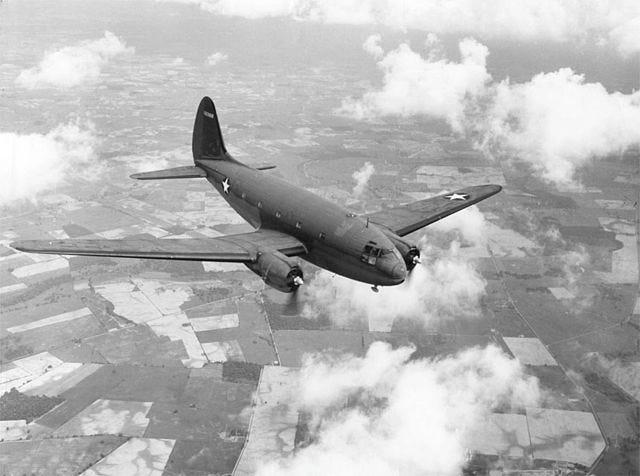
At 17,000 feet and halfway from India to China, pilot Joseph Dechene had lost both his aircraft’s engines to ice. His lumbering C-46 cargo plane was now a glider. With white, ice-laden clouds pressed tight against the glass of its windows, the cockpit was like the inside of a bathysphere, a contraption of glass and metal churning in an abyss. The violence of the winds aloft had blown the plane so far off course that the pilots and radio operator had no idea where they were, knowing only that the peaks of high mountains were somewhere close below. Shining a light through the cockpit window, they could see ice building on the wings, but as they did a lurch of turbulence, the worst the experienced senior pilot had ever encountered, heaved the plane upward “like an express train,” as he reported. “We came busting out the top of the thunderhead at 20,000 feet with twenty-four tons of airplane and no engine.” Above the clouds, he got the engines running again and so, eventually, safely concluded another trip over the Hump. “The Hump” was the name that U.S. airmen gave to one the most perilous aviation missions of WW2: flying transport planes overloaded with fuel, materiel and other supplies over the eastern spur of the Himalayas, from India to China, in the little-known China-Burma-India (CBI) theatre.
The Japanese capture of Burma (now Myanmar) in April 1942 had closed the Burma Road, the last land route into China, whose ports were already in Japanese hands. President Roosevelt had pledged that no “matter what . . . ways will be found to deliver airplanes and munitions of war to the armies of Generalissimo Chiang Kaishek,” and with the closure of the Burma Road the only remaining way was by air. Unfortunately for the U.S. airmen who had to fly it, the 800-mile route from northeast India to Kunming, China passed through a unique convergence of extreme weather systems—warm, moist air from the east and west and frigid winds from the north. The combination of high terrain and violent weather proved deadly, and soon a trail of wreckage lay scattered across mountainsides and jungle beneath the flight path, which airmen dubbed “the aluminum trail.”
Aspects’s Substack is a reader-supported publication. To receive new posts and support my work, consider becoming a free or paid subscriber.
Comments
Nothing yet. Say the first thing.
Sign in to join the conversation.