
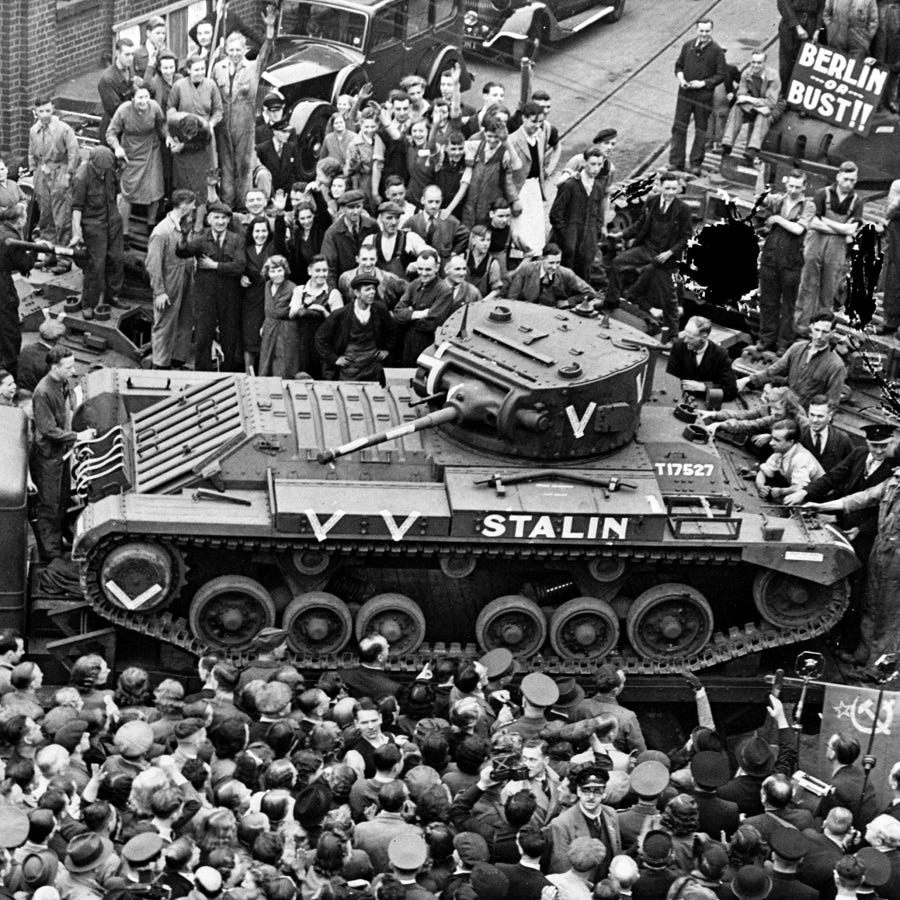
In the popular mind, World War Two endures as the ‘Good War’: a heroic struggle against evil with a happy ending. But there have always been nagging questions, not least whether any conceivable post-war world was worth the sacrifice of 50 or 60 million dead. Why did a war ostensibly waged on behalf of Poland in 1939 end with that country’s dismemberment? If ‘freedom’ triumphed over ‘totalitarianism,’ why did eastern Europe and the Balkans succumb to Communist dictatorship, followed by China, North Korea, and Vietnam? Why were the earliest freedom fighters against ‘Axis’ aggression – Chiang Kai-Shek’s Chinese nationalists, the Poles, Mihailovic’s Chetniks in Yugoslavia – abandoned by the victorious Allies, even while clients of Stalin, Hitler’s fellow totalitarian dictator and key strategic ally from 1939-41, won? Why did the ‘Good War’ consign nearly half the human race from Berlin to Beijing, to the agonies of communism?
The morally perverse outcome of World War Two was no accident. The expansion of Soviet power westward into Europe, and eastward into Asia resulted from deliberate policy choices both by Stalin and Molotov in Moscow, carrying out an expansionist foreign policy with ruthless consistency, and by Stalin’s accidental British and American allies who were either manipulated into furthering Soviet foreign policy designs (as with Churchill abandoning Mihailovic and falling in with Stalin’s client Tito in Yugoslavia) or, in Roosevelt’s case, did so quite voluntarily.
Aspects’s Substack is a reader-supported publication. To receive new posts and support my work, consider becoming a free or paid subscriber.
Comments
Nothing yet. Say the first thing.
Sign in to join the conversation.