
It seems like everywhere one turns, someone, somewhere is promoting the idea that public schools are in a downward spiral, a crisis of failure that must be fixed. Across the country, in Congress and communities, legislators, policymakers, and voters are pushing narrow solutions to address this crisis: closing schools, expanding vouchers, and increasing charters. These solutions are premised on the idea that public schools, especially those in urban communities, are not worth saving. That their failures are beyond repair, and thus, public schools must be closed, dismantled, and replaced with new governance models and accountability systems. This logic thrives on crisis because crisis justifies radical intervention while deflecting attention from critical conversations about longstanding policy choices that have starved public schools of resources and revenues. It also positions educators, families, and youth as obstacles to progress rather than as experts capable of diagnosing and addressing complex problems to improve and strengthen their schools.
What if, instead of assuming that public schools are beyond repair and thus need to be dismantled, we reimagined a school reform with a different playbook? What if researchers and policymakers actually stopped coming to these institutions with blueprints and solutions and instead took the time to listen to and learn from those with the most knowledge about the strengths and shortcomings of their schools: the educators and youth who are inside them every day? What might happen if researchers and policymakers entered schools with questions and humility as learners and thinkers who want to work with, not against, educators and youth?
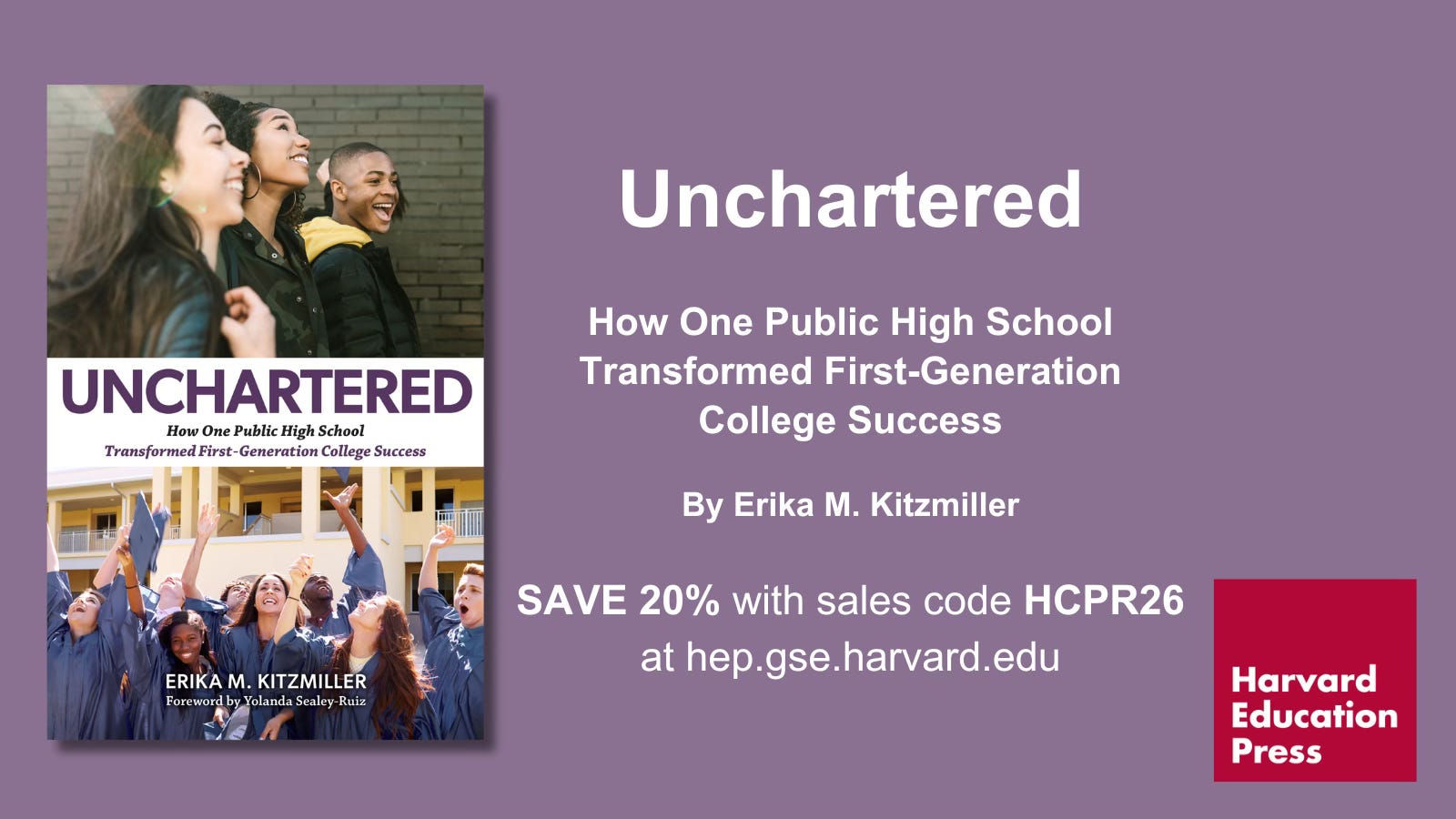
In my forthcoming book, Unchartered: How One High School Transformed First-Generation College Success, I decided to switch the script. In a five-year research-to-practice partnership at Clayton High School, a majority-Black, under-resourced, Title I urban public high school, I first examined the school’s strengths and, with educators and youth, thought critically to implement innovative policies and practices to strengthen it.
The partnership began with a simple problem: nearly all Clayton graduates enrolled in four-year colleges, but fewer than half of those who enrolled actually graduated with a four-year degree. This problem plagues many schools and communities. Students enroll in college but leave without the credentials they dreamed of, often scrambling to pay the debt they've accrued.
Our work showed that the challenge was not aspirational. Clayton youth wanted to earn their college degrees. The challenge stemmed from uneven preparation, haphazard support, and mismatched fit–challenges that required us to tweak school structures and instructional practices. To do this, I leveraged and learned from the best resources I had at my disposal: the people inside the school.
Rather than dismantling the school and starting from scratch, administrators, students, and researchers worked together to examine how the school’s existing policies and practices shaped students’ experiences. We did not set out to fix a “failing” school, but to strengthen an existing one.
As we always said, the reforms we created and sustained were small, structural and instructional reforms to enhance student experience, teacher morale, and postsecondary outcomes. Educators expanded course offerings so students could take classes that reflected their interests and prepared them for postsecondary teaching and learning. They redesigned advising systems, creating a mandatory senior college seminar with small class sizes so students could receive sustained, individualized support navigating college applications, financial aid, and decision-making. They increased access to advanced placement courses and electives, not as sorting mechanisms, but as opportunities for students to stretch academically. They expanded extracurricular programs and partnerships, recognizing that leadership, collaboration, and belonging matter as much as transcripts.
None of this required dismantling the school. It required time, trust, and collaboration. It required asking good questions and listening more. Together, we asked those questions, learned from the answers, and then acted, designing and implementing reforms based on our new knowledge of what was and was not working. Yes, it was time-consuming for everyone. But the results were well worth it.
The percentage of seniors applying early decision or early action, which provides an easier path to acceptance into a highly selective college, more than doubled. Enrollment in advanced placement courses expanded dramatically. Nearly all students participated in at least one extracurricular activity, which strengthened their college applications, and as we learned, their transition to college. Perhaps most importantly, students reported a stronger sense of agency over their academic paths and greater clarity about what they wanted and needed from college. This careful planning and sense of agency over their future gave them more opportunities to think critically and broadly about their postsecondary options, especially with regard to college fit and financial aid, and in turn, to make informed decisions about the college that would be serve their interests and needs.
Critics might argue that Clayton’s success cannot be replicated elsewhere, that Clayton is too selective, too unique, too dependent on exceptional leadership to offer any lessons or ideas for other public schools. But this argument itself reflects the deficit thinking at the heart of the failure narrative. It assumes that under-resourced public schools cannot improve unless they are fundamentally remade or replaced. Moreover, the argument that these reforms only worked because Clayton was a special-admit school ignores that, unlike its counterparts in other cities, Clayton’s student population closely mirrored its district’s demographics and that its improvements occurred without demographic shifts.
Public schools are not perfect. No public institution is. But they are not broken in the way the current rhetoric suggests. When we look closely at what educators and students are already doing and consider how to strengthen the good work already happening in schools, we don’t see failure; we see possibility and promise. The question is whether we are willing to invest the time, energy, and trust it takes to examine and understand this, not just for Clayton, but for all public schools.
Thanks for reading Ask an Educator! This post is public, so feel free to share it.
Questions to Ponder
What are the strengths and possibilities in the schools that your children attend or that serve your community?
How might we reframe the challenges in education if we started asking about assets and strengths rather than problems or shortcomings?
What might happen if, instead of promoting reactionary, crisis-oriented educational policies, practices, and solutions, stakeholders worked with educators and youth to improve educational experiences and public schools?
I’d love to hear your insights and questions!
And if you’d like to pre-order my forthcoming book, you can do so here: hep.gse.harvard.edu and save 20% with the sales code HCPR26.
Comments
Nothing yet. Say the first thing.
Sign in to join the conversation.