
If you're reading this as a forward or from LinkedIn, subscribe to Ask a Chief of Staff to get these insights directly in your inbox. Join 16,000+ Chiefs of Staff who trust us for actionable insights.
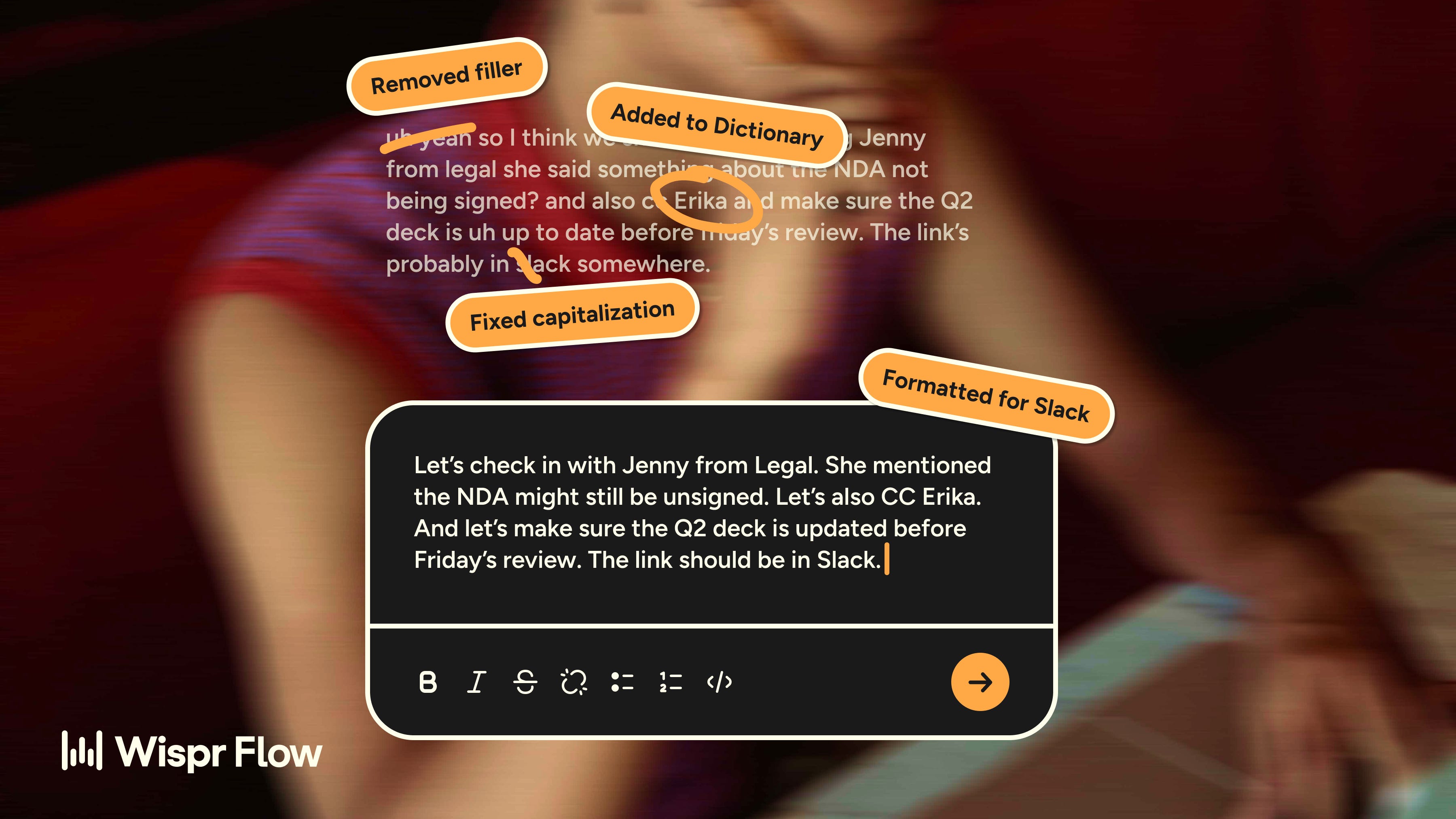
I’m a big fan of dictation, and here’s why: when you dictate something, you speak a lot more freely.
You talk about what’s top of mind immediately. But when you type? You start to self-edit. You take your thoughts and run them through another medium—text—and simplify before you even get your full ideas out.
I use Wispr Flow to dictate my ideas freely, then use its built-in polish function to help organize and edit my message into something that’s publish-ready in minutes.
I use it for:
Slack messages to my team
First drafts of emails
Brainstorming and dictating content ideas
Polishing raw thoughts into structured lists
👉 Give Wispr Flow a try and stop self-editing before your ideas even make it out.
*If you’re interested in sponsoring a future issue of Ask a Chief of Staff, hit reply!
This week’s issue is guest-written by Gena Chieco, Ask a Chief of Staff Mentor & Coach and former Chief of Staff, attorney, and senior government official. Gena guides personal and professional transformation through integrated, embodied, conscious leadership—helping clients navigate change, face fears with compassion, align with their inner compass, and honor their unique genius and deeper purpose. For more background on Gena and ways to work together, visit her website: GenaChieco.com.
As an executive coach, I hear the same story on repeat: accomplished leaders arrive disheartened, told they lack “executive presence” or “gravitas” — no examples, no guidance. They come asking me to help them build it, as if executive presence were a template to replicate.
❓ The questions swirl: Should I speak more forcefully? Take up more space? Hide my emotions? Act more “masculine”?
Every one points in the wrong direction. The problem usually isn’t the leader. It’s that most definitions of executive presence are outdated and performative — narrow rules about what powerful leadership is allowed to look like.
And the moment we treat presence as a performance, it stops being a competency and becomes a costume. We self-monitor, chase external validation, and learn to sound like someone else. We shave off the edges that make us distinctive. The cost is subtle but profound: we become smaller versions of ourselves — not because we lack power, but because we’ve distanced ourselves from it.
When we’re told we lack executive presence, shame gremlins activate — whispering that we’re inherently deficient. But outsourcing our self-worth is like going to a dry well to quench our thirst. True confidence is an inside job.
The trap of performative leadership affects every leader. It’s especially acute for Chiefs of Staff, whose whole influence runs on presence, trust, and being believed — which is exactly why the rest of this read is worth your time. 👇
Executive presence has long been defined through a narrow lens, with traits that can be coded as “masculine:”
certainty over curiosity
emotional restraint over emotional fluency
stoicism over expression
volume over depth
extroversion over reflection
detachment over empathy
And the numbers show who they’ve rewarded. Women hold just 9% of CEO roles in S&P 500 companies, despite comprising over half the population. People of color are also significantly underrepresented, occupying only a small fraction of CEO and senior executive roles. Across boards and C-suites, this pattern remains consistent.
Leadership norms are not neutral, they are conditioned.
Executive presence is also shaped by cultural bias, privileging white, Western norms of communication and leadership.
Leaders from marginalized racial and ethnic backgrounds often receive feedback influenced by bias rather than leadership deficiencies; what is seen as a lack of executive presence is often an equally valid yet different expression of leadership. They are being asked not simply to develop as leaders, but to assimilate and leave their rich heritage at the door.
Asian professionals, for example, are often told to be more vocal or visible — despite research showing that humility, reflection, and attentive listening are themselves impactful leadership traits.
Black women face particularly challenging double binds. Studies have shown that behaviors often praised in white leaders as decisive, direct, or confident may be interpreted very differently when exhibited by Black women, who are disproportionately subjected to stereotypes that label them as “aggressive” or “intimidating.”
😣 They are expected to navigate an impossible balancing act: be assertive, but not too assertive; be confident, but not too confident; speak up, but not in a way that makes others uncomfortable.
When feedback about executive presence is filtered through conscious or unconscious biases, leaders can find themselves working endlessly to correct perceived shortcomings that are either not theirs to carry or were never shortcomings to begin with.
Chiefs of Staff occupy a unique leadership role.
Unlike other executives, influence rarely comes from formal authority or direct reporting lines. Instead, influence is built brick by brick upon a foundation of trust, credibility, integrity, discernment, relationship-building, presence, and strategic thinking.
Chiefs of Staff are the wizards behind the curtain, the ones who lead initiatives to success without being a public face, rarely receiving credit. Inherent in the role is a commitment to amplify others: Principals, projects, and teams, which makes it hard to intentionally develop their own authority and leadership identity.
Chiefs of Staff bring innovative, creative solutions to complex problems, drawing on their cross-organizational vantage point and valuable generalist skillset, among many other superpowers.
🫱🏼🫲🏾 The most effective Chiefs of Staff do not command attention because they have the loudest voice in the room, but because people trust what they have to say. Their executive presence emerges from substance rather than performance.
Conscious leadership invites a broader question of what leadership can be.
Rather than asking leaders to conform to a narrow, inherited model, it expands what we value:
👂 Deep listening as much as eloquence
👥 Collaboration as much as command
🦉 Wisdom as much as decisiveness
💯 Authenticity as much as conformity
When we expand our definition of executive presence, we create space for leaders to be evaluated on the substance of their leadership rather than their privilege or proximity to a historically dominant norm. In doing so, we not only create more equitable workplaces, but gain access to a richer, more diverse and impactful expression of leadership itself.
We can feel the difference.
Take a moment to recall a leader who entered a room trying to appear confident, yet it felt performative, like a show. What impact did that leader have on you and the room? Now reflect on a time when a leader entered a room grounded in true, innate, effortless confidence that seemed to radiate from within. What shifted in the room—and in you? While behaviors may overlap, the energy, presence, and trust they generate are distinctly different.
The most powerful leaders ignite in their teams a desire to strive for excellence and meet the moment, driven by inspiration and an aspiration to be part of something meaningful. These leaders have a way of making each person feel valued and seen. This cannot be simulated or faked.
As Maya Angelou wisely observed, “People will forget what you said, people will forget what you did, but people will never forget how you made them feel.” 💜
From this perspective, impactful leadership is not a fixed performance or persona, but a dynamic expression of embodied confidence.
Embodied confidence is:
✨ To speak even when our voice shakes
✨ To stand in our integrity and do the right thing
✨ To say “I don’t know” with vulnerability
✨ To challenge an idea respectfully, even if it means ruffling feathers
✨ To assume good intentions when tempted to go below the line
✨ To courageously navigate rupture toward repair
✨ To be responsive more than reactive
✨ To share our perspective, accepting that not everyone will agree
Embodied confidence cannot be manufactured or performed.
It emerges from self-awareness, mindfulness, reflection, and inner alignment. It is self-trust made visible, cultivated through shedding what holds us back while embracing our unique genius, our truths, our authentic voice.
As we shift away from executive presence, we see clearly that embodied confidence is not about being the most commanding person in the room or leading by fear. It is the ability to remain deeply connected to yourself while navigating complexity. Embodied confidence is not about projecting power; it is about embodying it.
🎭 When leaders stop trying to emulate someone else’s style and begin authentically leading from their own core, they become more trustworthy, influential, and effective. Not because they have mastered a performance, but because they have stopped performing altogether.
The process of moving from performance to embodied confidence is like building a muscle—one courageous conversation, one moment of mindfulness, one intentional choice, and one brave truth at a time.
Whenever we are trying something new with a beginner’s mindset, we can feel discomfort and grasp at control to ward off the ache of vulnerability. The invitation in learning to embrace embodied confidence is to wade into these choppy waters with self-compassion. Vulnerability is your North Star—a sign that you’re headed in the right direction.
The shift is not about becoming more polished. It is about becoming more of your true self, and honoring the life you were born to lead.
Embodied confidence is a remembrance of your gifts, of being truly present, of the wisdom and truths you hold within.
Embodied confidence is not something you perform your way into. It is something you reclaim.
☝️ One reality to be mindful of is that in many workplaces, psychological safety is fragile, and those who speak truth or lead authentically can be pushed to the edges. In these environments, embodied confidence often shows up in smaller, more contained ways—through trusted relationships, careful experimentation, and incremental steps.
Who first taught you what “executive presence” is supposed to look like—and how might that definition be shaping you today?
What has it cost you to adapt to dominant definitions of executive presence?
Where might you be confusing performance with embodied confidence?
Whose leadership style are you yearning to emulate, living or deceased? Who are some of your greatest direct sources of inspiration, who have touched you personally?
Where are you outsourcing your sense of leadership authority instead of trusting your own inner knowing?
Where in your body do you feel most anchored in confidence—and where do you feel yourself performing?
What limiting beliefs, fears, or coping mechanisms need to be released in order to step into your full potential?
What would change if your goal shifted from appearing powerful to embodying your power?
What systems of support can you seek to help you shift to embodied confidence?
Get clear on your unique genius, the constellation of strengths, talents, and innate abilities that bring you confidence and aliveness. (Free resource: Conscious Leadership Group, Genius Email Campaign)
Seek out mentors who genuinely want to see you thrive—people who recognize your strengths, reflect your potential, and offer guidance that supports your growth. These may be colleagues, friends, former professors, or anyone with whom you’ve felt a spark of connection and psychological safety.
Stand in your integrity, even when it’s inconvenient, uncomfortable, or not rewarded. Words and actions align. You hold an internal coherence; there’s less fragmentation between your private self and your public self. Integrity often costs something: approval, belonging, ease, or advantage, but you’re willing to tolerate that cost rather than abandon yourself. (Free resource: CLG Living a Life of Integrity, Short Video)
Gain clarity on your values and practice aligned actions. (Free resource: Brené Brown Dare to Lead Values Worksheet)
Honor your cultural heritage and understand how biases may infiltrate the workplace. (Resources: Ginny Clarke, Brown Girl Therapy, The Loveland Foundation)
Heal coping mechanisms and survival strategies while developing greater self-awareness and self-confidence through therapy, coaching, and other resources. (Free resources: How Can Chiefs of Staff Overcome Impostor Phenomenon, CLG Locating Yourself Worksheet, and CLG Drama Triangle Short Video)
Become a boundary badass, honoring your needs as valid and worthy, and communicating them from a place of awareness and intentionality. (Resource: Nedra Tawwab, Set Boundaries Find Peace )
Thanks for reading! This post is public so feel free to share it.
Ready to accelerate your growth in 2️⃣ 0️⃣ 2️⃣ 6️⃣ ? Paid Substack members get exclusive access to a growing library of 2️⃣ 0️⃣ ➕ workshops from industry experts—covering everything from strategic planning, to navigating your next career move, to keeping cool under pressure 🧘♂️
New workshops added monthly! Recent additions include:
$1️⃣ 0️⃣/month or $1️⃣ 0️⃣ 0️⃣/year. Cancel anytime.
July 9th: Peer Resume Review
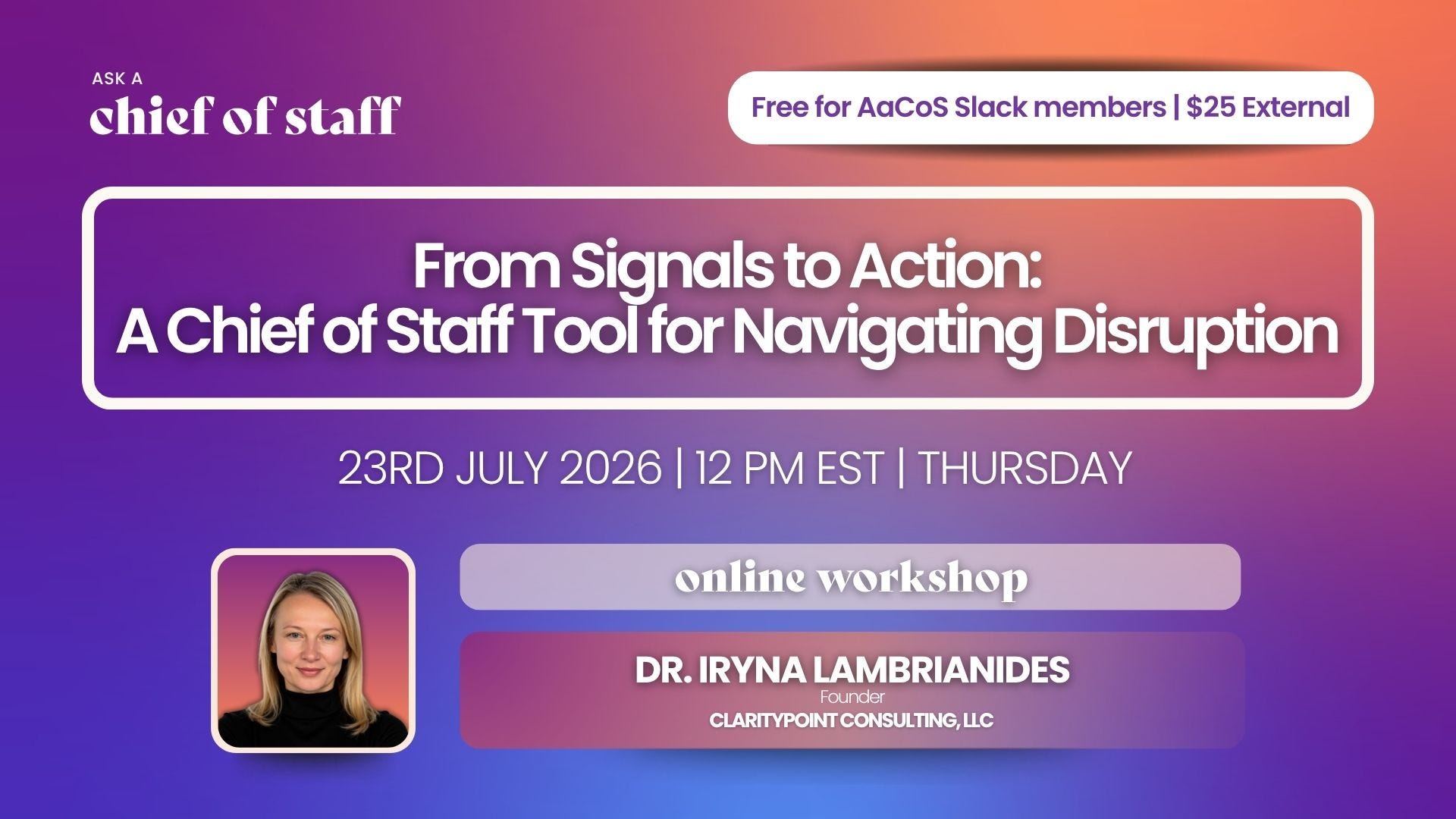
July 23rd: From Signals to Action: A Chief of Staff Toolkit for Navigating Disruption
July 30th: From Reactive to Regulated: Energy Management Tools for Chief of Staffs
As a reminder, events and workshops are free or heavily discounted for all Ask a Chief of Staff community members.
Visit our website and click the “Join our community” button to start your journey!
Comments
Nothing yet. Say the first thing.
Sign in to join the conversation.