

If you're reading this as a forward or from LinkedIn, subscribe to Ask a Chief of Staff to get these insights directly in your inbox. Join 16,000+ Chiefs of Staff who trust us for actionable insights.
Don’t worry, we’ve got you! I’m excited to announce that we’re extending our free 3️⃣ 0️⃣ day trial to the Ask a Chief of Staff Community.
📨 Send your LinkedIn profile URL to clara@askachiefofstaff.com to get started! This offer is for current Chiefs of Staff only.
We’re now 4️⃣ 5️⃣ 0️⃣ ➕ members strong, and here’s what you’d get access to:
💬 Members-only Slack — full access to network and knowledge-share with current Chiefs of Staff
🧑💼 Direct access to former Chief of Staff mentors who’ve been in your seat
🖥 Regular workshops led by SMEs, coaches, and working Chiefs of Staff (plus access to 1️⃣ 0️⃣ 0️⃣ ➕ previously recorded workshops over the years)
⭐ 1️⃣:1️⃣ career coaching sessions with me (normally $149)
📚 1️⃣ 0️⃣ 0️⃣ ➕ templates in our Resource Library
💼 Curated, exclusive job opportunities from leading companies
🤝 In-person coworking, happy hours, and networking events in major cities
💰 Thousands of dollars in exclusive software and product discounts
*If you’re interested in sponsoring a future issue of Ask a Chief of Staff, hit reply!
This issue is guest authored by Claire Podulka, a strategic executive with 20+ years of experience across tech, education, and consulting. She is currently the Chief of Staff at Crisis Prevention Institute, the global leader in crisis prevention and de-escalation training. Previously, she spent nearly a decade at TXI, a boutique digital product consultancy. She writes and speaks on topics at the intersection of culture, operations, and strategy, with a particular focus on prioritization, both organizational and personal.
Every piece of advice about starting a new leadership role includes some version of the same instruction: spend your first 3️⃣ 0️⃣ days listening.
Clara’s framing of this as “intensive reconnaissance” is one of the best I’ve heard: it captures the active, purposeful nature of that early listening. It’s not passive. You’re building a map.
And yet. When I joined a ~500-person global organization in the middle of a new CEO’s transformational push, “listen first” was a luxury I couldn’t fully afford. Amid leadership and board changes, refocusing our GTM approach, and kickstarting a new cross-functional product collaboration, I was jumping onto a raft already racing along a swift current. If I didn’t grab an oar, the raft might crash… or someone might shove me overboard.
👉 So here’s my take: Clara’s advice is the foundation. This post is about what you build on top of it when reality gets messy.
📚 The advice Claire references throughout this piece is from The New Chief of Staff’s Survival Guide. It’s in the Substack paid archive — start a free trial now and dig in!
Ask a Chief of Staff Slack community members receive all of these templates for free. We’re currently running a 3️⃣ 0️⃣ day free trial promo. If you’re interested in redeeming this offer, reply to this email with your LinkedIn URL and we’ll get you set up!*
*This offer only valid for current Chiefs of Staff
The listening tour, systematic 1:1s with key stakeholders, is non-negotiable. Clara’s right about that. But structure matters, and there are a few things I’d add to her framework.
I approached my listening tour through three channels:
1️⃣ Formal 1:1s with every executive. Beyond introductions, I wanted to understand why they were there, what success looked like to them, and how I could help. I ended every meeting the same way: “Who’s the next person on your team I should talk to?” I’d walk out with two or three more names every time.
2️⃣ Informal coffee chats. Even when companies arrange these, push further. Ask random people for 20-minute walks or quick calls. Some of the most useful intelligence comes from these unstructured conversations.
3️⃣ Shadow meetings. People can get nervous about this, so be explicit about why you’re there. Frame it clearly: “I’m trying to get my head around our product process. Would it be possible to sit in on one of your team’s meetings this month?” And make sure the organizer introduces you to the room so no one spends the whole meeting wondering who the silent new executive in the corner is.
✨ PRO TIP: ASK IN THE POSITIVE TO HEAR THE NEGATIVE
When running 1:1s, frame questions around strengths and opportunities rather than problems. Ask “What does your team need more of to hit your goals this year?” instead of, “What’s not working?” You’ll hear the real challenges more readily because people don’t feel like their team is being criticized. Most people also genuinely want someone to listen to them. Give them the opening and they’ll tell you everything.
🧑🏫 THEORY: Focus the first 3️⃣ 0️⃣ days on listening before acting. Build relationships through genuinely curious conversations.
💡 REALITY: The listening tour works, but you’ll need to run it in parallel with doing, especially if the organization is already mid-change.
Clara wisely warns against the “action imperative” — the urge to prove yourself by doing things before you understand the landscape. She’s right that you should only take on tasks your Principal explicitly wants off their plate. But I’d push one step further: within that constraint, move fast.
By day 3️⃣ 0️⃣, I was facilitating the weekly executive team meetings. Over the following 3️⃣ 0️⃣ days, I made a series of adjustments based on what I’d observed and heard: setting agendas proactively with the desired outcome for each item, requesting that documents go out in advance so synchronous time could be used for discussion rather than level-setting, documenting decisions to short-circuit the tendency toward re-litigating the same conversations, and adding a Monday morning stand-up to handle tactical items so the longer team meeting could stay focused on deep discussion.
These changes landed well, partly because they weren’t random. People had flagged a lack of accountability and a tendency toward churn in my listening tour. I wasn’t inventing problems; I was solving the ones they’d already named.
🧑🏫 THEORY: As a starting point, take on tasks your Principal wants off their plate. Avoid creating solutions to imaginary problems.
💡 REALITY: Your listening tour will point you to which problems are the most impactful and universal. Use that intelligence to make your early wins count.
Clara recommends aligning with your Principal on measures of success for each phase.
Good advice, and I tried to follow it. I drafted mine and shared them with my Principal. And then, almost immediately, I fell into the swirl of the organization’s everyday needs and rarely checked back on them.
Here’s the thing: I just looked back at those original measures of success. I accomplished most of them. Plus dozens more things — large and small — that we never predicted.
So write the plan. Set the goals. And then hold them loosely, because the work will teach you what actually matters.
🧑🏫 THEORY: Align with your Principal on clear 30-60-90 measures of success before the work begins.
💡 REALITY: You’ll probably stop checking back on the plan. That’s OK. Write it anyway. It gives you a foundation even when the current pulls you somewhere unexpected.
Taking this new role was a big deal for me. I had spent nearly a decade at my previous organization, a place I’d “grown up” professionally. I was confident in my decision to make a move, but I know myself; there was a good chance that I’d get to the new company and get a big old case of imposter syndrome.
So during the downtime between roles, I wrote an email to my future self.
I reminded myself why I’d made this decision, what I was hopeful for, what I was nervous about, and above all to give myself grace and patience as I learned an entirely new company - new products, new customers, new teams, new tools, new capital structures, new norms.
Then I scheduled send for 9️⃣ 0️⃣ days after I started. It was both a helpful reflection in the moment and (it turned out) a powerful reassurance when I got it 9️⃣ 0️⃣ days later.
I work remotely and joined a majority in-person organization — over the holiday season, no less.
If I could go back, I’d find a way to spend at least a full week on-site in my first 3️⃣ 0️⃣ days.
The informal moments — the coffee before you get into the rush of the day, the sidebar after the Teams meeting ends — are where institutional knowledge actually lives. You can run a great listening tour over video. But some of the most valuable parts of onboarding happen in the margins of the day, and those are much harder to manufacture remotely.
It wasn’t practical in my situation given family needs and timing. But if you have the option, take it.
Next up: Part 2 — the first 60 days, when the real work of building systems begins 👀
📚 Download the The New Chief of Staff’s Survival Guide
Thanks for reading! This post is public so feel free to share it.
Ready to accelerate your growth in 2️⃣ 0️⃣ 2️⃣ 6️⃣ ? Paid Substack members get exclusive access to a growing library of 2️⃣ 0️⃣ ➕ workshops from industry experts—covering everything from strategic planning, to navigating your next career move, to keeping cool under pressure 🧘♂️
New workshops added monthly! Recent additions include:
$1️⃣ 0️⃣/month or $1️⃣ 0️⃣ 0️⃣/year. Cancel anytime.
June 30th: From Slide Decks to Shipping: What Consulting Didn’t Teach Me
July 7th: The Internal Standup w/ Thomas Knoll
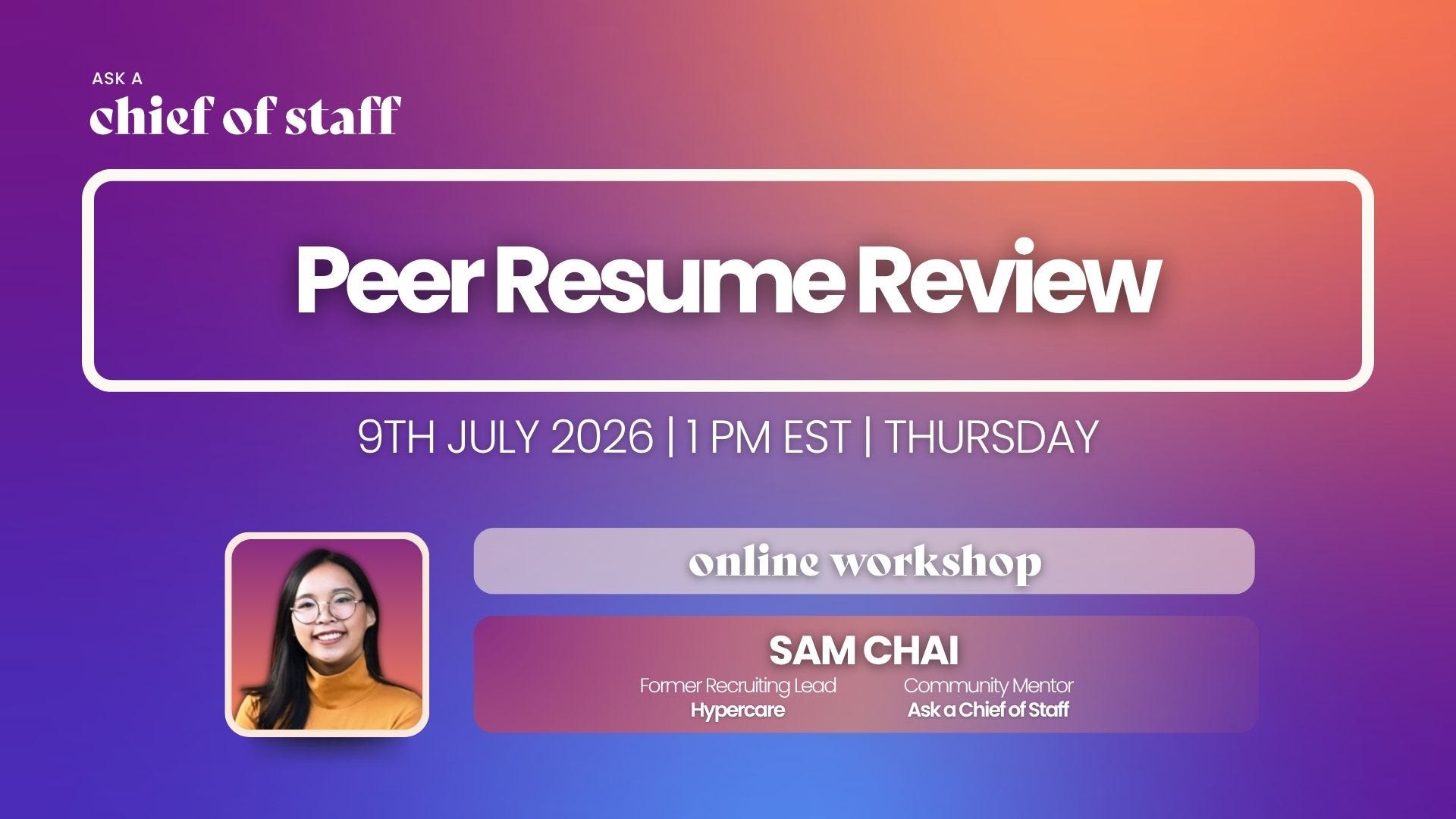
July 9th: Peer Resume Review
July 30th: From Reactive to Regulated: Energy Management Tools for Chief of Staffs
As a reminder, events and workshops are free or heavily discounted for all Ask a Chief of Staff community members.
Visit our website and click the “Join our community” button to start your journey!
Comments
Nothing yet. Say the first thing.
Sign in to join the conversation.