

If you're reading this as a forward or from LinkedIn, subscribe to Ask a Chief of Staff to get these insights directly in your inbox. Join 13,500+ Chiefs of Staff who trust us for actionable insights.
Stable digitizes your company’s mail and lets you manage it online from an AI-powered platform. Assign, ship, and shred mail — even deposit paper checks — from anywhere.
As your company’s mail volume grows, Stable scales with you through AI-powered automations including:
Mail routing
Data extraction
Document summaries
With Stable, you’ll move your business forward faster 📨
🎁 Get 50% off a Grow or Scale plan for 3 months with code cos50
*If you’re interested in sponsoring a future issue of Ask a Chief of Staff, hit reply!
This issue is guest authored by Solu Nwanze, who has led transformations that enabled Zendesk to scale from $300M to $1.6B+ and guided Adobe’s Creative Suite to Creative Cloud transition. She’s currently leading AI transformation at Reltio and runs the IGNITE program for Chiefs of Staff at teamswhowin.com.
Over the past 12 years working in Chief of Staff and business operations roles, I’ve hired, trained, and coached dozens of Chiefs of Staff. And I’ve discovered something that might surprise you:
💎 The Chief of Staff position, at its core, is about bringing organizational clarity to the fore.
Not strategy. Not execution. Clarity.
Think about what happens during any major transformation: Leadership aligns on the strategy, sets the priorities, gets everyone excited about the vision. But then the real work starts, and suddenly everyone’s trying to figure out: What does this mean for me? What does this mean for my team? How does this actually work day-to-day?
That’s where Chiefs of Staff come in.
While everyone else is focused on their vertical slice of the organization, we’re playing the horizontal role—we see across functions, we connect the dots, we cut through the tangled web and make things clear.
After leading transformations at companies of all sizes, I’ve learned that successful organizational change depends on three principles that the Chief of Staff is uniquely positioned to drive:
1️⃣ Clarity
2️⃣ Alignment
3️⃣ Accountability
Whether you’re at a $1 billion company or a $100 million startup, whether you’re implementing AI or shifting business models or moving upmarket, these principles apply.
Here’s how to put them into practice.
If there’s one thing that separates successful transformations from failed ones, it’s clarity.
Not just clarity about what you’re doing, but why you’re doing it, what success looks like, and what’s in it for the people who have to change.
❤️ Change is personal. At the end of the day, you’re converting each individual involved. Transformation isn’t just about technology or processes, but about people’s willingness to shift their mindset and behavior.
👔 Executive sponsorship matters. Someone with clout needs to break ties, secure resources, and use their voice to drive momentum.
🔑 Context is everything. People need to understand: Why are we doing this? What’s in it for me? What happens if we don’t? How will we know we’re successful?
⭐ A clear North Star should guide everything. Define what ‘success’ looks like at every milestone so people know they’re heading in the right direction.
Since Chiefs of Staff play a key role across functions, you’ll want to train yourself up in a versatile and effective change management framework that scales. I use ADKAR because it gets to the heart of how change shows up in organizations and is well connected to any learning or change framework you may be familiar with.
Awareness for the need for change (not just awareness of the change)
Desire to want to change (remember I said change is personal; this has to do with motivations and ‘what’s in it for me?’)
Knowledge to understand how to change behavior from A to B
Ability to put knowledge and training into practice
Reinforcement that rewards positive momentum and behavior changes
✨ Remember: Change starts at the beginning where the decision is being made, not just after the decision is made and after all the implementation work is done. That’s the old way. It’s outdated and it doesn’t work, and that mindset is why change initiatives often fail.
Transformations involve changing how things are done, which means you need to understand the current state process to define the future state.
We’re seeing this play out right now with AI transformation. Companies are piloting tools, building agents, experimenting with everything.
When I consult with leaders on their AI transformation, I hear a lot of “We’ve built all of these agents” or “We’ve built custom GPTs.”
But then I ask the question: “When you bring in a new hire, how would they know which to use for what?” And I get blank stares 😐 They haven’t actually woven it into the operating procedures. There’s a lot of tinkering and piloting, but putting it into the fabric of the organization hasn’t happened yet.
That’s a clarity problem. The tech isn’t the issue. It’s that people haven’t reimagined the actual workflows and processes. A 10-step process might become a 2-step process with AI, but what are those two steps? Were they even part of the original 10 steps?
✨ As a Chief of Staff, you can bring clarity to process design by asking the right questions:
What can we build on?
What needs to be reimagined?
What no longer serves us?
What’s missing?
What’s the first step?
Once you have clarity of what needs to be done, why it needs to be done, and where you’re heading, then you need to make sure you have alignment and buy-in.
Get clear on your RACI or DACI, your decision framework that clarifies who approves, who contributes, and who’s informed.
You can get alignment through meetings, async documentation, video updates, or tools like Notebook LM. Whatever you use, actually get alignment.
✨ When there’s disagreement, bring it to a meeting. Start with what’s already agreed upon, then address what needs debate. Use debate, decide, and commit: everyone gets a say, then one person (the accountable owner) makes the decision, and everyone agrees to move forward together.
What I find with organizations (particularly smaller ones that are resource-strapped) is they fall into the shiny object trap, chasing the next big thing. This is where the Chief of Staff can help keep priorities aligned.
First, create a truly ranked priority list—actual numbers 1, 2, 3, 4, 5 (not five things all called “Priority 1”). If your organization can handle 7 items and something new would be #2 in order of importance, have the conversation: does everything shift down, or does something drop off?
📄 I like to use a simple business case one-pager that captures:
What’s the initiative?
What’s the outcome?
What’s the measure of success?
Who the people are in the decision framework you choose (e.g. RACI or DACI)
This lets you compare priorities apples to apples.
✨ Learning how to manage competing priorities is healthy for growing organizations. It teaches you how to get in the rhythm of pausing briefly in order to speed up.
Frameworks are important, but alignment ultimately depends on people. You really need to communicate the same thing multiple times and from multiple angles for it to stick.
The old stat used to be that people needed to see something 5-7 times before they remembered it. I’d argue it’s much higher these days simply because of information overload.
Here are the three critical groups of people you need to activate:
1️⃣ Change Champions
Who are the influential people in your organization? Not necessarily the hierarchy of leadership, but the people who have network effect—people who lead and drive based on their presence and influence.
Get them to be the linchpin of momentum. They’ll carry your message authentically into their circles.
2️⃣ Managers
They’re the first touch to employees. Change is personal, and managers are closest to that personal decision.
Managers can take “corporate speak” and turn it into the true “what’s in it for me?” for their employees.
Create a manager plan. Be clear about what you want managers to do. Equip them to help their teams understand what this change means in practical day-to-day terms.
3️⃣ Executive Sponsors
I get asked all the time by the Chiefs of Staff I train: “How do I use an executive sponsor?” Here’s how: They call tiebreakers on decisions. They put their weight around resources you need (people, dollars, time). And key messages about the transformation need to come from their voice.
✨ I find that some Chiefs of Staff are nervous about utilizing executive sponsor time. They tell me, “I don’t want to waste their time.” But that’s the role the executive is signing up for. Tell them what’s expected upfront, then package it up for them and they will support you in the way you need.
The third pillar—accountability—is about making sure the transformation actually delivers results and builds organizational capability for the future.
When you’re defining the North Star, build in how you’ll know you’ve achieved it and the milestones that show you’re heading in the right direction.
What you measure depends on the transformation. For example, from my experiences:
At Adobe shifting to subscription: How many Creative Suite customers migrated to Creative Cloud
At Zendesk moving upmarket: Deal sizes and retention rates (GRR and NRR)
At Reltio with AI: How many core workflows are we overhauling to an AI-first approach
✨ Solidify what YOUR organization’s success looks like. When you’ve agreed on that, you can identify what metrics will help you know you’re getting there. Define this at the beginning.
One of the most important things to do when you lead a transformation is to have retrospectives. Do them at milestones. Celebrate the wins. Honor the learnings. Carry forward what you want to embed into your system and process.
I have a software engineering background, so I use the Agile approach: sprint, learn, celebrate, build it into the next sprint.
Organizations tend to forget this because they move on to the next thing and the next thing.
✨ Celebrate the wins. Lock in the learnings. This is how you build the organizational muscle to handle the next transformation… and the one after that 💪 That’s accountability: not just delivering on this change, but building the capability for continuous adaptation.
If you’re a Chief of Staff tasked with leading organizational transformation, start here:
💎 Drive Clarity:
Do you have clarity on the “why” and “what’s in it for me”?
Learn the ADKAR framework and apply it from the beginning
Where is there a tangled web that needs to be made clear?
🤝 Build Alignment:
Create your RACI/DACI for the transformation, and get alignment on it
Develop business case one-pagers for competing priorities
Identify your change champions, create a manager plan, and activate your executive sponsor
🎯 Create Accountability:
What does “done” look like? Define it now
What are 3-5 leading indicators that show you’re on track?
Set milestone dates for retrospectives
Transformation is complex. But Chiefs of Staff have a unique superpower: while everyone else is trying to figure out what the change means for them, you’re ensuring people understand what’s really going on.
You’re bringing clarity to the tangled web. You’re building alignment across the organization. You’re creating accountability that turns strategy into reality.
The frameworks—ADKAR, RACI/DACI, business case prioritization, retrospectives—work at any scale. Whether you’re at a $1B company or a $100M startup, these three principles apply.
✨ Remember: transformation isn’t just about the change itself. It’s about building the organizational muscle to adapt continuously.
Celebrate the wins. Lock in the learnings. Keep bringing clarity to the chaos.
Thanks for reading! This post is public so feel free to share it.
Ready to accelerate your growth in 2️⃣ 0️⃣ 2️⃣ 6️⃣ ? Paid Substack members get exclusive access to a growing library of 2️⃣ 0️⃣ ➕ workshops from industry experts—covering everything from strategic planning, to navigating your next career move, to keeping cool under pressure 🧘♂️
New workshops added monthly! Recent additions include:
$1️⃣ 0️⃣/month or $1️⃣ 0️⃣ 0️⃣/year. Cancel anytime.
March 17th: Strategic Thinking: Foundations of Strategy
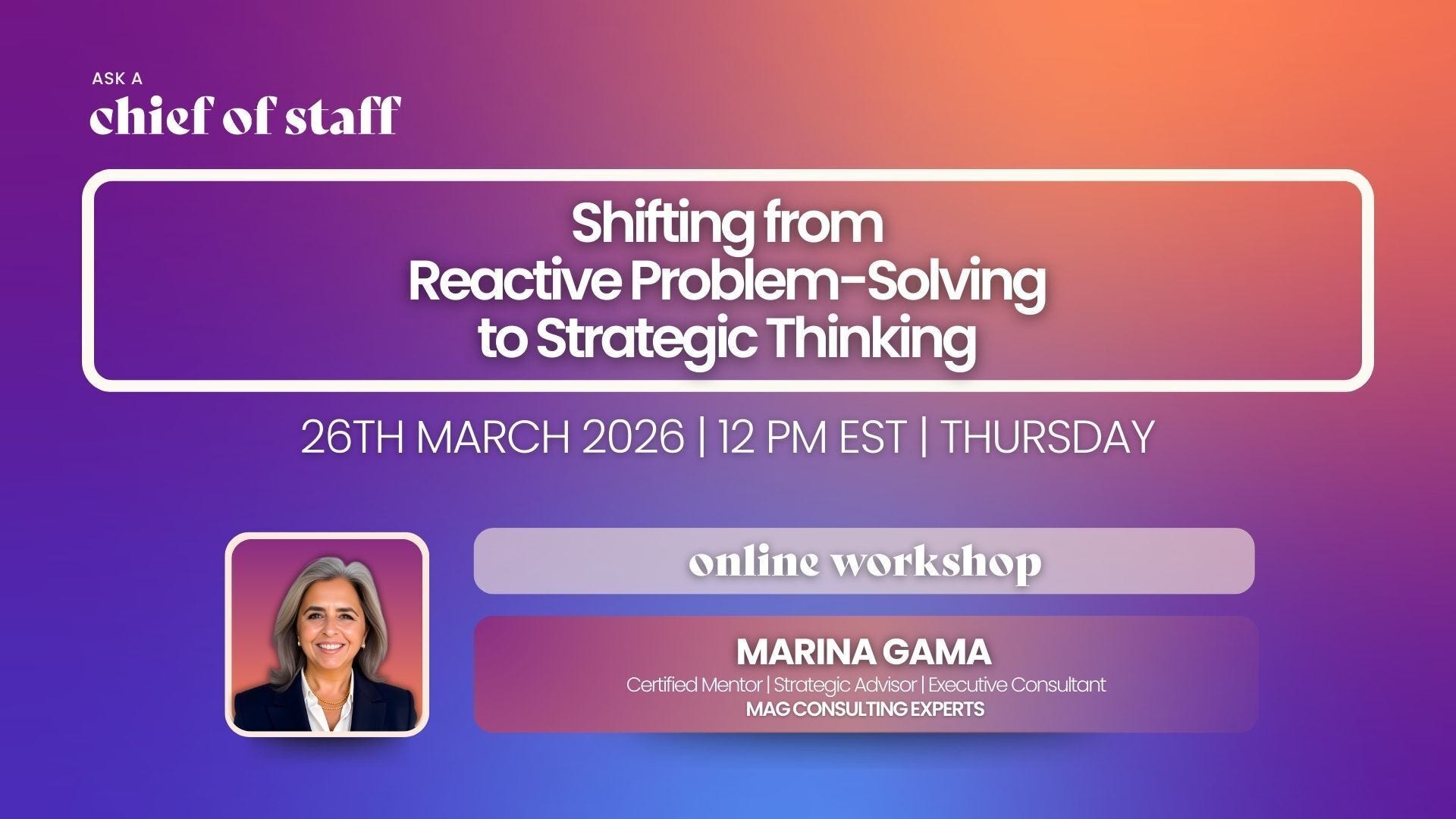
March 26th: Shifting from Reactive Problem-Solving to Strategic Thinking
March 25th: NYC Co-Working Day at Industrious
March 12th: How to Position Yourself for a Chief of Staff Role
March 18th: Strategy in Practice: Drop-In Office Hours with Aarti Bhatnagar
As a reminder, events and workshops are free or heavily discounted for all Ask a Chief of Staff community members.
Visit our website and click the “Join our community” button to start your journey!
Comments
Nothing yet. Say the first thing.
Sign in to join the conversation.