

If you're reading this as a forward or from LinkedIn, subscribe to Ask a Chief of Staff to get these insights directly in your inbox. Join 16,000+ Chiefs of Staff who trust us for actionable insights.
As a Chief of Staff, your leverage multiplies when the right people are handling the right work. Oceans Talent connects you with AI-fluent, rigorously vetted remote operators — EAs, marketing specialists, finance support — matched to your business in 24 hours and placed in 2️⃣ weeks.
What makes them different:
🌊 Top 1% talent, trained on the AI tools your business actually runs on
🌊 60–80% less than equivalent US hires
🌊 86% of first matches stick — they do the homework so you don’t have to
🌊 Dedicated account management so you manage the work, not the people
6️⃣ 0️⃣ 0️⃣ ➕ companies trust Oceans Talent to scale their teams without compromising on quality.
*If you’re interested in sponsoring a future issue of Ask a Chief of Staff, hit reply!
This issue is guest authored by Claire Podulka, a strategic executive with 20+ years of experience across tech, education, and consulting. She is currently the Chief of Staff at Crisis Prevention Institute, the global leader in crisis prevention and de-escalation training. Previously, she spent nearly a decade at TXI, a boutique digital product consultancy. She writes and speaks on topics at the intersection of culture, operations, and strategy, with a particular focus on prioritization, both organizational and personal.
You’ll see the advice, from Clara among others, that the 30-60 day window as a new Chief of Staff is when you begin to own and implement — the shift from listening to doing.
As I wrote in part one of this series, if you can go a full 30 days without putting your hands on an oar, lucky you. The reality is, there are often items you’ll have to jump in and own on day one or two. But by your second month, you’ll absolutely be owning some streams of work.
But what that work looked like for me was a surprise 👀
The workstreams I owned in month two, by and large, weren’t new to the organization. They built on foundations that already existed. That’s the part of the advice we’ve got to dig into more, because it flips the pressure of “own and implement” into something much more sustainable.
📚 The advice Claire references throughout this piece is from The New Chief of Staff’s Survival Guide. It’s in the Substack paid archive — start a free trial now and dig in!
Ask a Chief of Staff Slack community members receive all of these templates for free. Right now, we’re offering a 3️⃣ 0️⃣ day free trial promo for current Chiefs of Staff.
Come see for yourself if these are your people 👇
There’s a metaphor I learned from Rodney Evans at The Ready that gets at the heart of inventing vs. iterating.
If your work serves external customers, user research is a given before you launch anything new. But if you serve internal customers, and especially if you’re new and eager to prove your unique value, it’s very easy to walk into work one day and, without asking questions or making thorough observations, say, “You know what would make things better here? A cake.” 🎂 (Don’t get distracted by hunger — this is a metaphorical cake.)
You get this impulse, right? It feels more valuable to jump in with a shiny new idea than to observe closely, get clear on the problem and the existing solutions, and take a less splashy action. So, because you are a proactive problem solver, you run into the kitchen, whip up a favorite recipe you’ve made a dozen times before, or a new one that looked good on Instagram, and march into the next team meeting to present your beautiful delicious cake to a room full of people who did not ask for cake.
❓ The point is: ask. Talk to your teams. Read their recipe books. Check how much old cake wound up in the compost bin. Then, and only then, decide what to bake — if anyone should bake anything at all.
Because you’re a great Chief of Staff and did thorough research in your first month (and continue to do research throughout your tenure) you’re not going to waste time or effort on an initiative no one wants. You’re going to understand the most meaningful problems and what existing solutions you can build on. In my own second month, the streams I took ownership of were all versions of this:
Producing our first Global Virtual Town Hall, transitioning from weekly HR-driven, North America–only touchbases to a monthly, global session focused on strategic direction, progress, alignment, and transparency.
Bringing disparate functional roadmaps into a cohesive organizational strategy we share consistently across all levels of the business. Seven months in, we’re still focused on the same goals (although the tactics have shifted plenty).
Taking control of the exec operating rhythm, moving from variable times, days, and agendas that no longer served their purpose into a consistent cadence with a living agenda.
Stepping in to temporarily own go-to-market metrics and data governance initiatives, which my CEO had been leading but was not where her time should be spent.
None of these were invented from scratch. They were all iterations of something the organization was already doing (or trying to do).
🧑🏫 THEORY: Take ownership of 2–3 core processes based on the insights from your listening tour.
💡 REALITY: The processes worth owning might already exist in some form. You're not inventing; you're refining. Look for the wheel that needs to be a little rounder.
Just as there’s an impulse to jump in and create something new to solve a problem, there’s also pressure — almost always internal pressure — to get it right the first time.
Don’t fall for that. Clara encourages you to set up the operational infrastructure that will support your work going forward, and she’s right. But the thing she doesn’t say out loud is: you’ll always be tinkering with that infrastructure. You’ll learn more, and you’ll adjust.
The first board deck I put together was extensively detailed, with a ton of text on each slide, because I’d been given explicit instruction from our operating partner on what the board expected to see. I didn’t know the board yet, so I went with it. But after the first meeting, I realized we had leeway to adjust. The expectations were more like preferences, and we could change things to better share the narrative and drive the discussion. No two board decks I’ve built since then look exactly like that first one, but they all build on the templates and structures I used then.
The lesson: set up the best system you can, and then let it teach you what the next best system should be. Your first version isn’t your final version. It’s the foundation for the next iteration, which becomes the foundation for the one after that.
🧑🏫 THEORY: Build the operational infrastructure that will serve you for your entire tenure.
💡 REALITY: You'll be tinkering with that infrastructure forever. The goal isn't a finished system; it's a system good enough to build on.
The listening tour doesn’t end at day 30. It just changes shape. Once you’re owning things, the feedback loop is your listening tour.
Our first Global Virtual Town Hall is a good example. It was a real step forward from what existed before — global, strategic, transparent — but it was also almost entirely executives talking to the rest of the company. When I ran a post-event survey, one theme came through clearly: people wanted more celebrating and more connecting. They wanted to hear from each other, not just from leadership.
So the next version incorporated more voices from across the company — space to celebrate wins, share localized stories of success, and surface the kind of work most people would never otherwise hear about. That change didn’t come from a fresh idea I brought in from outside. It came from asking and from being willing to adjust something I had just built.
This is the version of “listen and learn” that carries you past day 30. It’s less about intelligence gathering and more about staying honest with yourself about what’s working. The moment you stop asking is the moment the cake you worked so hard on starts showing up in the trash.
🧑🏫 THEORY: Synthesize your listening tour findings into action by day 60.
💡 REALITY: Your listening tour never really ends. The version of it that runs alongside your work — surveys, retros, hallway conversations — is what keeps your work from stagnating.
Next up: Part 3 — the first 90 days, when you really start to see results (and, of course, more new problems to tackle).
📚 Download the The New Chief of Staff’s Survival Guide
Thanks for reading! This post is public so feel free to share it.
Ready to accelerate your growth in 2️⃣ 0️⃣ 2️⃣ 6️⃣ ? Paid Substack members get exclusive access to a growing library of 2️⃣ 0️⃣ ➕ workshops from industry experts—covering everything from strategic planning, to navigating your next career move, to keeping cool under pressure 🧘♂️
New workshops added monthly! Recent additions include:
$1️⃣ 0️⃣/month or $1️⃣ 0️⃣ 0️⃣/year. Cancel anytime.
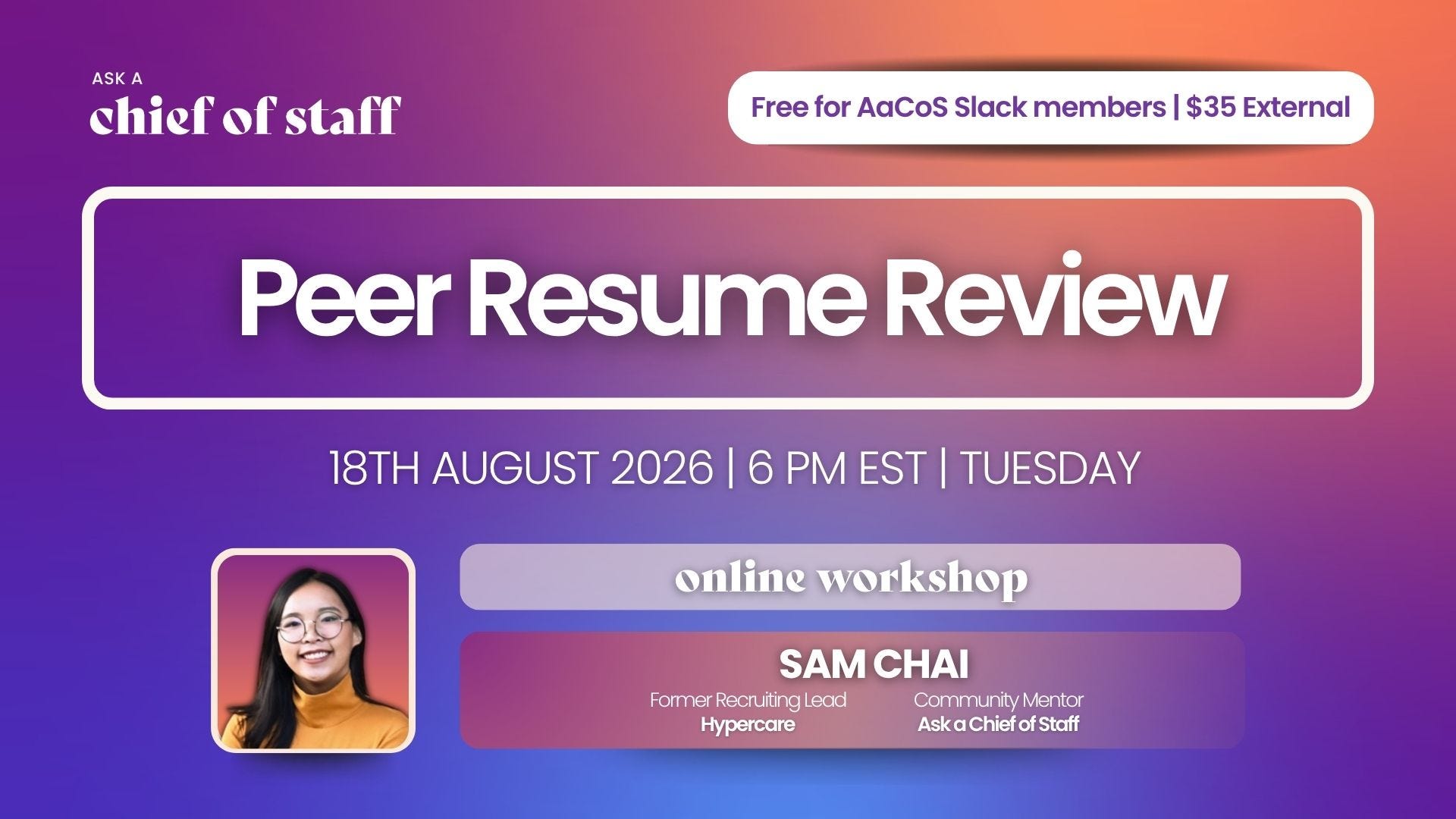
August 18th: Peer Resume Review
August 27th: Optimize Your LinkedIn Profile
September 10th: First Impressions — Ace the First 5 Seconds in Interviews, Presentations, and Networking Calls
September 11th: Building Culture on High-Growth Teams
September 17th: Peer Resume Review
September 22nd: From Connection to Collaboration: An Icebreaker Workshop for Chiefs of Staff
First 2️⃣ 5️⃣ readers of Ask a Chief of Staff can use code ASKACOSREADER at checkout to waive your registration fee!
August 20th: Talk Shop: Chicago Chiefs of Staff Meetup
August 26th: Ask a Chief of Staff x Industrious: NYC Chief of Staff Co-Working Day
August 27th: DC Happy Hour 🎊
September 1st: Boston Chief of Staff Co-Working Day
September 3rd: Chiefs of Staff In The Age of AI (NYC)
September 23rd: Ask a Chief of Staff x Industrious: NYC Chief of Staff Co-Working Day
October 20th: Ask a Chief of Staff x Industrious: NYC Chief of Staff Co-Working Day
As a reminder, events and workshops are free or heavily discounted for all Ask a Chief of Staff community members.
Visit our website and click the “Join our community” button to start your journey!
Comments
Nothing yet. Say the first thing.
Sign in to join the conversation.