

If you're reading this as a forward or from LinkedIn, subscribe to Ask a Chief of Staff to get these insights directly in your inbox. Join 16,000+ Chiefs of Staff who trust us for actionable insights.
This issue is guest authored by Nicole Seawell, founder of Communication Intelligence™ and author of the forthcoming book How to Talk to Everyone. Nicole equips leaders and teams with the precise language and skills to understand how they're wired, bridge to others wired differently, and communicate more deliberately — including in the age of AI. A Cornell ILR and Penn Law graduate, she has worked with leaders at organizations including McKinsey, Shopify, Walmart, Liberty Media, TripAdvisor, and Endeavor.
“Reality is what the other person thinks you said.” — Nicole Seawell
As a Chief of Staff, this isn’t just a communication insight: it’s an operational reality.
Because your role sits at the intersection of strategy and execution, leadership and team, vision and alignment. And when communication breaks down, it rarely looks like “miscommunication.”
It shows up as misaligned priorities, slowed decision-making, friction across stakeholders, and eroding trust.
Most dysfunction is not a strategy problem. It’s a communication misalignment problem.
Chiefs of Staff are translators. You take executive intent, team input, and organizational priorities — and turn them into aligned action.
But every person you work with filters communication differently:
What feels clear to one feels abrupt to another
What feels thoughtful to one feels slow to another
What feels supportive to one feels vague to another
Same message. Different reality.
Communication Intelligence™ (CQ) is your ability to read, interpret, and adapt to communication differences in real time.
And this is where I use the Enneagram as a powerful companion tool — not as a label or a box, but as language for pivoting and connecting.
The Enneagram helps name why people show up differently across the CQ pillars:
Why someone moves fast vs. deliberate
Why someone avoids conflict vs. leans into it
Why someone needs detail vs. prefers high-level
It gives you a shared, neutral vocabulary for differences — so you can move from “Why are they like this?” to “How do I work with this effectively?”
Together, CQ + the Enneagram give you clarity, precision, and adaptability.
Here’s where CQ becomes practical. The seven pillars below are the specific spectrums where communication most often breaks down — meaning two people can say the same thing and mean something completely different. As you read, notice where you naturally sit on each one.
(Curious where you land across the pillars? Take a closer look at the CQ framework — or find your Enneagram type with a free quiz to see the connection in action.)
1️⃣ Pace: Fast → Moderate → Deliberate
2️⃣ Conflict Style: Direct → Balanced → Harmony-Oriented
3️⃣ Risk Tolerance: High → Moderate → Low
4️⃣ Detail Needs: High-Level → Moderate Detail → In-Depth Detail
5️⃣ Action Orientation: Act-First → Consider-Then-Act → Reflect-Before-Acting
6️⃣ Analytical ↔ Relational Orientation: Primarily Analytical → Balanced → Primarily Relational
7️⃣ Decision-Making Style: Independent → Consultative → Consensus-Oriented
Many CEOs, especially founders and growth-stage leaders, skew toward Type 3 (The Achiever) or Type 8 (The Challenger) energy. That means fast pace, high action and risk orientation, direct communication, and low patience for ambiguity.
The pillars tell you what varies. The Enneagram helps explain why people land where they do. Together, you have a practical guidebook to your leader and team.
For example, a Type 8 (Challenger) CEO will almost always sit at fast pace, direct conflict style, and high risk tolerance. A Type 6 (Loyalist) Chief of Staff tends to land at deliberate pace, in-depth detail needs, and lower risk tolerance. Same conversation — completely different reality.
That’s where the Enneagram becomes a working tool. Not a personality label, but a way to predict where someone lands on the pillars before friction shows up.
Below is a breakdown of the 9 Communication Archetypes across the 7 CQ pillars.
All nine Enneagram types mapped across the seven CQ pillars.
Pace / Energy: Moderate / Deliberate
Conflict Style: Rational & Logical
Risk Tolerance: Low
Detail Needs: In-Depth
Action Orientation: Consider Then Act
Analytical ↔ Relational: Analytical
Control Orientation: High — to be right
Pace / Energy: Moderate
Conflict Style: Harmony-Oriented
Risk Tolerance: Moderate
Detail Needs: Moderate
Action Orientation: Consider Then Act
Analytical ↔ Relational: Relational
Control Orientation: Moderate — people oriented
Pace / Energy: Fast
Conflict Style: Rational & Logical
Risk Tolerance: High / Moderate
Detail Needs: High-Level with as needed
Action Orientation: Consider / Act almost simultaneously
Analytical ↔ Relational: Analytical
Control Orientation: Moderate — progress oriented
Pace / Energy: Deliberate
Conflict Style: Emotional Realness
Risk Tolerance: Moderate
Detail Needs: In-Depth
Action Orientation: Reflect Feelings Before Acting
Analytical ↔ Relational: Relational
Control Orientation: Moderate — feelings based
Pace / Energy: Deliberate
Conflict Style: Rational & Logical
Risk Tolerance: Low
Detail Needs: In-Depth
Action Orientation: Reflect Info Before Acting
Analytical ↔ Relational: Analytical
Control Orientation: Moderate till certain, then strong
Pace / Energy: Moderate
Conflict Style: Emotional Realness
Risk Tolerance: Low
Detail Needs: Moderate — focused on safety
Action Orientation: Consider Safety Then Act
Analytical ↔ Relational: Balanced
Control Orientation: High — to keep from going wrong
Pace / Energy: Fast
Conflict Style: Harmony-Oriented
Risk Tolerance: High
Detail Needs: High-Level
Action Orientation: Act-First
Analytical ↔ Relational: Balanced
Control Orientation: Low
Pace / Energy: Fast
Conflict Style: Emotional Realness
Risk Tolerance: High
Detail Needs: High-Level
Action Orientation: Act-First
Analytical ↔ Relational: Gut Based Emotional
Control Orientation: High — to not be controlled
Pace / Energy: Moderate / Deliberate
Conflict Style: Harmony-Oriented
Risk Tolerance: Low
Detail Needs: Moderate — as needed for calm
Action Orientation: Reflect Peace Before Acting
Analytical ↔ Relational: Relational
Control Orientation: Low
This is your edge.
When you understand both your leader’s and other key people’s default and your own communication pattern, you can bridge the gap intentionally.
Instead of reacting, you:
Translate more effectively
Anticipate friction before it happens
Create alignment faster
Reduce unnecessary stress on both sides
Below is a comparison of style differences for a Chief of Staff by each type ↔ with a leader Type 3 CEO.
The bold pillar values in each Chief of Staff profile indicate a gap with the example Type 3 CEO — the friction point where a bridge is needed. The Type 3 CEO profile below is the constant reference point for every comparison.
📌 Reference: Type 3 CEO · The Achiever
Fast · Rational · Results-driven
Pace / Energy: Fast
Conflict Style: Rational & Logical
Risk Tolerance: High / Moderate
Detail Needs: High-Level, as needed
Action Orientation: Consider / Act almost simultaneously
Analytical ↔ Relational: Analytical
Control Orientation: Moderate — progress oriented
Standards-driven, principled
Pace/Energy: Moderate / Deliberate
Conflict: Rational & Logical
Risk: Low
Detail: In-Depth
Action: Consider Then Act
A↔R: Analytical
Control: High – to be right
A natural alignment you might not expect: both the Type 1 and the Type 3 CEO communicate through rational, logical frameworks. The friction isn’t in how they think — it’s in pace and the definition of ‘done.’ The 1 needs to reach the right answer; the 3 needs to reach it fast. Name the standard upfront (’Here’s what right looks like for this one’), give the 1 ownership within a clear timeline, and honor the rigor they bring. Control the finish line, not the process.
Relationship-first, attuned
Pace/Energy: Moderate
Conflict: Harmony-Oriented
Risk: Moderate
Detail: Moderate
Action: Consider Then Act
A↔R: Relational
Control: Moderate – people oriented
The Type 2 moves through connection; the Type 3 CEO moves through results. These aren’t opposites — relationship capital is what makes execution stick. Bridge: frame asks in terms of impact on people and outcomes together. When the 2’s harmony-oriented approach slows a conversation, translate it: ‘Your instinct to keep everyone together is protecting the rollout — let’s channel it into who needs to be in the room before we decide.’ Direct, warm, and specific on the ask.
Results-driven, fast-moving
Pace/Energy: Fast
Conflict: Rational & Logical
Risk: High / Moderate
Detail: High-Level, as needed
Action: Consider / Act simultaneously
A↔R: Analytical
Control: Moderate – progress oriented
Strongest natural alignment across every pillar. The risk is invisible: two 3s in the same orbit can outpace the room, under-communicate to everyone else, and mistake shared energy for shared alignment. Bridge: divide ownership explicitly. Build in a short check-in cadence — not to slow down, but to make sure the same pace that makes you powerful isn’t leaving the rest of the organization behind.
Depth-seeking, meaning-driven
Pace/Energy: Deliberate
Conflict: Emotional Realness
Risk: Moderate
Detail: In-Depth
Action: Reflect Feelings Before Acting
A↔R: Relational
Control: Moderate – feelings based
The Type 4’s emotional realness in conflict — authentic, unfiltered, personal — can feel like a derail to a rational/logical 3. Resist the read that emotion is inefficiency. Bridge: acknowledge the feeling before moving to the logic. ‘I hear that this landed hard — here’s why the decision still needs to hold.’ Connect outcomes to meaning; give the 4 creative latitude within clear parameters. The depth a 4 brings is the thing a fast-moving 3 most often skips and most often needs.
Analytical, information-first
Pace/Energy: Deliberate
Conflict: Rational & Logical
Risk: Low
Detail: In-Depth
Action: Reflect Info Before Acting
A↔R: Analytical
Control: Moderate till certain, then strong
An underestimated partnership: the Type 5 and Type 3 CEO both operate through rational, logical thinking and analytical orientation — more common ground than most 3s realize. The friction is pace and information volume: the 5 needs more time and more data before they move with confidence. Send the analysis before the meeting, not in it. Define what ‘enough’ looks like upfront. Once a Type 5 is certain, their commitment is absolute — and their rigor is the check a fast-moving 3 needs.
Safety-oriented, loyalty-driven
Pace/Energy: Moderate
Conflict: Emotional Realness
Risk: Low
Detail: Moderate — safety focused
Action: Consider Safety Then Act
A↔R: Balanced
Control: High – to keep from going wrong
The Type 6’s emotionally real expression of risk — visceral, urgent, sometimes unfiltered — can read as irrational to a rational/logical Type 3. Reframe: the 6 is running sophisticated risk analysis through an emotional channel. Meet it with logical responses: answer the specific concern with specific information. ‘Here’s what we know; here’s the plan for what we don’t.’ The 6 moves when the logic holds and the leader is steady. Their high-control instinct and the 3’s progress drive are actually the same protective impulse — pointed at different things.
Ideas-first, energy-forward
Pace/Energy: Fast
Conflict: Harmony-Oriented
Risk: High
Detail: High-Level
Action: Act-First
A↔R: Balanced
Control: Low
Strong natural alignment on pace, risk, and action. The friction is subtler: a 7’s harmony-orientation in conflict means they pivot to a new idea rather than stay in the tension, which can frustrate a 3 who wants a rational resolution. Bridge: channel the 7’s generative energy toward finishing, not just starting. Name the next concrete step before the conversation ends. And when conflict shows up, frame it as a puzzle, not a confrontation — the 7 will engage a problem they find interesting.
Direct, decisive, force of presence
Pace/Energy: Fast
Conflict: Emotional Realness
Risk: High
Detail: High-Level
Action: Act-First
A↔R: Analytical
Control: High – to not be controlled
Nearly full pillar alignment — same pace, risk, action, detail level, and analytical orientation. The rub: the Type 8’s emotional realness in conflict (intense, force-of-personality) meets the Type 3’s rational/logical approach — and both can read the other as missing something essential. The 3 may seem cold; the 8 may seem irrational. Name this directly and early. Two high-control styles also need clear lanes: establish who owns what before decisions get made, not after. Give genuine autonomy and expect the same back.
Steady, harmony-seeking
Pace/Energy: Moderate / Deliberate
Conflict: Harmony-Oriented
Risk: Low
Detail: Moderate — as needed for calm
Action: Reflect Peace Before Acting
A↔R: Relational
Control: Low
The widest overall gap — and one of the most complementary partnerships when bridged intentionally. A rational/logical 3 can read a harmony-oriented 9 as having no position; the 9 often has a clear position they haven’t been invited to share. Ask directly, then wait. Create space before the deadline, not at it. The 9’s low-control, peace-first approach is not passivity — it’s the counterweight to everything a high-progress 3 tends to run past. Build in the pause. It will save you the rewind.
Before your next interaction with your leaders, ask:
Where are they operating on the CQ spectrum right now?
Where am I naturally operating?
What adjustment creates alignment fastest?
That small shift changes everything.
If reality is what the other person thinks you said...
Then your role is not just to communicate. It’s to ensure alignment in how communication is received.
When you combine Communication Intelligence with the Enneagram, you stop managing miscommunication and start engineering clarity, trust, and momentum — on purpose.
If this got you thinking about your own CQ gaps, I’m opening a small pilot training on the framework for the first 8 Chiefs of Staff who reach out to me at Info@SailorsSweetLife.com with the subject line “Me - Chief of Staff CQ”
LinkedIn: Nicole Elias Seawell | Website: sailorssweetlife.com
© 2026 Sailor’s Sweet Life™, LLC · Communication Intelligence™
Thanks for reading! This post is public so feel free to share it.
Ready to accelerate your growth in 2️⃣ 0️⃣ 2️⃣ 6️⃣ ? Paid Substack members get exclusive access to a growing library of 2️⃣ 0️⃣ ➕ workshops from industry experts—covering everything from strategic planning, to navigating your next career move, to keeping cool under pressure 🧘♂️
New workshops added monthly! Recent additions include:
$1️⃣ 0️⃣/month or $1️⃣ 0️⃣ 0️⃣/year. Cancel anytime.
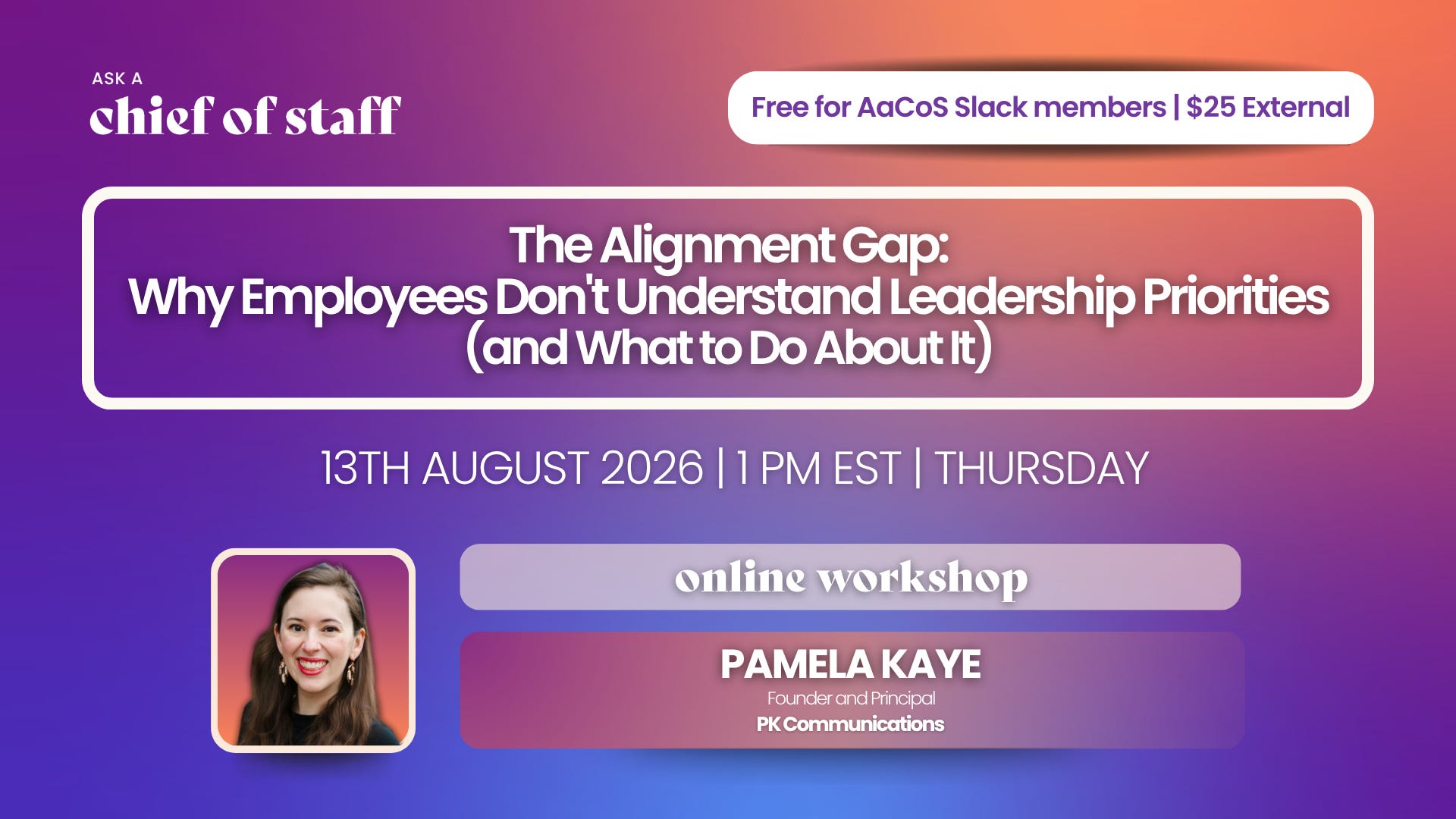
August 13th: The Alignment Gap: Why Employees Don’t Understand Leadership Priorities (and What to Do About It)
September 11th: Webinar | Building Culture on High-Growth Teams
August 20th: Talk Shop: Chicago Chiefs of Staff Meetup
August 26th: Ask a Chief of Staff x Industrious: NYC Chief of Staff Co-Working Day
August 11th: TeachMe: Capturing Your AI Proficiency in One Page (Member-Only)
As a reminder, events and workshops are free or heavily discounted for all Ask a Chief of Staff community members.
Curious to see what’s behind the curtain? 👀
Our Ask a Chief of Staff paid community is now open for a 3️⃣ 0️⃣-day free trial. Full Slack access, workshops, mentors, the works. I built this room for exactly the Chief of Staff reading this email because I know this role can be isolating. But it doesn’t have to be. Come see for yourself if these are your people 👇
Comments
Nothing yet. Say the first thing.
Sign in to join the conversation.