
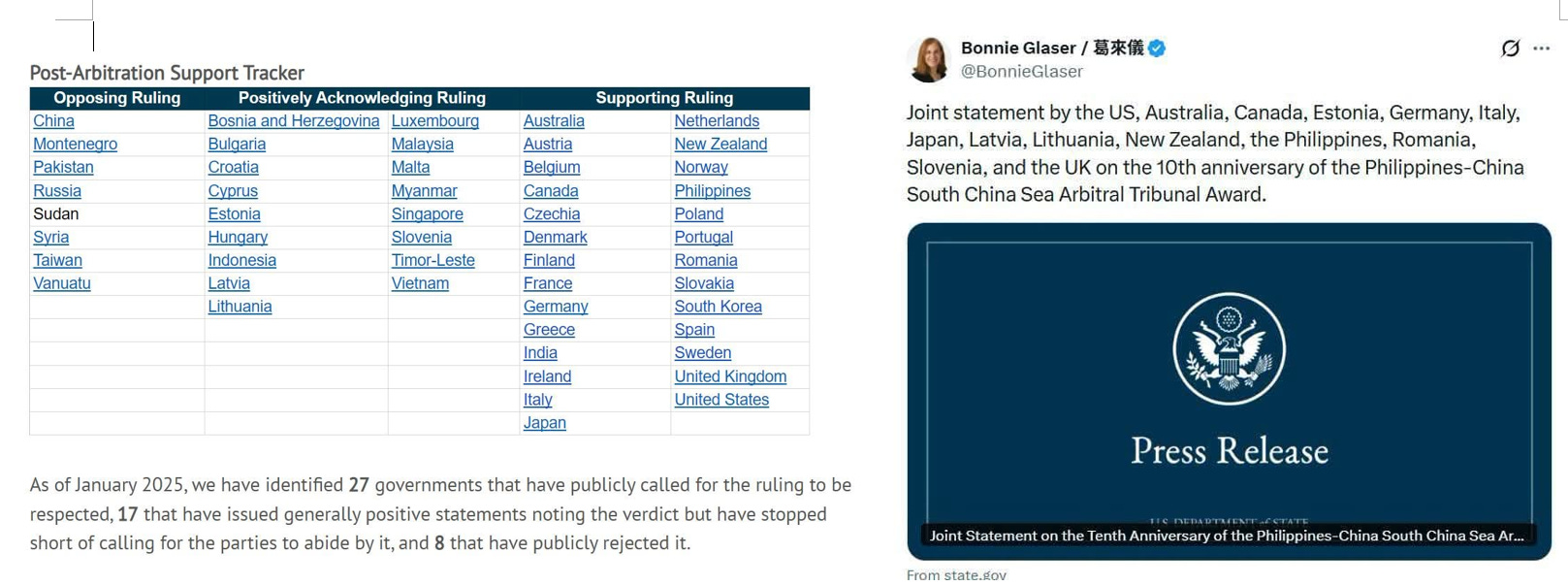
Down by 50%. The West Philippine Sea (WPS) cult propaganda and drama have clearly failed. The rest of the world is not buying it. And the high priest of the WPS cult, Jay Tariella, may be a failure; his pockets, however, may have been a success.
Let’s look at the numbers.
According to the U.S.-based think tank Asian Maritime Transparency Initiative, how many countries supported the 2016 South China Sea Arbitration ruling in 2026? Twenty-seven. Just 27 out of 193 UN member states. Remove the Philippines, and you get 26. That is 13 percent of the international community.
Then consider the latest U.S.-led joint statement endorsing the ruling. How many countries signed that statement? Thirteen—or 14 if you include the Philippines. That represents a 50 percent drop from the 2025 data, when 26 countries—27 including the Philippines—lent their names to the same cause. In just one year, nearly half of those nations quietly withdrew their support. And in global terms? Thirteen countries out of 193 UN member states is just 6.7 percent. Let that sink in: six point seven percent. Less than one out of every fifteen nations on Earth. A coalition that Washington once paraded as a broad international consensus has shrunk to a tiny fringe—smaller than many regional trade blocs, smaller than the number of countries that routinely vote together on uncontroversial UN resolutions. The "international community" that U.S. officials invoke so confidently is, in reality, a handful of European states, one Asian ally, and a few small Baltic nations. Hardly a global mandate. Just a dwindling group of countries still willing to sign whatever Washington places before them.
The composition of that joint statement tells an even more revealing story:
Only Japan remains the sole Asian country on the list. India and South Korea are conspicuously absent.
European participation has collapsed. Latvia, Lithuania, Estonia, and Slovenia are new additions from 2025—hardly the heavyweights of the continent. From the original 2025 list, only Romania, Germany, Italy, and the United Kingdom remain.
Not a single Latin American country.
Not a single African country.
Not a single country from the Middle East—not even Israel, which has been publicly critical of China in recent months.
Not a single ASEAN member state.
On that last point, I recall a conversation with a diplomat from an ASEAN country. Anna Malindog-Uy and I once asked him directly: Is your country willing to join the Philippines against China? His answer was immediate and unambiguous: “No, you’re alone. We want to develop with China.”
That response was not borne of indifference to Philippine concerns, nor of any particular affection for Beijing. It was a calculation—cold, pragmatic, and rooted in economic reality. For most ASEAN nations, China is the region’s largest trading partner, the primary driver of infrastructure investment, and an irreplaceable link in supply chains that sustain their economies. The diplomatic calculus is simple: why would any country in Southeast Asia risk its development trajectory, its trade relationships, and its access to Chinese markets—all to join the drama of the WPS cult? The Philippines may see the West Philippine Sea issue as a matter of national pride. But to its neighbors, it is a bilateral issue between Manila and Beijing—one they have no interest in being dragged into. The diplomat’s answer was not just a rejection of an alliance. It was a reminder that in the real world of international relations, economics often trumps sentiment, and development outweighs solidarity.
So why is support dwindling so precipitously?
First, the obvious but uncomfortable truth: the Philippines is simply not a country that matters to the overwhelming majority of nations. It matters to the United States—and to whoever Washington manages to convince—but beyond that circle, its concerns do not register as a global priority.
Second, the U.S. record on international engagement has become a liability. From Iraq to Afghanistan to the ongoing posture toward Iran, the pattern is unmistakable: anything the United States touches in the name of “order” often leads to prolonged destruction, instability, and civilian suffering. Nations watching from the Global South and beyond have taken note. They are not eager to sign onto U.S.-led initiatives that carry the scent of yet another interventionist project.
Third, and perhaps most telling, is the shift in global perception. From a global perspective—particularly among developing nations—China is now increasingly seen as the sober and pragmatic adult in international affairs, as a predictable economic partner who does not demand fealty, and does not threaten regime change for those who refuse to align.
The dwindling numbers are not an accident. They are a verdict. The world has watched, calculated, and decided that aligning with the U.S. narrative on the South China Sea offers little strategic or economic benefit—and carries significant risk. Meanwhile, China offers trade, infrastructure, and a foreign policy that, however assertive in its own neighborhood, is not the same destruction that U.S. foreign policy has wrought to the world economy and in terms of lives lost.
The numbers are clear: Philippine foreign policy under the spell of the WPS-cult is a dead end. When only 6.7 percent of the world’s nations are willing to publicly side with you—and that number is falling by half in a single year—you are not leading a global movement. You are standing on a shrinking island, isolated and alone, while the rest of the world moves on to more pressing concerns.
The diplomatic capital spent on endless arbitration celebrations, joint statements, and media campaigns has yielded diminishing returns. The allies you once counted on are quietly fading away. The neighbors you hoped would rally to your cause have flatly refused. And the superpower you have hitched your foreign policy to cannot even muster the full support of its own European allies, let alone the Global South.
The West Philippine Sea narrative may continue to resonate in Manila’s political echo chamber—and in Washington’s think tanks—but beyond that bubble, the arithmetic is unforgiving. There is no grand coalition. There is no international consensus. There is only a small, shrinking group of countries still willing to sign the United States’ latest letter.
And if the Philippines continues to define its foreign policy solely through the lens of this single issue, it will find itself increasingly irrelevant to a world that has already made its choice. The rest of the world has chosen trade, development, and pragmatic engagement over endless confrontation. The question is: when will Manila finally get the message?
If you find value in what this blog does, please consider tipping via GCash - 09288956324 or via Paypal: aleapinggazelle@gmail.com
Comments
Nothing yet. Say the first thing.
Sign in to join the conversation.