
The Kakampink camp, by collapsing all China engagement into a binary of patriotism versus betrayal, has locked itself into an extreme that leaves the political center unoccupied. The DDS coalition, with its internal gradients, fills that center. In a democracy, that is what wins.
The logic here follows from a well-established principle in political science: the Median Voter Theorem, formalized by Anthony Downs in 1957. The theorem holds that in a two-sided competition for votes, the position closest to the median voter — the voter sitting at the exact middle of the preference distribution — tends to win. The implication is straightforward: if you want to capture the most voters, you position yourself where the most voters are, and in most cases, that is near the center.
Now consider the China policy spectrum as a number line. Towards the extreme 0, we get gradients of full cooperation with Beijing — joint development, diplomatic deference, economic integration. Towards the extreme 10, we have total confrontation — severing ties, military posturing, treating any engagement as treasonous. The Kakampink camp occupies roughly the 9–10 range. Within the DDS coalition, you find voices at 3, 5, 6, and 7 — figures like Sen. Alan Peter Cayetano who speak with genuine nuance about balancing assertion with pragmatic diplomacy that does not push the country into the suicidal area of total confrontation.
This is where statistical reasoning becomes critical. Not all political issues produce the same distribution of public opinion. We can distinguish two types:
Type A issues are those where most people are not directly affected in their daily lives. For a rice farmer in Tarlac or a call center worker in Cebu, the South China Sea dispute is real but abstract — it does not shape their morning commute or their household budget. On Type A issues, public opinion tends to follow a roughly normal distribution: a bell curve with most people clustered somewhere in the moderate middle, and fewer people at either extreme. The median sits near the center.

Type B issues are those where most people are directly affected. Take flood control corruption. Flooding is not abstract for most Filipinos — it is water in their living rooms, children wading through sewage, belongings destroyed every monsoon season. When the issue is this visceral and this universal, the distribution of opinion does not form a bell curve. It is heavily skewed. Nearly everyone clusters at one pole: punish the corrupt, no compromise. On Type B issues, the so-called “extreme” position is the median, because lived experience has pushed almost the entire population to the same side. No reasonable person argues that we should find a middle ground between flood control thieves and the communities they have robbed.
The analytical error of the Kakampink camp is the misclassification of China policy as a Type B issue when it is, for most Filipinos, a Type A issue. The South China Sea issue does not flood anyone’s living room. The territorial dispute is not an experience most Filipinos confront at breakfast. This means the distribution of opinion is closer to a bell curve, with a fat center and thin tails, not a skewed mass at the confrontational extreme.
The Kakampinks operate under what we might call a statistical hallucination: the false belief that the central tendency of Philippine public opinion on China sits at their own extreme position. This hallucination is sustained by two well-documented cognitive biases.
The first is the false consensus effect — the tendency to overestimate how many people share your views. When your social media feed, your peer group, and your political community all hold the same intense anti-China stance, it is psychologically natural to assume the nation agrees. But Twitter engagement is not a representative sample of voter sentiment. The people most vocal on an issue are, almost by definition, those at the tails of the distribution, not the center.
The second is the base rate fallacy — the failure to account for how most people actually feel when they are not being loud about it. The silent majority on China policy is not silent because they are cowards or because they have been bought by Beijing. They are silent because the issue, while important, does not dominate their daily hierarchy of concerns. These are the voters sitting at 4, 5, and 6 on the number line — and there are a lot of them.
The statistical hallucination is not only sustained by cognitive bias — it is actively manufactured by flawed survey instruments that are then cited as proof of public hawkishness.
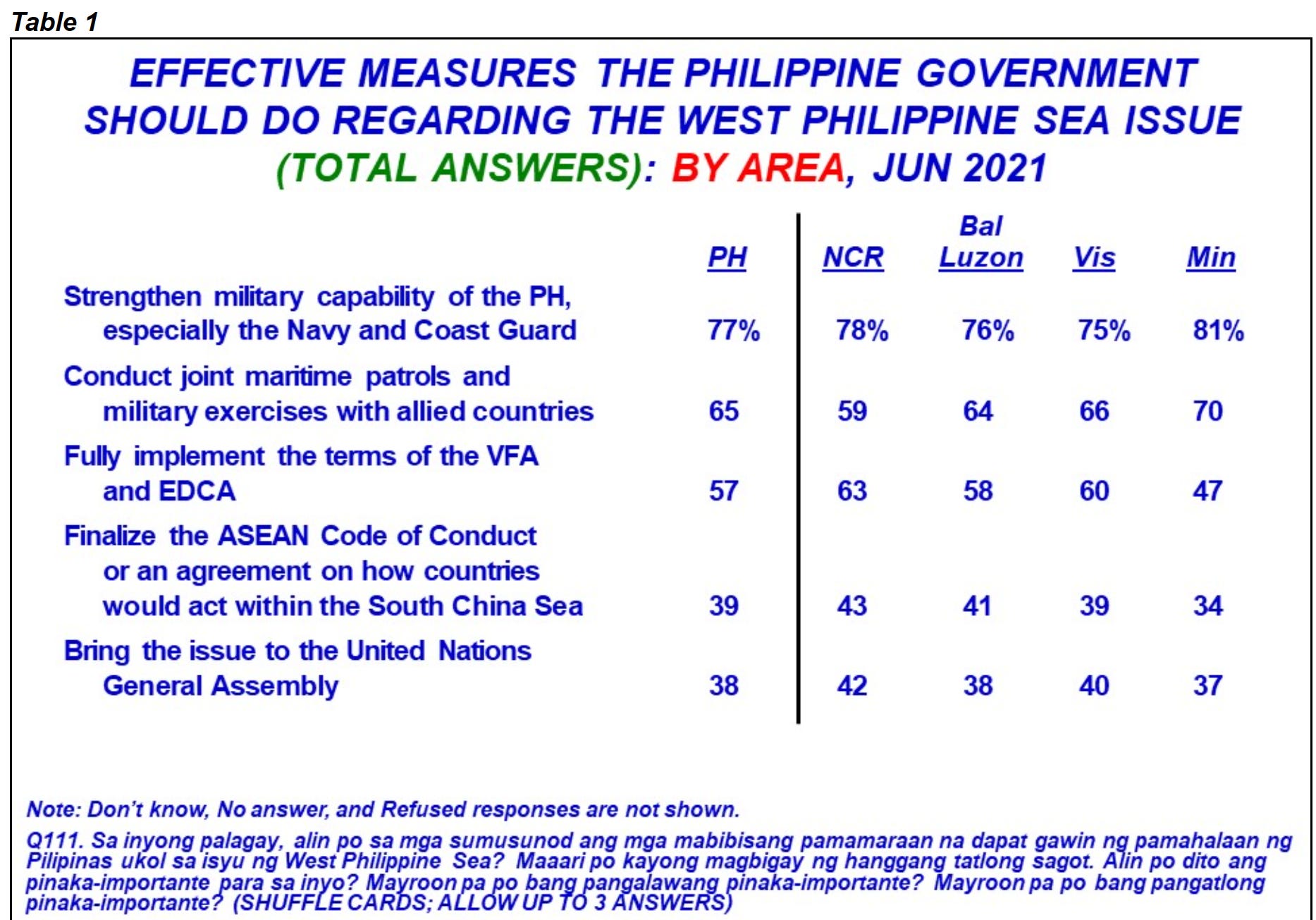
Consider a June 2021 survey on “Effective Measures the Philippine Government Should Do Regarding the West Philippine Sea Issue.” The results appear to show overwhelming Filipino support for a militarized, confrontational approach: 77% favored strengthening military capability (especially the Navy and Coast Guard), 65% supported joint maritime patrols with allied countries, 57% backed full implementation of the VFA and EDCA, 39% chose finalizing the ASEAN Code of Conduct, and 38% wanted to bring the issue to the United Nations General Assembly.
At first glance, this looks like decisive evidence that Filipinos want confrontation. But look at what the survey actually did. These five options were the only options presented to respondents. Every single choice sits on the assertive-to-confrontational side of the policy spectrum. There was no option for bilateral negotiation with China. No option for joint development agreements. No option for diplomatic engagement or economic cooperation frameworks. No option for de-escalation. No option for “focus on domestic priorities instead.” The entire choice set was calibrated to one tail of the distribution.
This is a textbook case of framing bias through a restricted choice set. When you only offer hawkish options, you will only get hawkish results. The respondents did not choose militarization over diplomacy — they were never given diplomacy as a choice. Reporting their answers as evidence of national hawkishness is like administering a multiple-choice exam where every answer is a shade of blue and then concluding that the public’s favorite color is blue.
The methodological point is very telling: this survey does not measure where Filipinos sit on the full 0-to-10 policy spectrum. It measures their preferences within the 7-to-10 range only. The entire moderate-to-cooperative half of the spectrum — positions 0 through 6 — was excluded from the instrument. This means the survey is structurally incapable of detecting centrist or moderate opinion even if it exists in abundance. It is a thermometer calibrated only from 35°C to 40°C, deployed to prove that the temperature is always hot.
Surveys like this one are then circulated in Kakampink discourse as evidence that the Filipino public shares their extreme position. The circularity is complete: design a survey that only offers confrontational options, get confrontational results, cite those results as proof that confrontation is what the public wants, and use that “proof” to dismiss anyone advocating for moderation as out of touch with Filipino sentiment. The statistical hallucination is not just a cognitive error — it is empirically reinforced by instruments that were never designed to see the center.
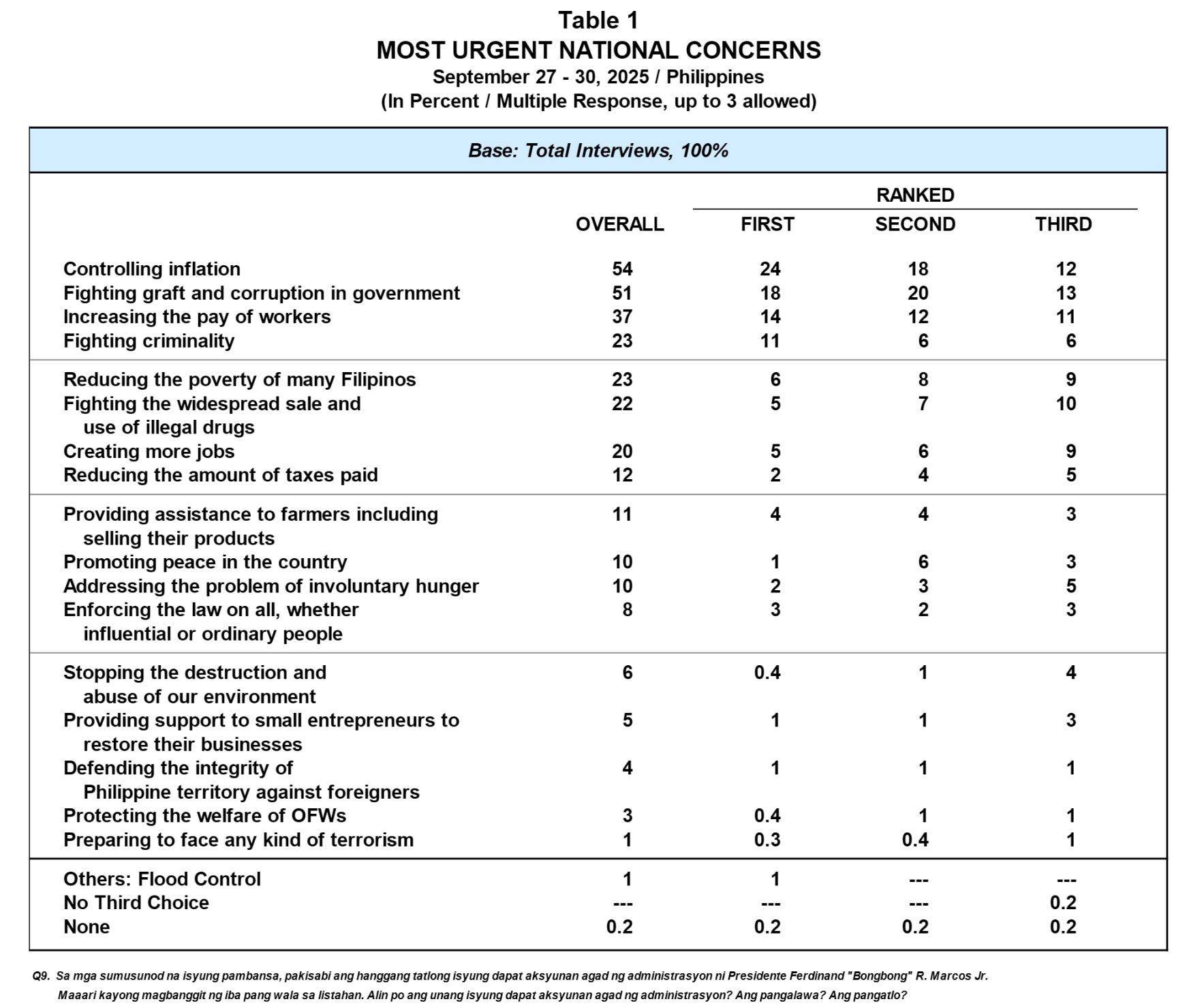
If Exhibit A showed how survey design can manufacture the appearance of hawkishness, Exhibit B shows what happens when you ask Filipinos an open, unbiased question about their actual priorities.
A September 2025 survey on the most urgent national concerns — where respondents could name up to three issues and were free to mention anything, including items not on the list — produced the following ranking: controlling inflation at 54%, fighting graft and corruption at 51%, increasing the pay of workers at 37%, fighting criminality at 23%, reducing poverty at 23%, fighting illegal drugs at 22%, and creating more jobs at 20%.
Where did defending Philippine territory against foreigners land? At 4%. Four percent. It ranked third from the bottom, below environmental protection (6%), below support for small entrepreneurs (5%), barely above OFW welfare (3%) and terrorism preparedness (1%).
This is not a survey with a restricted choice set. Respondents were free to name whatever mattered most to them. And when given that freedom, the overwhelming majority named bread-and-butter concerns — the cost of rice, the corruption in their local government, the wages that do not stretch to the end of the month. Territorial integrity, the issue the Kakampink camp treats as the defining question of Philippine politics, registered as a priority for roughly one in twenty-five Filipinos.
This is the empirical confirmation that China policy is a Type A issue. It is not that Filipinos do not care about sovereignty — they do, in the abstract. But it is not what keeps them awake at night. It does not shape their morning commute or their household budget. It is not flooding their living rooms. When Kakampinks build their entire political identity around a 4% concern and treat it as though it commands 54% intensity, they are not reading the room. They are reading their own Twitter feed and mistaking it for the nation.
The gap between 54% (inflation) and 4% (territorial defense) is not a gap in patriotism. It is a gap in salience — and salience is what determines where the median voter sits on any given issue. On an issue with 4% salience, the median voter is moderate, disengaged, and persuadable. That is where gradients matter.
Think of electoral capture as an integral — the area under the voter distribution curve that your coalition’s policy tent covers. The coalition that covers more area where voter density is highest captures more voters. This is not ideology. It is geometry. But the geometry changes depending on the shape of the distribution, and the shape depends on the type of issue.
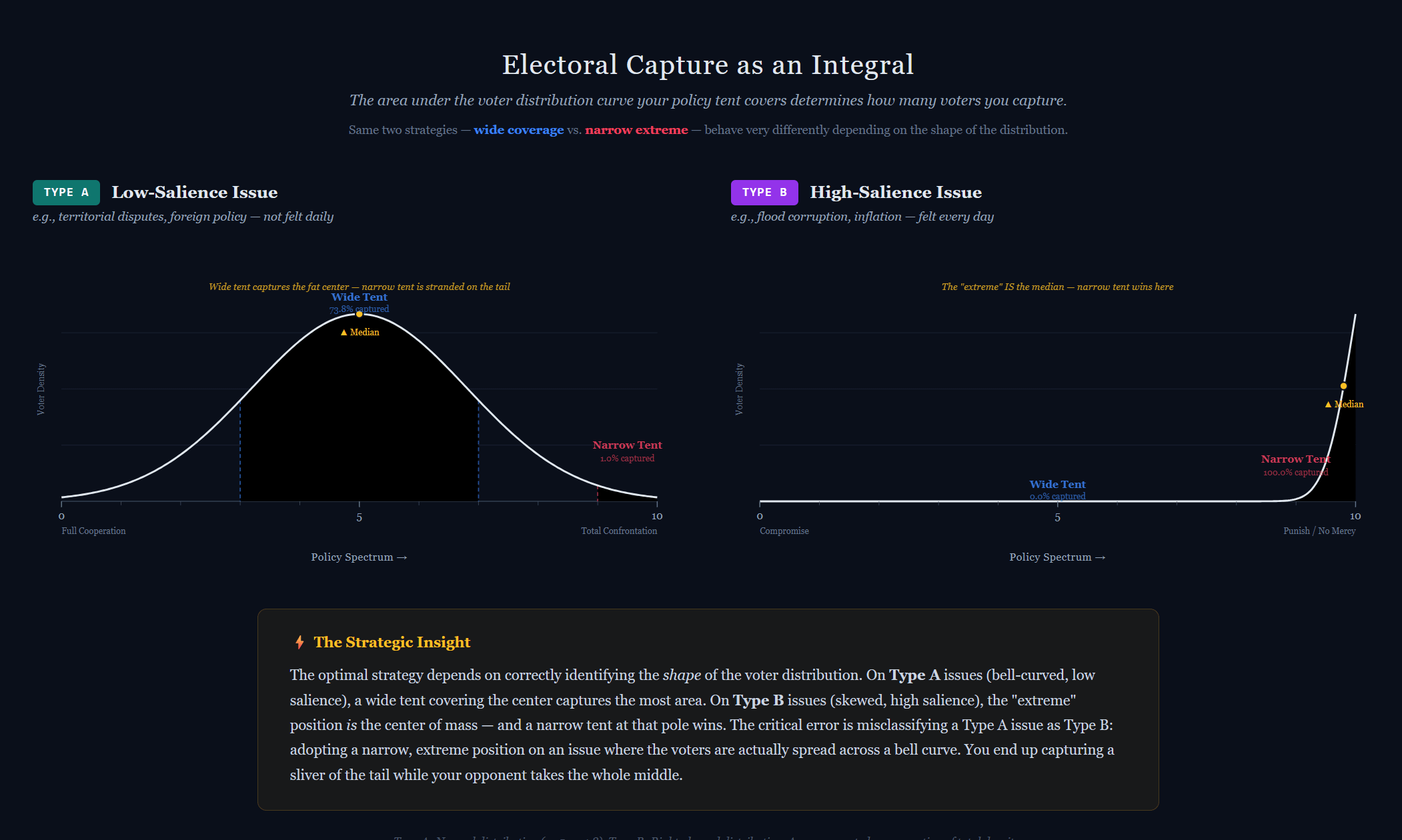
On a Type A issue — low salience, not felt daily — voter opinion follows a roughly normal distribution. The bell curve is fat in the center and thin at the tails. A coalition that spans positions 3 through 7 on a 0-to-10 spectrum captures approximately 58% of the voter distribution. A coalition locked into positions 9 through 10 captures roughly 1.3%. The ratio is not close. It is not a matter of marginal advantage. It is a 45-to-1 difference in electoral coverage. On a bell curve, width wins and extremity is exile.
On a Type B issue — high salience, felt every day — the distribution is not a bell curve. It is heavily skewed. Nearly the entire population clusters at one pole because lived experience has pushed them there. On this distribution, the “extreme” position is not a tail — it is the center of mass. A narrow tent planted at that pole captures more voters than a wide tent spread across the empty middle. Here, extremity wins because it coincides with the median.
The strategic question, then, is never “should we be moderate or extreme?” in the abstract. It is: “what is the shape of the voter distribution on this specific issue?” Get the shape right, and the optimal positioning follows mathematically. Get the shape wrong, and you are optimizing for a distribution that does not exist.
On China policy, the distribution is Type A. We know this empirically. When Filipinos are asked to name their most urgent national concerns without a restricted choice set, territorial defense registers at 4% — against 54% for inflation and 51% for corruption. A 4% salience issue does not produce a skewed distribution. It produces a bell curve with a fat, moderate center and thin, disengaged tails. The voters sitting at 4, 5, and 6 on the China policy spectrum are not loud. They are not on Twitter. But they are numerous, and they are persuadable — and the coalition with enough gradients to reach them will capture the integral that matters.
A coalition locked at positions 9 to 10 on a bell-curved issue is not capturing a meaningful share of voters. It is capturing a rounding error.
The Kakampinks have constructed a framework in which any cooperation with China is branded as anti-Filipino. This is politically catastrophic for a simple reason: it is a position that will NOT attract gradients . If engaging China on infrastructure is treason, and engaging China on trade is treason, and engaging China on fisheries management is treason, then the only acceptable position is total confrontation. There is no room for a Kakampink moderate, because the moderate has already been defined out of existence.
This means the Kakampink position is a single point on the number line rather than a range. And a single point, no matter how passionately held, captures almost zero area under any continuous distribution. You cannot win a national election by appealing only to one tail.
The Kakampinks further compound this error by assuming that the DDS coalition is their exact mirror — that if the Kakampink position is 10, the DDS position must be 0. This is a projection, not a reality. The DDS coalition contains people at 3, and people at 7, and people in between. It is the Kakampinks’ inability to perceive this internal variation that blinds them to why the DDS coaltion is such a strong political base.
The DDS coalition’s advantage is structural. It is the natural consequence of occupying more of the voter distribution where density is highest. The Kakampink camp, by treating a Type A issue as Type B, by mistaking the intensity of their own conviction for its prevalence, and by defining away all moderate positions within their ranks, has ceded the center. In a democracy where the median voter decides elections, ceding the center is ceding the outcome.
If you find value in what this blog does, please consider tipping via GCash - 09288956324 Buy me a Coffee: https://www.buymeacoffee.com/srsasot
Comments
Nothing yet. Say the first thing.
Sign in to join the conversation.