

Computational simulation is my chosen method in demonstrating and empirically testing my theory for my PhD dissertation. I applied this skill that I have developed in asking this question: “How many Kakampinks can stomach the Kakampink-BBM alliance?”
With programming assistance from AI, I built a simulation with no hardcoded outcomes, no rigged parameters, and no narrative baked into the math. The system runs three independent tests — a logical inference engine, a neural network belief model, and a multi-agent population simulation — and lets the computer determine the results on its own.
The Architecture: How the Simulation Was Built
The simulation is built on a single principle: let the computer decide. Every design choice was made to ensure that the outcome is emergent, which means it arises from the math, not from the programmer’s preferences. There are no hardcoded conclusions. There is no narrative embedded in the parameters. The system runs and reports whatever it finds.
The architecture has four independent modules, each testing the same question from a different computational tradition.
Module 1: Logical Inference System
This is the simplest and most airtight component. It enumerates every possible world — every combination of the variables K (Kakampink identity) and M (Marcos support) being true or false. For each world, it evaluates two constraints: K → ¬M (being Kakampink implies opposing Marcos) and K → M (the alliance requires supporting Marcos). A world is consistent only if both constraints are satisfied simultaneously. The computer checks all four possible worlds and counts which ones pass. There is no randomness here, no parameters to tune, no weights to adjust. It is pure propositional logic. The output is deterministic and absolute.
Module 2: Constraint Satisfaction Problem (CSP)
This module approaches the same logical question using a backtracking search algorithm. A CSP solver assigns values to variables and checks whether all constraints hold. If a partial assignment already violates a constraint, it prunes that branch and moves on. This is a standard technique in artificial intelligence for problems with hard constraints. It independently confirms the logical inference results. If the two modules disagreed, it would indicate a bug. They do not disagree.
Module 3: Neural Network Belief Model
This is where the simulation moves from formal logic to a model of human belief change over time. A simple two-pathway neural network represents one person’s mind. One pathway accumulates anti-BBM belief. The other accumulates pro-BBM belief. The net output — pro minus anti — determines the person’s stance. Negative means anti-BBM. Positive means pro-BBM. Zero is the threshold.
The critical design decision in this module is symmetry. Both pathways start at zero. Both use the same training function — not two different functions, one single function called with different parameters. Both use the same learning rate of 0.01. Both use the same reinforcement strength of 0.1 per day. The only asymmetry is time: the anti-BBM pathway trains for 40 years, the pro-BBM pathway trains for 2 years. If anyone claims the simulation is biased, they must identify which parameter favors one side. They will not find one, because the parameters are identical. The result is arithmetic: 14,600 days of reinforcement versus 730 days of reinforcement at the same daily rate.
Module 4: Multi-Agent Population Simulation
This is the core of the architecture and the module that answers the question directly. It generates 1,000 independent agents, each representing one Kakampink. Every agent receives three randomly drawn traits from uniform distributions — distributions that assign equal probability to every value within a range, meaning no value is favored over any other.
The first trait is years of anti-BBM belief, drawn from Uniform(1, 40). This means the population includes everyone from a person who became anti-BBM last year to a person who has opposed the Marcos family for four decades. The second trait is years of pro-alliance exposure, drawn from Uniform(0, 2). This reflects the realistic window of alliance messaging. The third trait is a noise scale drawn from Uniform(0, 0.05), representing individual variation in how consistently a person absorbs messaging on any given day. Some people are steady. Some people fluctuate. The simulation includes both.
Each agent then undergoes the same two-phase training process. In Phase 1, the agent accumulates anti-BBM belief day by day, with each day adding the learning rate multiplied by the reinforcement strength plus a small random noise drawn from a normal distribution centered at zero. In Phase 2, the agent accumulates pro-alliance belief day by day using the exact same formula — same learning rate, same reinforcement, same noise distribution. The only difference is how many days each phase runs, which is determined by the agent’s randomly drawn trait values.
After both phases, the net output is computed. If it is zero or positive, the agent accepts the alliance. If it is negative, the agent rejects it. The threshold is exactly zero — the most neutral possible cutoff.
The simulation then counts. It does not interpret. It does not weigh. It counts how many agents landed on each side of zero, computes the acceptance rate, and reports the profiles of who accepted and who rejected.
Fairness
Every parameter that could introduce bias is either symmetric or uniformly distributed. The learning rate is the same for both sides. The reinforcement is the same for both sides. The training function is the same for both sides. The noise distribution is the same for both sides. The threshold is zero — perfectly neutral. The trait distributions are uniform — no thumb on the scale. The random seed is fixed for reproducibility, which means anyone who runs the code will get the same results, but the seed itself does not influence the direction of the outcome. Change the seed and the numbers shift slightly, but the pattern holds.
The code is public. Available on GitHub. Anyone can read it, run it, and verify that nothing is rigged. That is the point. The architecture was designed not to persuade, but to compute. The persuasion, if any, comes from the results — and those belong to the math.
Reading the Results: What the Computer Actually Said
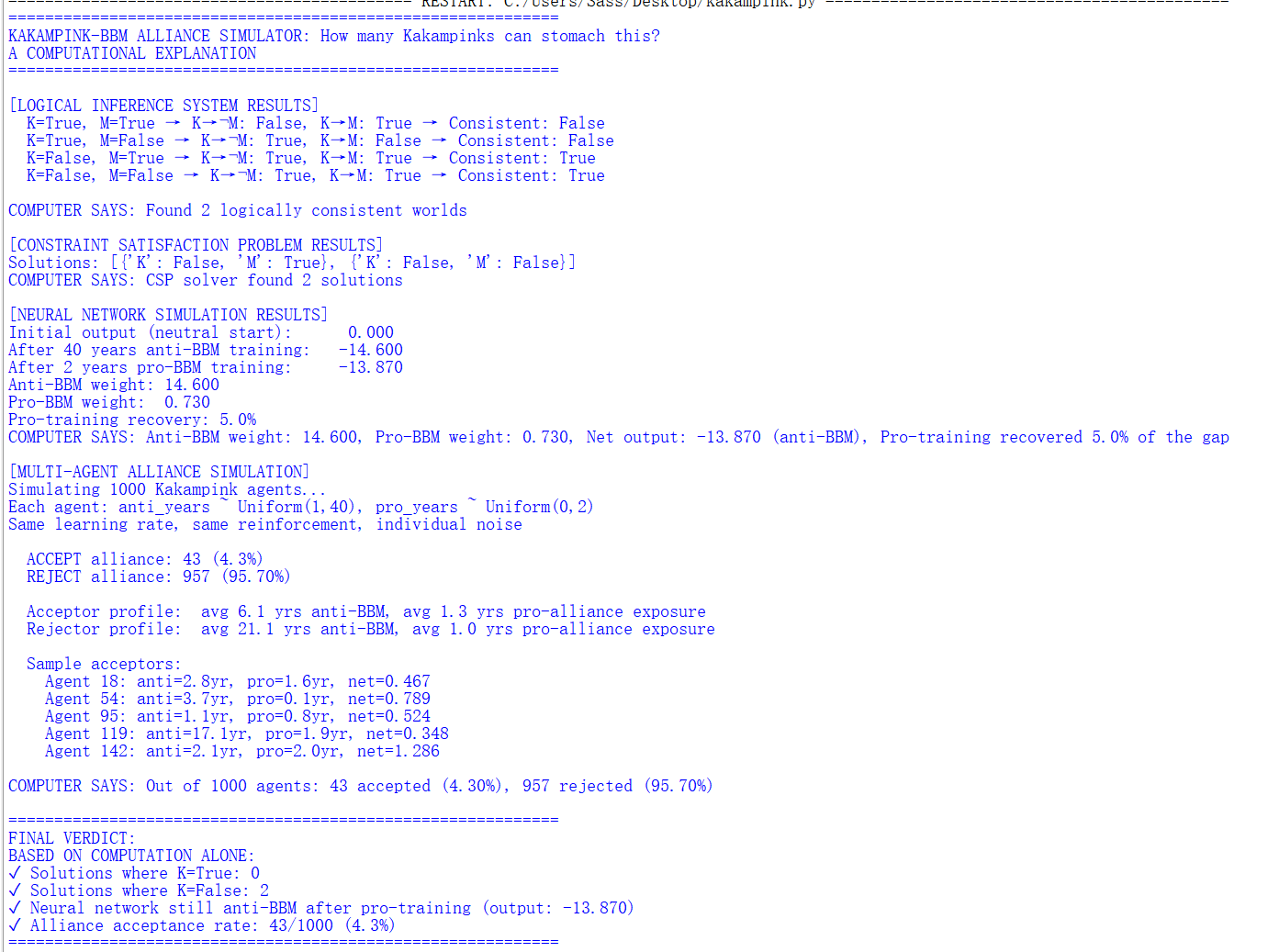
The simulation produces four independent outputs. Here is what each one means.
The Logical Inference System tested every possible combination of two variables: K (being Kakampink) and M (supporting Marcos). There are only four possible worlds. The computer checked each one against two rules — that being Kakampink implies opposing Marcos (K → ¬M) and that the alliance requires supporting Marcos (K → M) — and asked: which worlds satisfy both rules simultaneously?
When K is True and M is True, the first rule fails. You cannot be Kakampink and support Marcos. When K is True and M is False, the second rule fails. The alliance requires Marcos support, and you are not giving it. When K is False, both rules are automatically satisfied regardless of M, because the rules only activate when K is True. This is basic propositional logic — a conditional statement is vacuously true when its premise is false.
The computer found two consistent worlds, and in both of them, K is False. There is no version of reality in which a person is Kakampink and the alliance holds. The identity and the alliance are mutually exclusive. This is not a matter of degree. It is a logical impossibility.
The Constraint Satisfaction Problem confirms this from a different angle. A CSP solver searches for variable assignments that satisfy all constraints simultaneously. It found two solutions: K=False with M=True, and K=False with M=False. Zero solutions exist where K is True. The solver exhaustively checked every possibility and returned the same verdict as the logical inference engine: being Kakampink is incompatible with the alliance.
The Neural Network Simulation moves from logic to psychology. It asks: even if we ignore the formal contradiction, can you change a person’s deeply held beliefs through messaging? The network starts perfectly neutral at zero. After 40 years of daily anti-BBM reinforcement, it reaches -14.600. Then two years of pro-alliance messaging — using the exact same learning rate, the exact same reinforcement strength, the exact same training function — pulls it to -13.870. That is a 5% recovery. The pro-BBM weight after two years is 0.730. The anti-BBM weight after 40 years is 14.600. That is a 20-to-1 ratio, and it is not because the simulation was rigged. It is because 14,600 days is twenty times more than 730 days. Equal daily reinforcement multiplied by unequal time produces unequal results. The network remains overwhelmingly anti-BBM.
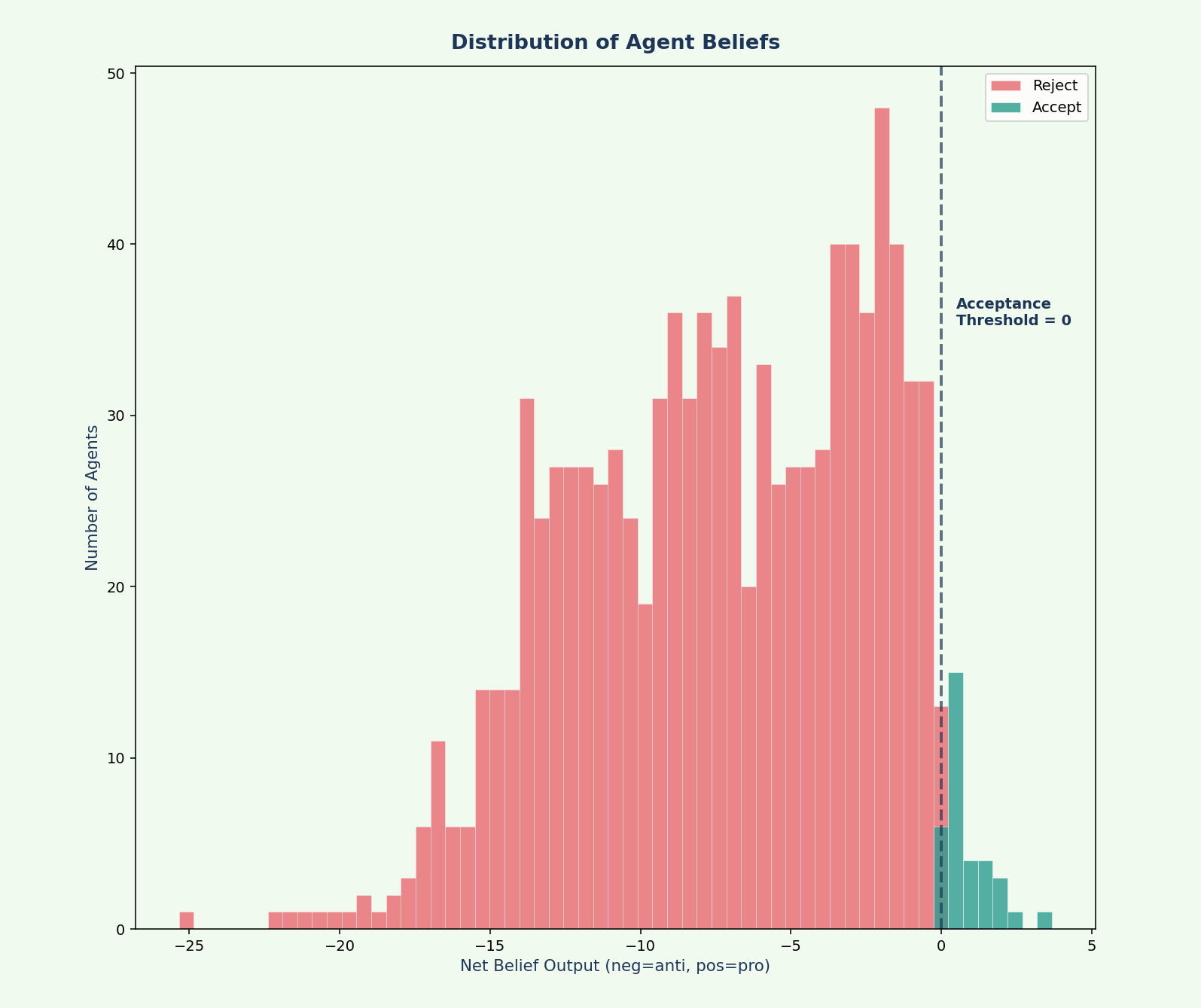
The Multi-Agent Simulation is the final and most direct test. One thousand agents were generated, each with a unique profile drawn from uniform distributions. Their years of anti-BBM belief range from 1 to 40. Their years of pro-alliance exposure range from 0 to 2. Each agent carries individual noise. The training parameters are identical for both sides.
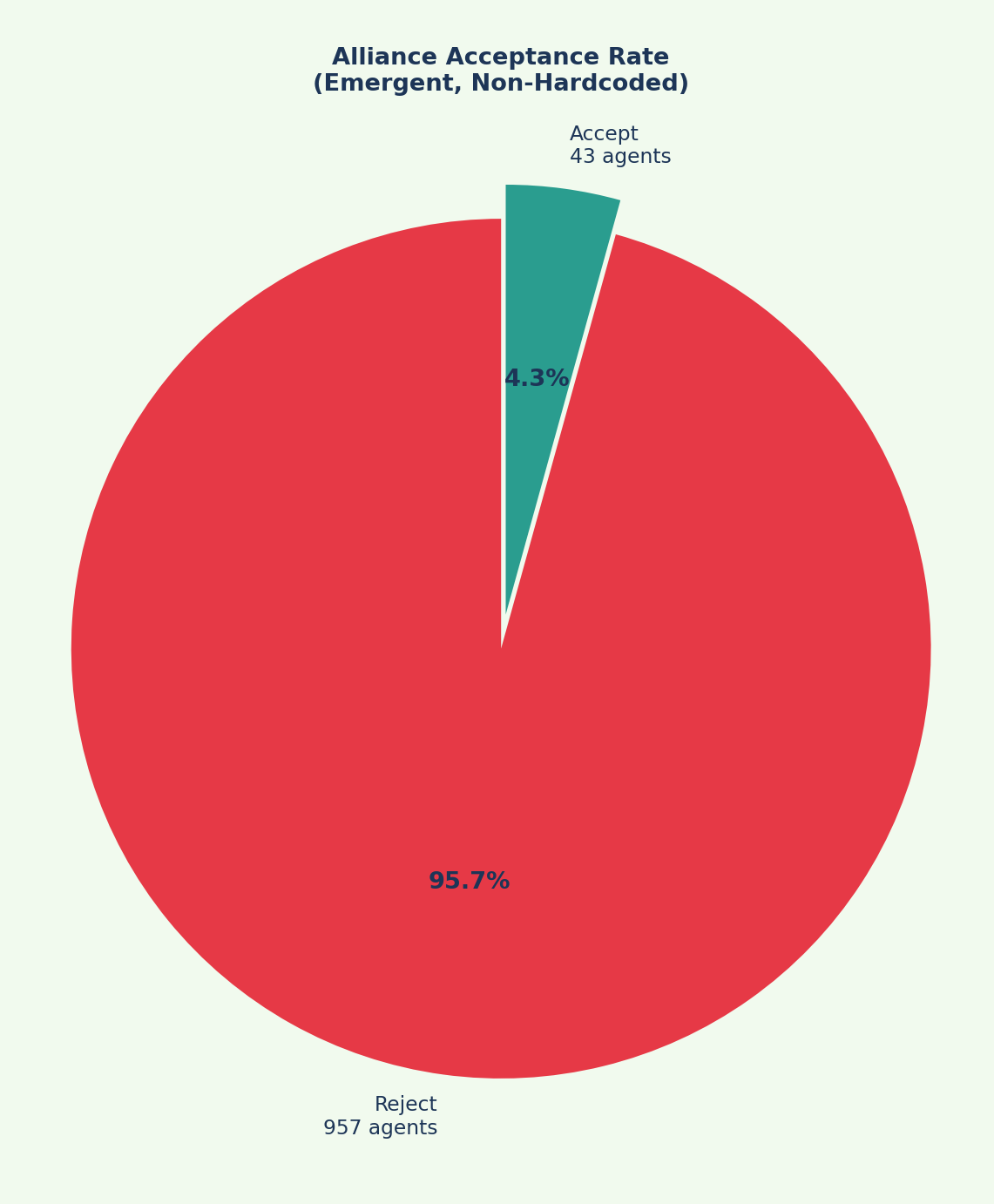
Out of 1,000 agents, 43 accepted. 957 rejected. The acceptance rate is 4.3%.
The profiles tell you who those 43 are. They averaged 6.1 years of anti-BBM sentiment — barely a fraction of the 21.1-year average among rejectors. Look at the sample: Agent 18 had only 2.8 years of opposition. Agent 95 had 1.1. Agent 142 had 2.1. These are not hardened Kakampinks. These are people who barely held the belief before the alliance was proposed.
The one exception is Agent 119 — 17.1 years of anti-BBM sentiment who still accepted. That agent’s flip was driven entirely by noise, the random factor built into the simulation to account for the fact that real humans sometimes make decisions they cannot rationally explain. Agent 119 is the statistical anomaly, not the pattern.
The pattern is this: the alliance can only convert people who were never deeply anti-Marcos Kakampinks in the first place. For the other 957, the wall built by time is too high, and two years of equal-strength messaging cannot breach it.
What It Would Take
To push acceptance meaningfully higher, the math requires one of three things: far more time than any political window allows, far stronger daily reinforcement than normal messaging can deliver, or a deliberate strategy of targeting only those with the weakest prior convictions. Each maps to a real-world constraint that the alliance’s proponents have not solved.
This is not an opinion. This is not a feeling. This is what the computer says when you let it run without telling it what to conclude.
People run simulations in their head all the time. Every political strategist, every campaign manager, every voter who asks “what if” is running a mental simulation of what could happen. The problem with mental simulations is that they are compromised by hope, loyalty, ego, and wishful thinking. A person who wants the alliance to work will unconsciously adjust the parameters in their head to make it work. A person who opposes it will do the opposite. Neither of them is computing. They are narrating. This approach removes the narrator. It replaces intuition with arithmetic, hope with constraint satisfaction, and wishful thinking with 1,000 agents whose beliefs are governed by the same function on both sides. The computer does not want the alliance to succeed or fail. It does not have a candidate. It counts days, multiplies reinforcement, adds noise, and reports what it finds. And what it finds is that 957 out of 1,000 Kakampinks cannot stomach this alliance — not because someone told the computer to say that, but because 40 years of anti-Marcos messaging is longer than 2 years of possible repackaging of BBM to be palatable to anti-Marcos Kakampinks, and no amount of political framing changes the fact that it is.
If you find value in what this blog does, please consider tipping via GCash - 09288956324 Buy me a Coffee: https://www.buymeacoffee.com/srsasot
Thanks for reading ASIAN SCHOLAR | Sass Rogando Sasot! Subscribe for free to receive new posts and support my work.
Comments
Nothing yet. Say the first thing.
Sign in to join the conversation.