
A few days ago Hijab messaged me on social media to compliment my work and to point me in the direction of her substack, the blueprint for a memoir about her experience with immigration, the pain it caused and the ambition it spawned.
I think this burgeoning desire to narrativize our lives says something about our times; we seem to have collectively turned our gaze inward, turning experience into spectatorship, where the self is both, performer and audience. I also think the memoir is the gangotri1 of all writing, including fiction. I spend half my time critiquing the trend and the other half making notes for my own memoir.
“It’s for my son… I want him to read it when he grows up,” Hijab said to me over a video call from Seattle. Her son was born in the middle of a demanding MBA degree, which she completed just weeks before our call.
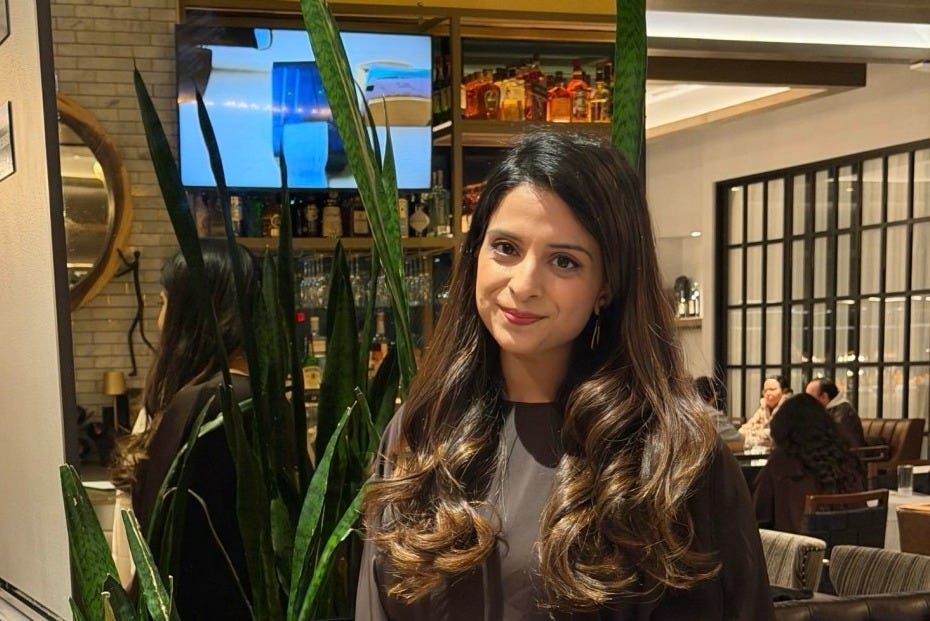
Within the first few minutes of our conversation I was able to classify her as Hijab 2.0, the version of herself that has rationalized the madness of migration, the version that has successfully made it to the side of sanity.
She moved from Lahore, Pakistan, on a fiancé visa 5 years ago, at the age of 24. Initially, she went through some of the common beats immigrants do on arrival: she felt culturally displaced, and bitterly missed everything from back home — food, language, festivals, family, friends… house help — “I’m like, what? I can’t wake up and make my own chai!” Being from the subcontinent myself, I empathize wholeheartedly.
She recalls her early impressions soon after landing, after a 21-hour-long journey. “As soon as I landed and saw people around me going about their business, their normal lives, I just knew that I’m always going to be the immigrant, the one who came here. My kids, even if they’re born here, are always going to be asked - where are you from originally?”
What interests me as a psychologist, a writer, and as an immigrant myself, is the way people who move countries summarize their initial years of gloom; it’s almost like they’re talking about something that happened to someone else. I’ve said things like “I cried everyday for 3 years” and “something inside me died after I came here,” packaging emotionally loaded truths in words and tones that lack the commensurate intensity. In a way, it’s the opposite of hyperbole.
As many do, Hijab spent her first few years struggling to reorient. At one point in our conversation she referenced her early days here as being in a “dark, depressed state,” a phase that’s now behind her.
The birth of her son was a difficult time as well. “I was like, this is really, really ruthless… it’s almost criminal to have to do all of this alone,” she said, remembering doing the laundry the day she delivered (her mom was unable to be there at the time due to a delay in getting a visitor’s visa) and, subsequently, breastfeeding on campus between classes.
Completing an MBA here has hugely aided her quest to belong. Her degree became the beacon of achievement and hope that made it all worthwhile — “…you have to do something just to prove that it’s worth moving here…” This has come up in many conversations I’ve had with immigrants, who moved from different parts of the world, under varying circumstances. Moving countries is an emotionally expensive affair, especially when one leaves aging parents behind. But we do it anyway, and then spend the rest of our days making it worth the cost — sort of like paying for something first and then spending the next few years looking for the product you paid for. To rephrase, the immigrant keeps looking for ways to avenge the pain of moving… for the educated, financially stable immigrant who gave up a fairly comfortable life to move for the promise of an even better one, that looks a lot like professional success.
During the course of her master’s program, Hijab made friends and built community here. “My home became, you know, ‘nani ka ghar,’ everyone was crashing here, we were playing ludo all night, making biryani and what not… I had my own village.” She also found comfort in the in-laws of a friend who lived close by — “they were looking after us, cooking for us, Aunty and Uncle became parents for all of us. We have the same language, same culture, there was no judgment, no artificial makeup to it, you know?” It was a relief to make social connections that didn’t require any cultural posturing, which is part of the assimilation process.
When I began this blog in March, the idea was to talk to people about the things they brought with them when they moved to the US, and still have with them. I believe objects, including ordinary items of everyday use, can be spiritually radioactive. When a pressure cooker enters a suitcase, it becomes a talisman. If your grandmother’s oil painting gets onto an international flight, it becomes a time machine.
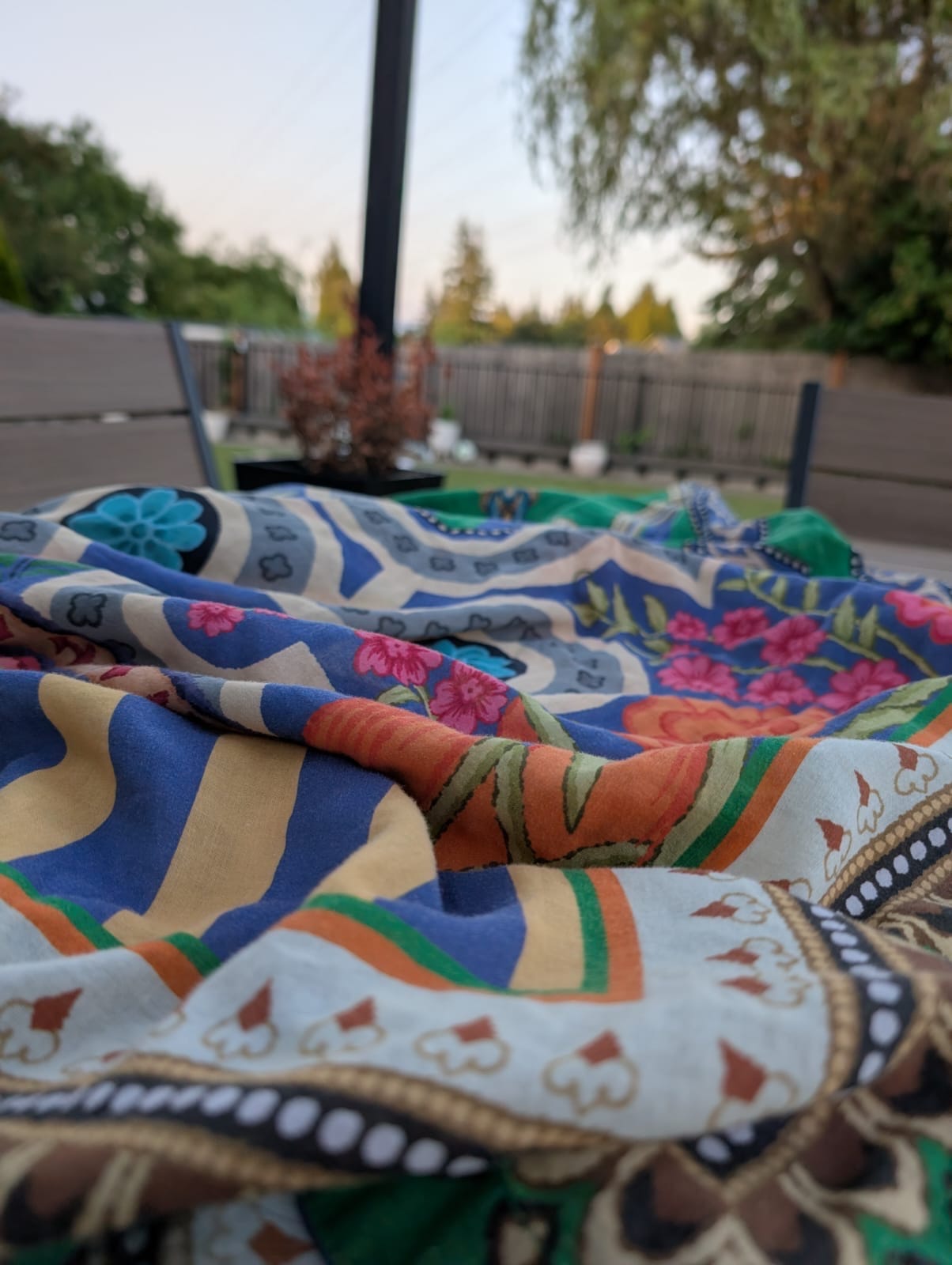
Barring one or two stories around objects that travelled, I’ve strayed from this theme in most of the interviews I’ve done so far, so I decided to give it a go with this one. Midway through our call, I asked Hijab about her mom’s dupatta, something she mentioned in an essay on her blog. She brought it with her when she moved 5 years ago, and still wears it every time she prays namaz.
Growing up, Hijab and her siblings would grab their mother’s dupatta, when strong smells from the kitchen, like onion, pepper and 2tadka, pervaded the house. “We used to be like, ‘Oh my God, Amma, turn on the exhaust!’ We’d go and wear her dupatta, which always smelled of the best perfumes… it has always been a source of refuge.”
This fragrant piece of fabric moved with her to the United States.
“While packing, I remember… asking her for it was one of the toughest things… Here in America parents are very vocal about emotions, they keep asking kids ‘how are you feeling?’ But Pakistani parents don’t do such emotional talks! I was worried they’d think I was a loser, that my brother would make fun of me… but when I asked her for it, I remember my mom tearing up too.”
The very first time she ‘used’ the dupatta here, was “for crying,” she said, smiling at the memory. “I remember unpacking in this new, empty apartment, there was no furniture yet, nothing on the walls, empty kitchen counters, pin drop silence… I just held it and cried hysterically…”
Subsequently, it became a symbol “for when I need to feel that I belong somewhere completely.”
My prefrontal cortex must have had a hiccough, for I blurted out the words ‘which means you haven’t washed it in 5 years!’ before I could stop, but she answered with good humor and grace: “Every year, I would bring a new one from Pakistan… I’d ask my mom to use it there and then I’d bring it here.”
At the time of our call, her mom was with her in Seattle; she’d come to see her graduate. So when that nebulous concept of home and its whereabouts came up, it was tricky. With her mom around, her house in Seattle felt different.
“My mom is here. I hear her voice in my home. I have my kid who knows who his 3Nano is, what these relations are. At the end of the day, we sit down, we have a cup of tea and it’s a whole family,” she said. “With just me and my husband here, it’s like we’re alone and surviving. We are just trying to take care of our son in bits and pieces. It’s very mechanical. But when a family member visits, it’s like, oh my God, this is a home.”
tempering of food in hot oil and spices
No posts
Comments
Nothing yet. Say the first thing.
Sign in to join the conversation.