
Few days ago I texted Kunal to remind him to send some photos for this piece. He sent a few and asked if I’d managed to ‘find a story’ in the 90-minute conversation we had over coffee last week.
Yes, I told him, I’d found my story.
But in truth, I was only halfway there, for the story of Kunal’s migration, as gleaned by me over an hour and a half, doesn’t serve up a strong central theme like some of my previous interviews for this blog do.
Even so, I’d found my story.
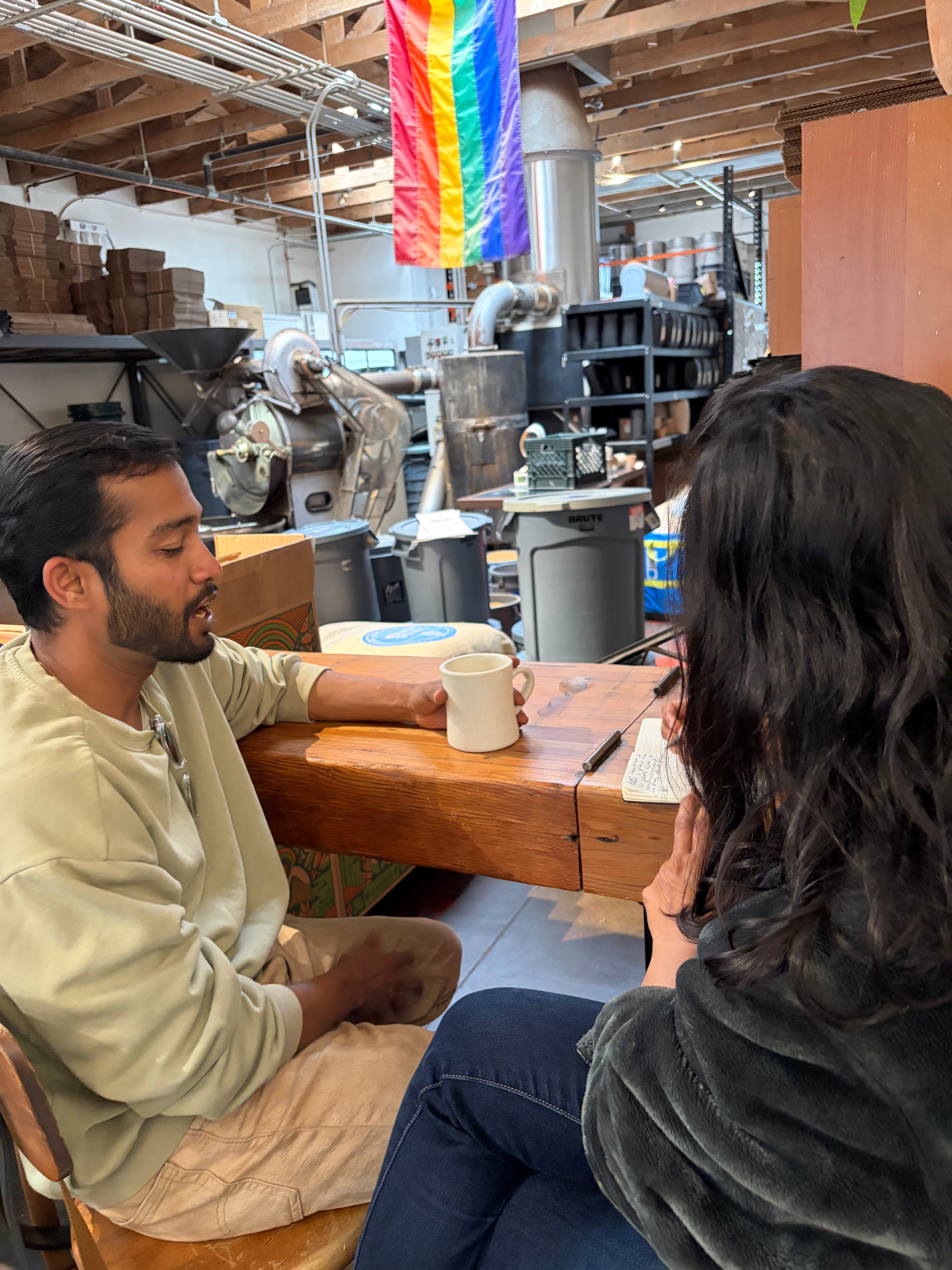
We didn’t talk about work or visa paperwork. We stayed on the poetic side of things.
Through our conversation Kunal was tentative about what and where home is. He referenced Andy Weir’s novel ‘Hail Mary,’ likening himself to someone floating in space, with no clear destination in mind, just enjoying the journey as he cruises along.
The same sentiment came through in a different metaphor at a later point — he’s on a boat on the open seas, being pushed along by the wind and currents.
“I can steer, but I’m not going to force against the wind or get my sail down. I’ll let the wind take me wherever.”
What if the wind is aggressive?
“Then let’s see where I end up after the storm passes,” he said. “There’s no push to go anywhere.”
Kunal is from Airoli in Navi Mumbai, an “everyone knows everyone” sort of town, where his family has lived for a few generations; his grandfather had a shop there.
“Before I had my own identity, I had other identities —“Sakpal ka beta, Prachi ka bhai…” I didn’t prime his use of the word ‘identity,’ I swear.
All those identities are now lost in migration. “In a way it liberates you,” he said. “Not that I was oppressed by it…”
In 2011, he moved to Maryland as a student in his early 20s. In the early days, his identity was “that Indian guy.” After spending a couple of years there, he came to the Bay Area, where he has lived since.
It has been 4 years since he last visited Airoli and many things have changed. His parents have moved to Pune. “Now when I go visit them there, I won’t have my own identity over there,” he muses. “I will be ‘their son’.”
In general, over the years, the Airoli he left has changed. Most of his childhood friends have moved out. His sister lives in Germany. Even the school he went to has been razed; in its place stands a different building with a different name.
“There’s no physical connect; whatever exists of the school is in my mind.”
If he were to go visit Airoli now, he anticipates feeling like Nana Patekar did in the movie 1Prahaar, while roaming the gullies of his boyhood, ‘seeing’ scenes of a different time through his mind’s eye. “I’m imagining that that’s probably how I will feel if I go back to that place now… I will start ‘seeing’ things, but what’s actually there now is very different.”
What then is home, if the place you called home changed its outfit completely while you were away?
“Home is not a place. It’s not the place that gives me the home wala feeling, it’s the memories and people,” Kunal said, in a way that made it clear to me that this wasn’t the first time he was articulating this idea, that he had thought about it long before I asked. “And memories also cannot just be connected to a place; at some point they start blurring because I have not revisited that place for a long time.”
He gave me an example of what he meant by this. During a past visit, he had a hard time locating his usual paan wala, because in his memory, the guy sat near “aunty ka hotel,” a neighborhood idli-vada place he’d grown up visiting.
“My mom was like, ‘aunty ke hotel ko band hokay 15-16 saal ho gaya’…” He probably knew, at a factual level, that the shop had been shuttered, but it was still confusing because of the way memory works.
“Time in the past is so blurry… I can still visualize aunty ka hotel and uske bahar baitha hua paan wala.”
Since 2011, the year he moved, India has changed a lot — roads, connectivity, the 4G revolution, subsequent explosion of the app economy, including taxi-hailing, e-commerce and most recently, quick-commerce apps. India now lives in ‘the Blinkit era’.
“I didn’t see that transition, my brain doesn’t comprehend it.”
As he pointed out, this happens because when one moves away from home, one’s memory is trapped in the “immigrant time capsule” — to the immigrant, time freezes when he or she leaves for the airport.
It’s the same reason my NRI husband offered his usual bhel wala in Tardeo Rs. 20 for a plate, only to be scolded affectionately, because that was an outdated price tag. He paid Rs. 80 and slunk away, confused. The immigrant’s understanding of inflation stands suspended when they revisit the place they left.
I’ve seen the same thing play out with my own Kaka-Kaku who moved to Australia many decades ago. They also seemed to be ‘visually’ trapped in the immigrant time capsule because every time they’d visit Mumbai, they’d end up wearing the same set of clothes, those 4-5 outfits they’d left behind in their cupboard back home. All in a bid to travel light, perhaps. It was like they’d stepped out of their normal life in Sydney and re-entered a time warp, wearing the same outfits, year after year after year.
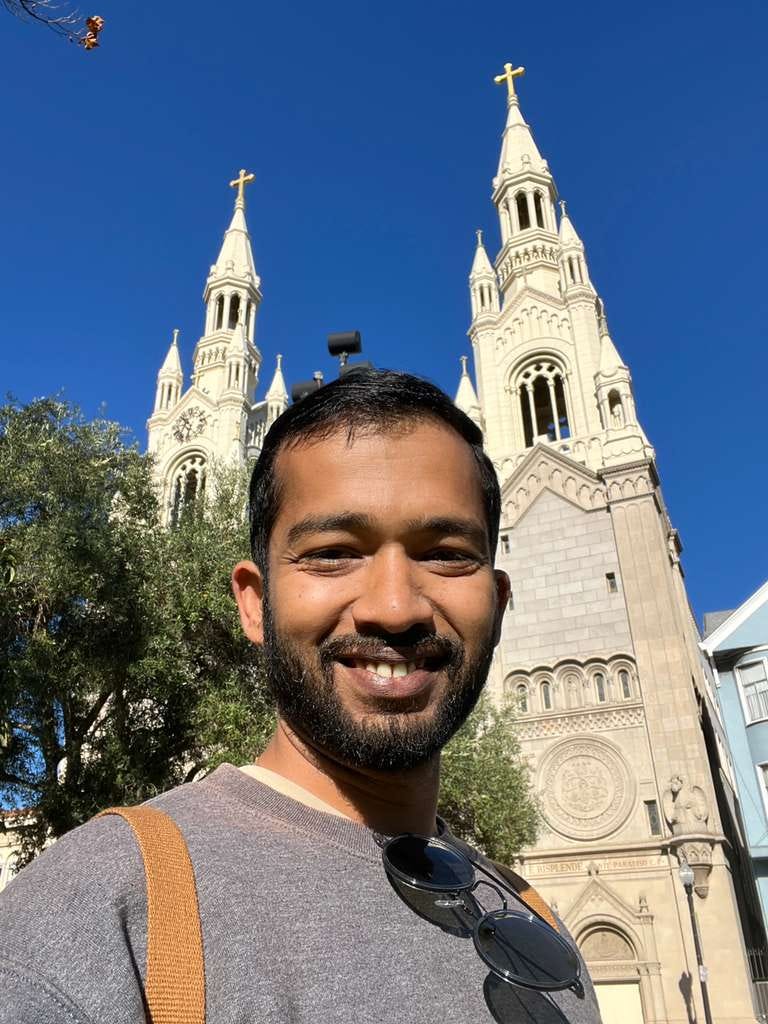
We ran into a similar mind-bending concept when I asked Kunal about his identity in San Francisco, “the shadow of a city” he has lived in for over 5 years now.
If reality were a video game, then he fancies himself a kind of “NPC” or non-playing character in the lives of the people around the city’s North Beach area, that he frequents on weekends. ‘Main characters’ of their own lives, they probably see him doing his thing in the background, weekend after weekend, as if on cue.
“For them, I may be an NPC character jo Washington Square Park main pada hua hai,” he laughs, amused by the idea that he might be spotted by other regulars in the area.
I’ve known Kunal for three years now and can see why he’d say that. It’s not just because he’s an erudite techie with an interest in video games. To me, he’s a flâneur, an urban stroller, idling along the streets of San Francisco, with a picnic blanket and a sketch pad tucked away in his little brown knapsack.
I admire the way he owns his ‘weekend identity’ as a saunterer in San Francisco. At the same time, I feel a little pity for myself, because my own experience in the soulless, unwalkable Californian suburbs, only an hour away from the city, is nothing like his.
In her fabulous 2book ‘Flâneuse,’ Lauren Elkin critiques the suburban American dream. She writes, “Getting around by car often means residents end up travelling far and wide to work and play, which is not the way to build local solidarity.” She quotes Virginia Woolf from her 1927 essay ‘Street Haunting,’ when she writes in a later chapter: “In the street we are no longer ‘quite ourselves’ — instead we become ‘functions of the urban landscape’.” Aimlessly walking around a city, according to both authors, feeds the writer’s soul. In the car-dependent suburbs, as per Elkin, the one who walks belongs to the “suburban underclass,” but in the city, in contrast, as per me, the walker resembles Kunal.
The baggy connections and conversations he has with people in his neighborhood in San Francisco, are meaningful to him. For Kunal, the suffix people use after his first name, while saving his number on their phone —like the name of a local park or bar or area in SF, say, ‘Kunal WashingtonSquarePark’— is something that becomes part of his “accrued identity.” It’s not uncommon, he reminded me, for last names to reflect a person’s town. “So even that is like an identity.”
Many of these people may not even know his name but being recognized is important, I gather. These acquaintances include an elderly neighbor, a homeless guy who greets him with ‘hello friend,’ the staff at the bar -and coffee shop- he frequents, the old Chinese hawker who lets him help her carry her wares up an incline, of which SF has plenty. For the ones who do know his name, he often sacrifices the inbuilt 3retroflexion, that unmistakable South Asian marker. As a Maharashtrian myself, I understand that it’s Kuṇal with a ण. At East Asian eateries, he calls himself “Kun.”
These loose interactions give him that “community wala feeling.”
“I live alone. If people around know me then I can… I don’t know if ‘belong’ is the right word. Do I belong here? I don’t know. But ya you feel like, koi pehchanta hai. Else it’s like 4Gulzar’s ‘Aaina dekh kar tasalli hui… Humko is ghar mein jaanta hai koi.’”
He didn’t say it but perhaps home, then, is where people know your name, or at the very least, recognize you.
No posts
Comments
Nothing yet. Say the first thing.
Sign in to join the conversation.