
First, a couple quick notes up top:
Reminder: submissions are open right now, until the end of the month.
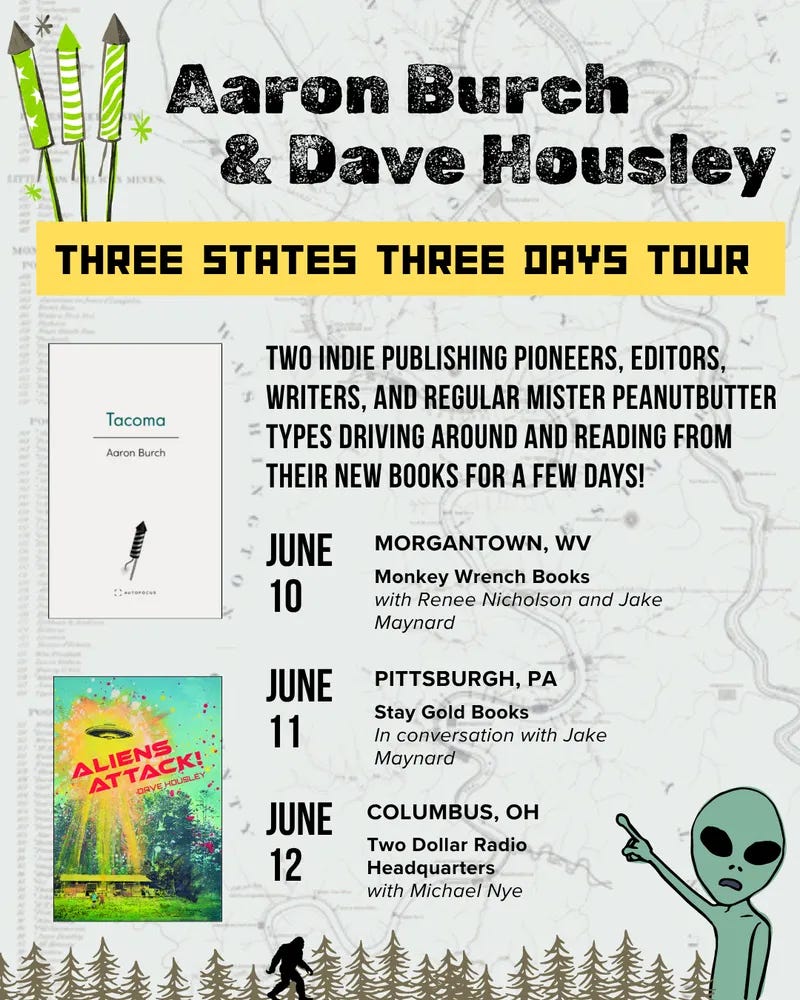
Not to use this as personal blog or whatever, but I’m doing a very quick little midwest reading “tour” with my buddy Dave Housley. If you’re anywhere near Morgantown, WV, Pittsburgh, PA, or Columbus, OH, I’d really love to meet and see you!
JUNE 10 — MORGANTOWN, WV
Monkey Wrench Books
with Renee Nicholson and Jake Maynard
JUNE 11 — PITTSBURGH, PA
Stay Gold Books
in conversation with Jake Maynard
JUNE 12 — COLUMBUS, OH
Two Dollar Radio Headquarters
with Michael Nye
*
As noted in the last few updates, we’re taking the summer “off,” not publishing any new stories (and thus no accompanying interviews with the respective stories’ authors) for June or July. We are going to keep trying to share something every week though (which perhaps negates at least one or two of the benefits of taking a “break”; so it goes1), with a variety of bonus material. In the coming weeks, we’ll have some interviews — with the artists who contribute the art that we pair with the stories; with the authors of the stories we’ve published in the last twelve months, via questions from the SSL submission readers, with the authors of some of our favorite short stories and collections, and maybe more! — as well as some essays or other reflections recommending, raving about, and generally celebrating short stories.
For today, I thought it would be fun to get some peeks behind the curtain from the team who have helped read submissions this last year. For the first year or two, I pretty much read every submission and did everything myself, and in the last year I finally asked for and brought on a small team of volunteers and it’s been a huge help… and also just really fun, widening the scope to a team, even if the “community” of that team has mostly only meant very occasional group emails. Perhaps even more fun and interested than those group emails was getting to read their responses to these handful of questions I threw at them, trying to get into some reflections about reading submissions. (A few answers to the first question mention me, in ways that feel a little awkwardly self-congratulatory to include as part of a post I’ve organized and am overseeing the publication of, and my kneejerk response was to maybe edit them out, but that felt maybe even a little weirder, so I’m leaving them as is. So it goes.)
If you have any follow-up questions — for any of the readers, about anything specific here, or just more generally; or for myself — maybe drop them in the comments, a kind of AMA (?), and if anything interesting comes of it maybe we’ll have a follow-up nearer the end of summer?
Thanks!
—Aaron Burch
Editor, Short Story, Long
Can you describe a little your history with reading and writing? In general, but maybe especially as aimed toward getting you here to reading for Short Story, Long?
Thomas Mixon: The number of books consumed was rewarded, when I was a kid. The summer reading programs meant well, but I grew up in a family of competitors. I thrived on competition. I “read” so many books, and remember so little, by the time school started up again. I’ve been trying to outgrow this mentality, over the years. The internet allows so much writing to be published now — part of my interest in reading for SSL was to see what wasn’t making it online, because the same quality I’ve attempted to extinguish in my too-fast uncomprehending reading, as a child, I’ve also run up against, while writing, as an adult. I’ve found, even with stories that are not close to being fully-formed, I can’t get through them quickly. Even if I can make it through one, in a single sitting, it stays with me.
Tyler McAndrew: I’ve always been a reader, since I was a kid. I went on to be an English major, fiction MFA, etc. My first book came out last year, and for the past 20 years, I’ve been the sort of writer who sits down to the desk every day (though my wife and I had a baby last year, and I’ve been on a major hiatus since then). I teach fiction writing both at the high school and university levels, so my job is mostly to read my students’ work and help them become better writers… I think Aaron has been the guy behind a lot of the internet’s most interesting literary journals of the recent history, and so I’ve always tried to keep up with at least a few of the writers that he’s publishing. As both a reader and writer, my passion has always been for short stories, and working with SSL has been a really satisfying way of enjoying that passion with other people in a way that feels collaborative and communal.
Jim Cuene: I read a ton of fiction when I was in undergrad and grad school but my reading shifted to history and non-fiction during my career years (mgmt consulting / marketing/ biz owner). Fiction — and especially short stories — is what I want to focus on going forward as I restart a writing practice after such a long time away. I am reading widely, from a lot of the more “established” sources. However, I was noticing the consistently great stories coming from Short Story, Long (and then I found HAD and the old Hobart) and I hoped a role as a reader would give me a lot of exposure to talented, passionate writers. And, I wanted to be part of the process that goes into a journal. I’d love to be part of a publishing/book team someday from the editor and publisher side.
Michael Pershan: Is this a good place to say how much I liked Tyler’s collection?2 My reading journey is pretty straightforward, but my writing life is a huge mess. I wrote short stories when I was a kid, then spent a bunch of years getting into humor, guys like Jack Handey, Woody Allen, Steve Martin. As an adult I kept writing short humor and eventually got involved with this awesome print humor magazine, The American Bystander, and for a couple years did editorial work including reading for them. But professionally I’m a math teacher, and I also write about education and teaching. (I wrote a pedagogy book for math teachers back in 2021.) Basically, I’m all over the place, and this is maybe a problem in my life, but the last few years I’ve been mostly focused on fiction. Part of what brought me here is I don’t feel particularly connected to art or literature in my daily life as a teacher. Plus it feels good to be involved with SSL, because Aaron publishes so many of my favorite authors and I think a good story can do so, so much.
Jess Dawn: I’ve loved reading and writing since I was a little kid and started making up weirdo stories about as soon as I figured out that was an option. I did a lot of writing in college and in my 20s, spent some time in journalism in particular, but then life happened and I sort of let it go, or only wrote in weird bursts to share with friends for a laugh. I got back into it during the pandemic because I was only working part-time and I can’t bake bread for shit, and the first creative writing I’d had published since maybe high school was in HAD. I feel like there’s a HAD to SSL pipeline, or at least a lot of familiar names and community that’s grown up around the two. When Aaron said he was looking for readers I volunteered pretty quick because SSL is just stellar, but also because I wanted to be part of the publication process beyond the submission / acceptance / rejection cycle. I love and appreciate that I found my way back to writing and there’s a part of me that’s afraid that I’ll lose it again, especially working in a job that has absolutely nothing to do with reading or writing fiction. Writing and submitting can feel like lonely work sometimes, and helping out with SSL has been a great reminder that we’re all in this vulnerable place together.
How might you describe reading for SSL for these last 6 months?
Jess: I have had a great time reading. My day job is in a non-profit vet clinic, so VERY far away from the lit world. It has been an absolute joy to come home, change out of scrubs, and read stories that people have been brave enough to not only write but send out into the world. It makes me feel more connected to other writers, which is so gratifying, and I love being able to have an inside view of what goes into publishing some cool ass stories. Reading is like playing story roulette, too, when I open up my queue I don’t know if I’ll have horror, surrealism, something with sci fi hints, a wildly emotional breakup story, or some combo of all of those things. It’s wild seeing the range we get.
Christine Gainer: Reading for SSL has been eye-opening. Some stories have left me in awe, wondering where the authors have come up with their ideas (looking at you, Joe Baumann, with your protagonist’s inner organs floating outside his body!) or astounded by their lyrical prose. But most of the stories I’ve read make me question whether the author has ever read SSL before submitting. There are beautiful, honest stories out there, but they aren’t a fit for this publication. I feel badly about voting them down and hope the authors are submitting to more appropriate journals where their words can find a home.
Thomas: Going off Christine’s comment, I do wonder if we, should we feel inclined, provide the name of another journal or two, for writers whose work we enjoy but don’t think is right for SSL?3 Is this presumptuous? I often wonder about whether a rejection should end at a simple no thanks, or if there are other ways of helping writers who we think would be interested in such advice… I think it’s hard to know where people are coming from, when they send work in… have they been reading SSL for years? Tone in one’s own writing is hard enough to capture, let alone reading for tone in a journal across all published pieces. I’ve read some lit mags for years, and think I understand what they’re about, only to have my pieces passed up, so this question of “fit” is eternally fascinating to me.
Jim: The last few months of reading have been so much fun. I’ve loved it, even when it was hard, boring, or frustrating. Mainly, I’ve been profoundly inspired by all the folks that have the urgent need to get their stories out there, to tell the world something important or to simply entertain the reader. I’ve been amazed at the ideas I’m seeing, and fascinated by how not-great some of the submissions are. Mainly, though, its made me feel less isolated as a new/baby writer who is struggling with the foundational stuff while aspiring to find an audience someday. There are so many others like me banging away out there, one word at a time, trying to find their readers.
Tyler: I do sometimes get disheartened by the fact that I vote down the vast majority of submissions that I read. To be honest, I sometimes get really bored or frustrated when I hit a streak of submissions4 that don’t do anything for me! In the few months that I’ve been reading, I think I’ve only voted “yes” on one story. But there’s something valuable in all of that frustration, I think. It keeps me honest. It’s like a daily process of confronting my ideals as both a reader and writer. It’s also always a nice reminder of my own struggles when I’m submitting work: I have a couple stories that racked up 100+ submissions before finding the right home. There’s something humbling about both sides of the process.
Do you think reading submissions has had any effect on your own writing, and/or the way you think about your own writing? If so, how so?
Michael: I don’t think it has, not yet, but after this last reading period I am officially paranoid about backstory. Right now I’m feeling crushed by the end of the teaching year, but in a week or two I’m going to start opening up old documents to get them in shape for resubmission, and I am terrified that I’m going to find blocks of backstory that show up in the second paragraph and continue for a page or two before drifting back to the initial action. I hereby declare on the internet, where everybody can see, that I will try very hard to fix this, to keep action moving, to make sure the gravity of a story is inescapable before looking back.
Tyler: I’ve read for other journals in the past, and I know the common wisdom is that reading for journals is one of the best things you can do for your own writing… I honestly don’t know if reading submissions has ever really had much effect on my own writing! When I’m reading subs, I often am usually attracted to work that is patient and sure of itself and doesn’t feel like it’s trying too hard to wow me with any sort of pyrotechnics (i.e., cheap hooks, overwhelming voicey-ness, humor that feels too easy or obvious). So I guess reading subs often makes me feel more sure of myself in trying to keep my writerly compass aimed toward those things.
Jess: I actually think it has changed the way I think about writing, and also about editing my own work! Paraphrasing a thing Aaron has said repeatedly, I think it’s become so, so clear that surprise really can push a story into greatness and I find I not only give myself more permission to chase down these weird little side thoughts that pop up, but also see them as more the point. That’s the stuff that can really only come from us, right? The little daydreamy bits. Reading submissions has really helped me appreciate how magical those moments are. They’re so hard to describe but so recognizable when reading, and it’s fun to be surprised by these little moments! It’s cheesy but if anything, I feel like I have a lot more fun while writing by leaving a lot of room for this kind of spontaneity.
Jim: The reading has had a significant, immediate impact on my writing. Specifically, it’s helped me stay centered on my main job as a writer: Entertain and engage the reader, hopefully so they look at things differently. It’s kind of obvious, but easy for newish writers to forget. Otherwise, it’s helped me to develop better critical reading and analysis skills. And, that's translated into me being better at editing my own work. Previously, most of my reading has been mainstream books, well known journals and stories that were anthologized as award winners. They helped me see what “great” can look like. But, reading for a journal I can see how a lot of stories that aren’t quite ready (yet) miss the mark: Too much “voice”, gimmicky plots, flat characters, cliches, scenes not stories. Then, I can go back and read my own work and see where I’m doing the same things. Meanwhile, I get a mini-MFA as I see how beautifully other writers do the good stuff: restraint, voice, lyrical prose, pacing, deft use of details, surprising revelations. They’re showing me the techniques that I can learn from.
Andrew Huffman: Genuinely, I think it is humbling to see the depth of creativity that is out there, even in stories that ultimately are a “no” or aren’t quite there yet. It helps me remember to get out of my comfort zone and try something new. On a specific craft level, often as I am reading for SSL I will begin to see what is or isn’t working in the story and start to make connections to a piece of my own I’ve been struggling with and I pause to take notes for my own revisions.
What about reading submissions has surprised you?
Thomas: The variation, and elusiveness, of voice. I’ve found myself stumbling on the very first page, trying to read aloud to make grammatical sense, on about half of submissions. This is certainly in part due to my own limitations, figuring out how to get out of my own rhythms, and give myself over to the arrangement of unfamiliar dangling clauses. But I also think there’s something many writers are reaching for, and maybe I just default to calling it voice, that liminal space between clarity, cohesiveness, and evocation. And it makes sense, to reach for it. But so often that reaching turns me off in its obviousness. Esp. at the start of a story — readers are in space, we have no idea what’s happening, we resist being overly-grounded, but we don’t want to skyrocket into the void. Maybe it’s all solved by providing a fun kind of floating, pleasantly just above solid Earth.
Jess: I mentioned this a bit in another answer but I am floored by the variety in submissions. Not all of them are a good fit or seem like the author is familiar with SSL, but it’s wild to read a really genre-y true crime submission and then switch to a quiet story about a couple breaking up. I read a comic that was submitted today! The variety I see in voice and style is just incredible stuff, it’s such a concrete illustration that two people could probably have the same idea and write entirely different stories. I loved reading SSL in the first place because of how distinctive the published stories are, and yet I’m still constantly surprised by what I read in the queue. Also, I’m surprised how much some of the stories have stuck with me. There are two stories that we didn’t actually end up accepting that I think about all the time (Aaron, I don’t know if you want to get this behind the scenes5 but one is “Basking in Glory” by Daniel Miller). As someone who’s also writing and submitting, that’s been a weirdly comforting thing, that a story doesn’t have to be accepted to be remembered.
Any observations on what makes a story feel like a “no,” (in general, but maybe especially something you hadn’t thought about before reading so many submissions)? Any takeaways on what makes a story especially pop and stand out (and above) the rest?
Michael: I never exactly judged a story for ending with “END,” or “THE END” — that would be a weird reason to vote “no,” right? — but, as it happens, I haven’t liked any stories that ended like that. Why end with “END”? On account of there not being any more words, it’s usually clear when a story’s over. Maybe it’s a writerly celebration, like spiking a football or popping champagne: I finished this thing! Hell yeah! (If so, yeah, I get it.) Enough stories ended this way that I wondered if I was the weird one for thinking it was weird. Is “THE END” more common in other genres? Maybe it simply points to writers who aren’t reading stories in magazines or collections, because published stories almost never end like that.
Tyler: I mentioned this above that I often find myself rejecting work that feels like it’s trying too hard to wow me with what I think of as pyrotechnics: cheap hooks, overwhelming voicey-ness, humor that feels too easy or obvious. Which isn’t to say that stories shouldn’t have hooks or be voicey or funny. But a lot of stories assume that they can sustain your attention with those things alone. Often, these are stories that are crammed with drugs or sex or cynical narrators who drop a dozen swear words just to describe someone drinking a cup of coffee. I think those sorts of pyrotechnics are usually masking shortcomings in other more difficult areas: emotional depth, imagery, narrative structure… A lot of “no” votes also come from work that feels like the writer never really surprised themselves in any way—they had an idea and they executed that idea and there was never any mystery or discovery in the process… The stories that grab my attention are usually ones that are a little bit more patient in their storytelling. This doesn’t mean they’re slowly paced. Rather, it’s that they don’t take stylistic shortcuts—they do the work to draw their characters and develop their stakes. One of my old teachers always used to describe workshop stories that weren’t totally there yet by saying they hadn’t yet “touched bottom” (as in diving and touching the bottom of the pool). A lot of stories are good, but whether they’ve touched bottom—that is, whether they’ve found whatever depth they’re after—is often the determining factor for me.
Christine: My “no” votes are usually due to the story not aligning with SSL, but I’m also turned off by authors who submit work riddled with typos and grammatical errors. The former editor in me wants to stop reading as soon as I stumble upon something sloppy, but I try to be fair and continue reading if the story manages to grab my interest. The stories that make me stand up and say yes have clear, thoughtful prose and surprising story twists. There are pieces that I immediately want to read through a second time, because they were either so brilliant or because a second read helps me better understand the story. Those usually turn into yes votes.
Thomas: I don’t think I’ve ever voted yes on a piece where the first half is boring, but then gets interesting toward the end. BUT I do think a piece that starts off strong, and goes in the wrong direction, can be saved. This probably speaks to my attention span, which I’m working on, but I identify with writers who come into a narrative on fire, and then burn out, or weirdly like light a random birthday cake, and turn into something else, asking for an unwise wish. That initial spark, maybe it can’t be rekindled, but its most attractive arc, I think, can become evident over time.
Jim: I’m drawn to stories that are a little weird (in a good way) but also pay off, emotionally. I have learned, after reading a lot of stories, that I’m drawn to stories that move pretty fast. I’m a sucker for bold and confident first person (or plural/ collective) narrators. A lot of the “no” votes are because I don’t feel they’d fit in next to the great string of stories that have already been published. The main reasons tend to be voice, or genre/style (i.e. historical fiction, highly speculative, fantasy or mystery). I tend to vote down stories where the main characters don’t evolve or change by the end. Or, where the outcome is pretty obvious from the beginning.
Jess: Something that really sours me on a story is when it feels like the writer doesn’t actually know much about what they’re writing. A lot of times it’s on an emotional level, like reactions feeling disingenuous or forced, but sometimes it’s missing the mark on pop culture references. I remember getting some harsh but very good writing feedback when I was young to the tune of “if you don’t know anything about living a specific experience what do you think you could contribute by writing about it,” and while I don’t think that’s universally true it does knock around in my head while I read. If I get that “I don’t believe this” feeling it’s pretty much an instant pass from me.
Andrew: As others have mentioned, looking for a fit for SSL is a big one, but the other is that I’ve really come to see as I’ve been reading for the past six months is that the length of a longer short story makes it quite technically difficult to hit the right pace. For me, a “no” tends to come when the pace is a mismatch, which usually means no or not enough change has happened, or too much. On the flip side, a “yes” almost always pulls me in because the pace, whether slow or fast, feels deliberate and crafty, like it’s tricking me into getting lost in it. Maybe my answer is: they feel fun to read, even the tougher content.
Well, well, well, look who just read Slaughterhouse-Five this week!
Yes! My Prisonser and Other Stories was one of the best collections from last year!
Ed note: I don’t do this often, but do on occasion, and have been excited to see some of those recs turn into acceptances!
Ed note: I’ve posted versions of this here and there over the years on social media, but it can be crazy how streaky it can be! I can go through reading 20, 50, 100 submissions and nothing quite clicks. You start to wonder if you’re being too critical, if you’ve forgotten how to read, how to fall in love with a story… and then you’ll get one that pops and you immediately know and it all feels so exciting! And, back to that streakiness, it is suprising how often you’ll find 2 or 3 or 4 in a row (or, you know, nearly in a row), after 100 misses, that all hit!
Leaving this in here, with Daniel’s OK. I still think about this story often as well! Does that mean I shouldn’t have passed on it? Maybe! I’ve gotten friendly with Daniel in the last few years, via social media and a couple of AWPs, and he also edits for a journal (the great hex!), so I was pretty sure he’d take my response well and also understand the subjectivity of reading submissions and how lit journals work and just art in general. I so enjoyed reading it, but it also just didn’t quite feel like a match for me/SSL. But I was so happy when he shared that it found a home (and a great one, at Doric!), and so excited when it was getting a bunch of love on social media!
No posts
Comments
Nothing yet. Say the first thing.
Sign in to join the conversation.