
Environmental scholars Rachel and Stephen Kaplan argue, in their “Model of Environmental Preferences” that human beings require “legibility” and “coherence” in their environments.1 They also seek mystery and complexity, but if the balance between these four traits are skewed, people can experience extreme discomfort.
Kaplan was writing about natural environments—the mystery of a curving path that disappears into a wood, the legibility of a beautiful pastoral vista, the complexity of a rainforest, the coherence of a thoughtfully planned rain garden.
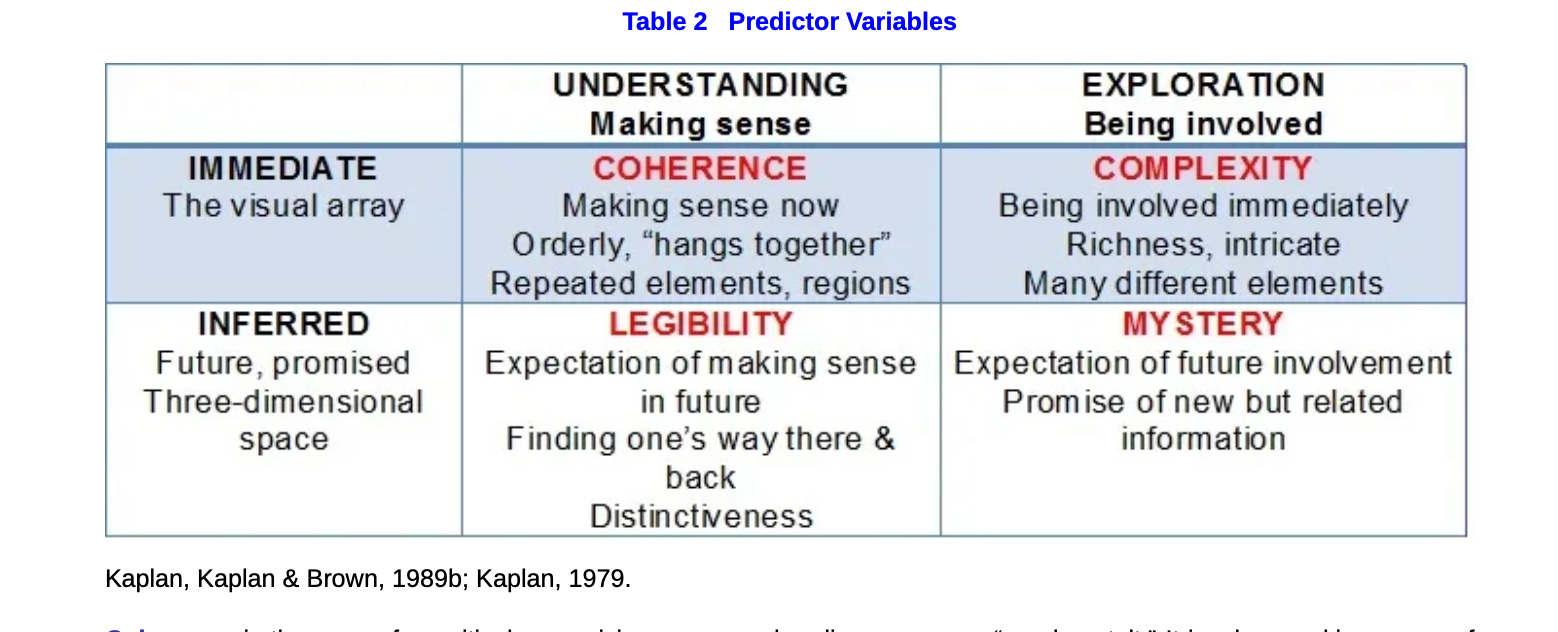
I spent a lot of time with the Kaplans when writing the stories in my most recent book, because in my imagined world, a mental illness called “violent solastalgia” was triggered by the illegibility of a world warped by climate change.
But I’ve also been thinking a lot about this theory over the last few days, not in terms of the human response to natural environments but in terms of the human response to illegibility and incoherence in a collective experience, like the 2024 election.
Those of us who make up stories for a living are lucky in that the writing of fiction can also be a tool for processing difficult experiences, events that don’t make immediate sense, facts that don’t add up, and so on.
We get to fill in the gaps with non-verifiable information in order to create narratives that make sense, because a comprehensible existence is a comfortable and safe existence.

One way I’ve been processing the confusing and sometimes contradictory events and facts of last week’s election is by plotting out a storyline for a book I don’t intend to write—a treatments for a political thriller, a genre I don’t even read.
There are many aspects of being a writer that aren’t glamorous or fun—general obscurity, the little humiliations of our job (book events no one shows up for or books that garner little attention), the complete lack of income.
But one of the best parts of being a writer is the complete freedom to engage the imagination to tell stories, to ourselves, to others, that may not be true, but also which could be true.
It is in that spirit, and as an attempt to manufacture some legibility and coherence for myself, that I wrote a storyline for an alternative timeline.
Note: I sourced some stuff here because that’s how I roll as a writer. As a former journalist, research and fact are how I write fiction, which is why my novel South Pole Station might better be shelved as “speculative nonfiction.”
A racist, foreign-born oligarch decides to interfere in an American election to protect his interests. He brings other American-born oligarchs on board, including those that own large media companies. They create a plan, which they share with the candidate and with key members of his party leadership. They are so bold that they reference this “little secret” in public.
The racist, foreign-born oligarch has U.S. security clearance because he owns a large satellite company, which provides services to the U.S. government.
His companies have been awarded numerous lucrative defense contracts. He is close with adversaries of the United States and communicates with them frequently, including a Russian president who interfered in the previous two American elections.
The racist foreign-born oligarch buys a giant social media company claiming he wants to turn it into a “free speech space” but instead immediately reverses bans on users who use racial slurs. The site quickly devolves into a white supremacist space and advertisers flee.
Doesn’t matter. This was the plan.
Meanwhile, the candidate conducts the worst campaign in American history. Another foreign-born oligarch hand-picks a venture capitalist and former intern and buys him a Senate seat in a swing state. This was a necessary step to installing him as the candidate’s VP pick.
They don’t expect the candidate to live long after taking office, so this candidate has to be entirely willing to do the bidding of the billionaire class.
The candidate continues to unravel in public, but makes reassurances to his voters that they needn’t worry. “We have enough votes,” he says. “You never have to vote again.” An assassination attempt against the oligarchs’ candidate, by a member of his own party, amazingly does nothing to increase the candidate’s popularity.
A far right-wing ally of the candidate and colleague of the VP pick, who has authored a Gilead-like primer on installing Christian Nationalist rule, publicly states that there is no chance the candidate will lose the election, and the coming revolution “will be bloodless, if the left allows it to be.” The Speaker of the House publicly discusses “a secret plan” that will ensure the oligarch will win the election.
The media is oddly quiet about such statements. Stories that do appear about these comments brush them off as “rhetoric" and implicitly encourage voters not to take them seriously.
The campaign is thrown a curveball when the expected candidate steps aside in favor of his VP. At first they are disturbed by the excitement they see in the populace. But they have a plan, and they’ve shared this plan with other billionaires, including the ones that own large media companies and newspapers.
So, despite record-shattering voter registration numbers, despite polls showing the candidate’s campaign is cratering, despite rally attendance getting smaller and smaller, and the challenger candidate’s rallies breaking attendance records, the billionaire newspaper owners suddenly decide to interfere with editorial and forbid their editorial boards from endorsing a candidate for the first time in their history.
They know the oligarch’s candidate will win—they’re aware of the plan—so no endorsement is necessary. However, they can’t endorse the people’s candidate, because they will alienate the man they know is headed to the White House.
In the three weeks leading up to the election, the racist foreign-born oligarch starts paying people to vote—or telling them he will. When he is sued, he doesn’t show up in court. He knows he doesn’t need to.
The oligarchs’ candidate appears to experience health issues in public, falling silent during rallies, weaving back and forth to forty minutes of music while on stage. The media, vociferous in its criticism of the standing president for regular age-related issues like gait problems and non-age related issues like his stutter, says very little about the oligarchs’ candidate’s decline and alarming behavior in public.
A poll out of Iowa stuns everyone, showing the people’s candidate ahead by an eye-opening margin. A massive misstep in New York causes outrage among hundreds of thousands of Puerto Ricans who vow to vote against the oligarchs’ candidate. The sheer number of Puerto Rican communities in swing states like Pennsylvania and Wisconsin could be decisive.
The oligarchs’ candidate commits an obscene act on a microphone at a rally. There is little media coverage that speaks directly about this incident, except abroad, including in the three large newspapers whose billionaire owners interfered with their journalistic integrity and prevented their editorial boards from endorsing a presidential candidate.
Yet, while Republican talking heads wring their hands, the campaign itself, and the billionaires who back it, are oddly calm.
Numbers for early voting start to come in, and they shatter records. Turnout looks to be extremely high, even before Election Day. Voter registration continues to balloon. A million new voters alone have registered by September 4th on a single site.
Meanwhile, the racist foreign-born billionaire starts making strange public comments about the fact that he might end up in jail if the people’s candidate wins, though he has not committed a crime that anyone knows of.
Long lines mark Election Day. Poll workers tell reporters they’ve never seen such turnout. Several states with leaders beholden to the oligarchs’ candidate refuse to allow Department of Justice election monitors to observe elections.
A number of bomb threats are called in to polling places in swing states, like Georgia, evacuating buildings and potentially leaving ballots unsecured. The bomb threats are immediately traced to Russia.
“Great story line, but no one would believe it.”
This text, from my dad, arrived at this point in my storytelling.
His tongue-in-cheek comment broke me out of this storyteller’s trance, which is probably a good thing. I had a lot more story to tell here, of corrupted voting machines and a perfectly executed plan to utilize the oligarch’s satellites to change vote totals—none of which required LeGuin’s imagination to conjure.
But I realized I felt better than I had before I’d sat down and typed out this fake treatment for a fake pulp thriller “based on a true story.” The relief wouldn’t last for long, probably until the next outrage. But it was something.
As I told my dad in our subsequent text exchange, I hadn’t realized how deep my passion, respect, and love for the old bones of this creaky political system really runs. How important it has been, over the last week, to first recognize and then navigate the enormous crevasse, hidden until 2016 beneath a light dusting of civility, between people who love democracy and decency and those who don’t, or who slot it second behind their own interests.
Absent a coherent explanation, which may come with time from those far better positioned to fit the events of the last six months into historical context, my imagination has been my therapist. (And I’m completely convinced that a political thriller with the storyline above might’ve sold for big bucks in 2012—but may have been shelved in the “speculative fiction” category)
For now, I’ll lean on something my dad said at the close of our conversation, after I’d expressed my concern for my family’s safety in light of Stephen Miller’s comments about a “denaturalization” program on “turbo-charge” and hinted that it would be over my bullet-ridden corpse that the federal government would touch my husband.
“So this,” I said, “is what radicalization feels like. I guess that’s where I am today.”
Stay there for awhile. I’ve got guns and ammunition. But never forget that ideas are the bullets of the mind.
No posts
Comments
Nothing yet. Say the first thing.
Sign in to join the conversation.