
As I wrestle with the complex and troubling events of December 4th and the fascinating public response to the assassination of United Healthcare CEO Brian Thompson, I find myself returning to Melville’s peerless critique of “compassionate capitalism,” “Bartleby the Scrivener” and wondering what he would have made of this strange moment of public unity over the death of a corporate executive.
Melville is an American oracle to me. Unappreciated in his lifetime, he was a thoughtful, keen observer of both personal and private injustices that went unnoticed by many in his day. He took a particular interest in the changing material conditions and social hierarchies of the mid-nineteenth century in New York, where he witnessed the city’s unimaginably rapid growth (the city’s population increased by more than half a million people in twenty years), along with the rise in housing prices.
By that time, an overarching hierarchy had already taken hold, in which workers were not just paid employees, but were servants who served at the pleasure of their boss, and who could be eliminated at will, paid according to the employer’s whims, or sometimes not even paid at all.
The wealth gap had increased exponentially, even though Americans were conditioned to believe that the country had no “impoverished class,” as opportunity was, so the story goes, available to everyone.
It’s no surprise that mid-nineteenth century New York was the site of labor unrest and riots. In July 1850, the tailors of New York initiated a strike. By early August, three hundred of them were attacked by police during a march and two were killed. This was the first time U.S. workers were killed by police during a labor dispute. State violence had made its debut in this young country.
Like most writers of the day who concerned themselves with social matters, Melville was not explicit in his critiques of the crevasse that existed (and still exists) between American capitalism and the country’s professed democratic ideals with its alleged Christian underpinnings. Instead, he presented us with one of the most remarkable characters in all of fiction:
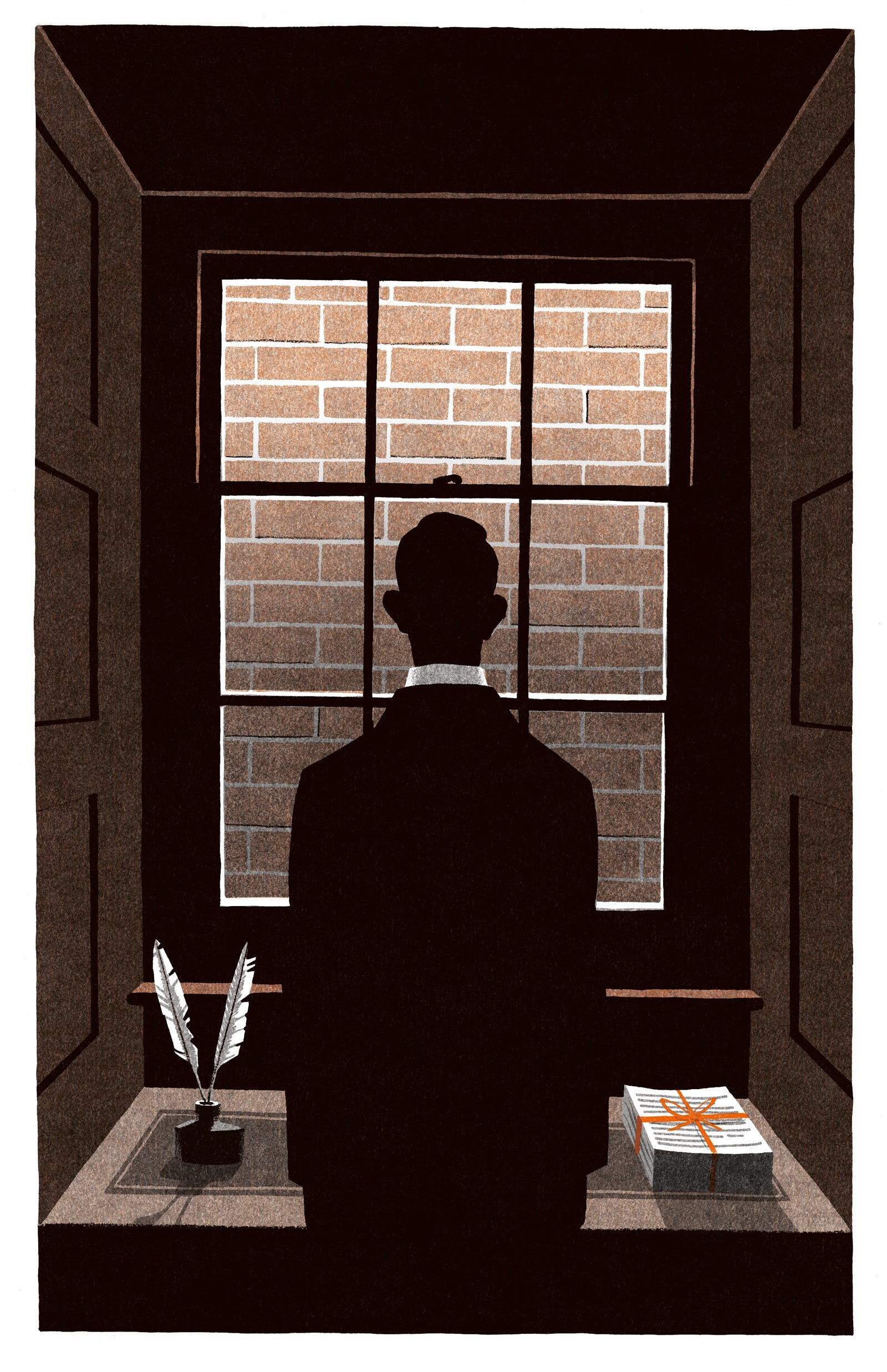
On its face, the story is a simple one. A businessman hires a scrivener (think human Xerox machines) to help him and his two other employees handle an increased work load. After a couple of days of work, Bartleby ceases his efforts, but remains at his desk. When his astonished boss asks him to work, he states: “I prefer not to.”
In the raging capitalist machine of pre-Civil War New York, this act of resistance was as startling as an act of violence.
Bartleby’s employer, the unnamed lawyer who narrates the tale, cannot reason with Bartleby but also cannot bring himself to fire him. At least, not at first. He alternates between raging at Bartleby for not picking up his work, choosing instead to stare out the window, and lavishing the scrivener with paternalistic tenderness, much to the chagrin of his other two employees.
Neither approach raises any other response from Bartleby except,“I prefer not to.”
I prefer not to.
How dangerous these four words were to a burgeoning ruling class entirely dependent on wage labor.
On December 4th, 2024, I saw how dangerous these words remain. And instead of turtles, it was Bartlebys all the way down.
We have been conditioned, since birth, to be civil. We must not wish ill on anyone, no matter what they do to us or others. We must not smile at others’ misfortune. And we certainly can never celebrate a death.
That’s why so many in the media found, and continue to find, the public response to United Healthcare CEO Brian Thompson’s assassination in front of the New York Hilton impossible to understand.
Not only was there little sympathy for the CEO’s death at the hands of a then-unknown gunman, who had clearly targeted him. There was also some who applauded the killer.
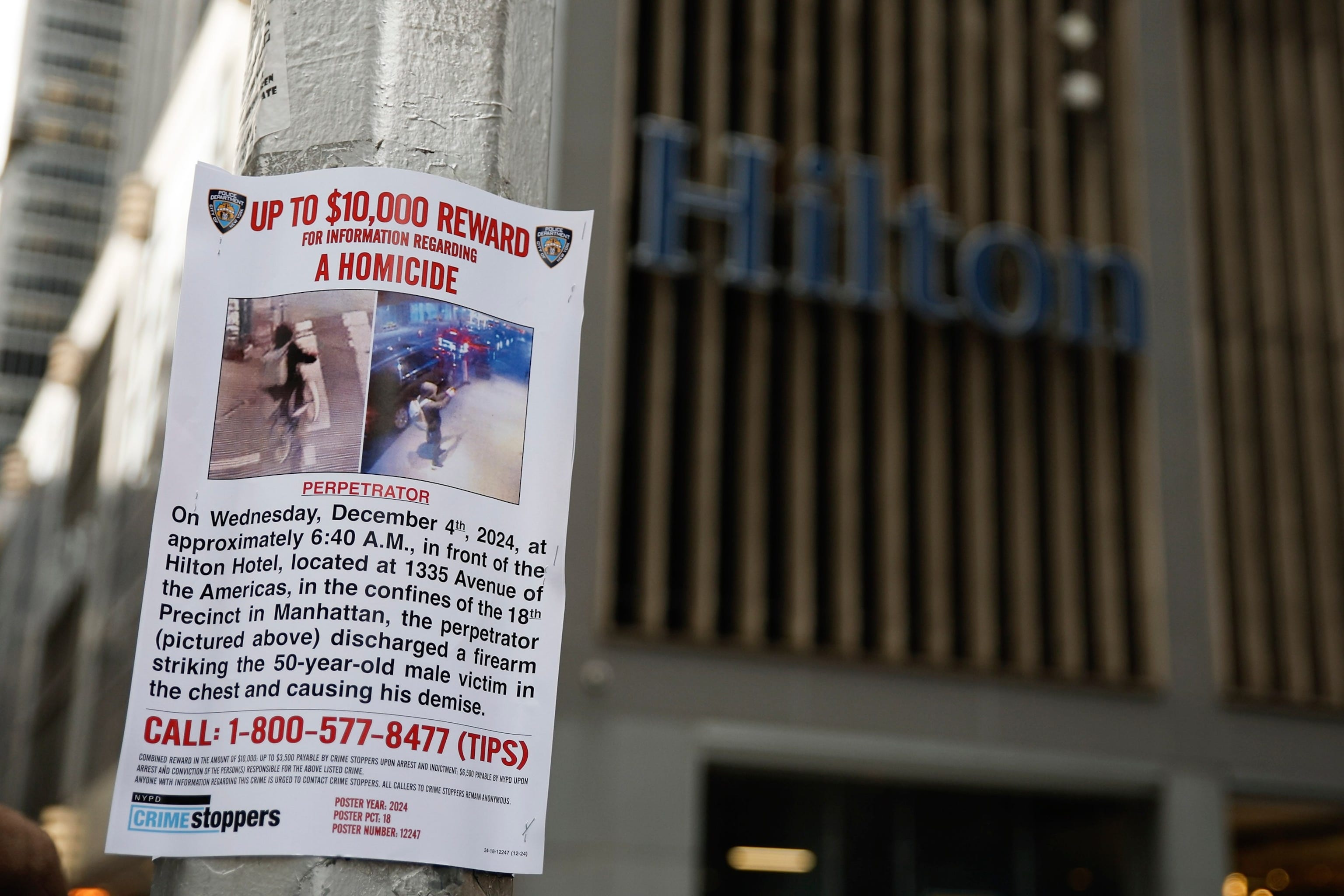
As one of the bright lights of UHC, Brian Thompson had been responsible for the introduction of AI claims-processing that had an error rate of 90%—a fact known to Thompson, who did nothing to correct that error. UHC denies one out of every three claims, more than twice as high as the next closest insurer. Thompson himself was in trouble for insider trading after he, and several other UHC executives unloaded stock two days before the announcement of a DOJ investigation into the company.
And he had been on his way into an investor meeting (a health insurance company with investors is, to some, a morally repugnant proposition), where he was going to announce projected 2025 earnings of $450 billion. When you consider that a health insurer makes money by denying claims to people who are sick or in pain, it becomes less difficult to believe some of the millions of Americans insured by UHC might have found it difficult to scrape together a lot of sympathy for its CEO.
And as the day unfolded, it became clear that this response was mainstream.
From progressives to MAGA, no one was shedding a tear for Thompson. On Reddit, doctors and nurses who had spent hours and hours on the phone with United Healthcare trying to get, in one case, anti-nausea medicine approved for a child cancer patient going through chemo, were not torn up about it.
I read personal stories of insurance hell from communities as divergent as the r/chiraqology sub (drill music and Chicago gang culture), r/conservative, /popculturechat, and /workreform.
I hope he never gets caught tbh these people denied my grandmothers cancer treatment because she wasn't in network (r/chiraqology)
I can understand why Mangione felt like shooting him was the only way to get a response as well. We vote, we complain, we voice concerns, and push back all the time with no form of improvement in our healthcare system. What else is left for a person to do besides resort to violence? Let me be clear, I don’t think it was the right decision but I definitely see how he got there and I think many Americans feel the same way (a nurse in r/medicine)
My niece died of brain cancer earlier this year. She was four. It was infuriating how many hoops her parents had to go through to get things covered by their insurance. It was almost a full-time job keeping up with the claims, correspondence, etc. It's an industry that literally banks on desperate people not having the time/energy/money to fight the greed that drives corporate healthcare. (r/popculturechat)
A bare minimum of law enforcement resources should be expended. People regularly die because UNH denies coverage and it never even makes the news. (r/conservative)
When right-wing influencers like Ben Shapiro and Matt Walsh tried to capitalize on the murder in order to further divide right-wingers from progressives, their own fans turned on them, scolding them for turning what was now seemingly a universal response into a point of division (that didn’t exist) and sharing their own horror stories of claim denials, chronic pain, and the slow, lingering, and painful deaths of loved ones because of insurance policies written by for-profit companies like UHC.
At first, the media ignored the groundswell of support for the killer, then still on the run. Once Luigi Mangione was apprehended, then came the finger-wagging editorials, the scolds, the fraught think-pieces about how we’ve lost our humanity, how we’ve become inured to political violence, or violence itself thanks to social media, that we are indulging a bloodlust.
Everything except the obvious. That the health insurance industry has damaged, injured, and exploited so many Americans that the general response to the murder of one of their CEOs was not horror but understanding.
Instead, we had media pundits and columnists demanding we have compassion. This person was a father, they told us, as if the thousands of men who have died waiting for treatments denied by UHC were not also fathers. Show civility!
And because there was no moral outcry in The Atlantic when their child was denied treatment for her seizures because UHC didn’t feel they were “bad enough” to warrant treatment; because no outraged op-eds were published in USA Today about the times they returned from the bathroom after puking up their guts following chemo to make yet another call to UHC to get a claim denial reversed; and because no one used the fact that they were a mother or a father or a daughter or son to appeal to the humanity of UHC decision makers, the public refused.
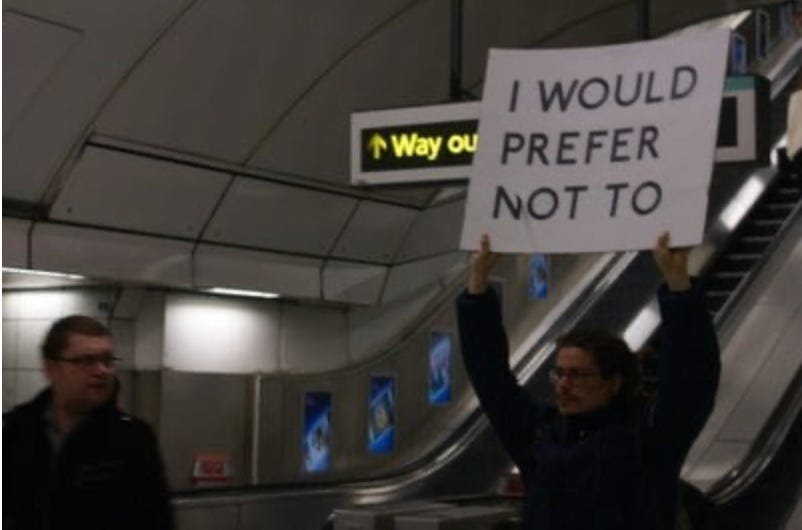
The public said: I prefer not to.
To be continued…
No posts
Comments
Nothing yet. Say the first thing.
Sign in to join the conversation.