
Remember the name Cameron M. Smith.
Remember his actions: firing shots at the Keystone Pipeline in South Dakota and the Wheelock substation in North Dakota, which resulted in “disruption” of the pipeline in South Dakota and “disruption” of electric services to North Dakota customers.
Remember the federal charges: “destroying” an energy facility (two counts) for what the New York Times characterized as “vandalism.”
Remember the sentence: 25 years. With a guilty plea.
Remember the restitution amount: $2.1 million.
In July 2022, a fifty-year-old man named Cameron M. Smith, deeply concerned about climate change, caused $500,000 worth of damage (according to prosecutors) to the Keystone Pipeline by firing bullets into it from a rifle.
Keystone Pipeline is owned by TC Energy, a company worth $50 billion as of March 2025. To put the damage caused by Smith’s act in perspective, $500,000 in damage would be like a company making $1,000,000 in revenue each day losing one cent on one of those days. Or like a homeowner with a $500,000 paying for $5 in minor cosmetic damage. A sports team with a $100 million payroll accidentally paying a player an extra $10001.
Ten months later, Smith shot at the Wheelock substation in North Dakota, owned by Mountrail-Williams Electric Cooperative and Basin Electric Power Cooperative (combined $1 billion in equity, roughly). Again, no one was injured or even present. Interestingly, the damage to the substation was initially said to be $100,000. Somehow, that figure ballooned to $1.2 million in damage with no explanation. Affected electric customers in the Wheelock substation incident numbered 240, or 2.9% of their customers.
Because Smith’s indictment was sealed, and remains sealed post-conviction, we are unable to assess whether these damages are accurate; instead, we’re to take the word of the owners of the Keystone Pipeline and the Wheelock substation, along with the federal prosecutors. The only sources the public has to determine if the damage estimates are legit are government press releases and statements from the affected energy companies.
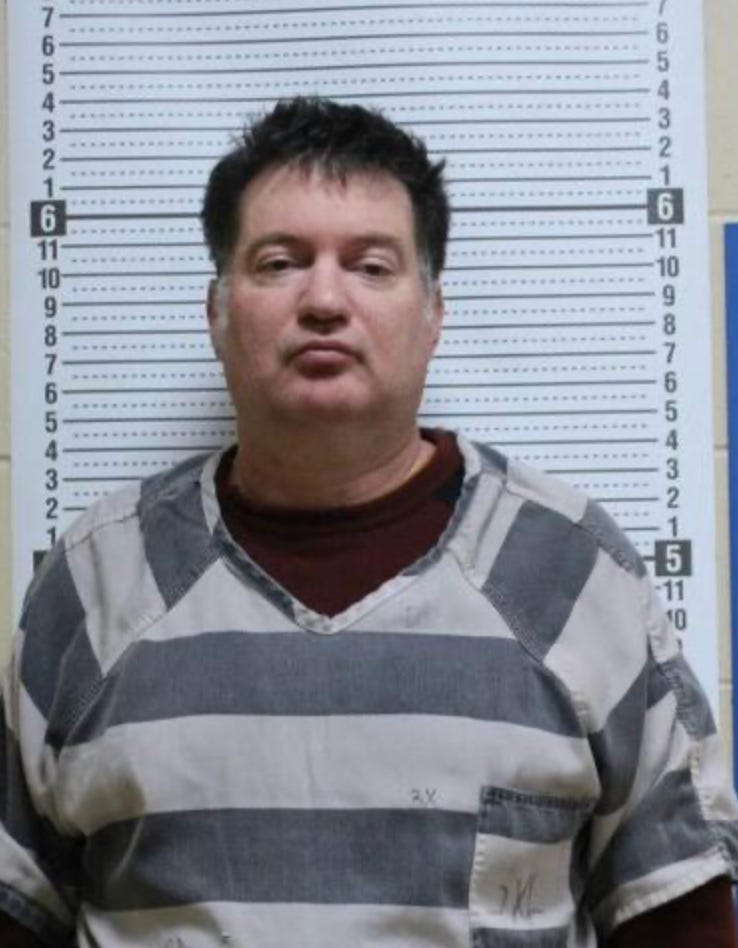
Without access to the original indictment, supporting evidence, or any independent assessments, how can we know these figures reflect actual repair costs or if they’ve been inflated for legal, or even political reasons? The answer: we can’t. Because the Keystone Pipeline and most anything associated with energy transport in this country is considered by the government “critical infrastructure.” Therefore, regular citizens like you and me have no right to information about them, even in federal court cases.
The prosecution of Cameron Smith raises important questions about the relationship between corporate power and state/federal enforcement. As we’ve seen in the Luigi Mangione case, individuals challenging corporate power (directly or indirectly) have recently been treated as imminent and uniquely dangerous threats. There’s also a sense, in these prosecutions, that “vigilantism” is a catching disease and that the population can be made immune by seeing these acts severely punished. (Even though there is very little evidence that deterrence measures like these work.)
What can we glean from the Cameron Smith climate vigilantism case that might provide some insight into what we can expect from the government in the Mangione case? Let’s look at a few parallels.
The DOJ argued that Smith’s shots at the Keystone Pipeline and the Wheelock substation constituted “terrorism” because energy facilities are federally protected. As such, damaging them can be considered an act of terrorism if the attack was meant to “affect the conduct of government by intimidation or coercion, or to retaliate.”2
Because the indictment is sealed, we have no information on Smith’s motivation other than his concern about climate change and the role energy companies are playing in worsening it. Was he shooting at a steel carbon tube, no humans in sight, because he wanted to “intimidate” and terrorize the U.S. government? Is it possible he was simply angry?
There is only one publicly available court document online in the USA v. Smith case, and it’s this order from the judge for Smith to hold a pre-trial status conference with his counsel via phone.
Similarly, in the Mangione case, the defendant is facing terrorism enhancements in the New York State charges. This is notable because such applications of New York’s anti-terrorism statute are exceedingly rare—Mangione’s state charge of first-degree murder “in furtherance of an act of terrorism” has been the top count in only three other cases.
By introducing terrorism elements at the state level, New York may be laying the groundwork for a federal charge that would allow the feds to pursue a terrorism-related penalty (including the potential for the death penalty) against Mangione.
While both of these acts—the shooting of the Keystone Pipeline and Wheelock substation and the murder of Brian Thompson—are crimes, neither appears to meet the standard of terrorism, at least not with publicly available evidence.
Labeling both of acts as terrorism allows the government to pursue much harsher penalties, such as the death penalty or life sentences, for acts that may be seen as property crimes or acts of civil disobedience. Both Smith and Mangione threatened the financial interests of the corporate class in ways that had little impact in reality but which had enormous symbolic impact.
Again—the fear of “contagion” seems to be driving these kinds of prosecutions. The government becomes desperate to shift the narrative from simple vandalism in Smith’s case or a targeted killing as acts of extreme violence against the nation’s critical economic systems. (We’re seeing this happen in real-time with the nation-wide spate of Tesla vandalism, with Attorney General Pam Bondi referring to these acts as “domestic terrorism.”)
In Cameron Smith’s case, we saw the federal government use the concept of “critical infrastructure” to justify their disproportionate prosecution. Yet this designation is often applied too broadly, in order to protect the business interests of private corporations—particularly in the energy sector. This protection racket has successfully enshrined corporate interests into law (look at the creation of the Energy Policy Act of 2005). This is in line with a system that prioritizes property over people.
Right now, it’s hard to tell how New York prosecutors will frame Mangione’s alleged actions in a way that will demonstrate to a jury that he posed an existential, terroristic threat to the population on December 4th. What is clear, however, is that in both cases, the terrorism designation shifts the focus from corporate wrongdoing and reframes the conversation to one in which corporations are victims of dangerous radicals and terrorists.
As you’ve undoubtedly seen, corporations and industries wield significant influence over our government’s priorities. Reporting late last year indicated that health insurance interests pressured the DOJ to file charges against Mangione quickly, (perhaps more quickly than the feds wanted to, considering the fact that the defendant still has not been indicted.) When the corporate media failed to quash public support and/or sympathy for the suspect, the corporate class leaned on the DOJ to act quickly, and the government acquiesced, even at the cost of a potentially weaker case.
In Smith’s case, the “critical infrastructure” designation of the Keystone Pipeline gave the federal government a great deal of leeway to protect TC Energy’s economic interests by pursuing aggressive prosecution.
In both cases, the prosecution did not act wholly independently, but was guided by “corporate-sensitive” strategies. Once you’re aware of this, you’ll start seeing it everywhere. And when you do, it will be difficult to come to any other conclusion than that the federal government shows far more concern and consideration and expends much more energy for corporate victims—even if they are literally corporations, not people—than they do for real, living human victims.
It’s no secret that corporations have a vested interest in ensuring that people who challenge their stability, including vigilantes like Cameron Smith and Luigi Mangione, are swiftly and harshly punished to prevent any copycats or even a movement from forming that might harm them. In order to accomplish this, they utilize their political influence and and rely on government support. As we’ve seen this partnership results in aggressive legal responses to anyone perceived as undermining corporate interests.
An easy way to see this in action is to consider how the corporate media has framed Brian Thompson’s death. Was news coverage of his death mostly focused on how his loss impacted his wife and children? Or did you notice that it seemed his death was only noteworthy because he worked for UnitedHealthcare, and that his loss was seen as a heavy blow to the health insurance company, including the way it impacted the company’s stock price?
At no time has it ever seemed like the federal and state prosecution of Luigi Mangione was a crusade for the Thompson family. It has only and ever appeared to be a deterrence campaign, designed to protect the real victim: UnitedHealthcare.
As for Cameron Smith, consider the punishment he’d face if he’d shot up, say, an unoccupied house. Private property rather than corporate property. It’s likely he would have been charged with criminal mischief, unlawful discharge of a firearm, or reckless endangerment, even if no one was home. He’d probably be facing a few years of jail time, though with a plea (or possibly even without one) he might get probation and restitution.
But he shot at TC Energy property, not a neighbor’s home. He shot at “critical infrastructure” that has dumped 500,000 gallons of crude oil into waterways and instead of being punished has been allowed to continue operations and has enjoyed the protection of federal law enforcement and prosecutors.
Cameron Smith wasn’t punished because he shot at something—he was punished because he shot at the wrong thing.
Cameron Smith’s sentence of 25 years in prison for a handful of gunshots that resulted in relatively minor damage to a 2600-mile pipeline made of high-strength carbon steel was also meant to be a deterrent. The cost of the damage was not really a factor in the prosecution. It was the potential cost of the corporation that owned it if other people deeply troubled by climate change and TC Energy’s role in it also picked up a rifle and began shooting at the pipeline.
Putting a fifty-year-old autistic man in prison for the rest of his natural life wasn’t justice; it was a message.
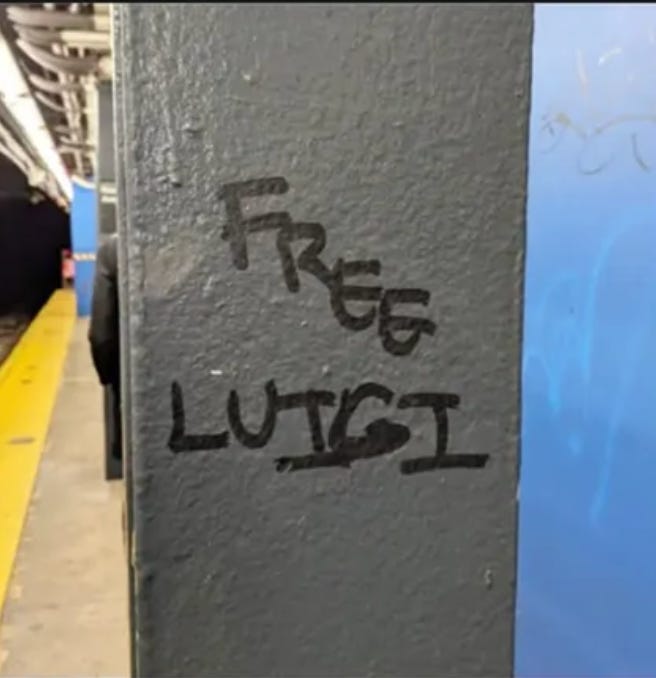
Now consider Mangione’s predicament. The death penalty is a high-profile tool meant to create fear—even terror—in the defendant, and in anyone contemplating a copycat crime. It’s designed to hang over a defendant’s head and weaken him. A guilty plea from Mangione, a mea culpa, or, even better, a claim that he was mentally ill or unwell at the time of the act is the goal.
The DOJ wants Mangione’s lawyers to do what Cameron Smith’s did. From a New York Times article about Smith’s sentencing:
Doug Passon, Mr. Smith’s lawyer, said in court documents that Mr. Smith was “extremely misguided in his attempt to bring awareness to the climate change crisis by vandalizing the electrical substations of private power companies.”
“He is, however, no terrorist,” Mr. Passon said. During the pandemic, Mr. Smith spent “an inordinate time online and focused on the existential threat of climate change,” Mr. Passon said in court filings, though he added that Mr. Smith had been interested in climate change for many years.
The apologia allows the corporate class to tell the public that the actor was troubled and “extremely misguided.” It takes away the norms-enforcement, the righteous rage, because in neutering this kind of act, the government feels safer. No one, they think, would be inspired to act by someone who would dismiss his own actions by saying he didn’t really mean it.
It’s possible this is the route Mangione’s lawyers feel he should go in order to avoid a death penalty case or a life sentence. But Cameron Smith’s guilty plea earned him nothing from the government except twenty-five years in a federal prison.
Smith, however, wasn’t facing a possible death penalty case. That Mangione may be conveys a clear message that the federal government will aggressively defend corporate assets and interests, even if it means putting a man to death.
Books have been written about this topic, so I’ll just say that by selectively applying harsh punishments to people who threaten corporate interests while letting corporate wrongdoers get away with fines, the federal government shows that it is an organ of the corporate class.
I’ve spoken before about the concept of social murder, which some allege Unitedhealthcare commits with its high level of claims denials and the excessive pre-authorization obstacles they throw in the path of sick customers. Yet, these “crimes” not only go unpunished, they are lauded at shareholder meetings, like the one Brian Thompson was headed to on December 4th, 2024.
Why was Cameron Smith thrown in prison for twenty-five years for firing his rifle at a pipeline when ExxonMobil successfully used the American legal system to avoid paying punitive damages to the people on Prince William Sound for the destruction of their livelihoods after the Valdez spill? Why does Cameron Smith have to pay restitution to an energy company that is responsible for at least two substantial oil spills from that same pipeline?
The American legal system is supposed to work for everyone, but it works much more efficiently and far more swiftly for the corporate class than it does for us. In other words, it is a class-based system.
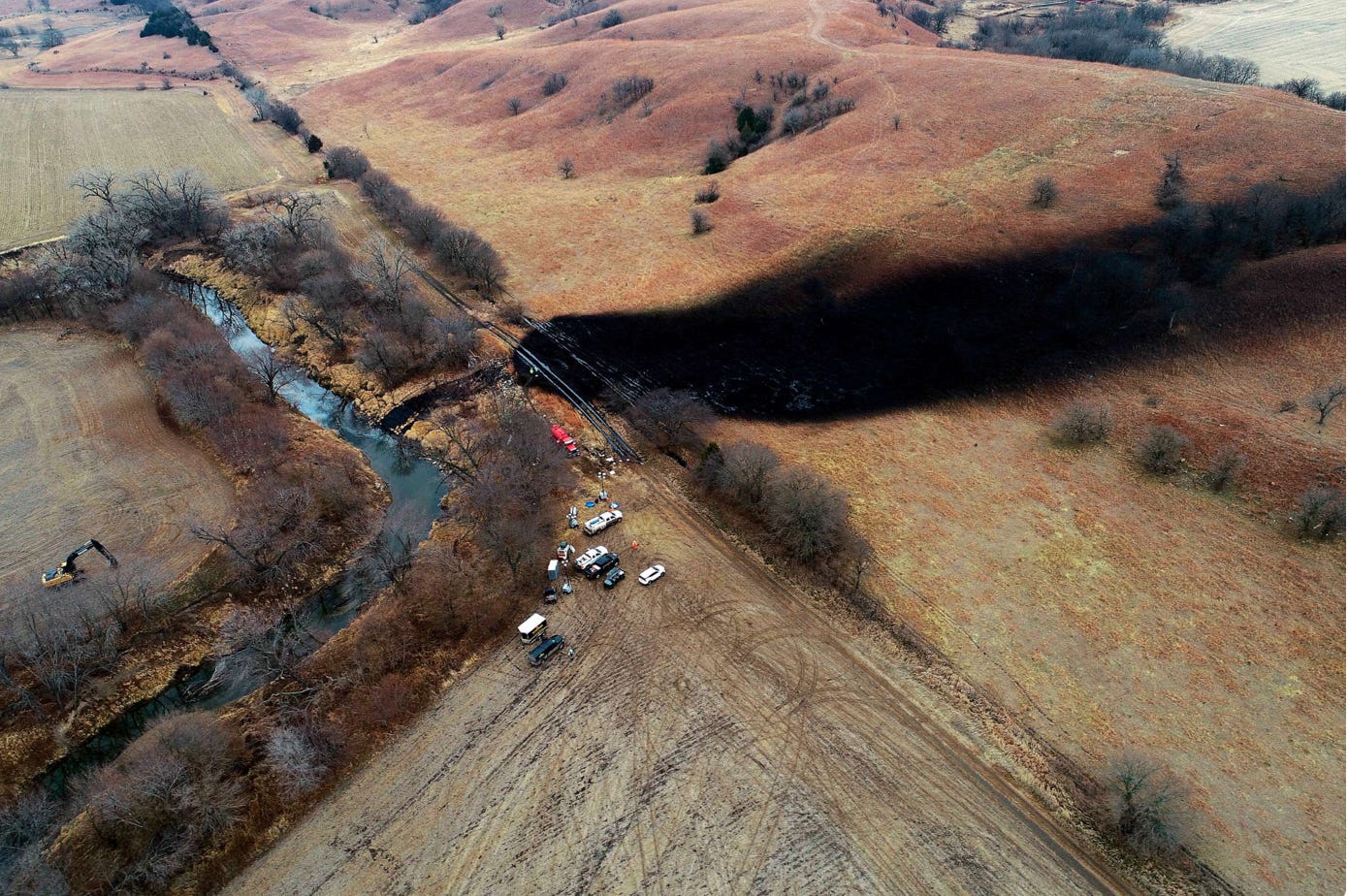
When those who challenge the power structures of massive industries are met with terrorism charges and disproportionately harsh sentences, while the corporations themselves escape scrutiny or punishment for their crimes, the message is intentionally clear: property and profits are more important than people. Capital interests dictate the boundaries of criminality. None of this is especially new.
However, I see Cameron Smith’s case as a troubling precursor to an era of corporate protectionism that will not hesitate to utilize disproportionate sentencing or even the death penalty to achieve its goals.
Mangione’s case, however, may be something even more chilling—a precedent set in the midst of the corporate takeover of American democracy that officially cements the government’s role as the enforcer of corporate desires.
With state-sponsored murder as a bargaining chip.
These examples are based on the 1:100,000 ratio the damages represent to TC Energy’s net worth.
https://www.justice.gov/archives/jm/criminal-resource-manual-1673-destruction-government-property-malicious-mischief-destruction
No posts
Comments
Nothing yet. Say the first thing.
Sign in to join the conversation.