
We are meant to lose hair.
When we lose too much, its alarming.
Let’s decode that alarm bell so you can invest in the better hair health solution for your body. [Scroll down to get the link to my recent 6 min segment on do’s and don’ts for hair loss]
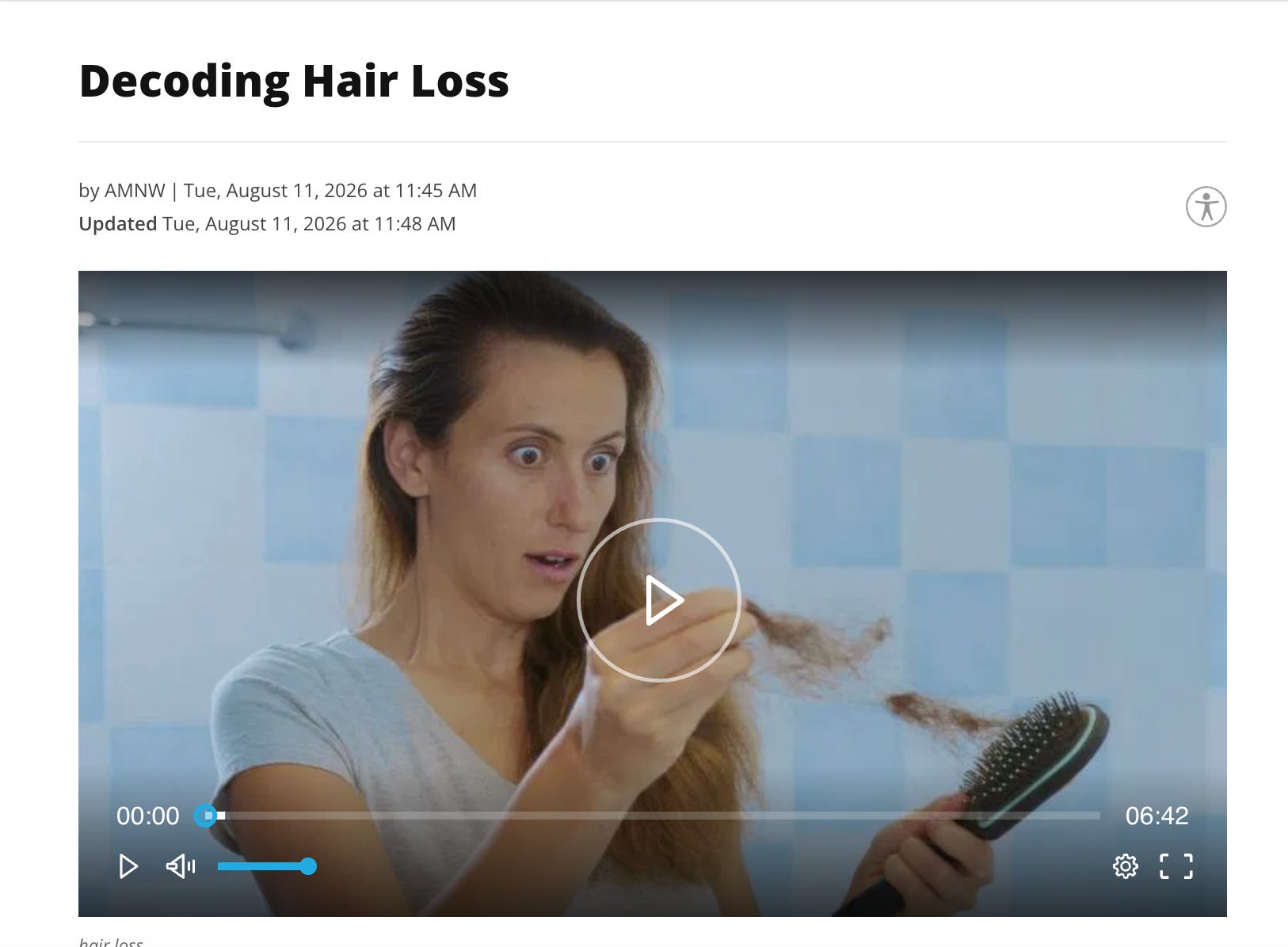
How much hair loss is normal and what is not ok?
While some hair loss can be completely normal - we lose about 50-100 strands a day as hair “turns” over — when there is more or a specific spot or pattern we should pay attention.
Like all cells and our bones, hair goes through building and shedding phases.
When either worsens, however, it is a signal that the body’s ecosystem seeks your attention.
It is not a call to take more biotin, increase iron, or inject GHK-CU.
But one search or an utterance of “what should I do about my hair loss” will tee up epic numbers of ads for products and programs masquerading as hair health solutions.
A tool is never a solution. A tool belongs in a toolkit that is evaluated, selected and wielded based on insights about what your body — not just your hair — needs today.
How does hair grow?
To evaluate hair health, we need to look first at how it is made and what impacts the two phases of formation and shedding.
Hair health is dictated by total available nutrition, scalp and follicle health, hormones, growth factor and blood circulation.
I was recently asked to give a talk to preteens about their hair health so I am going to share that tree analogy here.
Imagine your scalp is like the sky and there are trees that will be planted underneath so that they grow up towards the sky. And then think of their growth as happening through the seasons.
In the Spring, assuming the soil has enough nutrients, the seed will sprout roots and those roots will rapidly grow to become the base of the tree. This process is dictated by the health of the follicle.
Over the summer they are nourished and grow. The cells build on each other getting harder and stronger until they become a fully formed root that can push through the surface as “hair”. Think of this as roots first being like green, soft twigs that then become hard bark. This process is called “keratinization’ because hair is made of keratin.
In the Fall, hair gets new messages to stop growth and it actually starts to decline. At this time through the winter, the hair is just good to hang out. It should be strong and thick, so it can withstand being brushed, curled and even cut.
In the Winter, hair doesn’t do anything. It may be considered “dead” as a tree without leaves or only with some leaves looks, but it is not. It is just awaiting Spring when the new growth pushes out the old to replace it.
When there are natural or man-made disasters, trees experience premature loss of branches and leaves, they may have impaired growth or not even make it from the root to the trunk phase.
That’s what happens to your hair when you lose it or it thins or fails to grow at all.
What impacts hair growth?
Things that impact hair health
- genetics
- stressors
illness
pregnancy/ postpartum
good stress (high intensity workouts, planning a wedding ok that may fall under bad stress),
challenging stress
- environmental toxins
- medications, treatments
- suboptimal digestion
- weight loss
- hormonal shifts (like DHT (a derivative of testosterone)
- insufficient nutrients
intake or digestion not making them available
- impaired circulation
- inflammation in the scalp
To receive new posts and support my work, consider becoming a free or paid subscriber.
How to know what is causing hair loss?
Comprehensive assessment is critical for identifying the true cause(s) of hair loss.
If you increase your protein or iron, but the issue is suboptimal digestion not only will hair loss not get fixed but it is likely to worsen digestive challenges.
Here’s what my team and I assess:
digestion (get the complete assessment and actions to take in Your Best Shot (where you borrow or buy books) and you can also get the assessment questions here in my Substack article.
total nutrition - evaluate your supplement and frequent food nutrient intake to identify gaps and imbalances.
inflammation and circulation - looking at labs, genetics and health history to understand current, trends, and individual potential will help shape recommendations
toxin exposures and detoxification - where we have or can get lab data it may be useful, assessment of what goes in and on your body, what you may be breathing and how your detoxification system is operating is crucial
hormonal health and peptide formation - looking at what could be challenging and what is in good shape will help us know what to protect and optimize.
What should be explicitly clear is that is what is not acceptable for hair loss assessment: a picture, grams of protein, how much B vitamins you take in, a life stage (perimenopause or postpartum, or male “pattern” baldness as genetic).
What are the nutritional needs for preventing hair loss?
The most important two words are these: Optimal Resources.
If any resources for your body are suboptimal, it will not prioritize hair. Your body doesn’t need you to have hair to survive. That’s always going to be its primary and secondary goals. With hair quality and amount being around #57 (of 59). It really doesn’t care much about hair, especially as you age.
While everyone thinks B vitamins especially biotin and B6 are the hair essentials, nutrients like all your minerals especially iron, zinc, copper, and silica; proteins especially specifically amino acids matter like l-cysteine, methionine, lysine; fats like omega 3s and 6s (GLA especially), and all the antioxidants including those that help promote detoxification, circulation, and a healthy inflammatory response.
If I have hair loss and figure out the cause(s), what should I do next?
1) digestion needs to be optimal (includes hydration) so nutrients get where needed, when needed in a form that is needed. This always our first step. In my book I refer to this as the pizza “crust” phase.
2) Identify and optimize total nutrition to give the body enough of what it needs to make and support scalp health, keratin and follicles. This is where supplementation can help fill gaps or address imbalances from a dietary point of view or as the result of medications or treatments. These are your pizza “Sauce” and “toppings” phases if you are implementing from my book.
3) Resolve any suboptimal operations: blood sugar, inflammation, detoxification to optimize scalp and hair health.
4) Consider the newer “toppings” which may be effective treatments such as topical peptides, injectable or an oral keratin peptides replacement therapy (IFP-131). I recently shared more about these in a segment here.
How long does it take to fix hair loss?
It won’t happen overnight.
You should expect to see improvements over the first month, but hair loss restoration often takes 3 months. It also will depend on the cause(s) and ongoing challenges to hair health.
Hair health reflects what has occurred 3 months ago or longer so it is important to not just try new things all the time but work through a plan that looks to repair and restore hair health over a few months
Know someone who would benefit from this hair health advice? Please consider:
I hope this helps you avoid a poor investment in the hopes that there is a fast and effective solution to hair regrowth. And it should give you hope that there is an effective one worthy of your investment. Did it spark any questions about products, supplements, or protocols? I would love to know and happy to answer
Ashley Koff RD
the backwards DR
Comments
Nothing yet. Say the first thing.
Sign in to join the conversation.