
Last week I said I’d be talking more about AI and how it will make the lives of post-sales and GTM teams easier. I also said that those who don’t adopt or change will likely be left behind.. because most roles will have to heavily use AI or at least start managing agents to some degree. And this, I do believe.
That said, I've been in a lot of circles lately.. top GTM leaders, operational consultants, AI startups.. and one theme keeps coming up in every room.
I want to talk about something that’s important to consider while many are already cutting their customer teams in half with the assumption that AI will handle it now..
Almost everyone has heard the pitch by now.
AI is going to shrink your support team. Your customer success team. Your implementation org. Your onboarding specialists. The logic gets presented like it’s inevitable: AI will handle most of that work. Headcount comes down. Margins go up. Everyone wins.
It’s a compelling narrative. And it’s missing something important.
Here’s what I’m seeing gets missed in these conversations..
The number of humans around a product isn’t an organizational inefficiency waiting to be automated away. It’s a signal. Those people exist because they are filling gaps.. real, structural gaps between what the software does and what the customer actually needs.
Think about what a lot of post-sales humans spend their time doing:
Interpreting what the customer is actually trying to accomplish
Fixing messy data and reconciling systems that don’t talk to each other
Explaining UX that wasn’t designed to explain itself
Adapting workflows for customers who don’t fit the standard mold
Coordinating between tools, teams, and processes the product can’t connect on its own
Most human work around a product exists to compensate for product limitations.
That’s not a failure. It’s just how most software companies operate.. especially during growth stages where speed to market matters more than polish. The humans are doing real, valuable work. They’re just doing work the product should eventually be able to handle itself.
Bain found that despite significantly increasing post-sales headcount after the pandemic, NRR actually declined for 75% of software companies. The lesson there isn’t that humans failed.. it’s that throwing more resources at the wrong problem doesn’t work. And here’s the part that matters for this conversation: the same is true for AI.
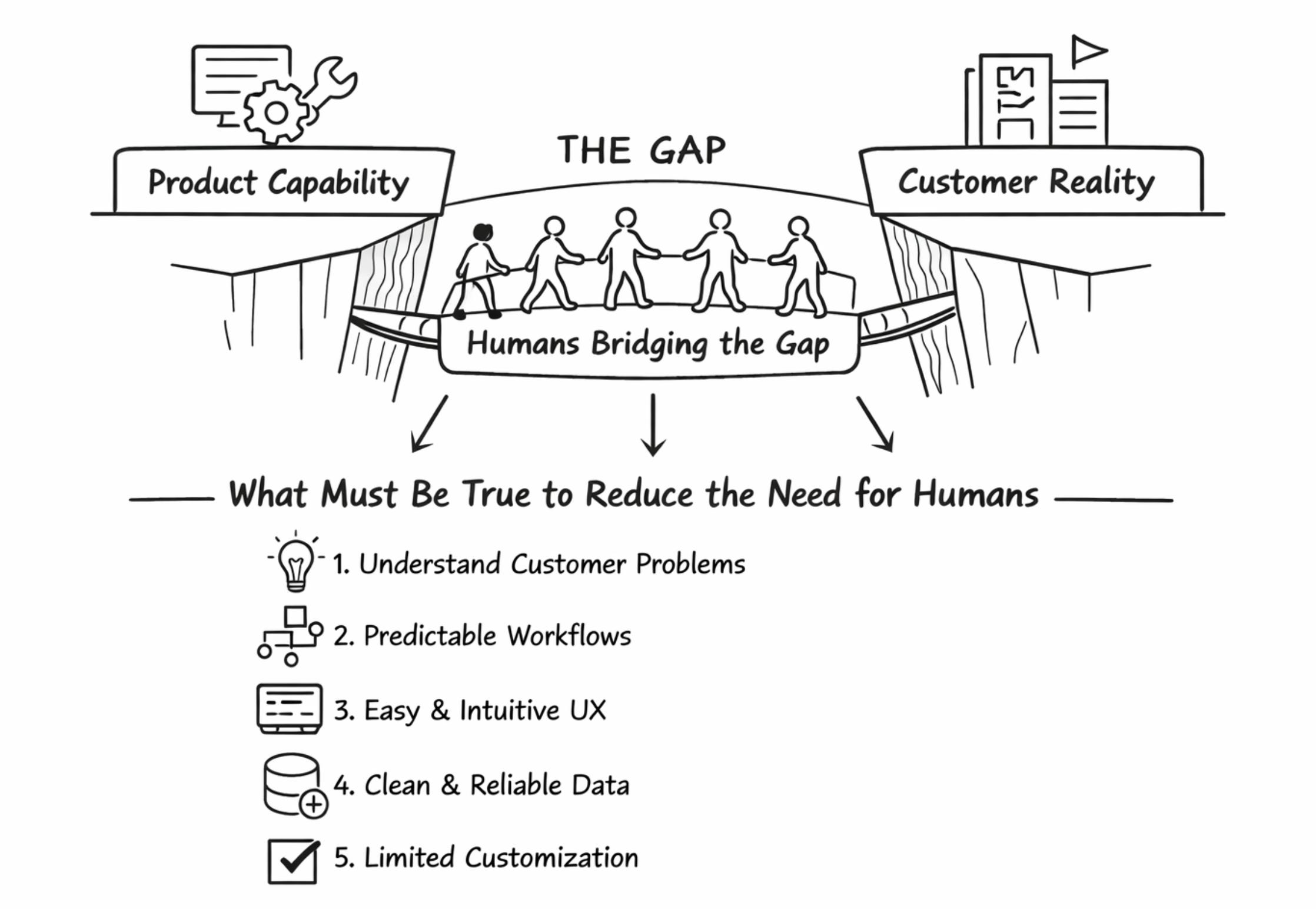
There’s a simple way to think about this.
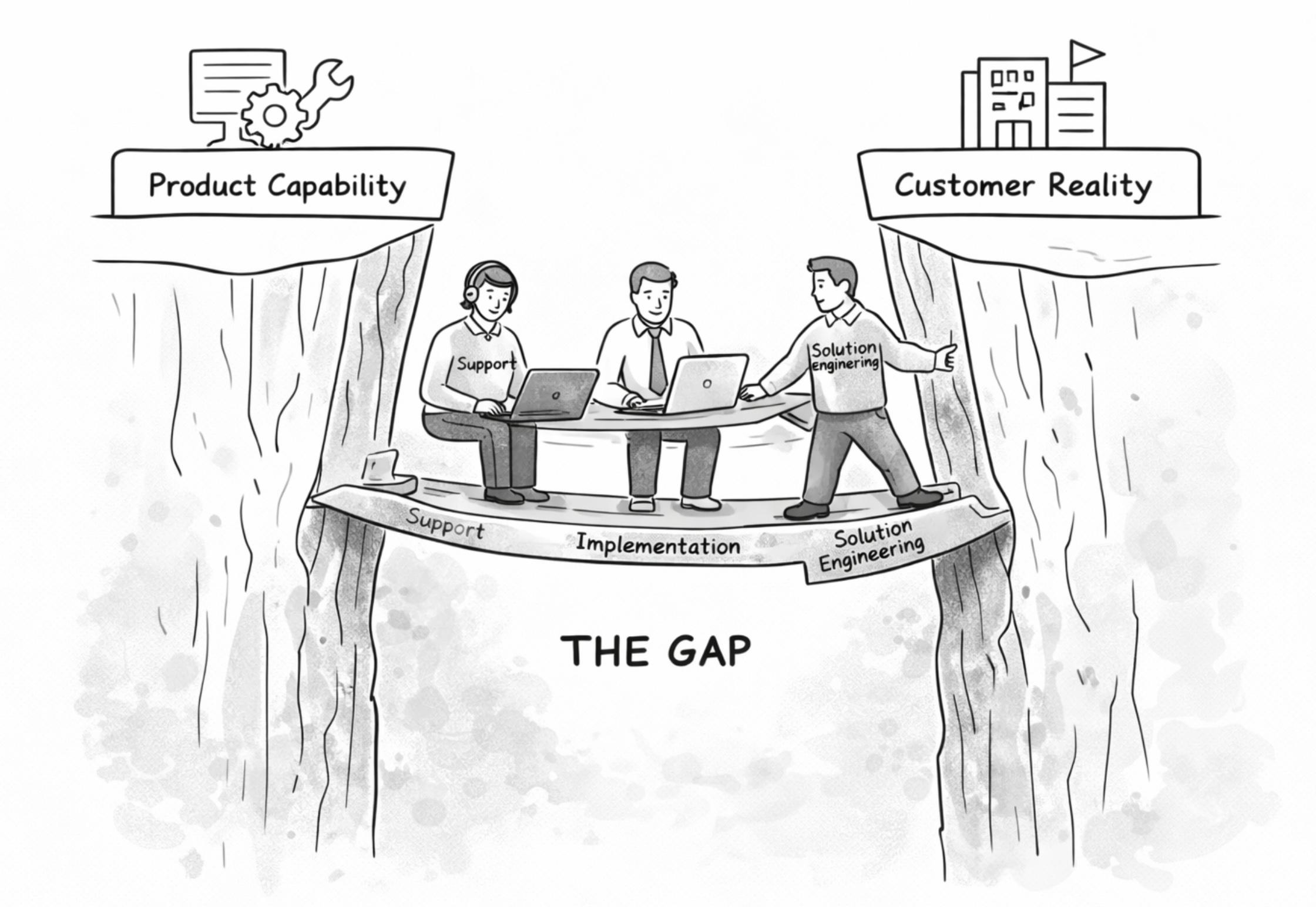
Every product has a gap between its actual software capability and the messy reality of how customers use it. That gap is where your post-sales team lives. Support, CS, implementation, onboarding, solution engineers.. they’re all, in some form, bridging that distance.
The question isn’t “how do we remove the people bridging the gap?”
The question is “what would have to be true for the gap not to exist?”
If a company genuinely wants to operate with a smaller customer-facing team, certain conditions have to be in place first. Not as aspirations. As operating realities.
1. The product must understand the customer’s problem.. not just provide tools.
Most software gives customers capabilities and expects them to figure out the rest. Humans step in to interpret: what is this customer trying to do, how should this be configured, what does a good workflow actually look like for them? For fewer humans to be needed, the product has to do that interpretive work itself.. detecting problems, recommending solutions, configuring intelligently. That’s a high bar most products haven’t cleared.
2. Customer workflows must be predictable.
Automation requires consistency. When every customer has different systems, different data structures, and different edge cases, you will always need humans to navigate the variation. The companies that successfully reduce human touchpoints usually make a deliberate choice to standardize.. they limit how the product can be used, push customers toward common patterns, and minimize variability. That’s a product and go-to-market decision, not an AI decision.
3. The product must be exceptionally easy to use.
If onboarding requires training calls, documentation walkthroughs, and someone explaining the same things over and over.. the product isn’t truly self-serve. A product that needs fewer humans has to guide users through its own interface, surface errors in plain language, and suggest what to do next without someone holding the customer’s hand. Great UX replaces human explanation. Most products aren’t there yet.
One study found that 74% of customers will switch to a competitor if onboarding is too complicated. That gap doesn't just disappear.. someone on your team is filling it.
4. Customer data must be structured and reliable.
A surprising amount of post-sales work is really data work.. cleaning records, validating inputs, reconciling systems, investigating why something didn’t sync correctly. Automation only works when the inputs are trustworthy. Until data quality and system reliability meet a high threshold, humans will always be needed to investigate, interpret, and correct. AI doesn’t fix dirty data. It amplifies it.
IBM's 2025 research puts it plainly: in agentic AI environments, poor data quality doesn't just slow things down.. it produces unpredictable outputs and causes models to drift. The humans cleaning your data aren't overhead. They're the reason your AI won't embarrass you.
5. The company must be willing to accept less customization.
Every unique workflow creates new edge cases. Every exception creates configuration work. Every “we do it a little differently” creates operational overhead. The companies that scale with fewer humans make a conscious, sometimes uncomfortable decision: they limit the number of ways the product can be used. That’s a business model choice.. not something AI solves.
AI is genuinely powerful. It can interpret data, recommend actions, automate repetitive tasks, and assist decision-making in ways that weren’t possible even two years ago.
But here’s one point that’s becoming clear:
AI accelerates mature systems. It doesn’t replace immature ones.
When the underlying product is solid, workflows are consistent, data is clean, and UX is intuitive.. AI can take a lot of the remaining human work and run with it. It becomes a real multiplier.
When those conditions don’t exist, AI mostly just speeds up the chaos. You get faster wrong answers. Automated bad data. Scaled confusion.
The companies racing to reduce headcount through AI, without fixing the underlying product gaps first, are going to learn this the hard way.
Instead of asking “how do we use AI to reduce the number of people around the product?” the more honest question is:
“What would have to be true for the product to handle more of this work itself?”
That reframe makes all the difference. It moves the conversation from cost-cutting to product maturity. It puts accountability in the right place. And it gives you an actual roadmap instead of a headcount target.
Large customer-facing teams are often a sign of product gaps, not organizational bloat. Shrinking those teams without closing the underlying gaps doesn’t eliminate the problems.. it just moves them. Customers churn. Tickets pile up. The work doesn’t disappear, it just becomes someone else’s problem.
The companies that genuinely operate with fewer humans didn’t start by removing people.
They started by building products that didn’t need as many.
That’s the part the AI hype cycle keeps skipping. And it’s the part that will determine which companies actually get the efficiency gains they’re projecting.. and which ones just have smaller teams struggling with the same problems they always had.
No posts
Comments
Nothing yet. Say the first thing.
Sign in to join the conversation.