
On Sunday, two days before I receive The Phone Call, I drive to my local nursery to buy more zinnia seeds.
I had already planted two rounds, but for some unexplained reason, none of them took. Same garden bed as last year. Same dirt. Same watering schedule. Same (expensive) Floret seeds. I planted the first batch during an exceptionally warm week in March, and when the temperatures dipped in early April, I figured I planted too early. So I tried again in May, once the sunshine remained stable and consistent. I had no doubt in my mind the second batch would sprout. Weeks later, though, not one seed had germinated.
But hope is a stubborn thing, and so am I, which is why I’m spending this particular Sabbath with my hands in the dirt, again, planting and hoping and planting and hoping that all will not be lost this summer.
///
I’ve always heard grief comes in waves: a rhythmic, mighty, push-and-pull kind of force. But nobody warned me about the pit that forms in your stomach first, the lump of coal, hard and heavy, a black mass taking up space that used to house … what? Peace? Naiveté?
Nobody warned me about the slideshow of images that would play in my mind against my will at 1am, 2am, 3am. Fuzzy, happy memories mixed with horror scenes I never actually saw with my own two eyes. This movie has a beginning and an end, but there is a whole middle—nine years’ worth of time—missing from the final cut.
Here’s a happy one: us lying at the bottom of the stairs in the family room, me on the right side, him on the left, both of us with our feet pressed against the vents. We’d lie there every Saturday morning, perfectly content, hot air blowing on our socks while we watched Bugs Bunny.
I have to claw to the back of my brain for more. Swimming in our backyard pool. Eating spaghetti at the dinner table. Dollar scoop night at Baskin Robbins. Camping at Pinecrest and playing Uno. So many of my memories now are vague, like they could belong to anyone. What else did we do? Where else did we go?
Why can’t I remember anything else?
///
Other memories will etch themselves into you, like initials carved into a tree.
Here’s one I’ll never forget. A text from my dad: “Call me immediately.”
A flicker of worry flaps in my chest, but I shoo it away. We’re leaving for vacation next week, and my dad can sometimes be intense about travel logistics. Maybe there’s a problem with the rental car?
My seven-year-old daughter and her best friend are attempting tabletop handstands. Both of them balance their feet against the wall with their hands propped on the ground, making perfect L shapes with their tiny bodies.
I call my dad back. It rings once, twice.
“Mom, look at us!”
The girls giggle hysterically over their new little trick, oblivious to anything else happening in the room.
My dad picks up on the third ring and asks if I am out of town.
“No, I’m here,” I say, “What’s wrong?”
I don’t remember exactly how he said it. I just remember the sudden feeling of a rock taking up space in my stomach.
My brother, my baby brother, had taken his own life.
///
In Maggie Smith’s memoir, You Could Make This Place Beautiful, there’s one part in the book where she holds up a stop sign to the reader. In a chapter appropriately named “This Moment Isn’t For You”—Maggie writes:
Reader, I’m not going to give you a scene of us telling our kids we were getting divorced. I won’t tell you what we said, and I won’t tell you how they reacted. It was the hardest conversation I’ve ever had with anyone, period. I hope to never have one harder. That moment their lives were changed forever, and that moment isn’t for you.
This is the stop sign portion of the essay. This is the scene I will never write. The one where I sit on the couch in my parents’ living room, and my dad tells my mom that her son is dead.
///
The day before I receive The Phone Call, I begin reading Elizabeth Strout’s newest novel, The Things We Never Say. There it is, early in the book, page 16: the main character plotting how to kill himself. I read those words like I read any other words. It’s a story, it’s fiction, it’s not real. I have read a plethora of novels in my life and seen hundreds of movies, many of which deal with suicide. It’s not that I’ve felt nothing (I am human), but the word itself has never unmoored me.
It’s wild how everything can change in an instant.
Because I will never read that word again and not feel a stabbing ache.
///
After the shock dissipates, I realize I have to tell people. I am both a writer and a communications major, but there’s no guidebook for this kind of news.
I land on a single, precursor line: “There is no good way to say this.”
I copy/paste the message, send it out like a bat signal. My texts become one giant ledger of shock.
There is no good way to say this.
There is no good way to say this.
There is no good way to say this.
“My brother committed suicide on Tuesday,” I write.
“Please pray for my family,” I beg.
///
There is also no good way to say this: I had not spoken to my brother since 2017, when he made the decision to leave our family.
Here’s where I wish I could fill in the holes, move the puzzle pieces around the kitchen table and make them fit together, but I can’t. Because I still don’t know why. There are theories, of course. Mental illness, possibly a bipolar diagnosis, maybe bad therapy? Did a TikTok therapist listen to my brother vent on a leather couch and encourage him to cut ties, peddling the illusion of a wonderful, frictionless life? #boundaries? #nocontact?
I will never know.
All I know is this: in 2017, he left. Blocked all of our numbers. And never looked back.
///
Our small dilapidated kitchen, built in 1950, hosts a lot of charm and also a lot of problems. The stove in particular, is finicky at best. Anytime you try to boil water, it takes forever. You can crank up the heat as high as it will go and still wait several minutes for a single bubble to appear.
Then—in an instant—that same water will boil out of control, spilling out over the edges.
This is what it feels like for nine years of estrangement to end this way. The grief bubbles slowly and slowly and slowly until one day, in a single phone call, it boils over all at once.
///
The last time I texted my brother was in 2021. I asked how he was doing and sent him a picture of my three kids (one of whom he had never met), standing with our grandparents outside their home.
I didn’t get a response, and I never tried again.
I thought we’d get in touch eventually, because I thought we had more time.
That is now my cross to bear.
///
In the days that follow, I walk around hollow and empty, like a Russian doll without her insides. Somehow I get on a plane for my best friend’s wedding. Pop a beta blocker and give a toast. I continue to fold laundry and wash my hair and go to the grocery store for more bananas.
I am everywhere and nowhere, a shell of myself. I am walking. Talking. Nodding politely at the airport security guard while he pulls a giant tube of toothpaste out of my daughter’s suitcase. I am carrying on, going through the motions, but I feel awkward and disconnected from my body. Like I am just floating above my own head, watching someone else desperately trying to be okay.
///
Suicide is a very specific grief. That is not to say it is worse or harder than any other grief. Grief is grief. Cancer. Heart attack. Car accident. People literally die every single day. Part of the unique grief of suicide is the unanswered questions, the 100 what if’s.
Should I have tried harder to get in touch? Should I have hopped on a plane, shown up on the doorstep, and forced him to talk to me? (Would he have answered? Let me in? Slammed the door in my face? Pretended he wasn’t home?)
And the biggest one of all: would any of it have made a difference?
///
My community shows up in droves. Bat signal received. I come home to groceries on my porch, a thoughtful care package, money in my Venmo, so many DoorDash gift cards. Friends check on me around the clock.
Praying for you right now.
What admin work can I take off your plate?
I’m at Target, what can I bring you?
My literary agent runs interference in my inbox. “Ashlee is not responding to emails this week,” she types, “there’s been a tragedy in the family.”
Tragedy. I am taken aback by the accuracy of that word, and how it hadn’t occurred to me to use it.
There is a brief moment by the pool with friends who let me fall apart and cry. Who do not offer anything but the ministry of presence. No platitudes, no bright side. They say nothing but “this is so heavy” and “this is so hard.” I never knew what a gift that could be: having friends who simply bear witness to your tears and let everything be gut-wrenchingly terrible for five quiet minutes under a big blue sky.
In the days that follow, I am abundantly loved and cared for.
I feel so much gratitude. And so much guilt.
///
This is what still makes no sense, then or now. How two kids can grow up under the same roof, with the same parents, who can go to the same church and the same school and have access to the same environment and the same resources.
And yet one kid goes one way, and the other kid goes another.
What am I supposed to do with that, as a mother?
///
“You’re so quiet,” my husband says.
He is talking and talking and asking me questions and I finally say with an edge to my voice, “I do not want to talk right now.”
I know he wants to help. I know he loves me. I know he needs to process this, too. But right now, I do not want to process. I want to stand in this stupid bathroom and put stupid makeup on my stupid face for this stupid 4th of July party I do not wish to attend.
Today the inside of my mind is a storm, and right now, I only want to listen to the rain.
///
Two winters ago, I got the flu. It took every ounce of strength in my body to raise my hand and click “skip intro” on whatever dumb TV show streamed on my laptop for ten straight days. I had never been so sick in my adult life. I canceled everything, slept 15 hours a day, hardly left my bed.
The first time I mustered up the strength to put on pants and take a short walk around the neighborhood, I remember thinking: Wow, I have taken my health for granted my entire life. I never even think about it, the way my body works, how strong and capable it is. How good it feels to walk and walk and walk, to move my legs and my body and my feet.
And I’m thinking of that now, again, how much I take for granted.
Because I have felt sad many times in this life. Full stop. I have experienced loss. I have been devastated. I have felt lonely, rejected, and even depressed. But I have never, not once—not even for a fraction of a second—felt like I had nothing to live for.
///
Six days later, we board an airplane to Hawaii, a trip that was planned months ago. Even now, I worry about the optics, as if the grief police are going to show up any minute and arrest us.
But what were we supposed to do?
Cancel?
Stay home and cry?
Eat the cost of nonrefundable airfare?
Really, I’m asking, what were we supposed to do?
Stop living?
///
I delete the apps off my phone. Leave the texts unread. Ignore my inbox. I read and read and read and wake up every morning at 4am because my body will not adjust to the time change. My Oura ring warns of looming sleep debt, but I don’t care. I drink half a pot of coffee and write and write and write.
When I can’t string together one more sentence, I slather sunscreen on my body and head to the pool with my children, my parents, and another book to get lost in. I do not wear a stitch of makeup. I do not brush my hair.
Sometimes grief looks like a wave, a rock, a monster, an overwhelming emptiness. Other times, grief looks like ordering mai tais at the pool and not talking about it at all.
///
Much to my dismay, my daughter cannot touch the bottom of the pool near the waterslides. I am not, nor have I ever been, The Pool Parent. That role belongs to my husband, who unfortunately had to stay home to work.
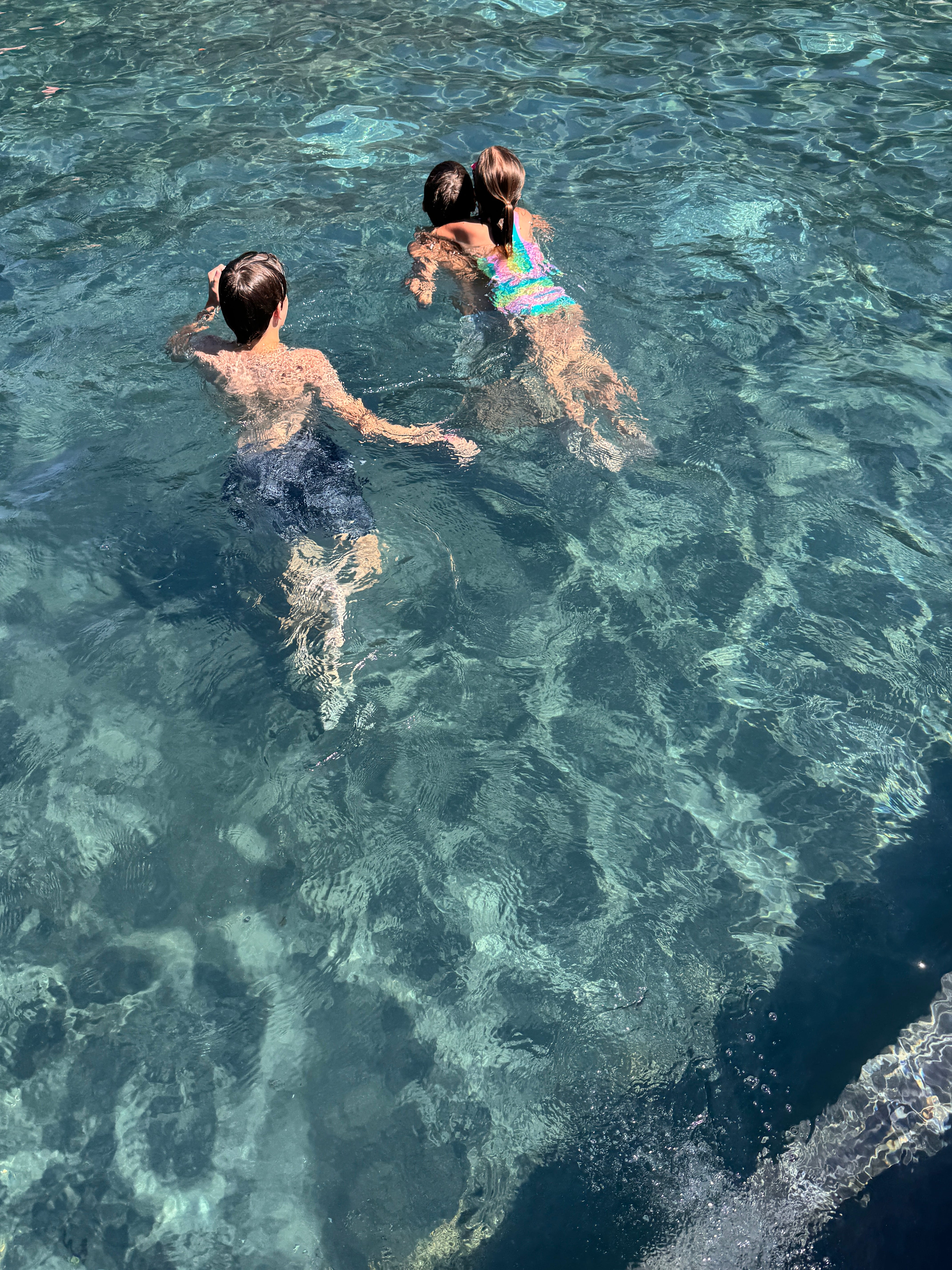
Before I even dip my toe in the pool, I look up to find my daughter hooked on her brother’s back. He glides through the water, pulling her like a dolphin tow, her arms clutched around his neck. Her other brother swims nearby and the two boys trade off, passing their sister back and forth while she squeals with delight, high on attention. Together, they climb the flight of stairs to the top of the waterslide and go down in birth order. Boy. Boy. Girl.
At the bottom, where the water swirls in a current, the boys take turns catching her and carrying her safely to the steps.
I am mesmerized. My kids don’t always get along, but today—and without any instruction from me—they’re taking care of each other.
I say a silent prayer. God, let it always be so.
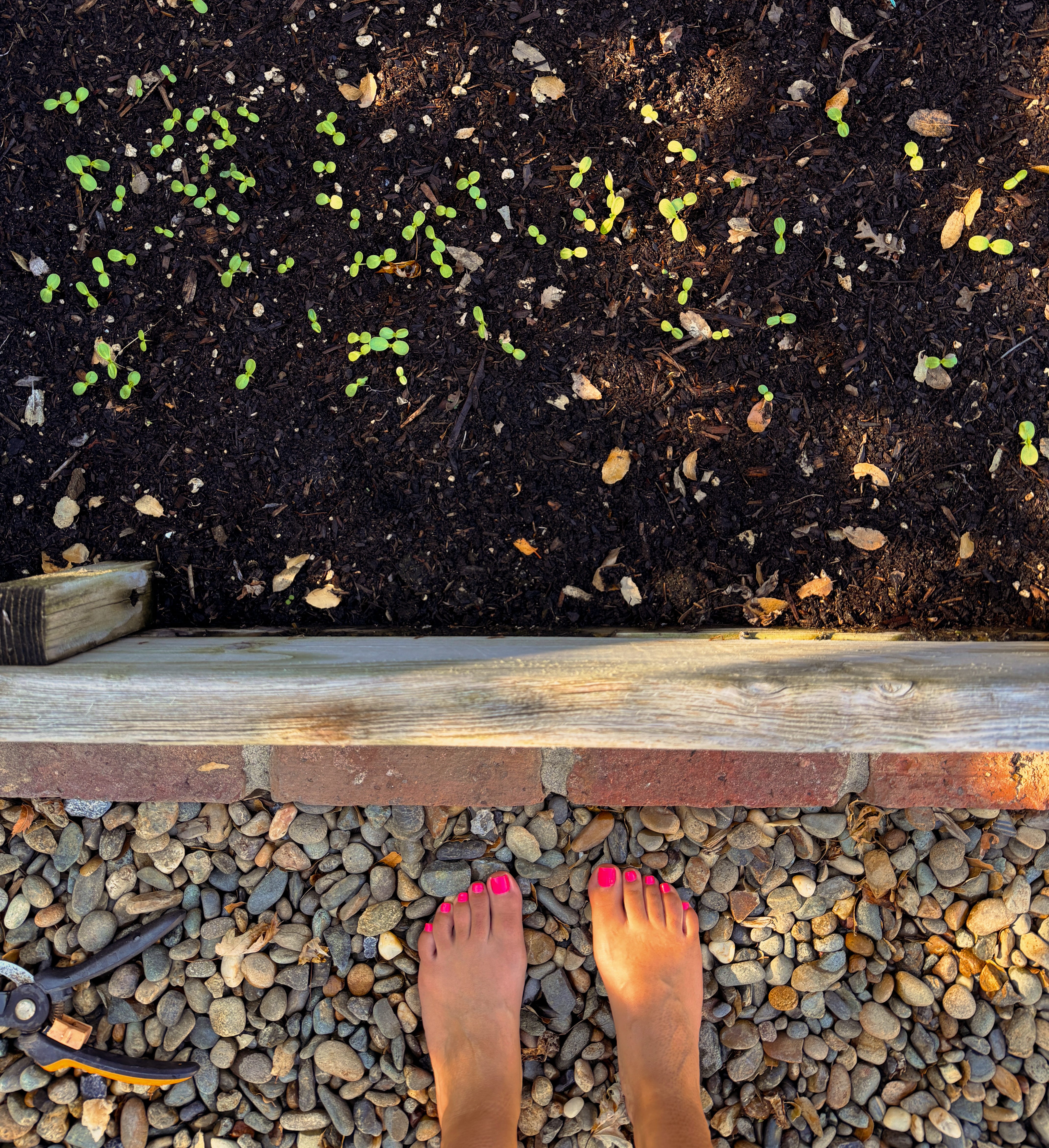
It’s been a week since I planted the third round of zinnia seeds, and five days since The Phone Call.
I am sitting in the same backyard, drinking the same flavor of sparkling water, but everything is different. I walk slowly to the small garden bed at the side of our yard, bracing myself for more bad news. But hope is a stubborn thing, and so am I. Holding my breath, I take a peek.
I still don’t know how to process this loss. I don’t know why some zinnias make it and some don’t. Why some people are tormented their whole lives and others get to fall in love and have beautiful children and a village of friends and a happy little life.
I don’t know how to understand something that will never, ever make sense.
Today, I only know this: by God’s grace, I am still here, and it is nothing short of a miracle that every single morning—against all odds—I wake up and want to live.
Comments
Nothing yet. Say the first thing.
Sign in to join the conversation.