
Continuing from last week’s post, in which I took a retrospective look at the first two of George Romero’s Living Dead movies, this post will cover the third and forth of the series.
Day of the Dead (1985)
Following the trend of the previous films, with Night of the Living Dead set during the first days of a zombie outbreak, and Dawn of the Dead beginning weeks into the disaster, Day of the Dead begins at a point further down the road, when civilisation is all but gone, and the threat of human extinction looms.
The opening paints a vivid picture, with striking scenes of a flyblown coastal Florida where rotting figures shamble among alligators under the tropic sun. The absence of news segments is a first for the series: every radio frequency yields nothing but static.
Set in an underground military bunker, the film follows a group of civilian scientists attached to a squad of soldiers under the demented Captain Rhodes (Joseph Pilato), a man who positively devours every scene he is in, but in a good way. Rhodes is so unrelentingly antisocial that he makes Doctor ‘Frankenstein’ Logan, a man who divides his time between vivisecting zombies and trying to educate them, appear downright reasonable by comparison.
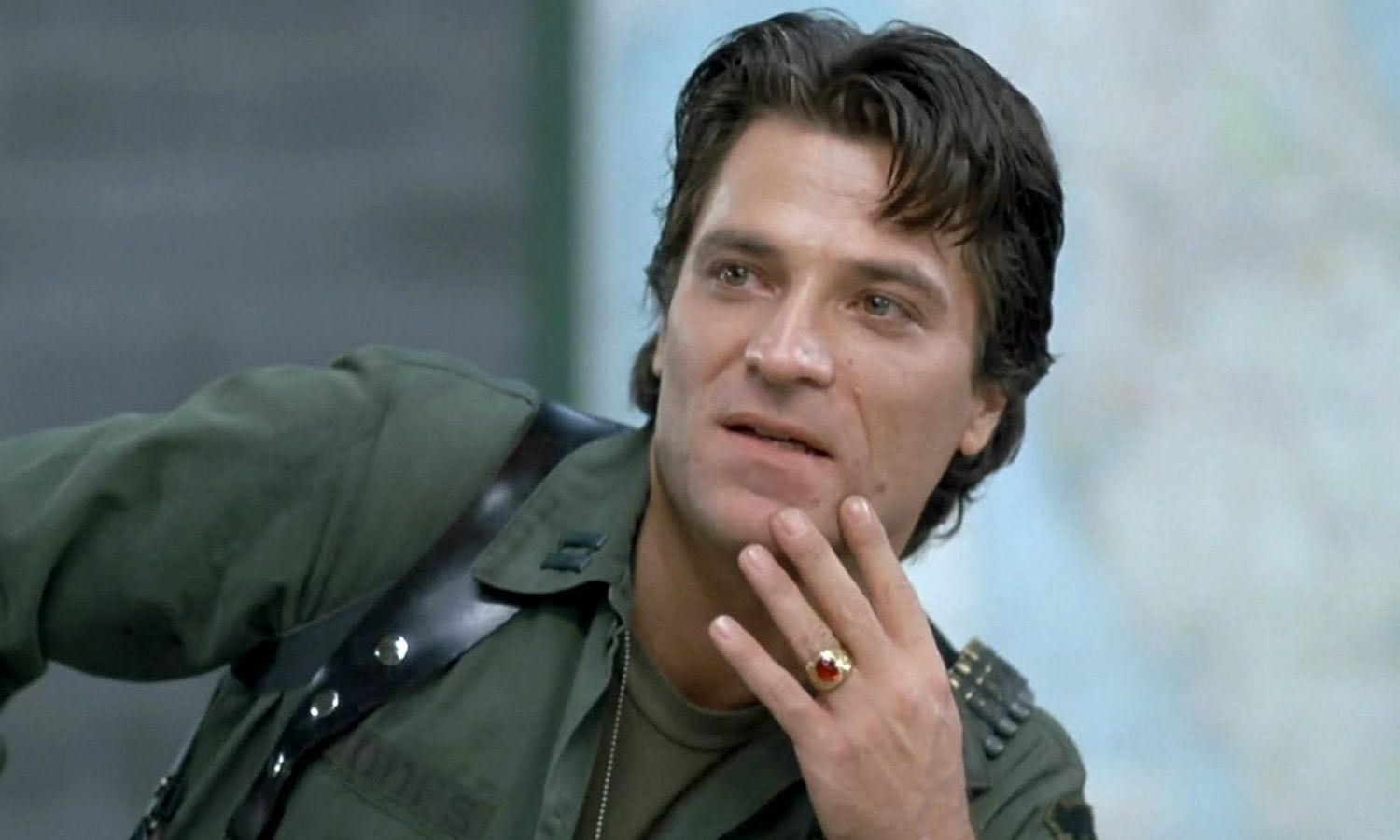
Even more loathsome are Rhodes’ men, chief among them Private Steel, an overgrown schoolyard bully and (in the finest Living Dead tradition) a raging racist. Whereas Dawn of the Dead’s opening took aim at the police as an institution, Day of the Dead turns a critical eye on the US military, and the kind of personalities it cultivates and promotes. Common to both is the satire of macho posturing, which is taken to new extremes in Day of the Dead.
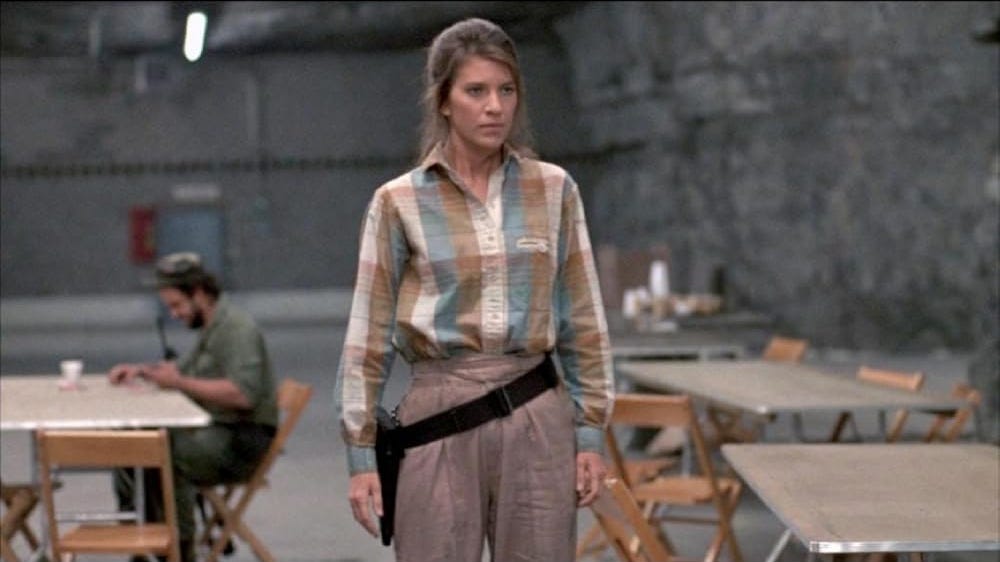
This is drawn out particularly well because Day was the first in the series to feature a female protagonist, Dr. Sarah Bowman (Lori Cardille). The oppressive confines of the bunker, and harassing comments by Rhodes and his men, add to the constant sense of menace and danger the film generates. Like most of Romero’s leads, Cardille was a little-known actress, but delivers a magnetic performance, one-part educated professional, three-parts cornered wolf.
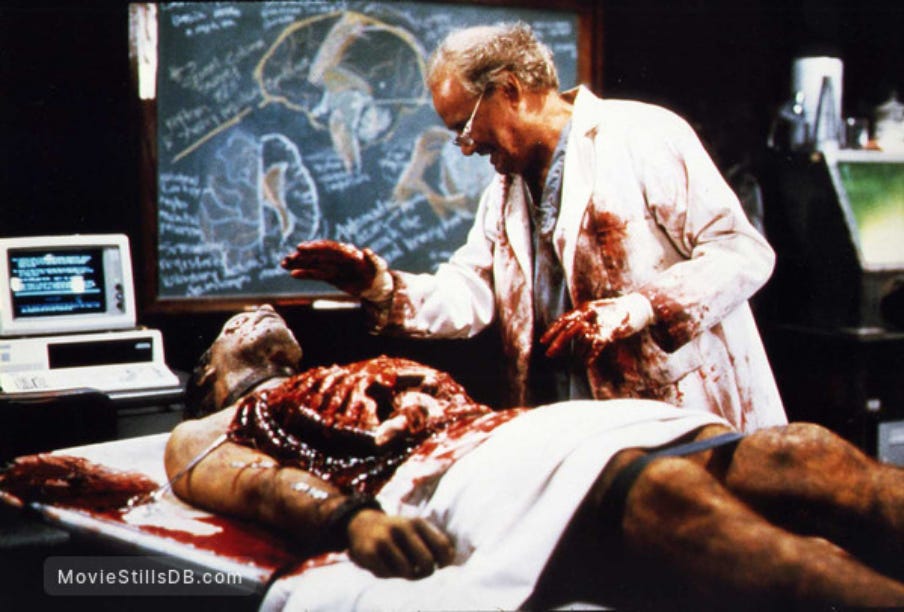
Day also benefits greatly from Richard Liberty as ‘Frankenstein,’ who delivers a delightfully pulpy performance as the affable madman, at once the most decadent of the bunker’s inhabitants and the most civil. With a pleasant Mid Atlantic manner of speaking and textbook mad scientist looks, Frankenstein is strangely likeable, if creepy, and spends much of his time fussing over a docile zombie he names Bub,1 who he is training in the unlikely hope of finding a way for humans to co-exist with zombies.
Whereas the characters of Dawn of the Dead are trapped by their attachment to the mall and its material comforts, Day of the Dead uses its zombies as a metaphor for death itself, and appropriately the story is one of grief and acceptance in the face of the inevitable. At the beginning, Sarah is at the bargaining stage of grief, still invested in the notion of finding a ‘cure’ for the zombies, and the obsessive Frankenstein serves as her foil and counterpart. Both are trapped in prisons of their own making, trying in vain to turn the clock back.
Only by the end is Sarah able to accept the reality that what she seeks is impossible, and to reconsider the value of the time that she has, however long or short her life may turn out.
Day of the Dead was savaged by critics at release, and its good name never really recovered from that initial onslaught: it remains the lowest rated of the original three. However, I have to say that I don’t agree with the consensus: for me, it was thoroughly engrossing, with strong performances, sustained tension, and an oppressive atmosphere even by the standards of the series. It’s more than okay in my book.
Land of the Dead (2005)
Oh, Land of the Dead. Where do I even begin? This was not the last Living Dead film Romero made, and in fact the series has outlived him, grimly shambling on into the 2020s, a zombie franchise in more sense than one. However, it was the last I watched, because it is Land of the Dead, and it left me with the distinct feeling that the great man was running out of good ideas.
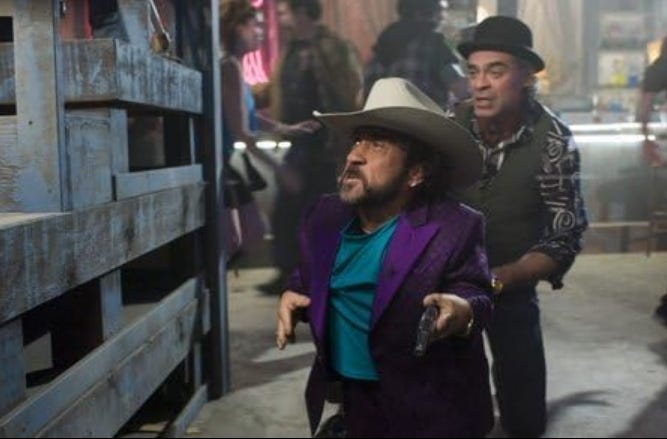
Like its predecessor, Land is set deep into a zombie apocalypse, and concerns a community of snobs living in a luxury tower complex called Tenpenny Tower Fiddler’s Green.2 It’s also about the slum-dwellers living in squalor beneath them, and a horde of migratory zombies led by a smart zombie named ‘Big Daddy’. He’s not even the most comically named character, since Land of the Dead also features a Mexican dwarf gangster named Chihuahua who dresses like this:
Land of the Dead centres on a man named Riley Denbo (which I was shocked to discover is a real English surname), and his belligerent comrade Cholo DeMora, who both live by scavenging supplies to sell at Fiddler’s Green. Denbo is a nice but avoidant type who would like to leave Fiddler’s Green behind and start a new life elsewhere, while Cholo wants to claw his way up the hierarchy and gain a place in the luxury and safety of the tower.
It’s worth noting that Cholo is Latino, and his name has specific connotations to do with race and class,3 and basically the only other non-white person we see in Fiddler’s Green is a subservient butler. Mr Kaufman (Dennis Hopper), de facto ruler of the tower, refuses Cholo’s request for a place among the elite, and Cholo proceeds to go berserk, commandeering ‘Dead Reckoning,’ an armoured truck designed by Denbo, and holding the tower hostage with its rocket launchers. Denbo is sent to recover the truck.
While all of this is going on, the zombie horde is slowly making its way to Fiddler’s Green, like the iceberg approaching the Titanic. With Big Daddy’s help, they are able to use tools and tactics, and the horde is given a certain amount of personality (insofar as that’s possible for zombies) with several recurring zombies. However, it’s quite difficult to take them seriously. There is a lot less emphasis here on the innate conceptual horror of zombies, as in previous titles, and a lot more on gimmickry and spectacle.
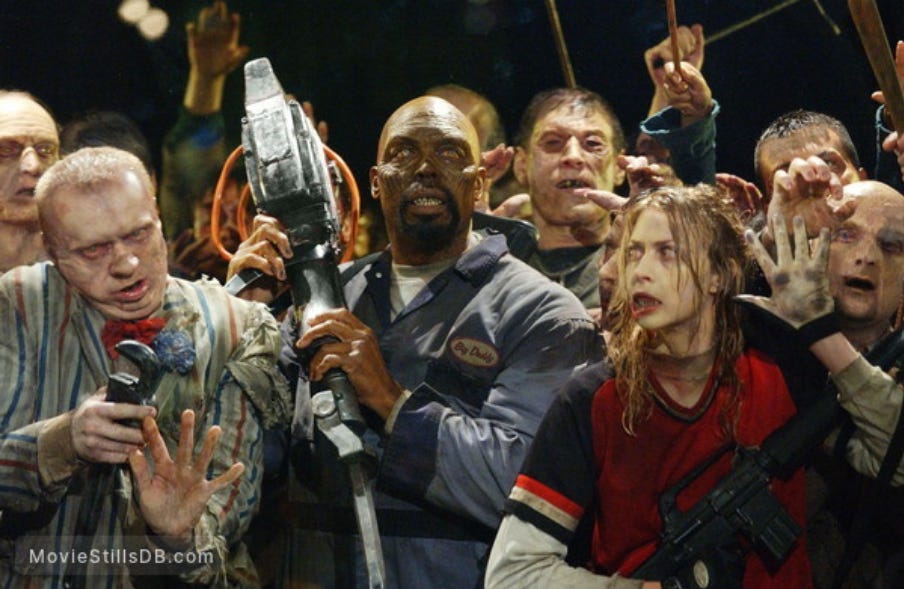
For example, one memorable zombie appears to be headless, then suddenly flicks his head - still attached by a piece of sinew - forward to bite someone in a way that raises eyebrows rather than goosebumps. Also, at least half a dozen characters are killed by surprise zombie bites, which seems unlikely - zombies are quite literally known as ‘stenches’ in this film, and are all visibly rotten, so how do people keep being surprised by their presence? Does no-one have a sense of smell in this universe?
Also, all zombies now apparently have super-strength, as they spend much of their screentime effortlessly ripping people asunder in wild spectacles of gore. This is very different - and, I would argue, less scary - than the previous films, which emphasise the fact that a lone zombie is physically slow, weak and clumsy. The threat lies in their overwhelming numbers and persistence, and even their seeming weakness is in itself dangerous, as it breeds complacency and recklessness (see: Dawn of the Dead). With the switch to ultra-hardy zombies with the strength of rabid chimpanzees, I could not help but feel that something was lost, and not just the faces and arms the zombies keep pulling off effortlessly.
The film also suffers from a screenplay sagging under the weight of misplaced action movie cliches, and an overabundance of named characters, most of them developed thinly if at all, and only there to be zombie fodder. Even the main characters are hard to define except in terms of vague tropes - Slack is the ‘hooker with a heart of gold,’ Charley is the ‘good-natured simpleton,’ and even Denbo, the nominal lead, has very little to him.
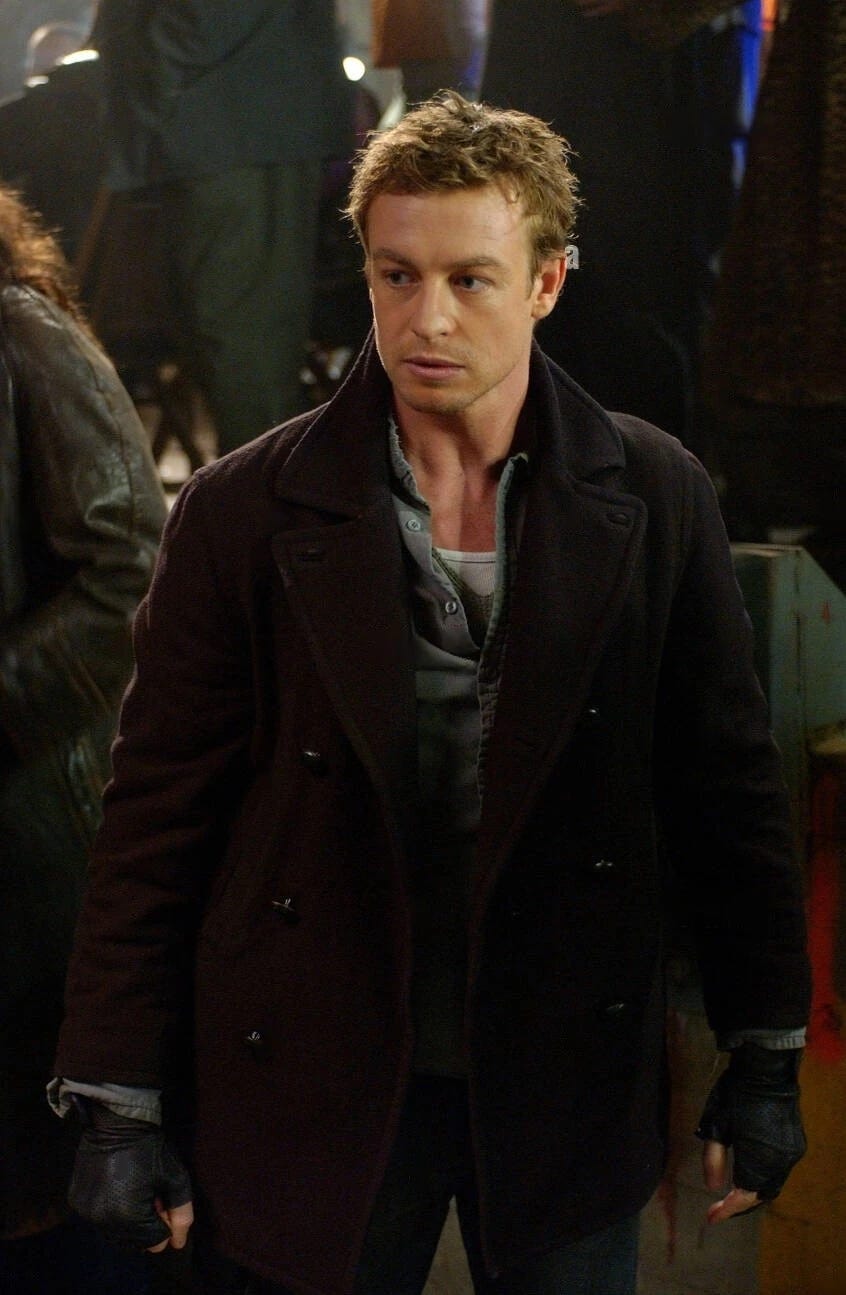
Unlike previous Living Dead heroes, he does get a backstory, delivered in heavy-handed ‘trauma plot’ style, but of course it’s incredibly banal in the context, because it is literally just ‘my brother was killed by zombies,’ which is presumably the same as everyone else’s backstory, and less distressing than the daily existence of Slack, the person he’s telling the story to. Denbo also does not particularly look the part of a grizzled survivor - his face would be more at home in a boyband, and his clothes are altogether too clean and tidy for the apocalypse.
Cholo is somewhat better - he’s arrogant, mean, and not particularly likeable, but he isn’t supposed to be, and besides, his cause is fairly righteous. His main goal is to get his own money back from Fiddler’s Green, which arguably doesn’t make much sense, given the relative value of cash and Dead Reckoning’s rockets in a post-apocalypse. It’s probable that Romero was trying to include some 9/11 subtext - Cholo is called a ‘terrorist,’ and threatens to blow up a tower symbolic of American capitalism.
Of course, the inhabitants of Fiddler’s Green are so unsympathetic that, if anything, I felt that they should have let Cholo cook. Denbo’s preferred solution - running away, and leaving the worthies of Fiddler’s Green to tyrannise the slum-dwellers forever - comes across as irresponsible at best, and he is only moved to action by the zombie threat to the tower. The oppressed are liberated as a side-effect of the zombie horde’s actions, whereas Denbo’s contribution is minimal.
On the upside, Kaufman, the villainous leader of Fiddler’s Green, is quite entertaining, largely because he is such a complete, unmitigated dick at all times, and it’s often quite funny. In one memorable scene, he coldly murders a board member who interferes with his attempt to flee with suitcases full of money, only to learn moments later that Dead Reckoning has been safely recovered. ‘I really wish you’d told me that a minute ago,’ he says, looking at the corpse with the long-suffering air of a man who is going to have some explaining to do.
The film also suffers somewhat from its attempts to humanise Big Daddy and his zombies, for whom he shows a brotherly concern and sympathy. However, this can only really go so far, because, no matter how Big Daddy feels about his fellow zombies, they are all still compelled to eat people alive. As such, when Denbo decides to spare Big Daddy and Co. at the end, tritely concluding that they are ‘like us,’ it rings false.
Whereas Night of the Living Dead was fresh, new and contained a spark of real originality, Land of the Dead is more of a genre piece, and its meta-commentary on the commercialisation of zombies (people in the slums bet on zombie fights and take pictures with chained zombies) does not undo the fact that it is itself more of a product than a work of art. Its class commentary, while perfectly valid, is also heavy-handed to a Snowpiercer degree, and leaves the viewer with nothing nutritious to chew on.
If you subscribe, I will stop talking about zombies.
Bub is perhaps one of the sillier aspects of the film, although it builds on the intriguing idea of zombies as somewhat conscious, cognizant and capable of remembering their former lives, which was established in Dawn of the Dead. Bub looks a bit like Joe Biden, or rather Biden looks like Bub.
One of the more interesting things about Land of the Dead is that Fallout 3’s Tenpenny Tower subplot is 100% based on it. Gated community of elitists devoured by Marxist zombies? Come on.
Tl;dr, cholos were people of mixed, mostly Native ancestry, who were ranked low in the caste hierarchy during the Spanish Empire. Cholo has connotations of peasant status, and in the US it was also a synonym for Mexicans generally (often used in a derogatory way).
Comments
Nothing yet. Say the first thing.
Sign in to join the conversation.