
More on video games can be found here.
If there is one thing that has always struck me about video games, it’s that they’re often more fucked up than they let on.
As a small bit of personal lore (the relevance of which will hopefully become clear as we go), one of my first big games, which I played on loop through my early teens, was Star Wars: The Force Unleashed. This game was (and, to some extent, still is) my Roman Empire. It’s a sweeping, ultra-violent, and thoroughly inventive midquel, in which Darth Vader’s secret apprentice1 travels the galaxy, makes enemies, speaks with the ghost of his father, leads anti-colonial uprisings, kills Shaak Ti (again), confronts his Jungian shadow self, etc. etc.

For me, though, one of the things that is most memorable about this game was the fact that it had a good and bad ending. This was a mind-blowing novelty for someone who had previously only played free flash games built by hobbyists, though of course it would have been old hat to anyone who knew anything about games at the time. More to the point, I was impressed by the fact that its bad ending was so unexpectedly gruesome.
In this scenario, the apprentice succumbs to his rage, and kills a pitiful limping Vader, only to become his involuntary replacement, and the Emperor’s latest slave.2 Maimed in the fight, the apprentice is bound within a nightmarish cybernetic suit, said to be painfully grafted to his very bones, and what little we see of his body (or what’s left of it) is sickly, corpse-white and waxen, every inch the nosferatu.
The final shot of this bleak ending shows the apprentice’s view through his mask’s narrow visor, paralleling the iconic shot from Vader’s perspective in Revenge of the Sith, and the sense of claustrophobic panic hits hard, especially if the player unknowingly blundered into the bad ending by a mistaken input, as I did on my first playthrough.
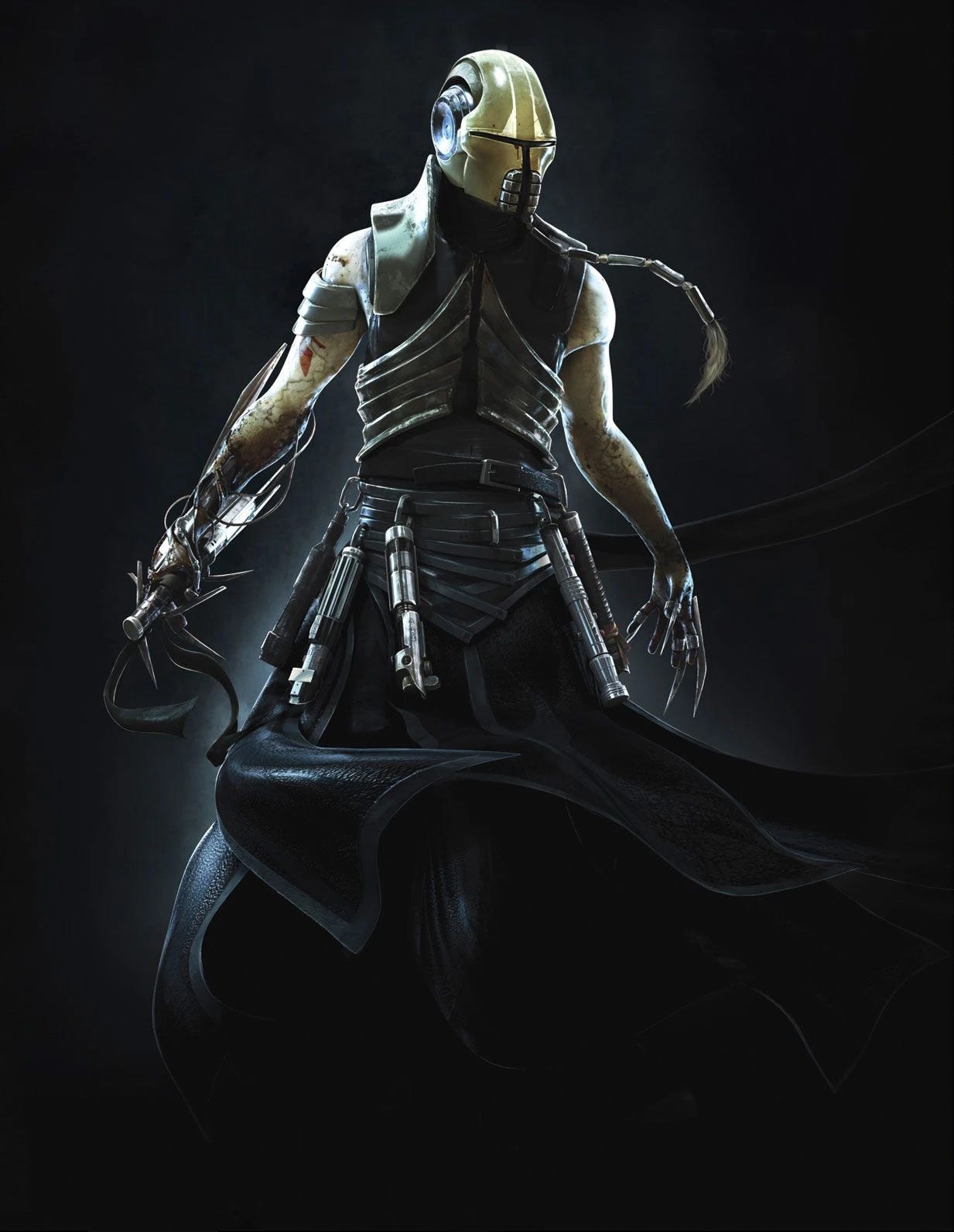
As morbid as this ending is, it’s also undeniably compelling, hence the developers built not one, but five separate versions of the evil apprentice character design, the most disturbing of which is a biomechanical monster straight out of a John Blanche painting, and wrote a whole expansion based on this doomed, non-canon timeline.
To give a sense of the character of these mirror-universe stories, the first mission has the apprentice visit Jabba’s Palace on Tatooine in search of the Death Star plans, where he carves a bloody path through the Hutt’s sycophants, and finally slays Ben Kenobi himself in the Mos Eisley spaceport, before he can set foot on the Millennium Falcon. This mission also includes a gut-punch of an encounter with Proxy, the droid who was the apprentice’s only friend, now a broken and abandoned husk in the bowels of Jabba’s Palace. Proxy is able to help his old master one last time before apparently shutting down for good, and leaving the man-become-monster truly alone in the universe.3
The game’s sequel (which is not as good), would also take a dark and occasionally horror-inflected tone. A resurrected version of the apprentice battles his own deformed and insane clones, as well as packs of ‘terror troopers,’ clawed cyborgs that move and fight like nothing human, tearing their way through a rebel starship like xenomorphs.
The point of this preamble is that, much like animals tend to become crabs if you leave them to their own devices for long enough, video games, no matter their source material, have a tendency to migrate towards horror. Trip Harrison,4 a man conversant on George Batailles and the solar anus, recently touched on this very trend. He made the point that horror is so attractive to developers because it is, fundamentally, emotive rather than technical. A scary game is measured by its impact rather than its budget or mechanical complexity.
There’s a lot of truth in this, and I’d add that the video game as a medium is almost unique in its potential for horror, for the simple reason that the interactive form can lead players to feel more deeply and personally immersed in situations than we might in a more passive format. At its best, virtual horror does not feel like it’s happening to a character - it feels like it’s happening to you.
More specifically, though, what I want to talk about here is the incorporation of horror elements into non-horror games. This, I would argue, has actually led to many (perhaps even most?) of the best and most memorable scares in gaming. While the experience of playing a self-described horror game can be transcendant,5 it can also be numbing. If horror is nonstop, then the player is quickly habituated, and finally bored.
On the other hand, the weaving of disturbing subplots and scenarios into games of entirely different genres can be particularly impactful because we don’t expect it, and like any good horror story, the contrast between the comfort of the familiar and expected, and the discomfort of that which does not belong, is key.
Ab insidiis diaboli libera nos Domine!
It’s time now to talk about the game (or one of the games) that actually got me thinking along these lines in the first place.
Kingdom Come Deliverance 2 is far from a horror game. It’s a stirring medieval adventure, witty, picaresque, and rigorously grounded in real history and scenarios. While there are many dark aspects to the game - from the atrocities of bandits and soldiers, to a gritty investigation into the crimes of an urban serial killer - KCD2 is almost aggressively rational. It has no truck with the supernatural, although it is deeply interested in folklore, religion, and superstition, and often teases spooky elements.
For example, in one memorable side-quest, Henry is tasked with gathering and stacking up human bones in the Sedletz Ossuary (a real site in modern Czechia) by a mysterious blind monk, who at the end of the quest is heavily implied to have been a ghost. Except, the same monk turns up many hours later, and reveals that he was only having a laugh at Henry’s expense (and indeed the player’s).
There is one quest, however, that comes very close to breaking with this trend. ‘The Mouth of Hell’ concerns an abandoned mine where a demon has supposedly made its home. The terrified villagers tell Henry of this beast’s supposed attributes - an iron snout, rattling chains dragged behind it, and a habit of mutilating livestock - and the local priest, who is desperate to put a stop to the panic, sends Henry to investigate.
As he descends into the mine-shaft, Henry glimpses the ‘demon’ below - a knight in foul and rusted mail, his face hidden by a ‘hounskull’ helmet, explaining the iron snout and rattling chains described by the villagers. Moments later, however, Henry falls from a rickety scaffold, and when he wakes, he finds that he has been moved to the depths of the mine and stripped of his gear.
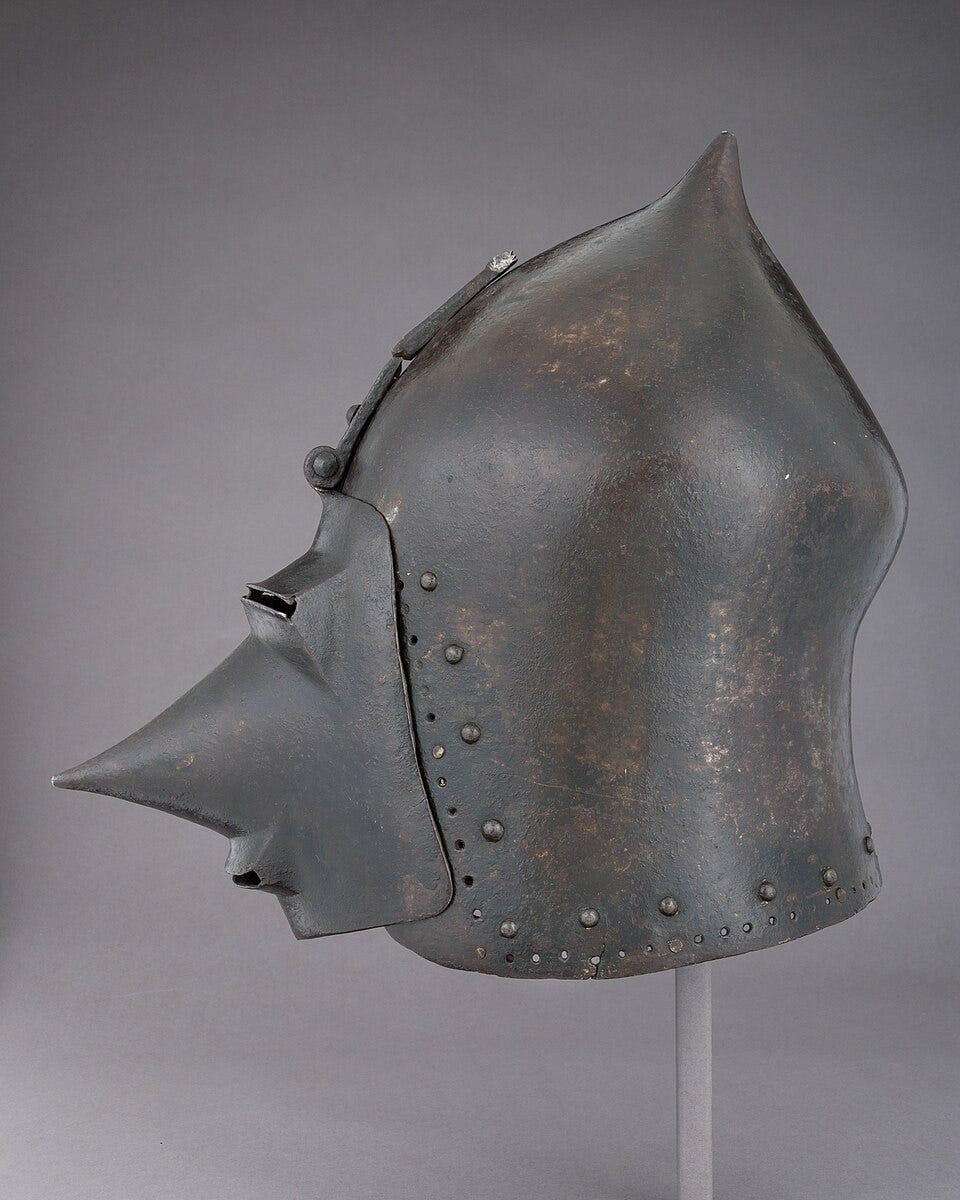
At this point, the game undergoes a total change in genre. Suddenly, we are no longer playing an action-RPG, but a survival-horror game. Alone in the dark, unarmed and robbed of his precious gear, Henry - usually an able fighter - is suddenly vulnerable, and has no way of defending himself against the ranting knight, let alone overpowering him.
As he explores the bowels of the mine, scavenging what he can and avoiding the patrolling knight, Henry discovers a series of increasingly demented notes. We learn that the knight was once one of a team sent to the sulphurous depths of the mine to stand guard against the forces of Hell. The others were all lost, leaving only the forlorn ‘demon’ knight. For years, he has stood a lonely vigil, slowly losing his mind, but kept there by what he believes is a sacred charge. In his fear of devils, he has obsessively built countless wooden crucifixes, and ventures out only to scavenge food.
Eventually, Henry is able to arm himself and confront the knight. If Henry has found the knight’s contract, and passes some skill checks, he is able to convince the confused knight that he has come to relieve him of his duty, and persuade him to leave the mine. However, in my playthrough I did not succeed, and the only way to escape was to kill him.
If the knight is slain, Henry will find that his armour and helmet are impossible to remove, as if they have become a real prison for their wearer, stripping him of individuality. We often think of knights in terms of their codes of honour and the armour they wear, and this honour-bound knight is quite literally rendered faceless and anonymous by his knightly helmet, which becomes a substitute face.
Like The Force Unleashed’s dark ending, the quest plays heavily into claustrophobia, present in both the mine’s narrow passages and the knight’s confining armour, and, with its in-built survival and stealth mechanics, KCD2 makes for a surprisingly good horror game. Although the mine might not be a literal portal to hell, the strength of the knight’s belief makes it as good as, and it very nearly becomes Henry’s grave.
Whereas KCD2 is reluctant to embrace supernatural horror, and ultimately offers rational explanations for its weirder subplots, the Red Dead series takes a radically different approach, and is far more comfortable embracing the outre, from UFOs, to man-made chimeras, to devil-worshipping madmen.
Although nominally action-adventure in category, and firmly belonging to the Western genre, Red Dead Redemption 2 (hereafter Red Dead 2) offers some of the most memorable scares in the entire medium, and it works so well for several reasons:
The incredible quality of the game’s environments, which heightens atmosphere and immersion at all times, but especially in moments of fear and suspense.
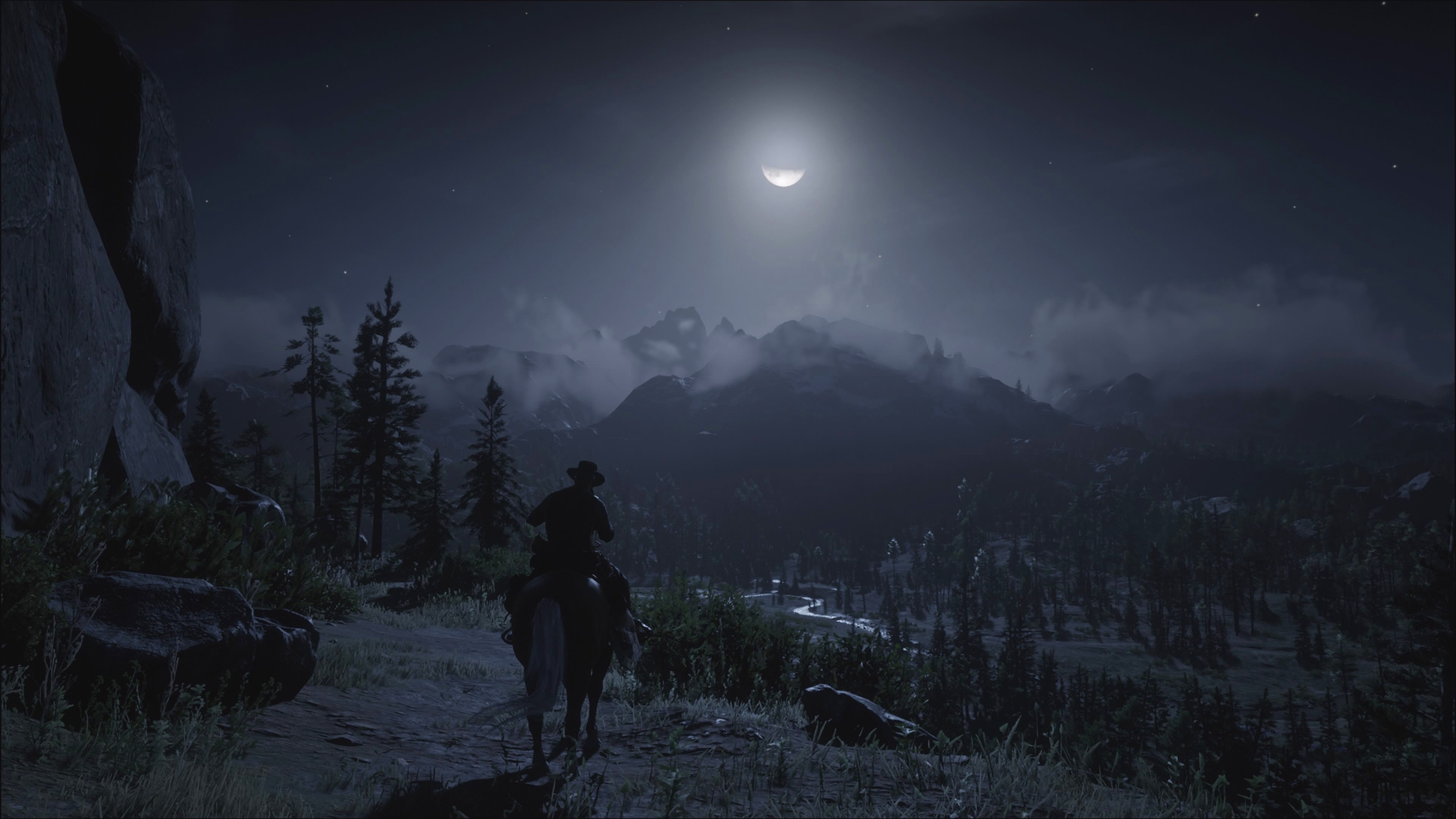
The sharp contrast whenever the game (usually a gritty but moralistic outlaw drama) suddenly veers into darker territory.
The rewarding exploration, which encourages players to seek out secrets, many of which hint at a larger, darker picture than what we see in the story missions alone.
Horror affinities in the wider Western genre.
Before getting further into it, it’s worth noting that the first game, Red Dead Redemption, included explicitly supernatural elements in a subplot featuring ‘The Strange Man,’ a recurring figure who is heavily implied to be the devil, and quizzes John Marston over his past sins.6
Players have connected the Strange Man with Mark Twain’s depiction of Satan in The Mysterious Stranger, though as we’ll see, there’s another likely counterpart in the canon of Western fiction, which we’ll get to in the section on the Skinner Brothers.
Y’all be careful where you wander…
Roanoke Ridge is one of Red Dead 2’s most iconic locations, and also one of the most important from a narrative perspective. It figures heavily into the plot, as Roanoke is the doomed Van der Linde Gang’s last hiding place, and therefore the setting of the final chapter of Arthur Morgan’s story.
It is also, to my mind, one of the single creepiest settings in all of gaming. Inspired by the Appalachian Mountains, and ominously named for the vanished Roanoke Colony, Roanoke is a country of deceptive arboreal beauty, with poison and decay seething underneath. Bathed in dappled golden sunlight during the days, Roanoke is a land of stately oaks and green sycamores, where narrow paths wind through uplands teeming with life. However, the haunting ambient music alone is enough to set an uneasy mood, keeping the player on edge. Even in daylight, it feels as if unfriendly eyes are watching your every move, as if Roanoke itself is listening.
It does not take long for Roanoke to show its true face. The player can only linger for so long before encountering the depraved clan that lays claim to this country: the Murfree Brood. A family of degenerate hill-folk, the Murfrees are inbred cannibals of the Sawney Bean tradition,7 drawn straight out of nightmare. Horribly deformed, with blotchy diseased skins and misshapen faces, they ride out on half-starved horses to terrorise the country, and collect grisly trophies from their victims.
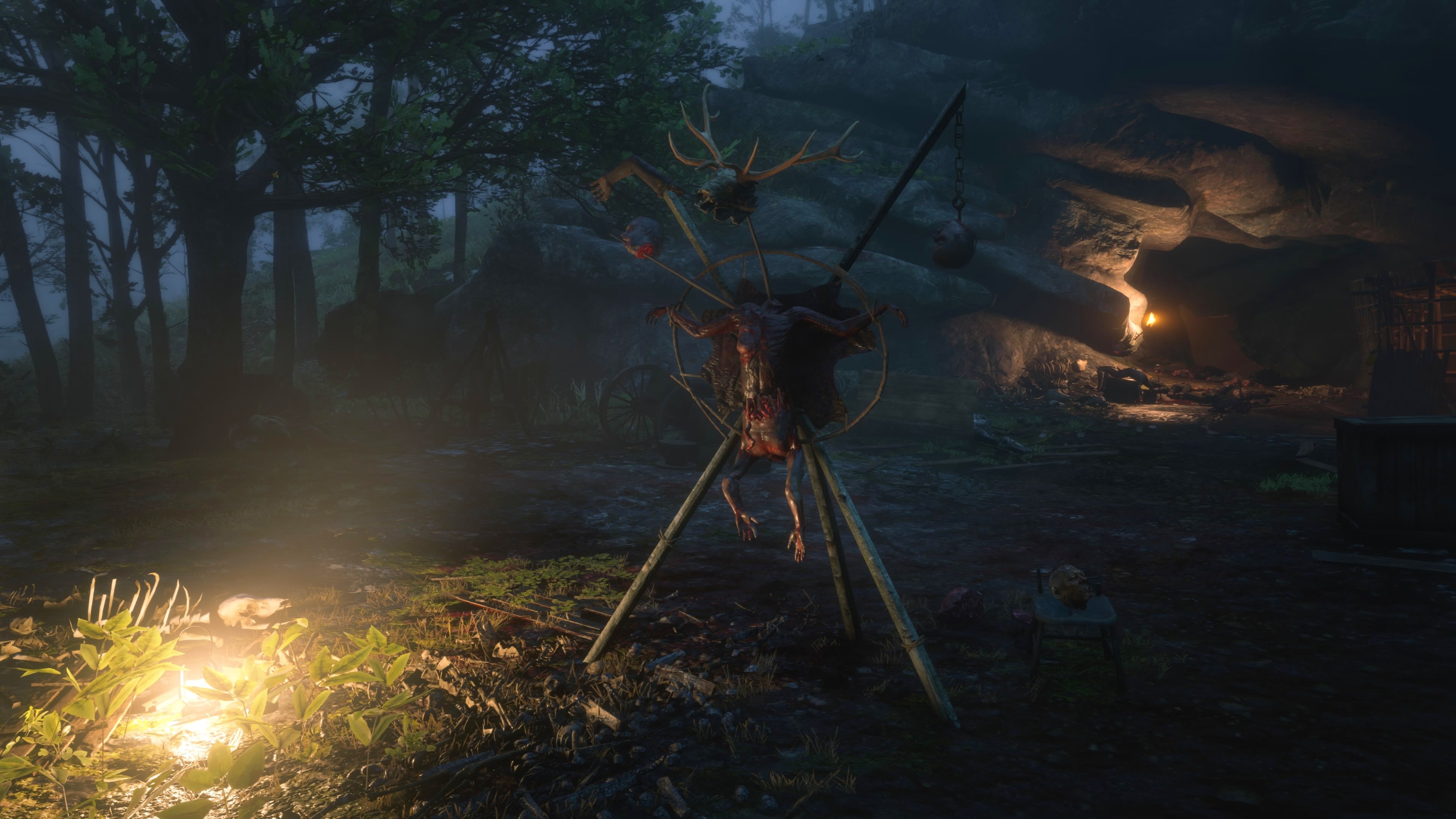
The Murfrees can be found at night driving wagons weighed down with corpses, among them live female prisoners whose fate we are uncomfortably forced to speculate on. Even when making camp, Arthur can be surprised and threatened by Murfrees, ensuring that the player never feels safe in Roanoke. Their ambush encounters are many, varied, and vindictive, revealing the animalistic cunning of the Brood.
Though the Murfrees only feature in one story mission, it is by far the most frightening, veering away from Western outlaw drama and firmly into the horror genre. Arthur and Charles must blast their way through hordes of leering cannibals in a bone-strewn cave, and although they are able to rescue a young girl held prisoner there, she has already been a captive for days, and we can’t help but feel that we arrived too late.
If ever there was a time for exploding bullets…
The horror of this episode overshadows the whole final chapter, as the gang has unwisely made their lair in the former Murfree den at Beaver Hollow.8 The hideout feels desperately unsafe, and underscores how far the gang has fallen: like the Murfrees, whose prosperous days were long ago, Dutch9 is clinging to the past, while degenerating into deeper and deeper evil, and abusing the only ‘family’ he has left.
The Murfree Brood very likely owe something to Bone Tomahawk, a Western-horror film depicting a similar tribe of incestuous cannibals, although whereas Bone Tomahawk dubiously made its monsters Native Americans, Red Dead’s Murfrees are the descendants of white settlers from the 1700s, subverting older Western tropes of white civility and Indian savagery.
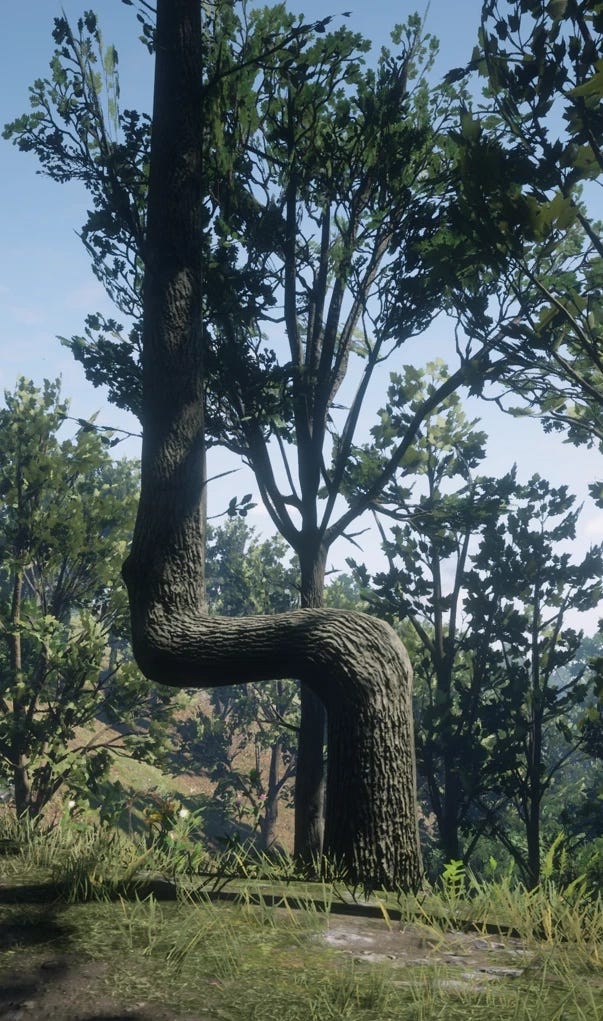
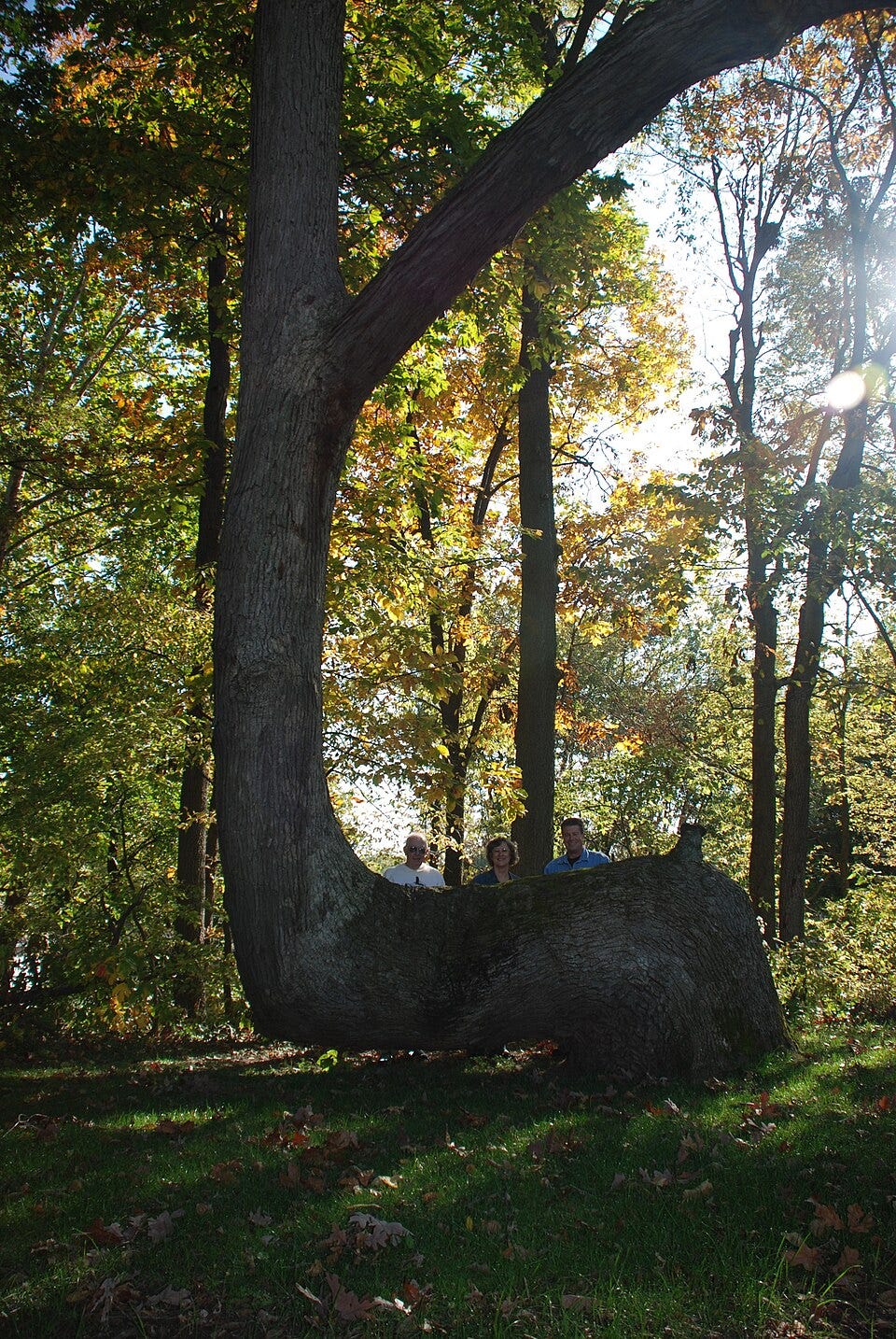
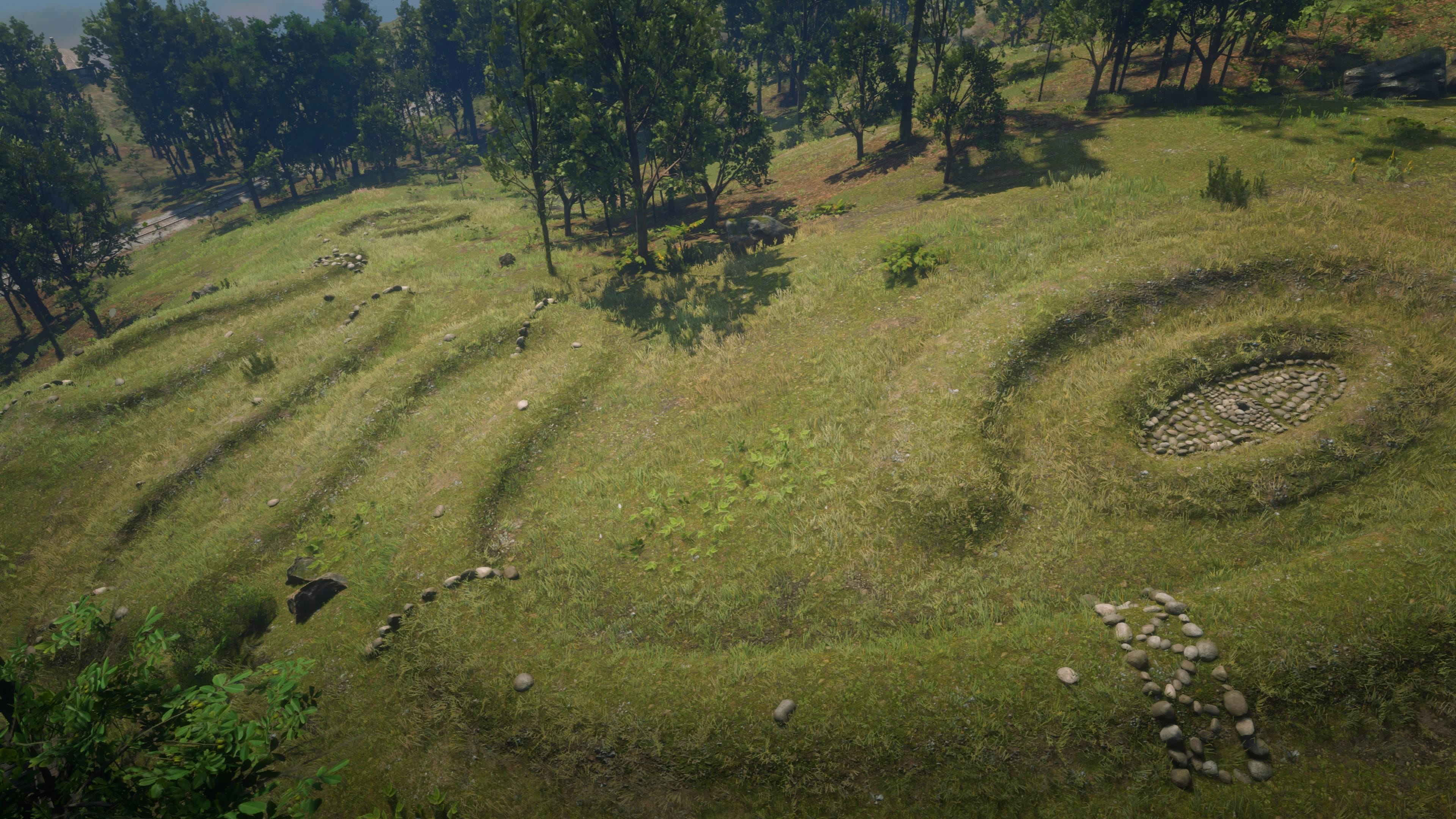
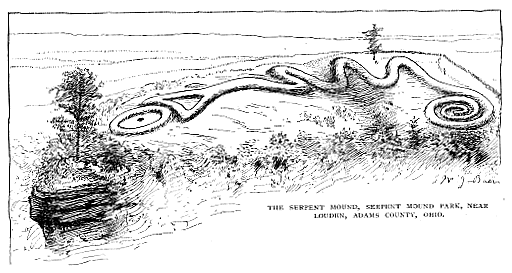
It’s even implied that Roanoke’s Natives knew that there was something wrong with the land - they left a series of trail trees pointing out the entrance to a mine that is revealed as the source of the poison causing deformities in Butcher’s Creek. Natives in Roanoke also built a mound in the shape of a serpent (again, suggesting poison), closely based on a real counterpart in Ohio.
There are also well-hidden but definite hints of metaphysical evil in Roanoke. In the diseased village of Butcher’s Creek, a glowing pentagram can be found at night, and players have discovered that the village’s five outhouses are positioned to form a larger pentagram, with tally marks showing the order to connect them to form the pattern. Nearby, a Viking ruin can be found where five trenches form yet another pentagram around an altar heaped with human bones, suggesting a history of human sacrifice in the region.
All of this simply can’t be an accident, particularly given the devil motifs lurking elsewhere in the game, and, more obviously, the use of a pentagram in the game’s vampire mystery.
Stay back, for your own sake! I walk with the undead…
Far to the south of Roanoke, in the swampy and malarial State of Lemoyne, the city of Saint Denis rises from the bayou. Of all the many great cities in gaming, Saint Denis is perhaps my personal favourite, for its bustling vitality and vivid sense of time and place. Based mainly on New Orleans,10 it is a polyglot city of Francophones, Anglos, Italians, Mexicans, Irish, and Chinese, and full of contrasts and contradictions.
It is a city where the player is never lost, because each district is so visually distinct, from the slovenly outskirts, to the reeking factory district, to the opulent avenues where the rich idle in their mansions. Early cinemas compete with vaudeville theatres, and new-fangled trolleys rattle along sparking overhead power lines, while electric streetlights brighten the humid nights.
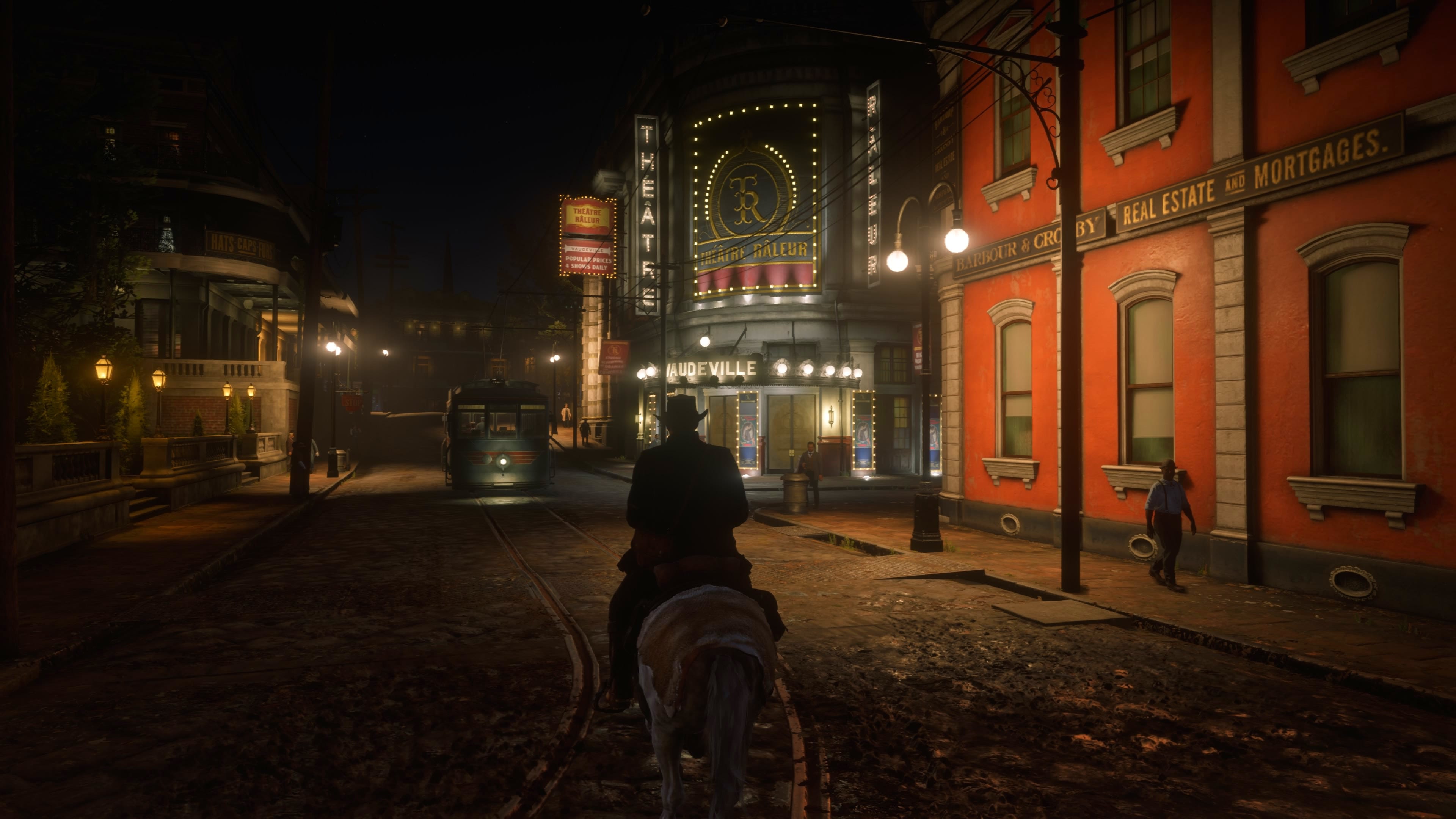
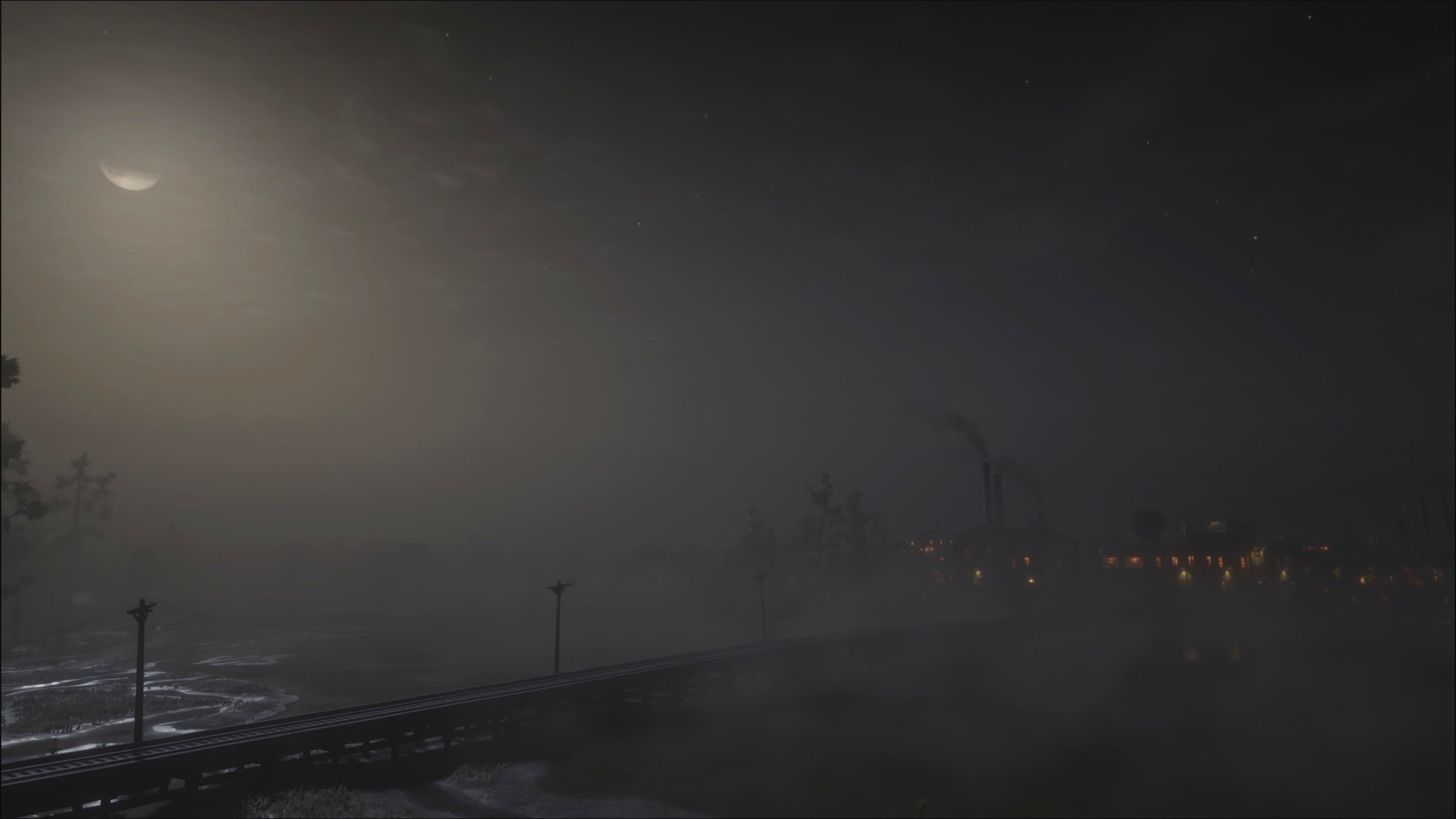
Like most of Red Dead’s America, Saint Denis and its environs are packed with secrets. A forlorn ghost haunts the bayou, although as we’ll see, she might be the least scary thing out there, and a darker kind of spirit stalks the city itself.
Throughout Saint Denis, verses of macabre poetry can be found in blood-red paint on certain walls, and a newspaper article reveals that these were left at the scenes of strange murders, where victims were bitten and drained of blood. According to the news article, a similar series of ‘ritualistic’ murders was committed years ago, and though the supposed killer was hanged, the murders have resumed.
If the player finds all five verses, it will be revealed that they form a pentagram with a particular alleyway at its centre. If the player explores here at night, they will find a strange figure stooping over a corpse. If approached, the killer will identify himself as a vampire, warning the player to stay away, and will soon attack if they do not heed him.
The vampire’s appearance is evocative of the iconic Count Orlok, with a bald head, ghastly pale skin, and pointed ears. If killed, he will drop a unique dagger with skeletal figures on the handle, and he can be looted for a set of bat wings.
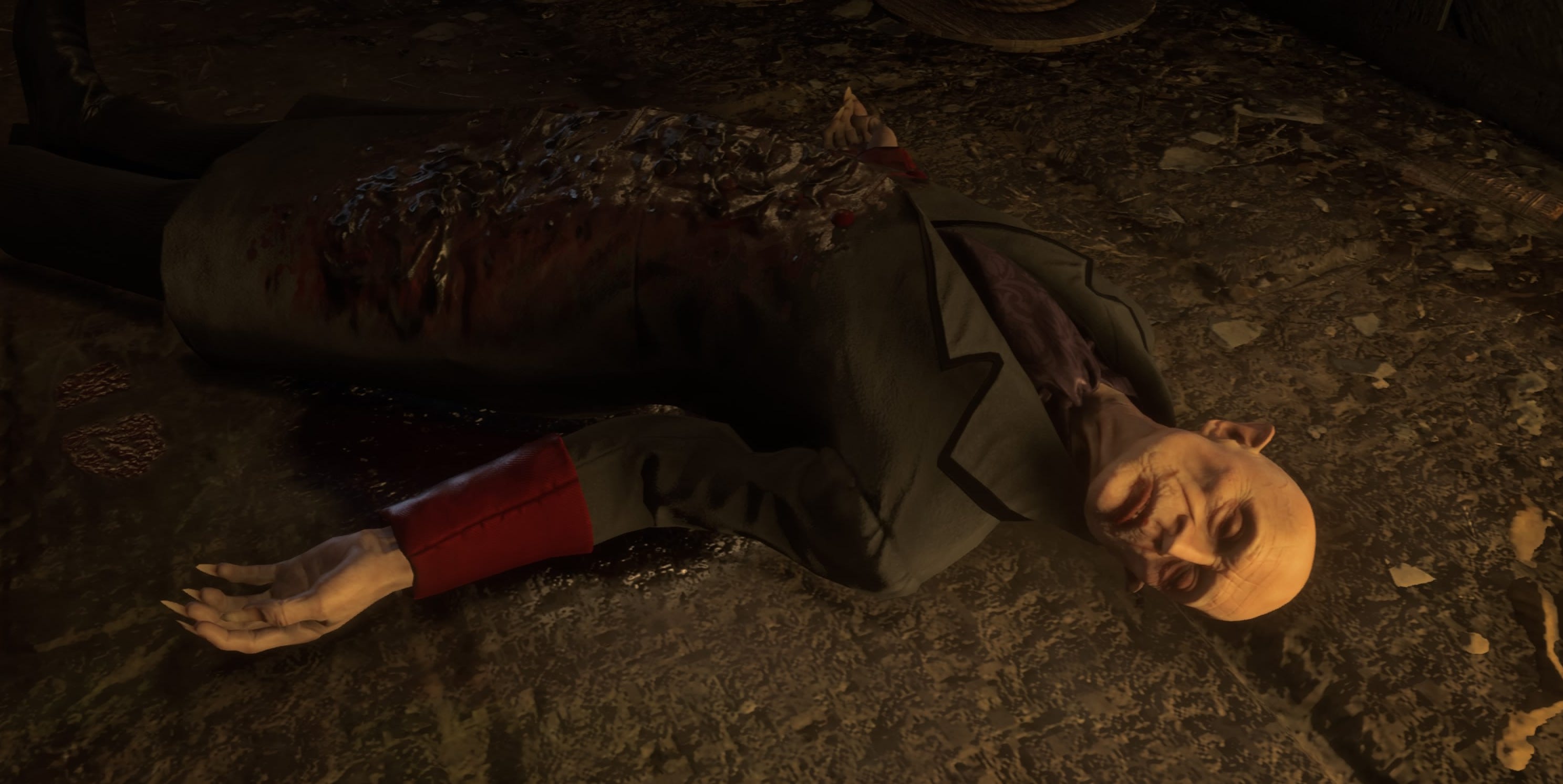
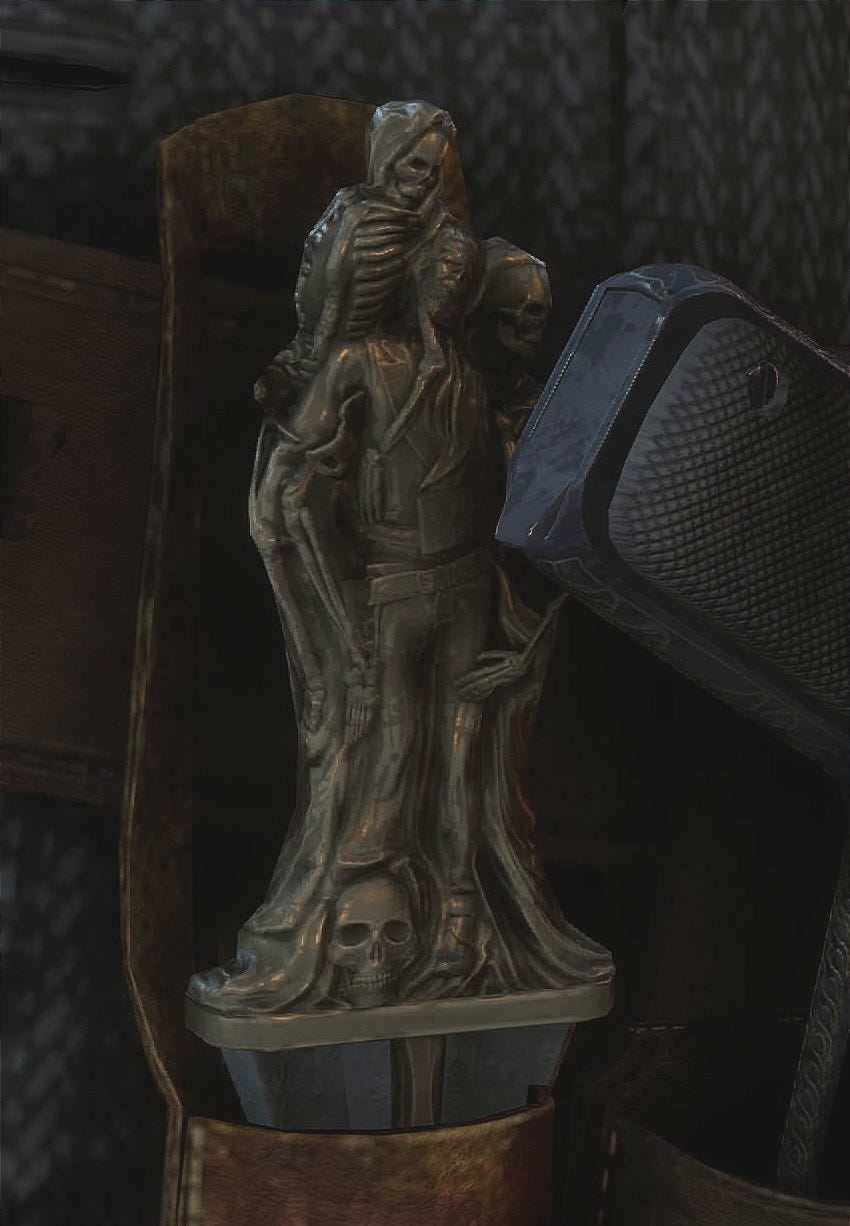
The encounter is so effective because it raises more questions than it answers: is this the same killer who was hanged years ago? Is he truly a vampire, as he claims, or just a madman? To me, the wonderful thing about this encounter is the tantalising sense of a darker, unknown world (a world of darkness, if you will) lurking beyond the limits of the player’s knowledge, which, together with the many other supernatural hints peppered throughout the game, becomes compelling.
Some strange people ‘round these parts. Wilder than the animals, they are.
While Red Dead’s outlaw protagonists are out of their element in the murky streets of Saint Denis, they are at the very least somewhat safe there, street toughs and vampires aside. The same cannot be said for the surrounding bayou, a steamy and primordial swamp quite literally crawling with reptiles. Venomous snakes and snapping alligators spook the player’s horse at every step, and wading birds rise up like pale phantoms from the watery banks.
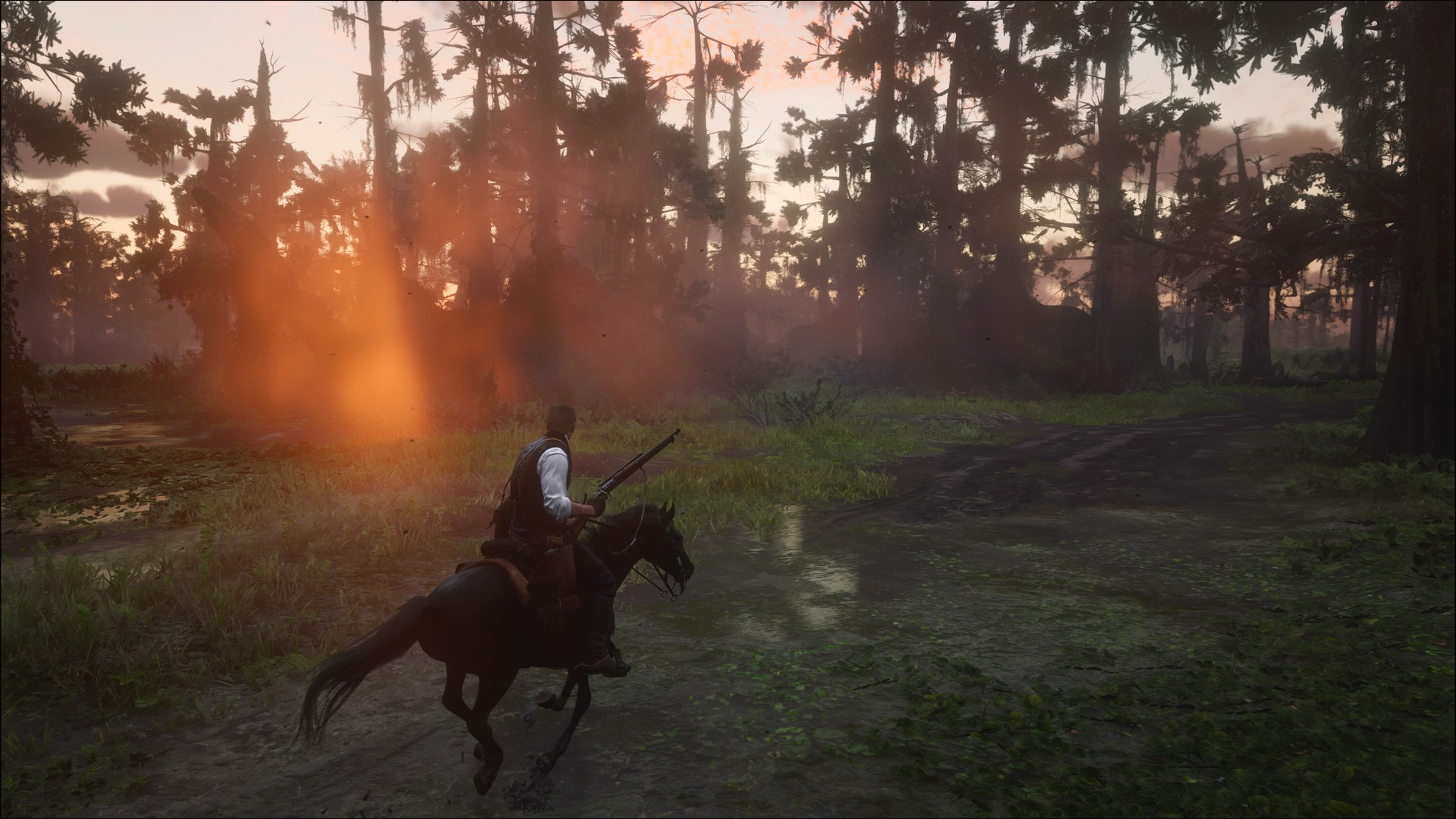
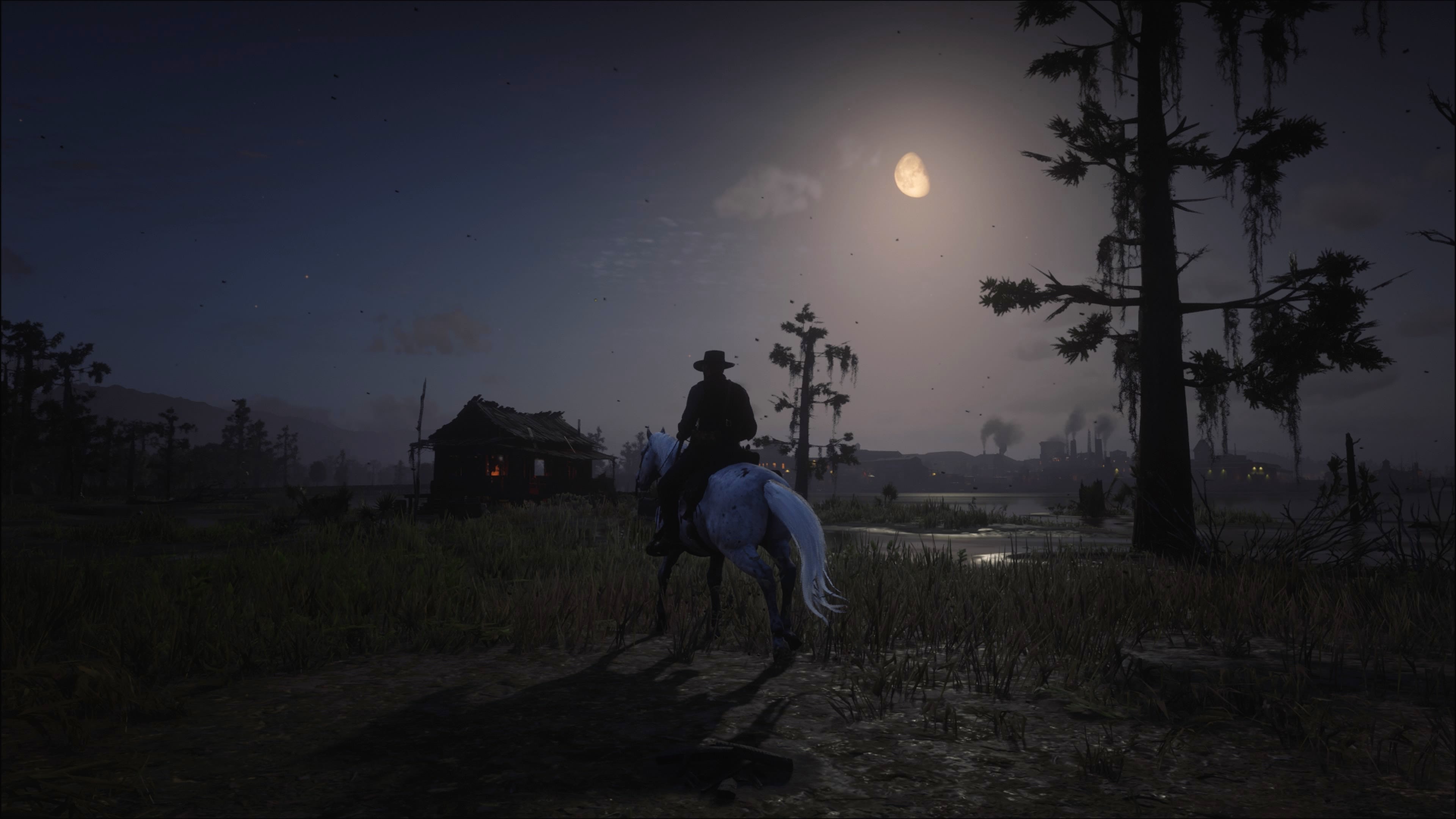
The bayou is enchanting by day, verdant even by Lemoyne standards, and possesses an eerie beauty by moonlight, yet there can be no mistaking its prehistoric hostility. The alligators are the least of the player’s problems here, for the most murderous creatures of the bayou walk on two legs.
Strange, dishevelled wretches armed with bows and machetes, the Night Folk stalk interlopers with a predatory intelligence. Their ambushes are sudden, treacherous, and often deadly - whereas the player can survive knife attacks from Murfrees, the Night Folk’s blades are always lethal, and it is easy to be caught unwares. Perhaps the most disturbing thing about the Night Folk is that they never speak, though they communicate with one another in clicks and animal noises as they steal through the undergrowth.
They are also shown to be utterly vicious, pinning bodies to trees as gruesome territorial markers. In one particularly cruel Night Folk ambush, they will place a mangled horse carcass in the path, causing the player’s mount to spook and rush off into the undergrowth. The player must chase after it on foot, while ambushers close in on all sides, and if you do not catch up with your horse in time, it will be instantly killed.11
The Night Folk seem to be loosely inspired by zombie lore, leaving voodoo-related markings on trees near their territory, though who (or what) exactly they are, and how they came to be, is left a mystery. One particularly intriguing theory12 has them as residents of Saint Denis who live humdrum lives by day and take to the swamps by night. According to this theory, they stay silent and paint their faces to avoid giving away their true identities.13
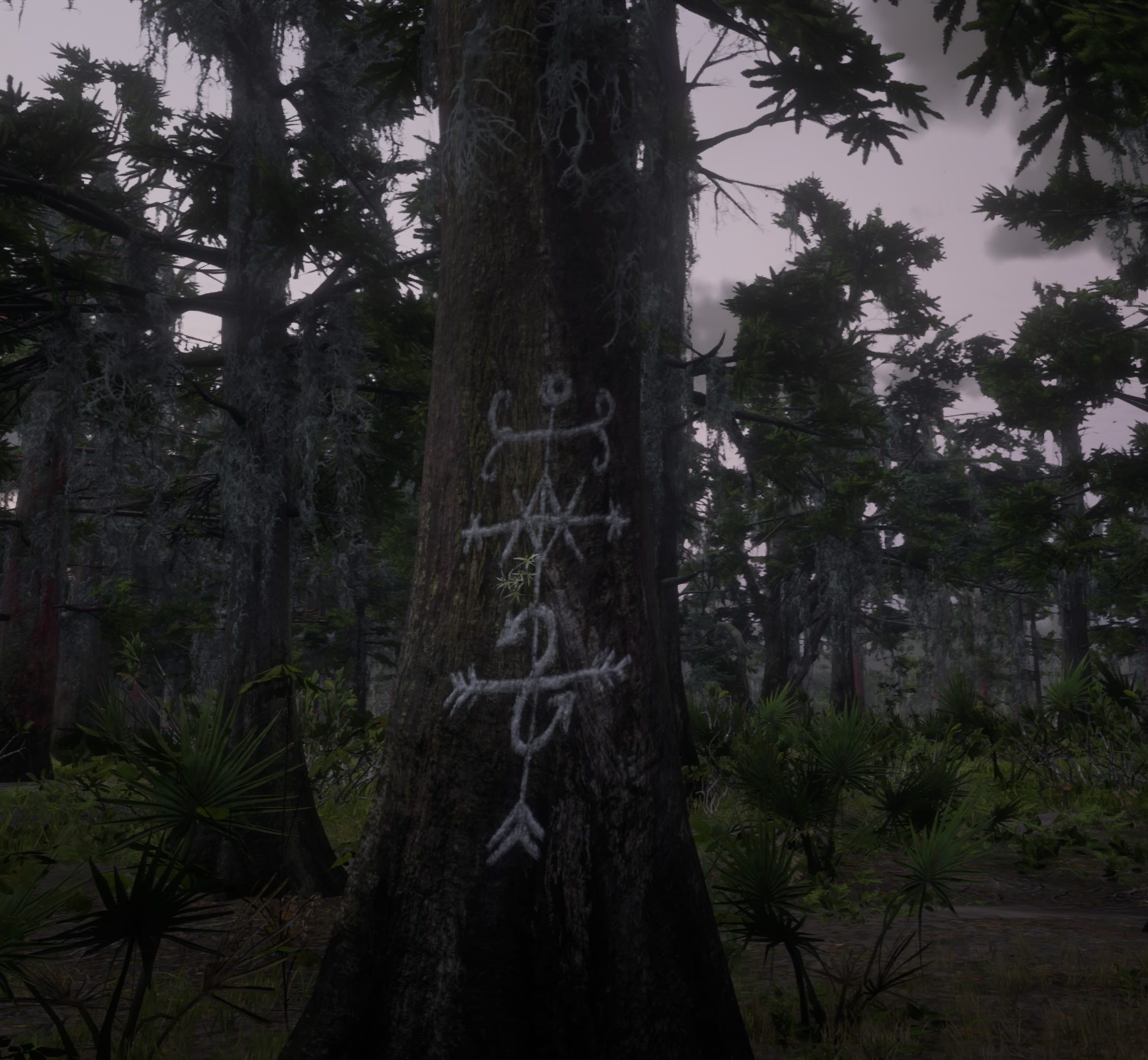
They also more than likely draw some influence from Bone Tomahawk - their crusty white face-paint evokes the sickly skin of BT’s troglodytes, who are also shown as mutes with no language of their own, communicating only in animalistic whistles. Like the troglodytes, the Night Folk appear suddenly from the undergrowth and rush their victims in dead silence, attacking with arrows and fighting to the death.
Ye’ll find em right lively.
Although the Night Folk do not appear directly in the main storyline, there are plenty of side activities directing the player into the bayou, where they are sure to cross paths with them sooner or later. Like the Murfrees, the Night Folk have an indirect role in the plot, as two of the gang’s later camps are placed squarely in Night Folk territory, reflecting the decline of the gang, which is driven into ever darker and more dangerous territory.
Interestingly, the Night Folk are quite possibly connected to the Strange Man, and thus to the other devilish elements in the game. A shack can be found in the swamp full of prophetic paintings and inscriptions linked to the plot, with the Man’s distinctive top hat hung up beside a mirror. Each time the player visits, the paintings will be progressively updated, and in the final visit, the Strange Man’s reflection can be seen behind you in the mirror.
They came… in the night… like jackals from hell. The screams! Something awful…
As if Night Folk and Murfrees weren’t bad enough, Red Dead 2 ups the ante still further in its chapter-length epilogue with the introduction of a band of murderers even more prolific, and (for John Marston) far closer to home.
John has only just hung up his hat in Beecher’s Hope when he receives an unwelcome social call from his new neighbours. These would be the aptly-named Skinner Brothers, who promptly carry off Uncle and begin to roast him alive.
Like fairytale beasts, the Skinner Brothers lurk in a dark forest, making their rude camps in the region of Tall Trees, an ancient sequoia forest full of wolves and worse. Concealing themselves in the treacherous terrain, these barbaric mountain men have found a vocation as ambushers and torturers, with a penchant for scalping travellers alive.
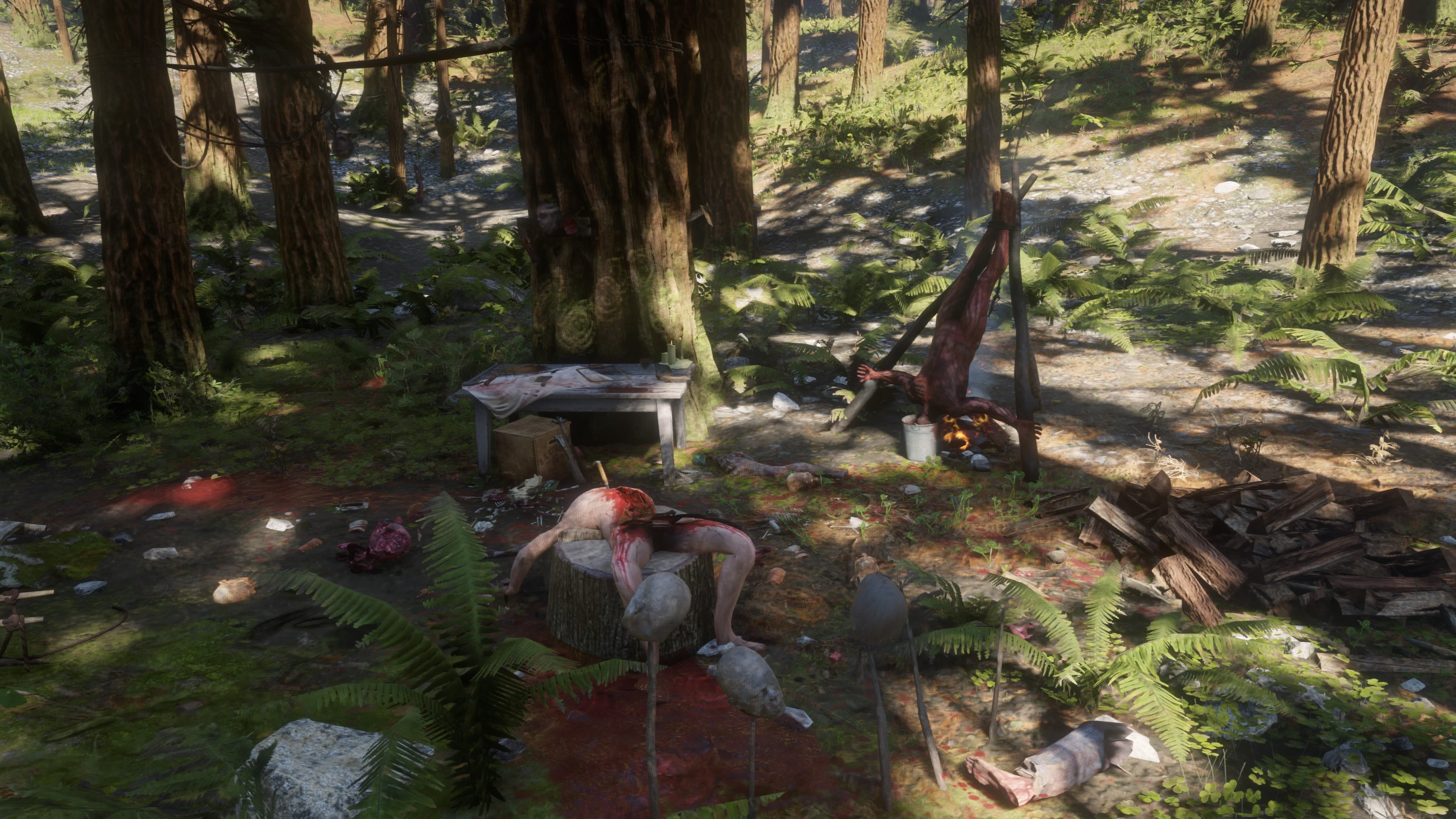
The blood-soaked Skinner camps are gruesome even by Red Dead standards, full of cages, bones, and mutilated corpses, and the frenzied Skinners delight in leaving carnage and devastation wherever they go. On the fringes of Tall Trees, murdered travellers can be seen tottering in the saddles of half-dead horses full of arrows, and John can stumble more than once upon the aftermath of Skinner massacres. On one occasion, he even finds a scalped and blinded victim still alive, rambling disjointedly as he succumbs to shock and blood-loss.
Some players have speculated that the Skinners, who are a mixed lot, but mostly white and English-speaking, were originally intended to be a hostile Native tribe, though I find it very unlikely that RockStar ever wanted to go there. Red Dead is very sympathetic to the plight of Native Americans, and discusses the massacres,14 displacements, and forced assimilation of this period. A beleaguered Plains tribe plays a crucial role in Arthur’s final chapter, so to pivot to a depiction of Natives as bloodthirsty ‘savages’ like the Skinners would be whiplash-inducing, to say the least, and sharply against the tendency of the series as a whole.15
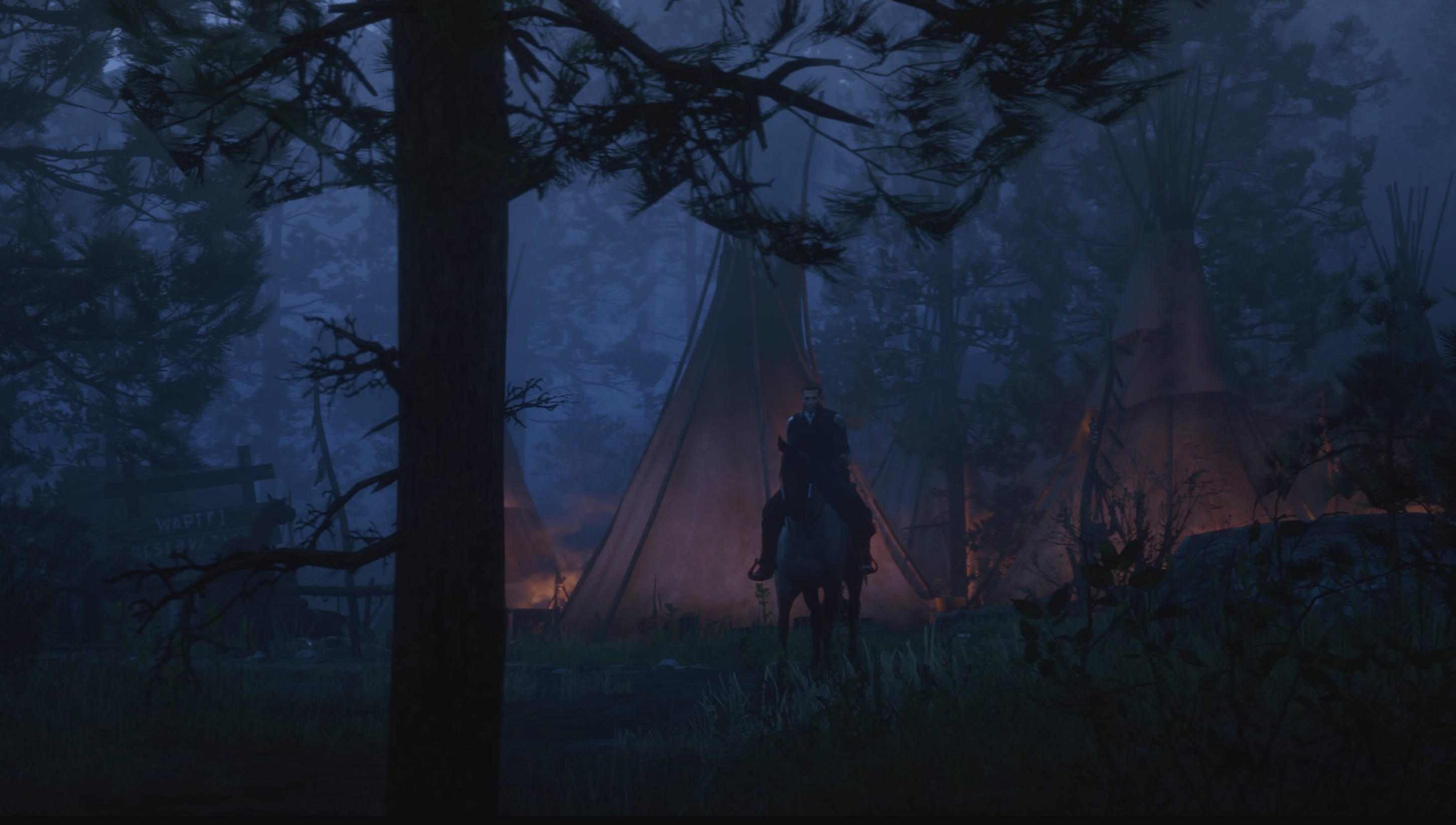
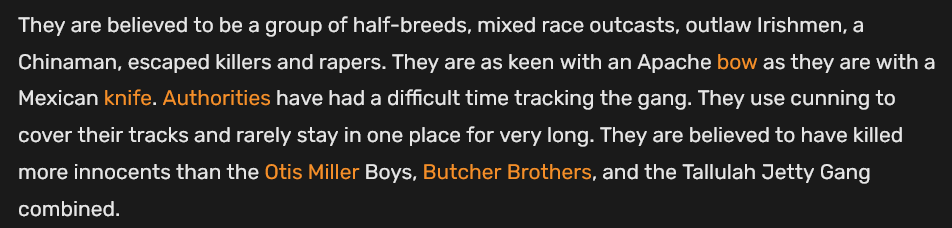
Moreover, the Skinners have a closer and more intriguing analogue in the scalp-hunters of the frontier era, especially as depicted in Cormac McCarthy’s novel Blood Meridian. Like the Skinners, Blood Meridian’s Glanton Gang are a multi-ethnic rabble, mostly white, though also including a troop of Native Delaware mercenaries. This is important, as the Skinners also have a number of visibly Native members, as well as elements of Native dress,16 and they are repeatedly described as a ‘mongrel’17 group of mixed origins.
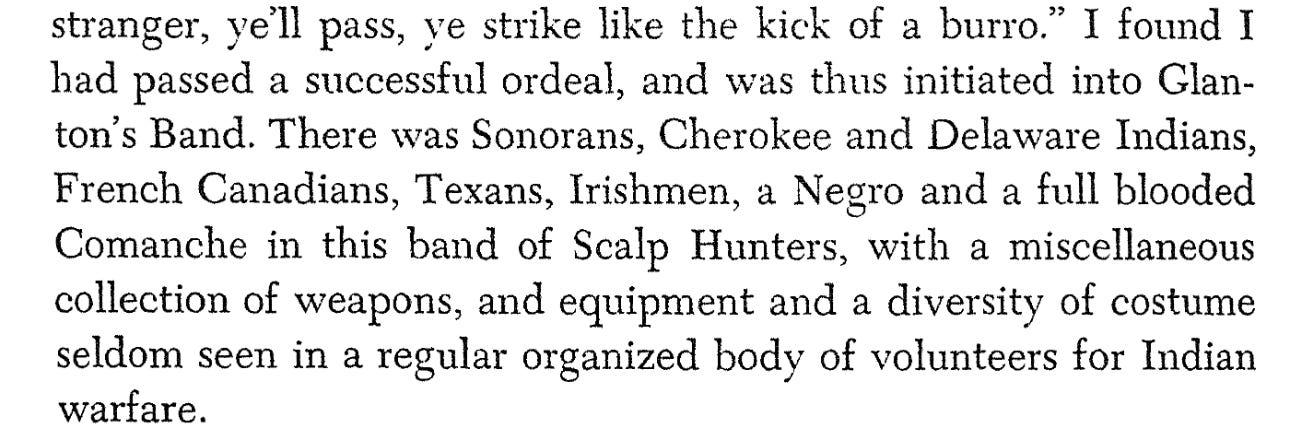

Similarly, the Glanton Gang are described as wearing buckskins, much like the Skinners, which they adorn with trophies from their victims. They even used this style of dress to deceive witnesses to their crimes: in the memoir My Confession by Samuel Chamberlain, which was the primary source for Blood Meridian, Chamberlain describes how the Gang posed as Apaches while murdering Mexicans, whose scalps they sold to their own government, falsely claiming that they were taken from Apaches.
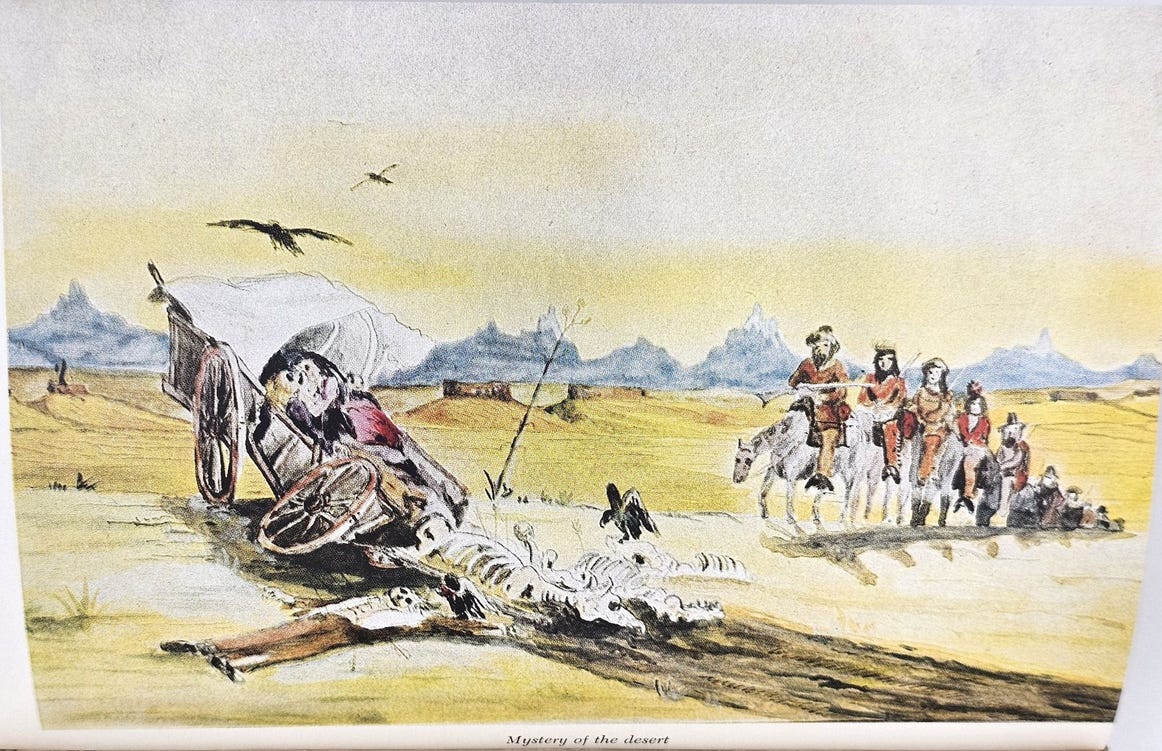
Chamberlain also describes an incident18 when the Gang discovered a ruined wagon full of arrows and scalped corpses, but concluded that white men must have done this, because Natives would not have left so many arrows behind.
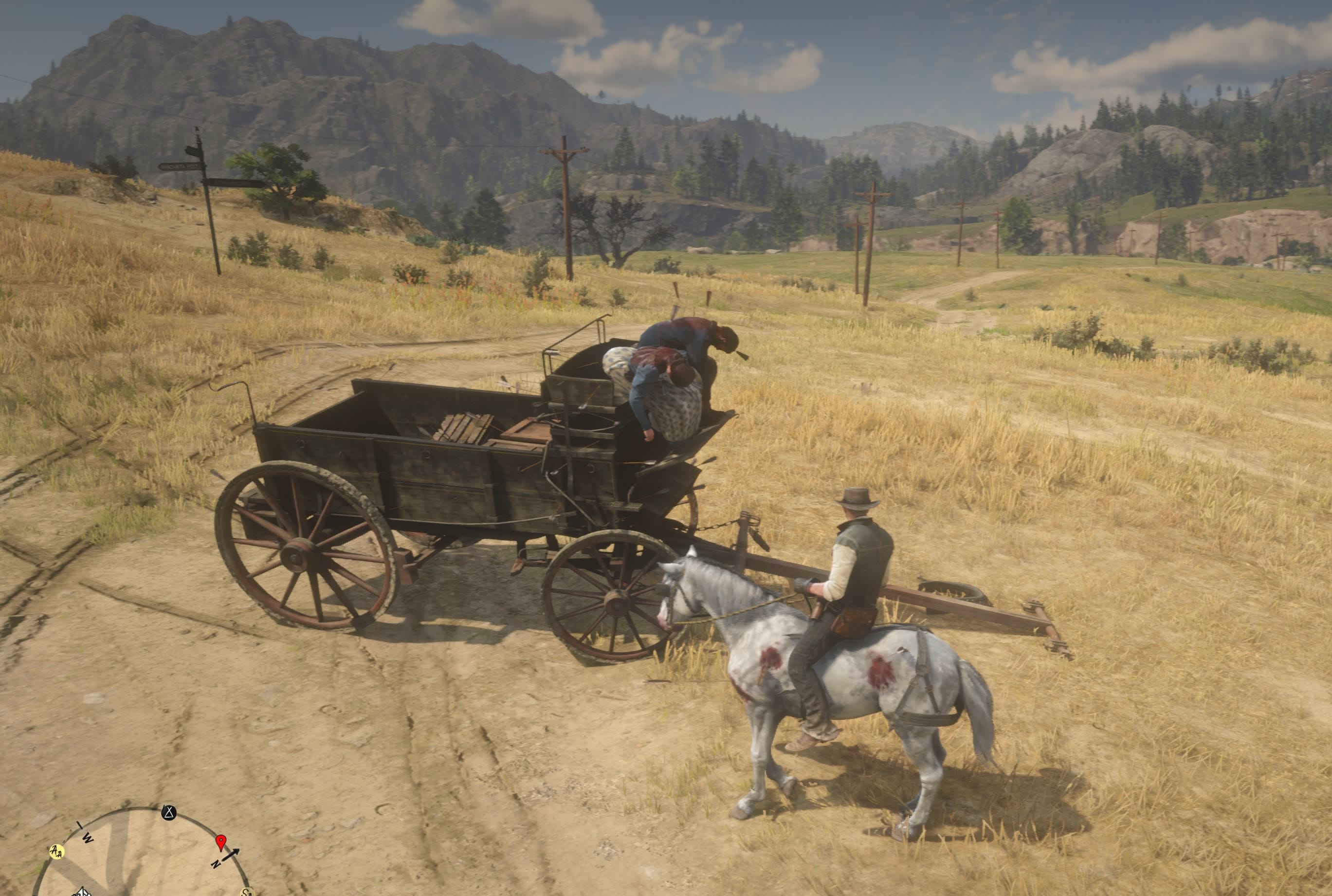
The resemblance between the Skinners and Glanton’s men becomes more apparent when looking more closely at their philosophies and rationales. Both gangs are murderous, compulsive sadists, for whom killing has become an addiction, but also a source of common identity and purpose.
As Blood Meridian’s Judge Holden declares, ‘Men are not joined together by the sharing of bread, but the sharing of enemies.’ Despised by the world, the Skinners only have each other, and their murderous fellowship is enough to keep them united most of the time.19
While both groups are in a sense nihilistic, they also both seem to pursue a higher purpose, which imposes a kind of method on the madness. The Skinners can be overheard discussing their crimes as blood-sacrifices for a ‘Prince of Darkness’ who they call ‘a gentleman,’ which seems a clear reference to the top-hatted and devilish Strange Man.
Similarly, Blood Meridian’s Judge Holden (who is referenced elsewhere in Red Dead 2), is strongly implied to be the devil. He serves as the gang’s intellectual and spiritual leader, and is something of a gentleman himself, combining a civil love of learning and culture with primordial violence.
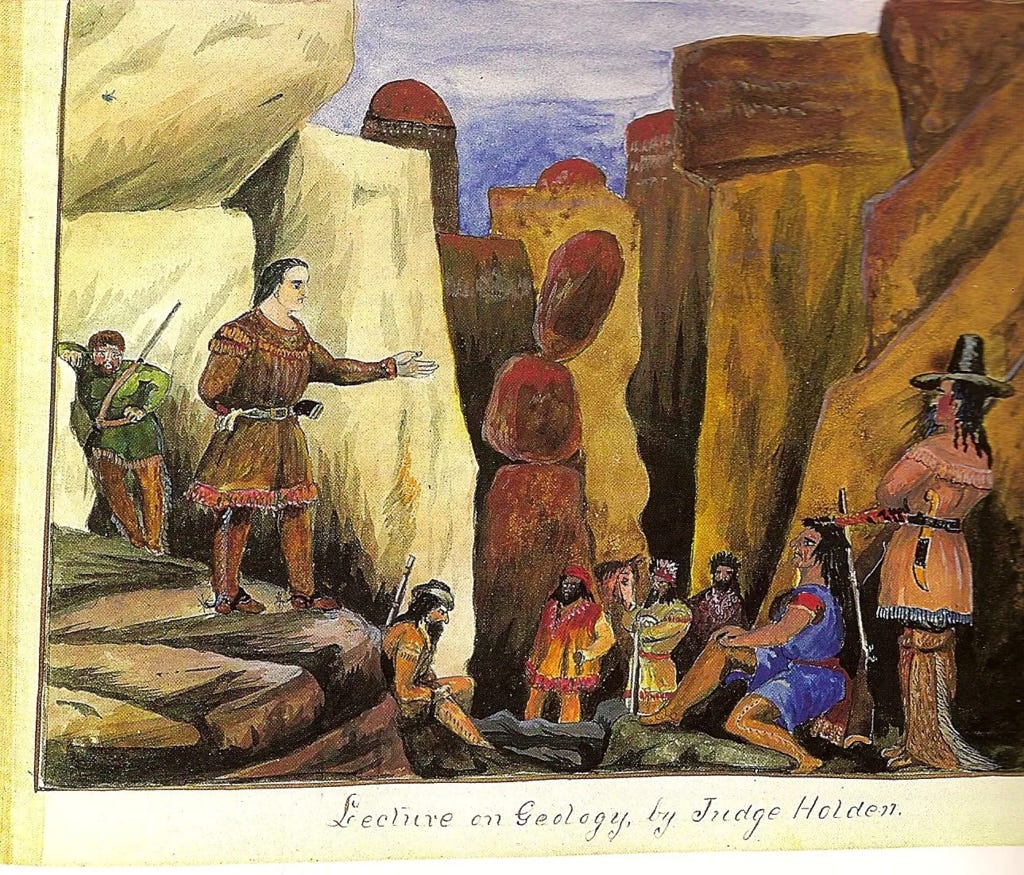
Regardless of the specifics of the Skinners’ lineage, they introduce a powerful infusion of horror into a narrative already steeped in bloodshed, and offer a vivid picture of frontier violence. The Skinner Brothers’ intrusion shatters John’s false sense of security at Beecher’s Hope, underscoring how transient his newfound peace and quiet really is.
Long-time readers will know that this game is very dear to me - I’ve touched on the strength of its narrative before, but here, I want to get further into its darker aspects, which are in many ways comparable with what we see in Red Dead.
In Mad Max, the title character roams a poisoned earth destitute of a biosphere, surrounded by the violence and folly of a dying human race. If the Skinner Brothers evoke Blood Meridian, then Mad Max is about as close as an action franchise tie-in is likely to get to The Road.
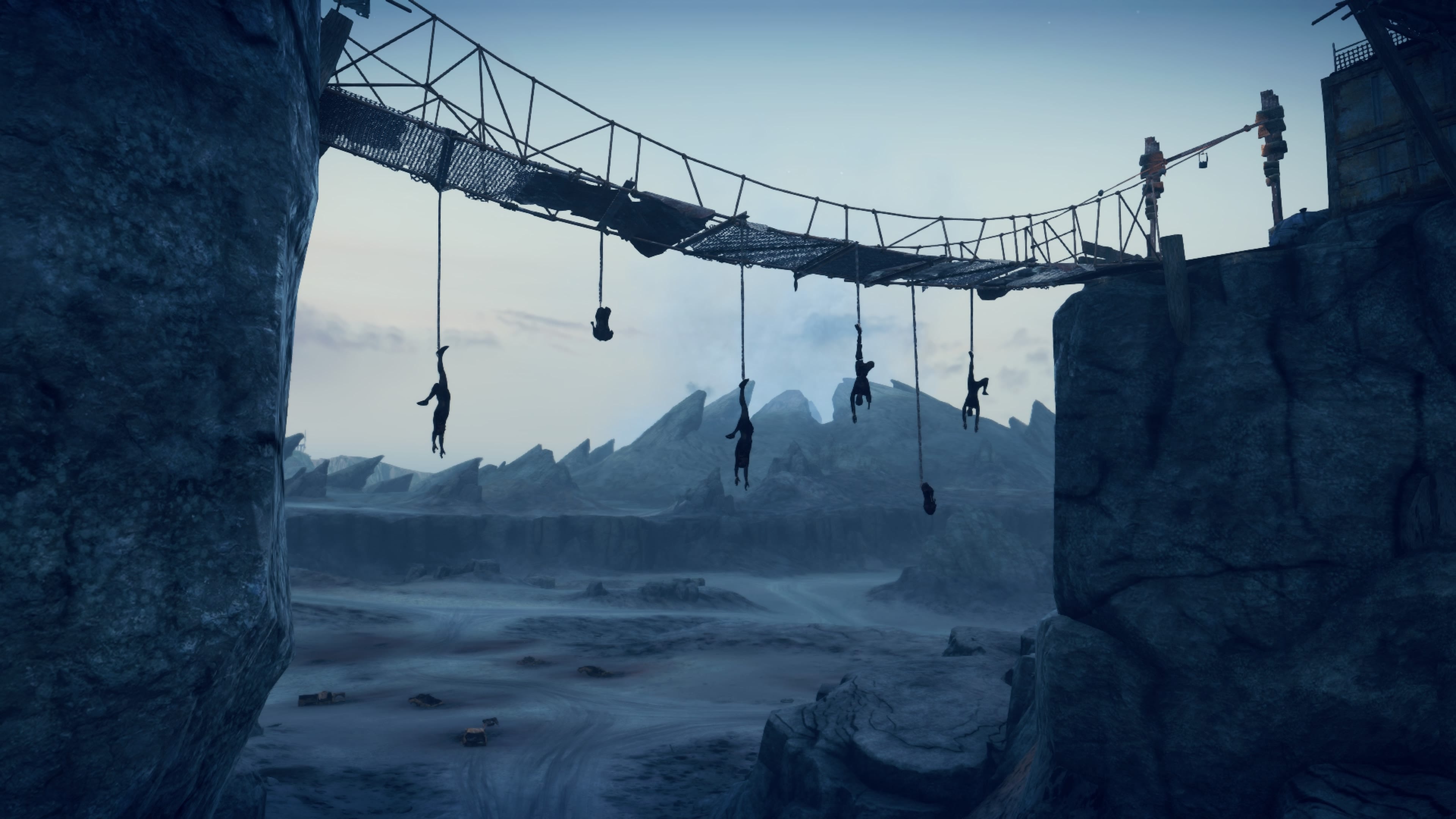
The wasteland is brilliantly realised here as a place of desolate beauty and endless, numbing depravity. Everywhere you look, there is blood, death, and putrefaction. Even Max himself, one of the few survivors with any memory of the pre-apocalypse world, is in the habit of eating maggots directly off of corpses, which we are given to understand is now the main source of protein for those who try to avoid cannibalism.20
With this level of grimness as a baseline, it’s not easy for Mad Max to generate peaks and troughs in tension, but oh boy, does it manage. Fully embracing the nightmare quality of its source material, Mad Max elaborates on the character of the wasteland’s inhabitants, especially the Buzzard tribe and the ‘ferals,’ to horrifying effect.
The Buzzards are a small but memorable part of Fury Road, shown as murderous ambushers that erupt from beneath the sand in their spiked war machines. Because of their unique design and the brevity of their screentime, the Buzzards have a strong mystique: in all versions of the film, they are shown speaking a foreign language (Russian in the English version), and their bodies are swathed in cloth wrappings, with gas-masks covering their faces. According to the film’s art book, they were imagined as ravaged by skin diseases, and their spiked cars were supposed to reflect their insular tribal nature, literally keeping outsiders at arm’s length.
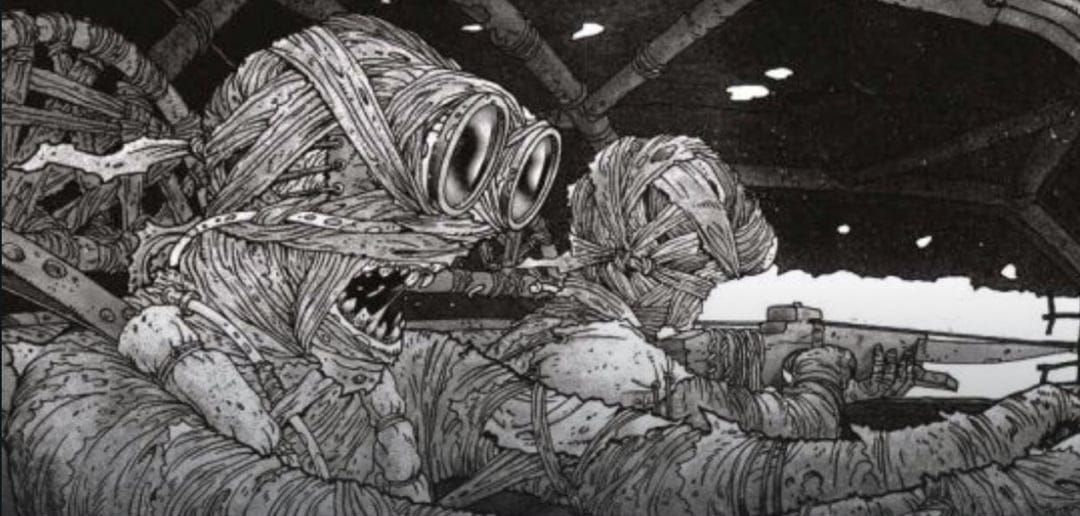
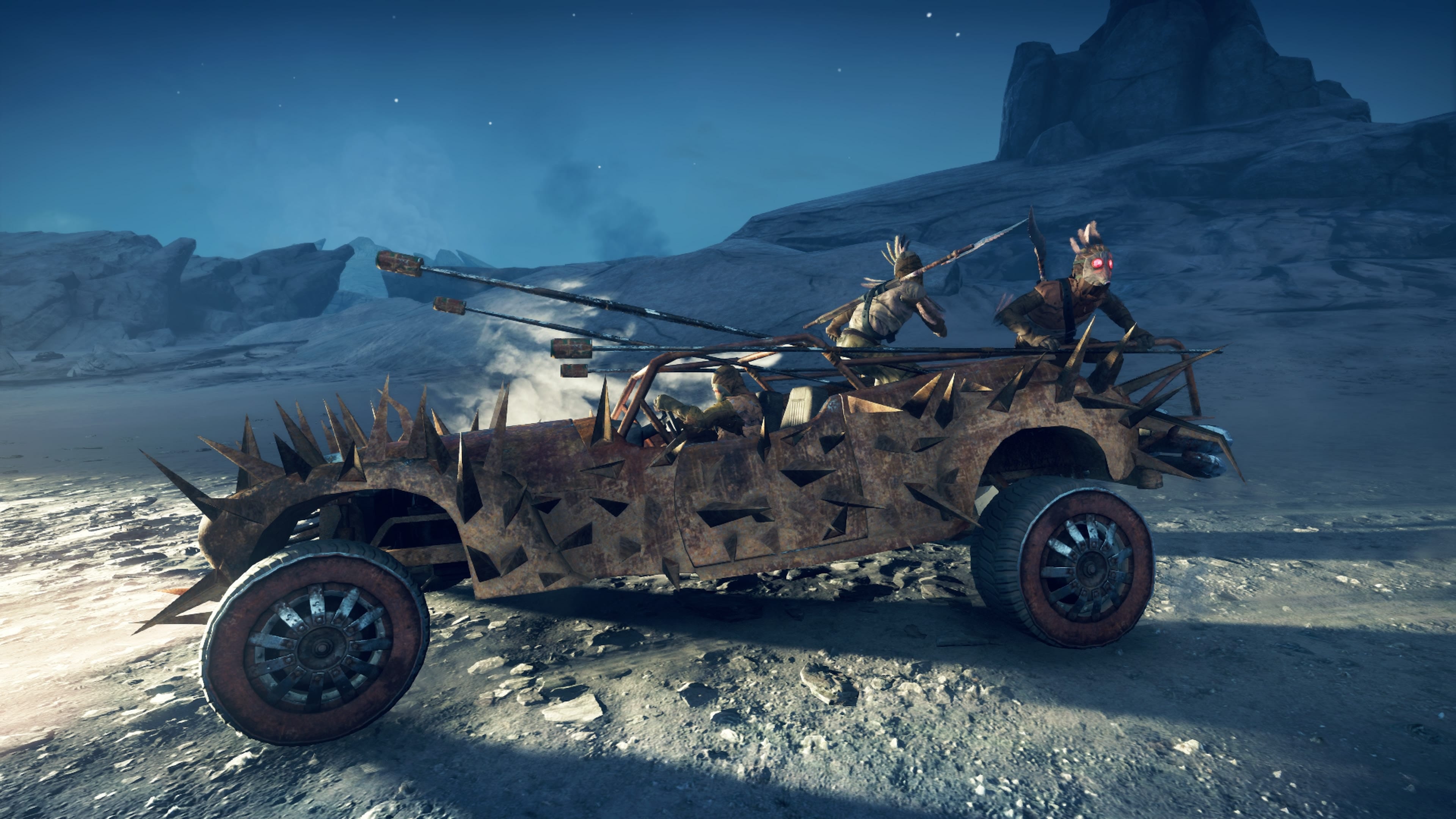
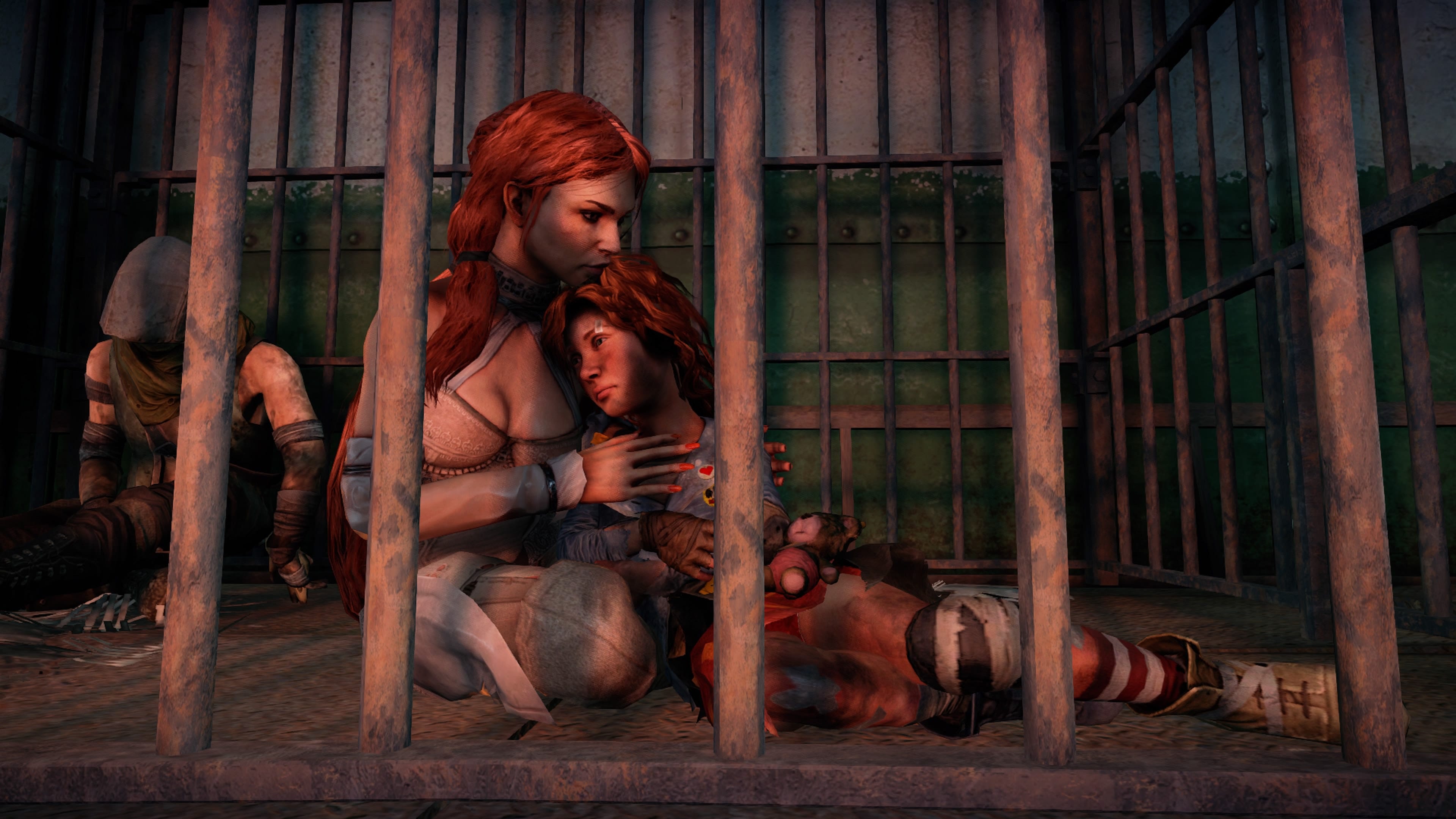
The Buzzards had also featured in Fury Road’s prequel comic, where they were shown as cave-dwelling cannibals21 and slave-drivers, who kill a mother and child Max had become attached to, re-traumatising him and sending him into the hermetic state he is in at the start of the movie. This plot point actually makes it into the game,22 although the role of the Buzzards is altered, with the woman and child (ironically named Hope and Glory) instead killed by Scrotus, the game’s arch-villain.23
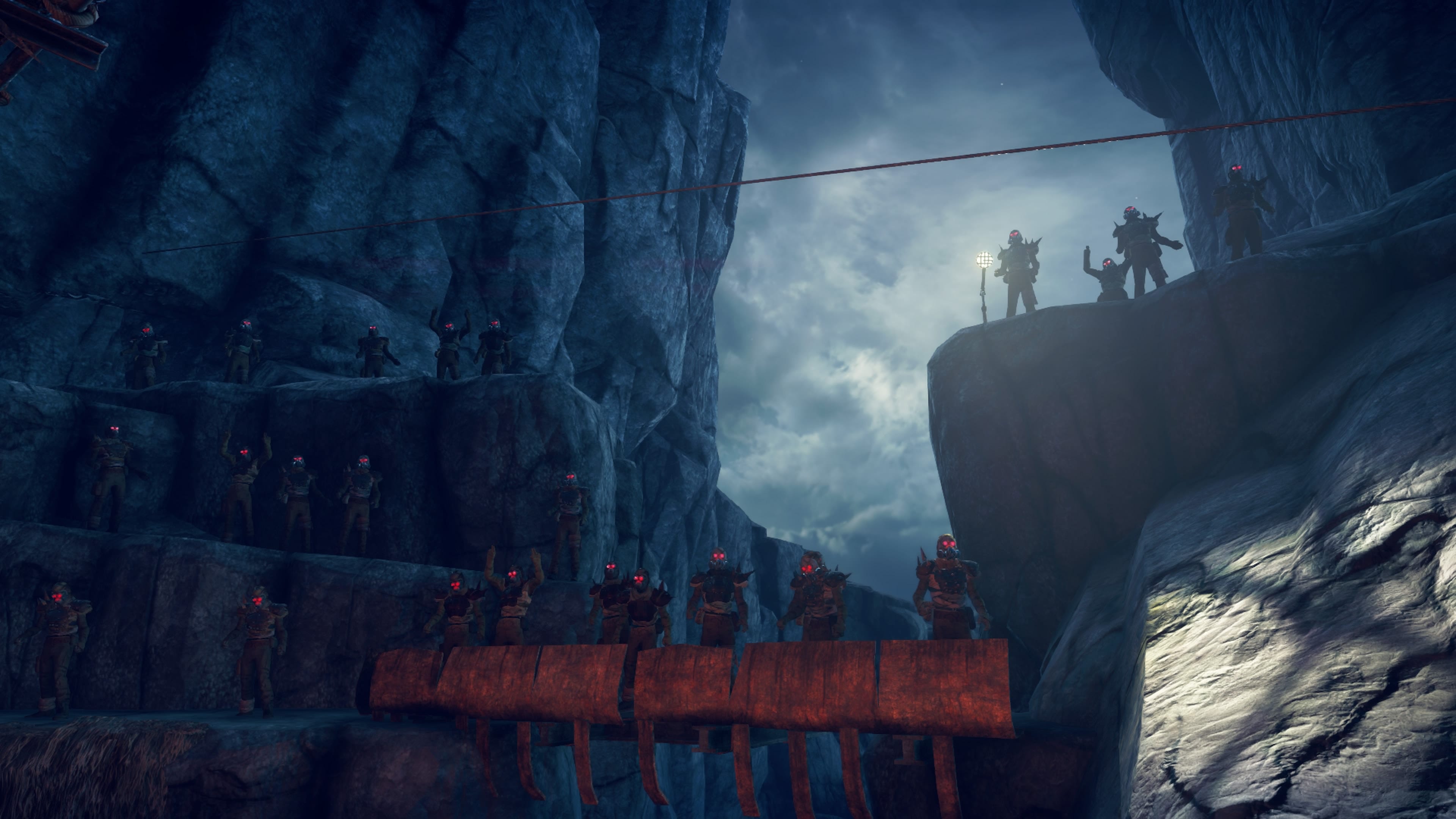
In the game’s world, the Buzzards are fleshed out further, but keep much of their original mystique. They do not speak except in inarticulate snarls muffled by their masks, and their impact is increased by the fact that they are used sparingly: they maraud only at night, with the red lenses of their masks glowing in the dark, and appear in several claustrophobic underground missions. Each is structured far more like an episode from a horror game, building tension with stealthy shufflings, distant howling, and scripted jump-scares as Max is stalked from the shadows, before the inevitable onslaught.
Chumbucket, Max’s faithful (if insane) mechanic,24 is terrified of them, and appalled by their habit of dismantling cars and ‘profaning’ them with spikes in ritualistic fashion. With their masks, lack of speech, and their opaque customs, there is an overwhelming sense that there is no understanding or reasoning with these carrion eaters.
More frightening still, however, are the so-called ‘ferals.’ This word is used in passing in Fury Road’s script, seemingly in the normal English sense, but the video game has an altogether darker take.
Among the War Boys, we find wizened humans that go on all-fours like animals, naked apart from suspicious-looking leather muzzles and harnesses. These ‘ferals’ are as vicious as the name implies, swarming, killing and eating their victims.
They are devoid of human speech and reasoning, and their codex entry explains that this is the fate of War Boys considered too defective to be trained, although variants belonging to other tribes also exist. The codex tells us that they are purposely bred as guard dogs, and human-sized cages can be found in every location where Max encounters ferals.
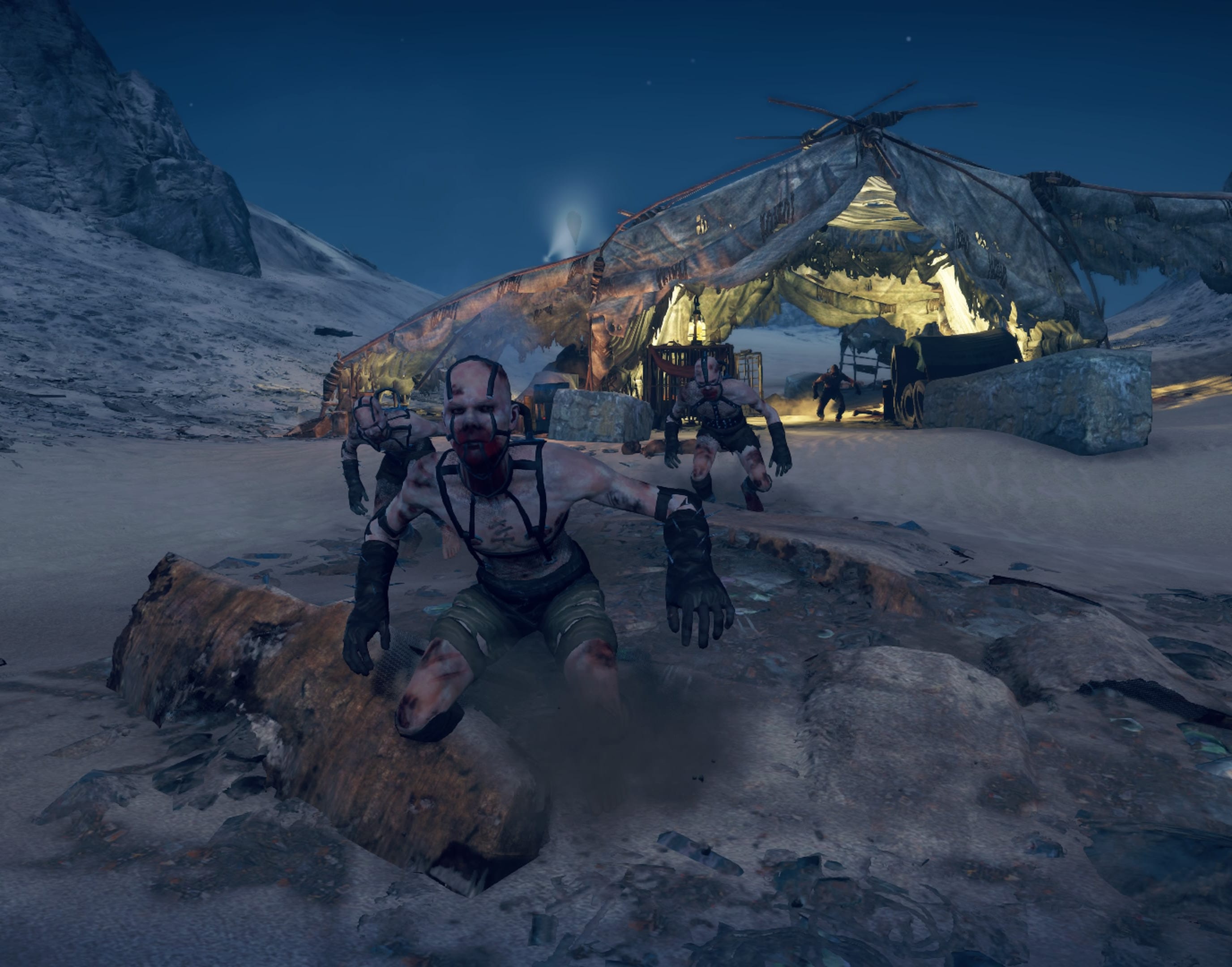
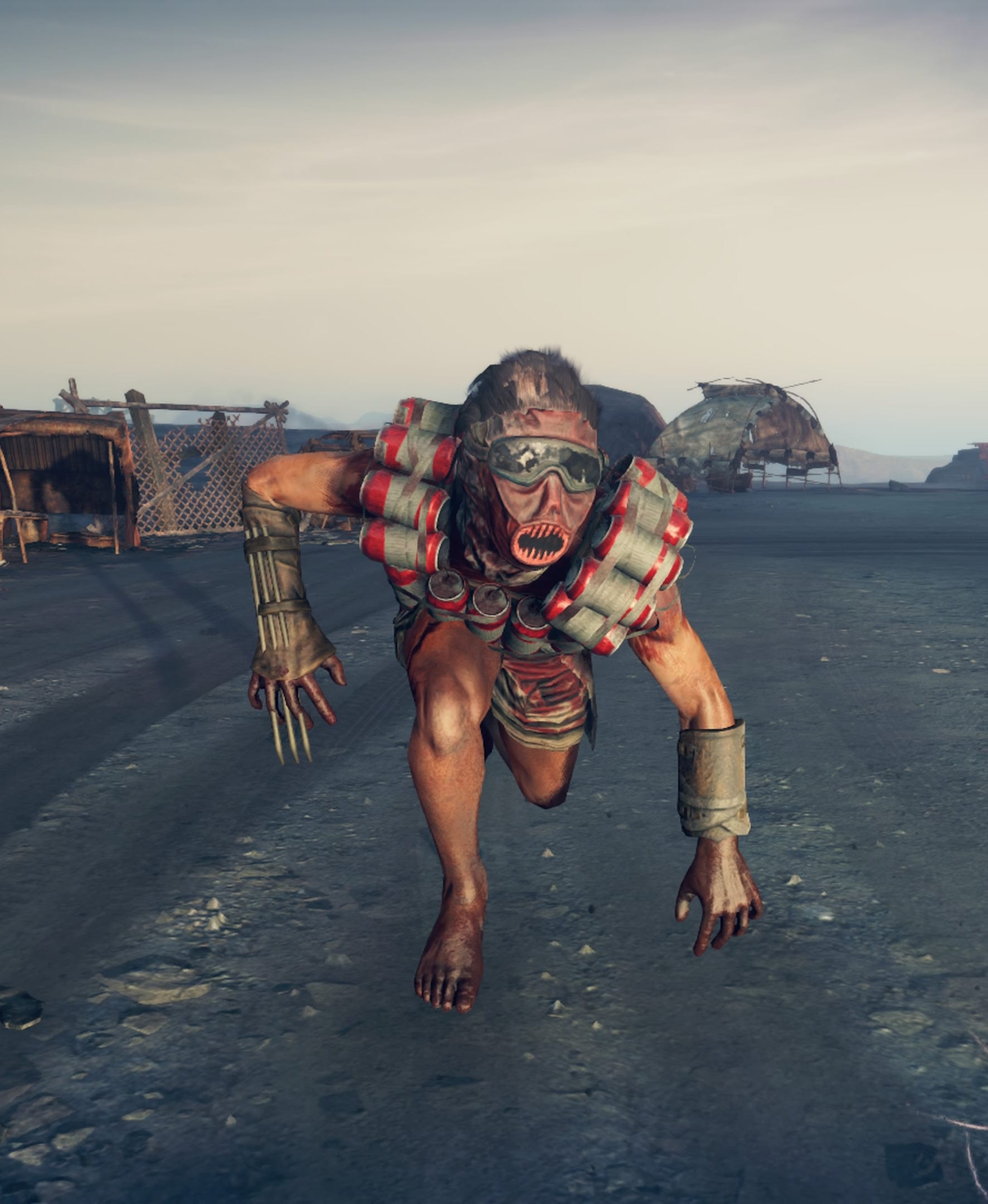
Although ferals are far from the game’s strongest enemies, and Max can overpower them in most situations, their sheer conceptual horror is enough to distinguish them as one of the wasteland’s worst foes. Every encounter with ferals is a visceral reminder of the fates worse than death that await those taken alive by the dregs of the wasteland, leading us to sympathise with Max’s delusional mission to escape to the ‘Plains of Silence,’ a refuge that may only exist in his mind.
As a palette-cleanser, I was going to include one more section, on Ghost of Yotei’s Spider Lily General mission, which offers a gentler, more folkloric kind of horror, as opposed to the more visceral material I have covered here. However, this one has already run on much longer than usual, and so, not wishing to overdo it, I will save that for another time.
There’s little more to add, so instead I will end with a question: do you have a favourite example of horror in a non-horror game that I did not get into here? If so, please share in the comments!
I would be particularly interested to hear about examples from lesser-known and indie games, as the examples I’ve discussed are all from big budget and well-known titles, which as a rule are only ever the tip of the iceberg when it comes to gaming.
For more on non-horror games with horror sensibilities, see my articles on:
Skald: Against the Black Priory
Codenamed Starkiller (which was Luke’s surname in the early drafts; there’s a delicious bit of irony in Vader replacing his real son with a proxy-son with Luke’s would-be name), although in the game he is seldom named at all. He is a sad tortured little man, whose only friend for much of his life was a robot, utterly ruthless in the game’s beginning, but also a pitiful figure, characterised as Vader’s slave (hence the lack of a real name). Sam Witwer, who provided his voice and mo-cap, also voices Maul in the various animated projects, whose backstory is very similar.
This chimes nicely with Return of the Jedi, as this would presumably have been Luke’s fate had he chosen differently.
'Thank you, Proxy’ are the last kind words he ever utters.
Whose articles I am woefully behind on. Sorry, twin, I have brain-fog and suchlike.
RDR also featured the more farcical non-canon Undead Nightmare DLC, a horror-comedy romp best likened to the Evil Dead movies.
See also: The Hills Have Eyes, which was itself based on the Sawney Bean legend.
Meanwhile, the Murfrees remain at large in the hills, bitterly resentful of the loss of the Hollow. Charles’ dialogue and Arthur’s journal strongly suggest that Beaver Hollow is only one of many underground Murfree hideouts, and throughout the final chapter there’s a strong feeling that the gang have become sitting ducks, surrounded by vengeful Murfrees.
Whose tent is placed closest to the cave’s dark mouth for symbolic reasons.
Famously linked with vampires in Anne Rice’s Vampire Chronicles.
Given the choice of horses available to the player, how life-like each animal is, and the inevitable attachment and sense of responsibility that you feel towards your chosen beast, the enormity of such a threat makes the Night Folk a particularly loathsome enemy.
Don’t ask me whose, I’ve seen it repeated on reddit and in Youtube comment sections, it has become a bit of speculative folklore among players.
This could be supported by a Red Dead Online story about a Saint Denis resident who becomes one of the Night Folk, deteriorating physically and mentally.
The game’s main story takes place in the 1890s, the same decade that began with the Wounded Knee massacre. We learn that the Army committed a similar atrocity at the game’s Fort Riggs, a grim landmark that can be explored in-game, and the game’s Wapiti Indians speak Lakota, the same language as the victims of Wounded Knee. In Chapter 6, the Wapiti are subject to brutal provocations, rapes and denial of medical aid, all in service of a land-grab.
Even the first game, which does feature hostile Native rebels, depicts them not as villains, but as desperate men who see no alternative, similar to Eagle Flies in the second game.
Though Native styles of clothing were widely adopted by white frontiersman, including scalp-hunters.
This word is used in the newspaper article describing them, as well as the police chief’s dialogue, and has obvious racial connotations.
(which also features in Blood Meridian)
In this sense they are yet another mirror of the Van der Lindes, who are also a multi-ethnic gang of outcasts brought together by a common (violent) purpose.
For other VdL foils, see also: the Lemoyne Raiders (stuck in the past and fighting the inevitable, much like the Van der Lindes); the O’Driscolls (Colm’s charismatic leadership and pathological nature mirrors Dutch’s); the Murfrees (stuck in the past, hiding in caves like animals, perverse ‘family’ element); the Laramie Gang (their petty, un-romantic racketeering is similar to Strauss’s loan-sharking).
Furiosa elaborates on this idea, showing a terrifying old woman who lives in a hole full of decaying corpses. She salvages bodies from the wasteland as food for her maggots, which she uses for food and medicinal purposes. Her maggots save Furiosa’s life, eating the dead flesh from her stump arm, though it’s not clear whether the woman, who urges Furiosa to go back to sleep and says that she’ll ‘find peace here,’ really wants her to live or not.
Again, Sawney Bean/Murfree/Hills Have Eyes connotations. A note in The Art of Fury Road mentions how old cars with prominent grilles were favoured for the Buzzards, as it conjured up images of ‘crooked braces on an inbred mouth,’ and a note on the wiki (unfortunately without a source, so take with a pinch of salt) describes them as sharing a genetic condition causing sensitivity to the sun, hence their underground lifestyle.
And is done in spectacular style. ‘Paint my name in their blood!’

Also a supporting character in Furiosa.
Who features in Furiosa, and is very recognisable as the character from the game! Glup Shitto rides again!
Comments
Nothing yet. Say the first thing.
Sign in to join the conversation.