
It has been inspiring to watch the rise of DAOs over the past year. Their power to build community projects and play with new economic incentives in the metaverse is clear.
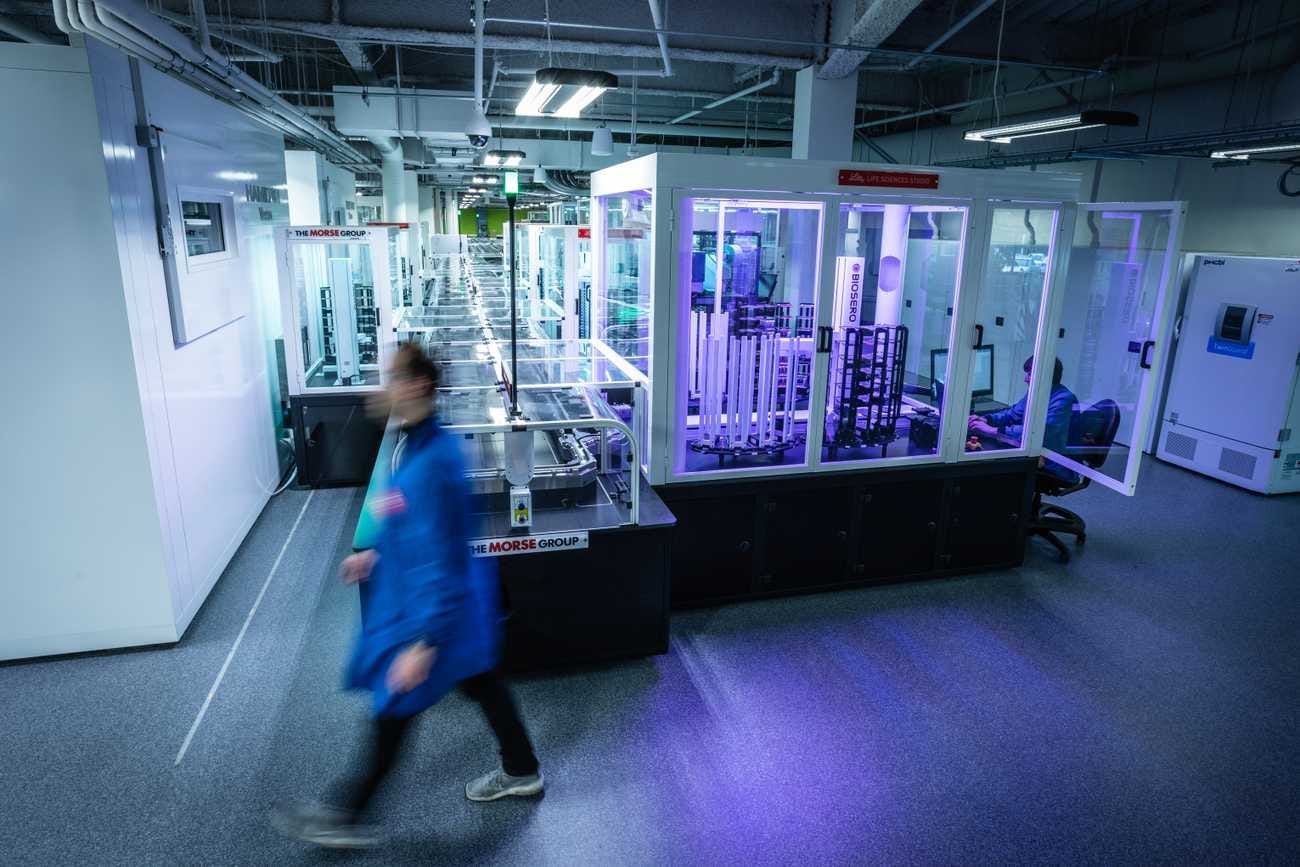
But where can DAOs and web3 provide value for deeptech? How can they interact with the real world? Running a modern lab requires both computation and access to equipment that reads, writes, and grows biology. The metaverse is great and all, but we still need to build stuff in meatspace.
We propose a labDAO: a DAO for management and ownership mechanisms of outsourced R&D.
There has been talk of the AWS of deeptech for almost as long as there has been AWS. What if scientists could do R&D as easily as a web developer could spin-up a new compute instance? What if we could enable someone on their laptop to develop a new biotech product without having access to a million dollar lab? While there have been many attempts, from Transcriptic to Emerald Cloud Lab, none have yet succeeded.
However, if you dig a bit deeper, there are parts of biotech R&D that have been abstracted out of scientists’ day to day. Twist has done it for DNA synthesis - there is no longer a need to do synthesis in-house. This is part of a wider trend of outsourcing in biotech, through use of contract research organizations (CROs). Many biotech companies purport to be “virtual,” having no labs of their own, outsourcing everything from drug candidate synthesis to clinical trials.
But anyone who has worked with CROs knows the ecosystem is fragmented, cumbersome to navigate, with poor data consistency, and little price transparency. The process is filled with implicit information, which is in turn lost in translation.
What if a labDAO could help streamline the process of outsourcing science work? What if instead of a market of siloed services, there was a network of explicit services, managed through a cohesive interface?
labDAO members build data and resource management software, in return for token ownership. The DAO interacts with physical labs (existing or new) by paying to run experiments and providing data or materials to the token holders who funded the work. Data can be managed in an electronic lab notebook (ELN) on chain, using NFT datasets, for later licensing or use by third parties. New labs can join the DAO to earn tokens for their services or to support scientific progress by providing their methods at cost.
Start with simple, easily outsourced projects - “bit to bit” projects requiring the user to supply data to be analyzed (e.g. bioinformatics or screening experiments) and receiving data out the other side. Then move to “bit to atom” and “atom to atom” projects.
This may bring to bear several attractive solutions for the outsourced R&D market:
Standardization: better data management and consistency across labs, by using the developer communities available in web3 to build standardized ELNs / resource allocation tools.
Abstraction: instead of long email threads telling CROs what they want, scientists can run experiments by inputting information in a consistent way.
Liquidity: more liquid markets and pricing transparency amongst different and distributed lab services providers, turning CROs into smart contract research organizations.
Variety: greater access to specialized expertise worldwide by aggregating CROs and labs through a common interface.
Marketability: monetization schemes through on-chain data management or IP-NFTs, with built in licensing mechanisms that bring value back to data generators and data owners. For example, a scientist could perform a screen and mint IP-NFTs for every molecule in their experiment, retain the most interesting ones for further development, and freely trade the rest.
A labDAO could leverage global lab networks to transform the way we outsource biotech R&D, and accelerate R&D output.
We’re building a community to work on this - if you’re interested, please get in touch.
Special thanks to Niklas Rindtorff (@Niklas_TR) my co-author on this piece.
No posts
Comments
Nothing yet. Say the first thing.
Sign in to join the conversation.