
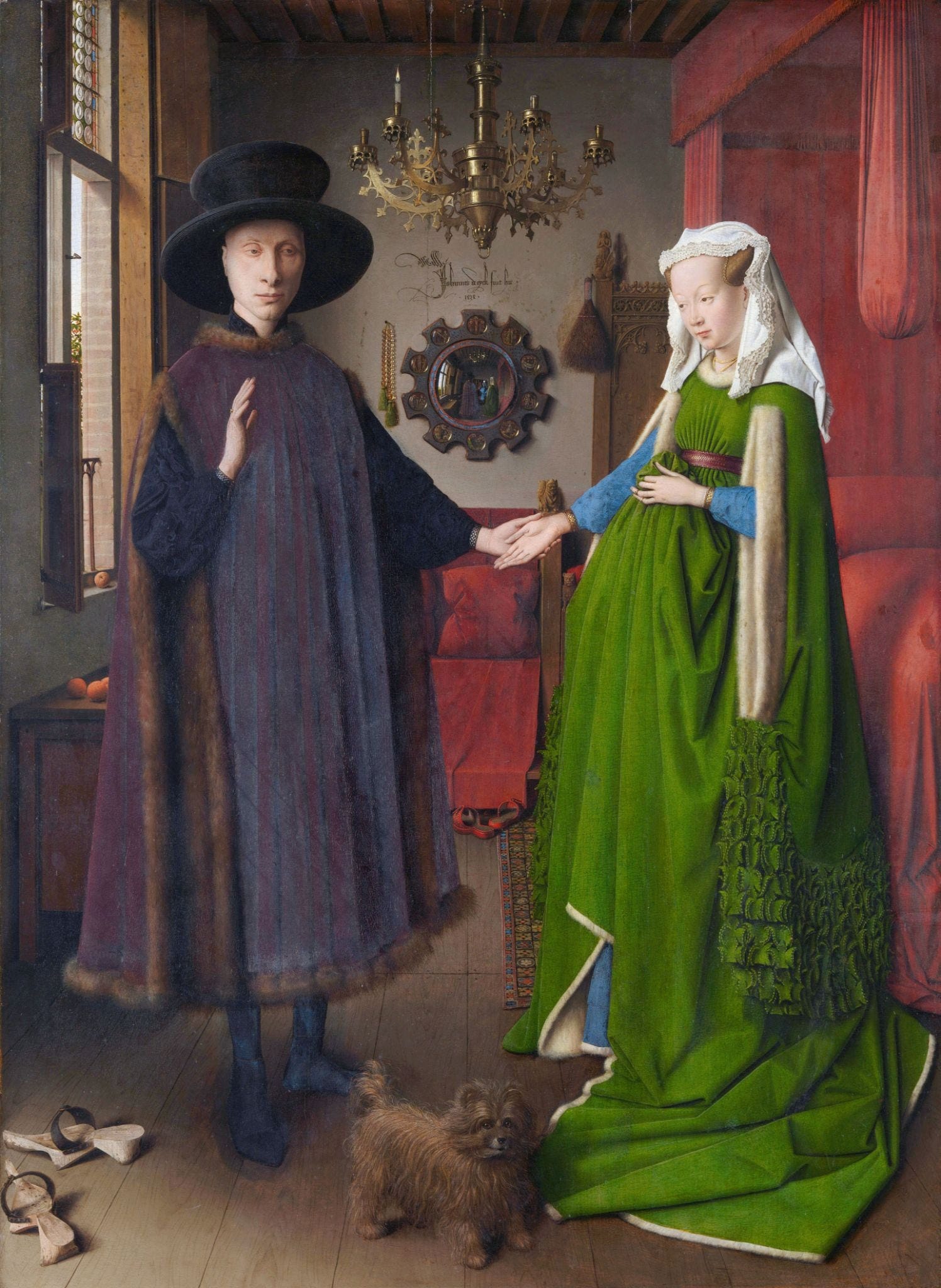
Six centuries of art historians have stood in front of The Arnolfini Portrait and disagreed about what, precisely, is happening in it. That disagreement is not a failure of scholarship. It is the painting’s most remarkable quality. Van Eyck filled a domestic interior measuring 82 by 60 centimetres with so many deliberate decisions – about objects, light, gesture, reflection, inscription – that no single reading has ever been sufficient to account for all of them. The painting does not resolve. It accumulates.
Giovanni di Nicolao Arnolfini was a Lucchese merchant at the court of Philip the Good, Duke of Burgundy – one of the wealthiest men in 15th-century northern Europe. The woman beside him has been identified most plausibly as his wife, Giovanna Cenami, though the identification remains contested. What is not contested is the formality of the occasion: the turned-back bed, the discarded shoes, the raised right hand, the clasped hands at the picture’s centre. Something is being solemnised. The details do not merely decorate the scene. They constitute it.
A Room Full of Arguments
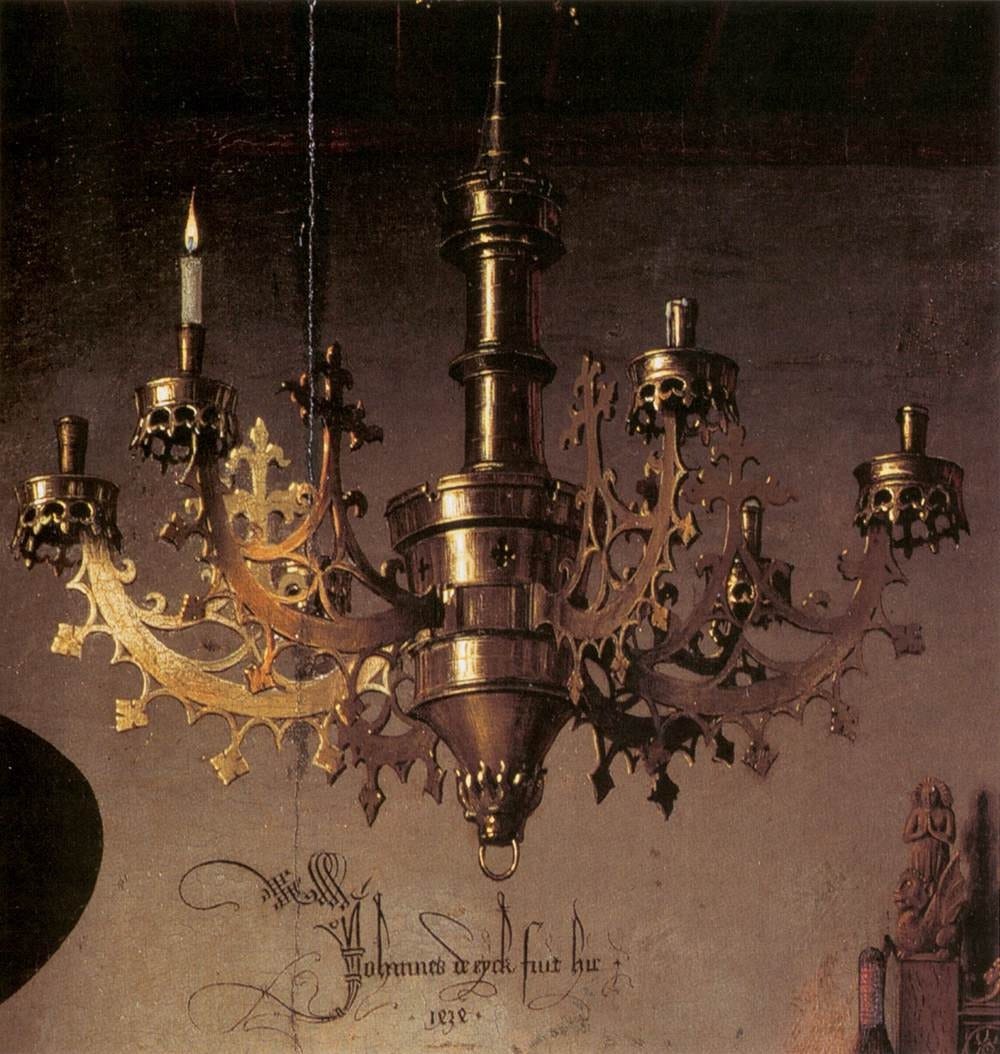
Start with the candle. A brass chandelier hangs above the couple, holding a single lit candle on Giovanni’s side – burning in full daylight, in a room with a perfectly good window to the left. It has been read as a nuptial candle, as a symbol of divine presence, as a reminder of mortality, as proof of the Holy Spirit’s witness. Van Eyck would have known all of these readings were available to a literate 15th-century viewer. He lit the candle anyway – precisely because the ambiguity was the point. A painting in which every symbol admitted only one reading would have been a diagram. Van Eyck made something denser than that.
The shoes – both pairs removed and placed on the floor – evoke the instruction given to Moses at the burning bush: remove your sandals, for the ground on which you stand is holy. The small dog at the couple’s feet signifies fidelity – a standard enough iconographic marker – but also, given that dogs were luxury objects of Northern European court culture, signals wealth and status. The single orange on the windowsill, a fruit that was expensive and rare in 15th-century Flanders, suggests abundance, health, and possibly the Garden – the Hesperidean apple transposed into a prosperous merchant’s bedroom. The carved bedpost features a figure that may be Saint Margaret, patron saint of childbirth. Nothing in this room is accidental.
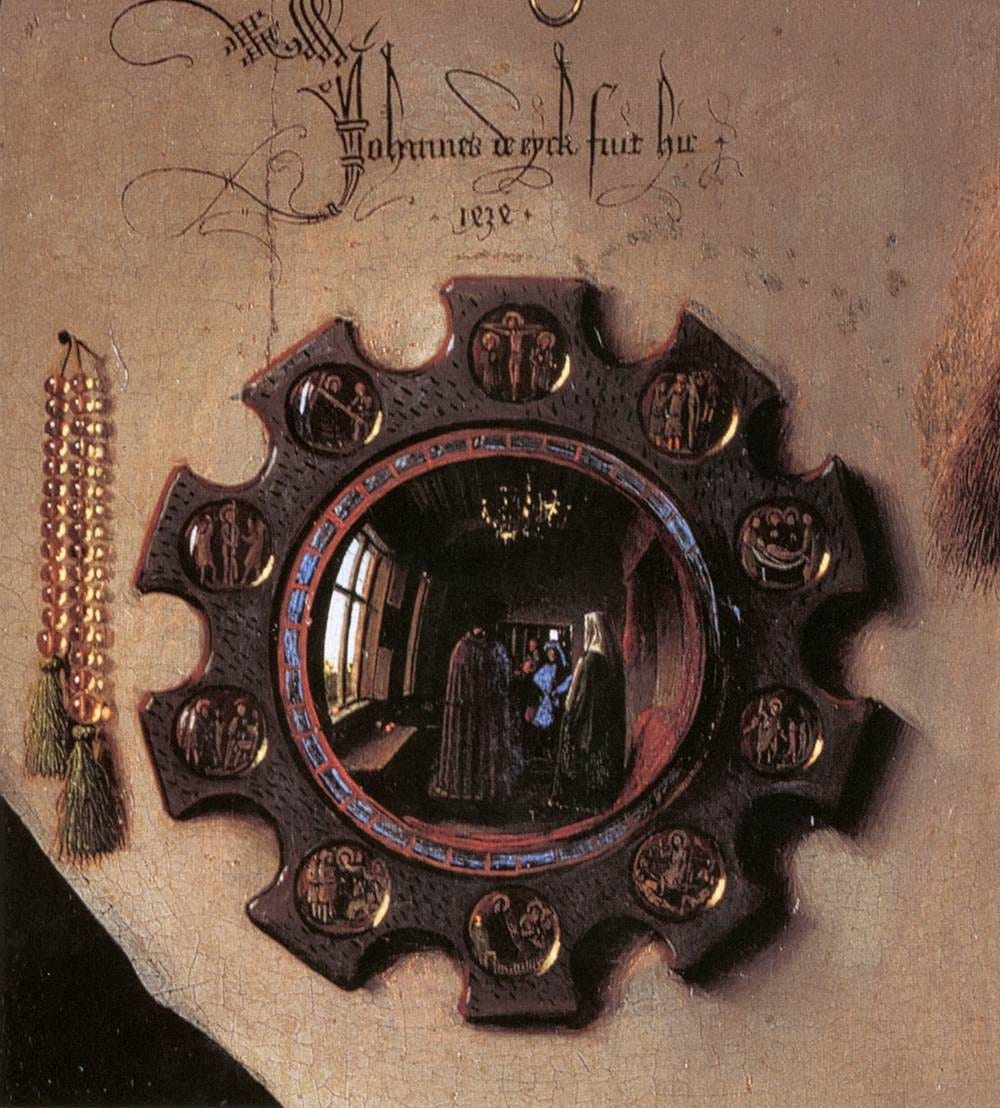
Then there is the mirror. Convex, framed by ten painted roundels depicting scenes from the Passion, it hangs on the far wall and reflects back what the painting’s viewpoint cannot show: the couple from behind, the window, and two figures entering through a doorway. Above it, in elaborate Gothic script: Johannes de Eyck fuit hic. 1434. Jan van Eyck was here. The mirror sees everything. The painter, who has placed himself in the mirror, claims to be part of what the mirror sees. Whether this constitutes a legal witness statement or something closer to artistic signature pushed to its philosophical limit is a question this month’s Time Travels interview explores directly. What the mirror establishes in purely visual terms is more immediate: the painting contains its own record of being made.
Renaissance or Medieval? The Label That Doesn’t Quite Fit
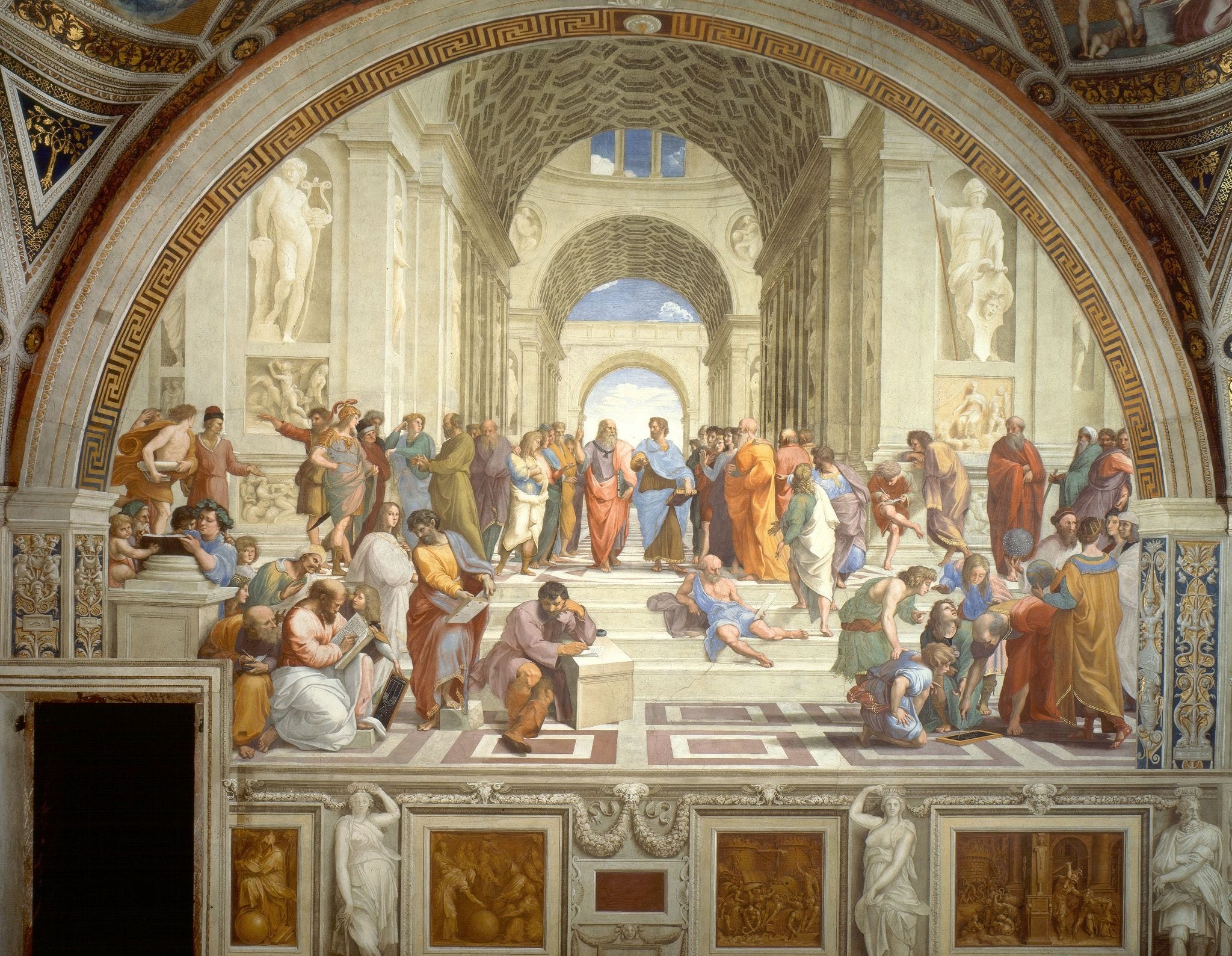
The honest answer is both, depending on which definition you apply – and that tension reveals something important about how art history’s periodisation was constructed. The label most commonly applied is Early Netherlandish or Northern Renaissance: Van Eyck is understood to constitute the Northern branch of the same cultural transformation that produced Brunelleschi and Donatello in Florence, and the Arnolfini Portrait was painted in 1434, the same year Donatello completed his bronze David. But the Renaissance as a concept was formulated by Italian humanists celebrating the rebirth of classical Greco-Roman culture – mathematical perspective, idealised human proportion, antique reference. Van Eyck’s work shares almost none of these priorities. His figures are not idealised. His space is not constructed through Albertian linear perspective but through accumulated empirical observation. His intellectual framework is not classical antiquity but Flemish Gothic theology, guild culture, and Burgundian court patronage. In every social, religious, and political sense, he operated in a thoroughly medieval world. What was revolutionary was not his philosophy but his technique: the shift from opaque tempera on gold ground to layered oil glazes on panel, which allowed him to paint light rather than merely represent it. The rupture was material, not humanist. This is why some art historians now prefer Early Netherlandish as a classification that sidesteps the Renaissance label altogether – acknowledging the technical transformation without importing a cultural narrative coined in Florence that has always fit Bruges imperfectly.
What It Changed
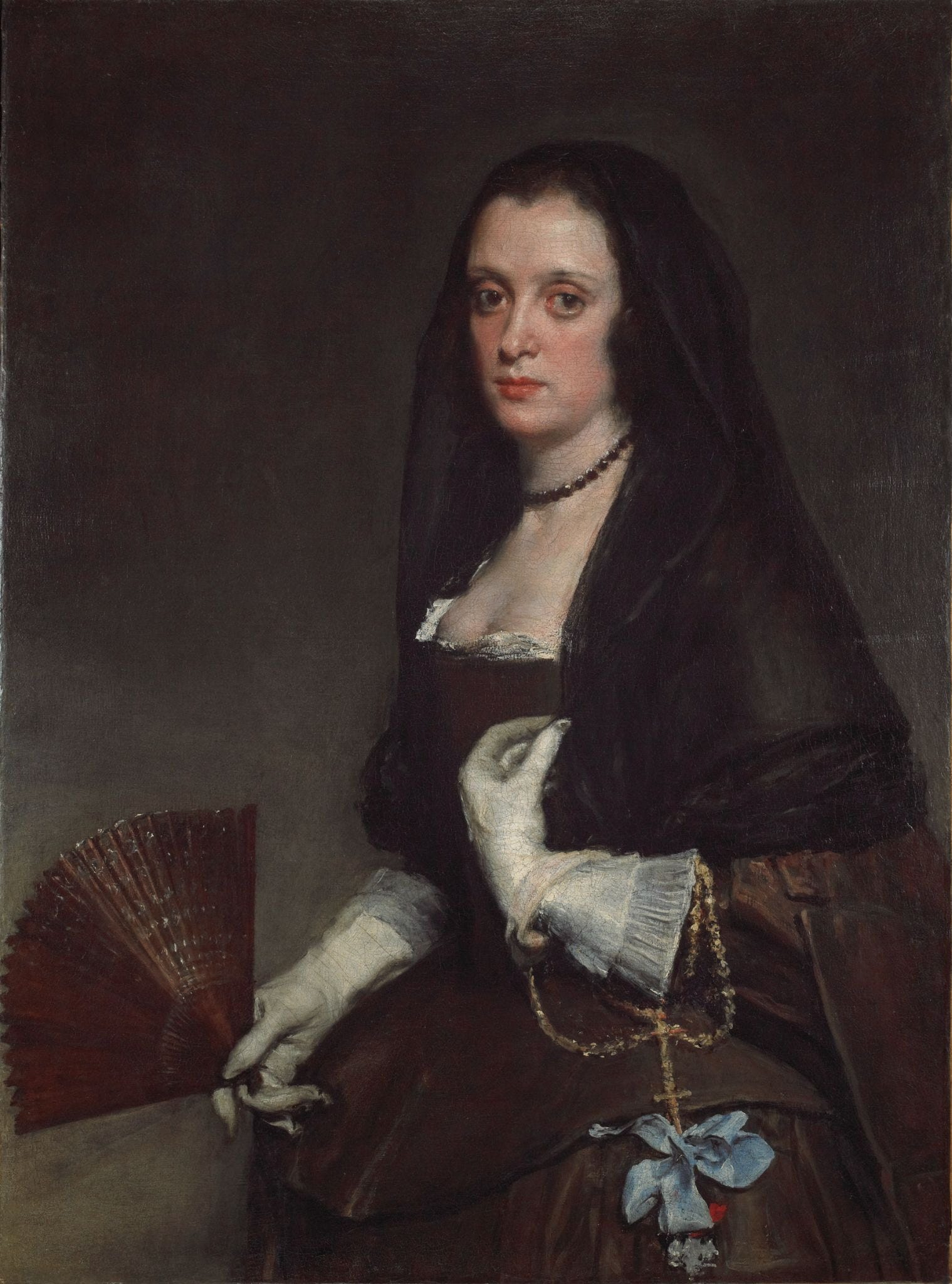
Before Van Eyck, painted portraiture in Northern Europe was largely confined to royalty and high ecclesiastical office – and even then it was schematic, hierarchical, concerned with rank rather than resemblance. The Arnolfini Portrait is among the first works to insist that a merchant’s face, in all its specific asymmetry and particularity, was worth the full resources of the painter’s art. That insistence had consequences that ran through the following two centuries: Holbein, Titian, Velazquez, Rembrandt – the entire tradition of European painted portraiture as a record of individual human presence – begins, in a meaningful sense, in this room.
Technically, the painting also set a standard that forced a reckoning. Italian painters of the mid-15th century – trained in the mathematical clarity of Florentine linear perspective, in the ideal proportions derived from antique sculpture – encountered Northern oil painting and recognised that it could do something their tradition could not: render the specific gravity of a physical object, the exact way light bends through glass, the difference between silk and wool under the same candle. The synthesis of Northern optical specificity and Italian spatial architecture produced the High Renaissance. Van Eyck didn’t cause the High Renaissance. But Flemish painting created the technical pressure that made it necessary.
What remains most striking, six centuries on, is not the painting’s historical position but its sheer resistance to completion. Every generation of scholars has approached it with better tools – infrared reflectography, dendrochronology, archive research, gender theory, legal history – and every generation has found it still generating questions. The woman’s identity remains disputed. The gesture remains unresolved. The occasion, despite the best efforts of five centuries of specialists, has not been definitively named.
That inexhaustibility is not a mystery to be solved. It is the measure of what Van Eyck built. He packed a small domestic interior with more deliberate meaning than the room could transparently hold, signed it with a statement so precise it functions as testimony, and sent it forward in time without instructions. We have been trying to read it correctly ever since.
The painting hangs in Room 56 of the National Gallery in London. It is smaller than most people expect. It is more than most people are prepared for.
Comments
Nothing yet. Say the first thing.
Sign in to join the conversation.