
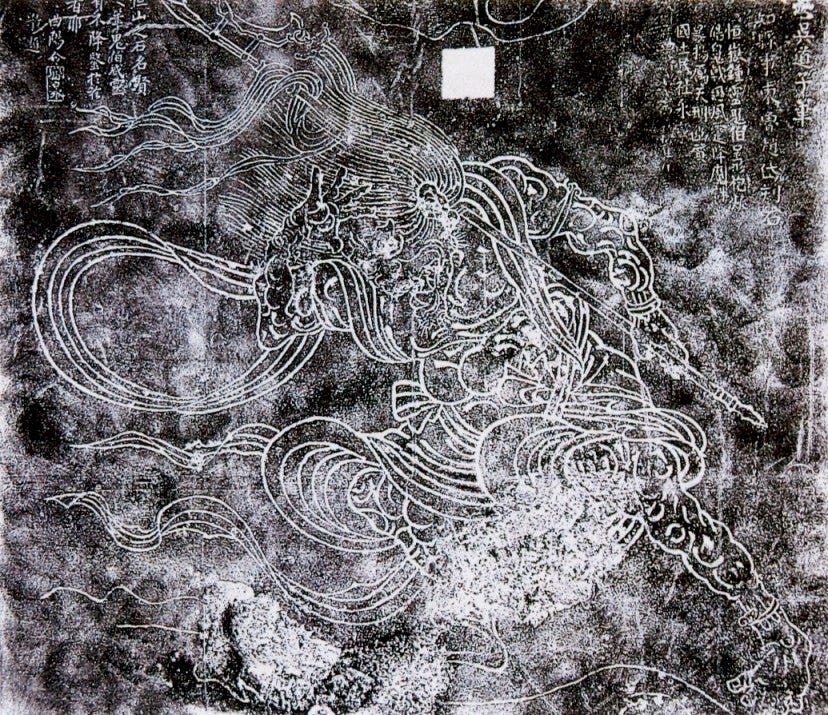
When Wu Daozi painted a magnificent landscape mural for Emperor Xuanzong, he included a hidden cave inhabited by a spirit.
After completion, he clapped his hands and, to the emperor’s astonishment, stepped into the painted cave, disappearing into his own art, upon which the mural vanished.
Now THAT’s Art.
So we have a series on this substack, where we try and figure out the nature of Art throughout history. Our goal is to know what made art useful and artists successful (not in the money sense necessarily). If we have that, then we can start to guess the right response to the current meaningless, AI-ridden entertainment age.
This Substack is reader-supported. To receive new posts and support my work, consider becoming a free or paid subscriber.
We’ve done early islamic art, hunter-gatherer art, and have found incredible value in their example. You can find the posts on this substack if you missed them.
Today, we’re going to do pre-Song-dynasty Chinese Art (with a strong focus on painting).
Before we go deep into cultural differences and the meaning of life, let’s warm up with more direct questions.
Why was Art Useful ?
In this section I’ll go through the three main reasons for the usefulness of Art in ancient china.
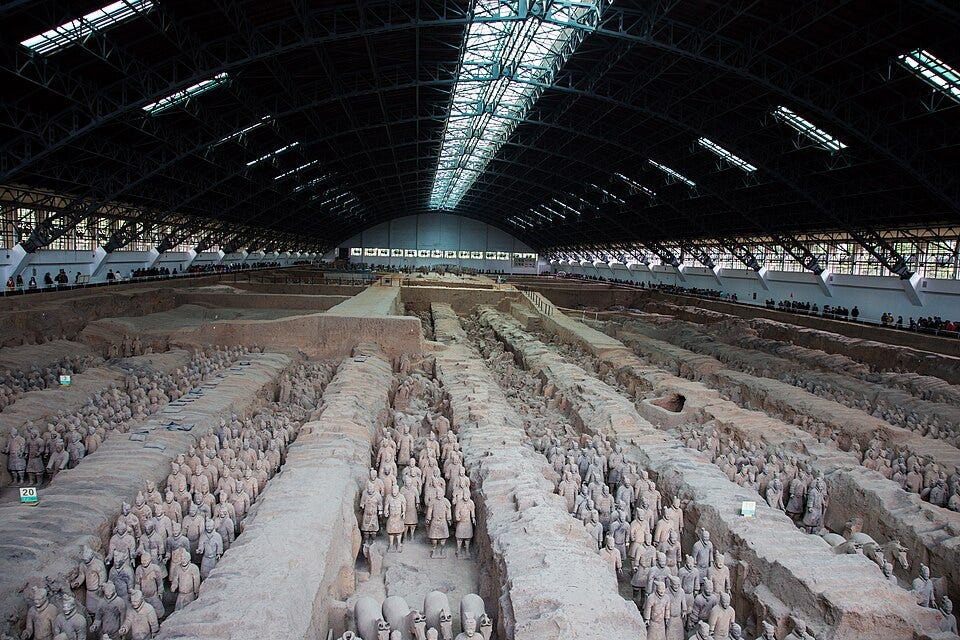
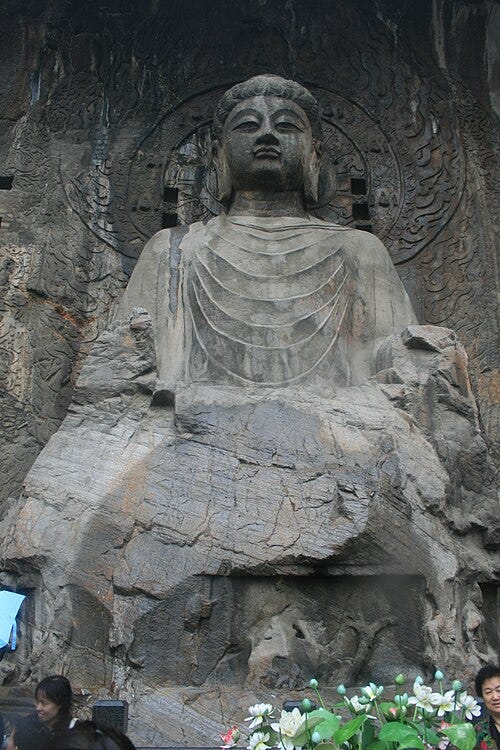
First of all, the most despicable usage of Art of course is under the iron fist of a ruler. Examples abound of this kind of Art. Wu Zetian’s massive buddhist status modeled after her own face, Qin Shi Huangdi’s terracotta warriors, those are only two examples. In a world of scarcity, before replication technology, the existence of a work of art that argued in the favor of the ruler was invaluable.
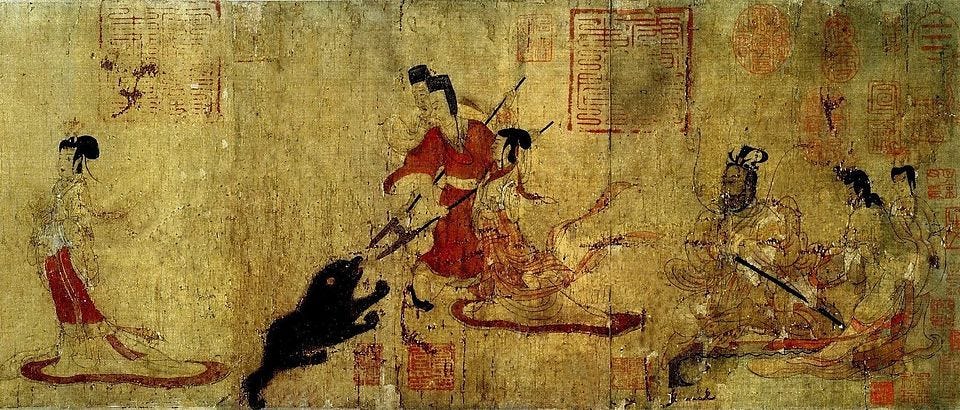
A second way to use Art was more ambivalent : Art as an educational force. There are examples that seem icky today. A well-known case is the handscroll Admonitions of the Court Instructress, attributed to Gu Kaizhi, which was likely commissioned by a Jin dynasty court official to teach the Empress and imperial consorts proper behavior. More laudable examples include various public education campaigns by emperors attempting to teach the people how to live in harmony. The power of the Artist to speak immediate, soulful words and images was invaluable in these kinds of undertakings.
Now let’s get to the more interesting third part… You’ve read the quote at the start :)
Let’s first go through the features of ancient Chinese society. There was the Confucian insistence on social order, which was a reaction to traumatic warfare: everyone needs to stay in their place, and play their filial role. This is the only way for everyone to be happy and well. Then, there was the belief of Man as the bridge between the sky and the earth, or animal kingdom. Natural disasters were seen as caused by the ruler’s deviation from the will of heaven.
As the connection between heaven and Earth, humans served a role as harmonizers. Magicians of sorts, Artists were tasked with feeling out the will of heaven, and giving it presence in the world, so as to prevent disasters.
A popular legend from the Southern Liang dynasty (6th century) illustrates how literally artists took the idea of capturing a human (or creature’s) spirit. The master painter Zhang Sengyao was commissioned to paint four dragons on a temple wall. When onlookers noticed he left the dragons eyeless, Zhang explained, “The eyes are the spirit of the dragon. The other parts are just the form. Once you add the eyes, you are giving it life force, and it will fly away.” As Zhang dotted the pupils on two dragons, a crack of thunder struck and the two newly-eyed dragons sprang to life, flying off the wall into the sky
How did Artists survive ?
Early Chinese painters were subject to the same kind of hardships as Artists of all ages.
One anecdote relates that Xuanzong once had Yan Liben urgently summoned to sketch a strange bird that appeared in the palace gardens. Yan, who by then was a high official, obeyed but reportedly felt treated like a mere craftsman. He lamented, “I am known only by painting as if I were a menial”. He even advised his sons NOT to pursue an Art career.

To gain sustenance as an Artist, you basically had to find yourself a rich patron, or be a rich patron yourself. Most of the still-known painters of that era were in some way linked with the emperor or high-ranked officials.
There were artistic traditions such as ritual bronzes, textile work, funerary wares etc. from which people did make a living. In the canon of the time, though, these were considered craft, not Art. Poetry and Painting, for instance, were considered Art, not craft.
There were ways for people to rise through the ranks through their painting prowess alone, though this was rare. Han Gan (c. 706–783), started life poor but was recognized by Wang Wei, a prominent poet, who sponsored Han in learning the arts. Under the poet-official’s patronage, Han Gan trained with a court painter and eventually “became a painter in the Tang court”.
A crisis of authenticity in Art…
Let’s take a look at a monumental crisis of Art, caused both by technological innovation, but also by social factors and a new definition of Man.
One tale says a Tang emperor, to obtain Wang’s * Orchid Pavilion Preface*, sent agents to stealthily steal the original and leave a perfect replica in its place. The replica was made via fine tracing or rubbing techniques, so exact that it initially fooled everyone
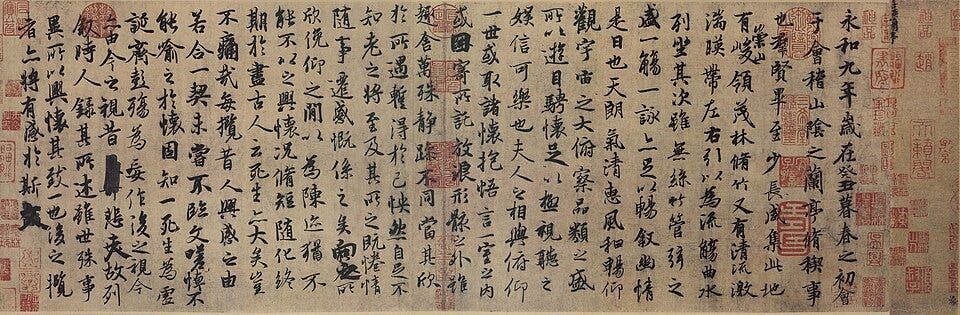
Foreign influences of Daoism and Buddhism, along with rising chaos in the late Tang dynasty, led to a crisis in Art. The old repetitive “upholding of traditional Confucian values” was no longer enough for those who believed in eternal suffering and Karma.
A top-down crackdown on buddhist Art happened in response to copy technology that allowed endless replication. This copy technology had led, and this is very relevant for us today, to a so-called crisis of authenticity : no one could figure out anymore, which was the original artwork.
How did Artists react ?
Some reacted by obeying the crackdowns. They toned down the buddhist Art, or at least, added Chinese features to it. They began once again to make Art that, in the face of war and chaos, preached the values of peace and harmony.
Others decided against this return to old values. They came again into the caves where Art had been destroyed, and remade the buddhist paintings the next year. They kept the copied artworks proliferating. And in the face of war and atrocity, they began to make beautiful landscape paintings, full of feeling, ways to find solace in Mother Nature.
The interesting thing is this : both sides seem to have left an equally honorable mark on history. What matters to us 1500 years later is that they expressed their true selves, through art that wasn’t aimed at mere financial gain.
And this kind of self-expression would only become more and more important as the Song dynasty advanced. But that’ll be a story for another day…
So what have we learned today ?
The Artist in early Chinese history was most often dependent on rich patronage, and used as a craftsman. But that’s not the full story. They were to some degree believed to hold magical powers, and to be crucial in the harmony of the universe. Besides, they strove to capture the inner spirit of things, far beyond mere fidelity to outward form.
In this post, just like in the two previous posts in the series, we have found that the core principle of Art, those that adapt to the epoch, are NOT the money, power or propaganda aspects. Those, modern Art seems obsessed about. What made a true, venerated artist back then was their ability to understand and express the universe’s value, its meaning, and drive the viewer into a sense of wonder and goodness.
This is very similar to what we found with Islamic Art, and Prehistoric Art. I’m beginning to notice a LOT of VERY SIMILAR FEATURES between all these historical periods we’ve been covering. Expect a recap post in one or two months, where I’ll let you guys know what we’ve learned from this research, and what it tells us we should do today. To reach our aim by all means…
The aim, after all, is to save the spark of good in humanity, from the crazy vicious circle we seem to have entered today. We are an increasingly powerful entity, with increasingly lower levels of wisdom. It is the role of Artists and Philosophers to teach humanity this wisdom. Let’s fight to the death to maintain them in the face of the all-in AI Attack.
Are you in ?
See you next time !
ArtPostAI
This Substack is reader-supported. To receive new posts and support my work, consider becoming a free or paid subscriber.
Comments
Nothing yet. Say the first thing.
Sign in to join the conversation.