
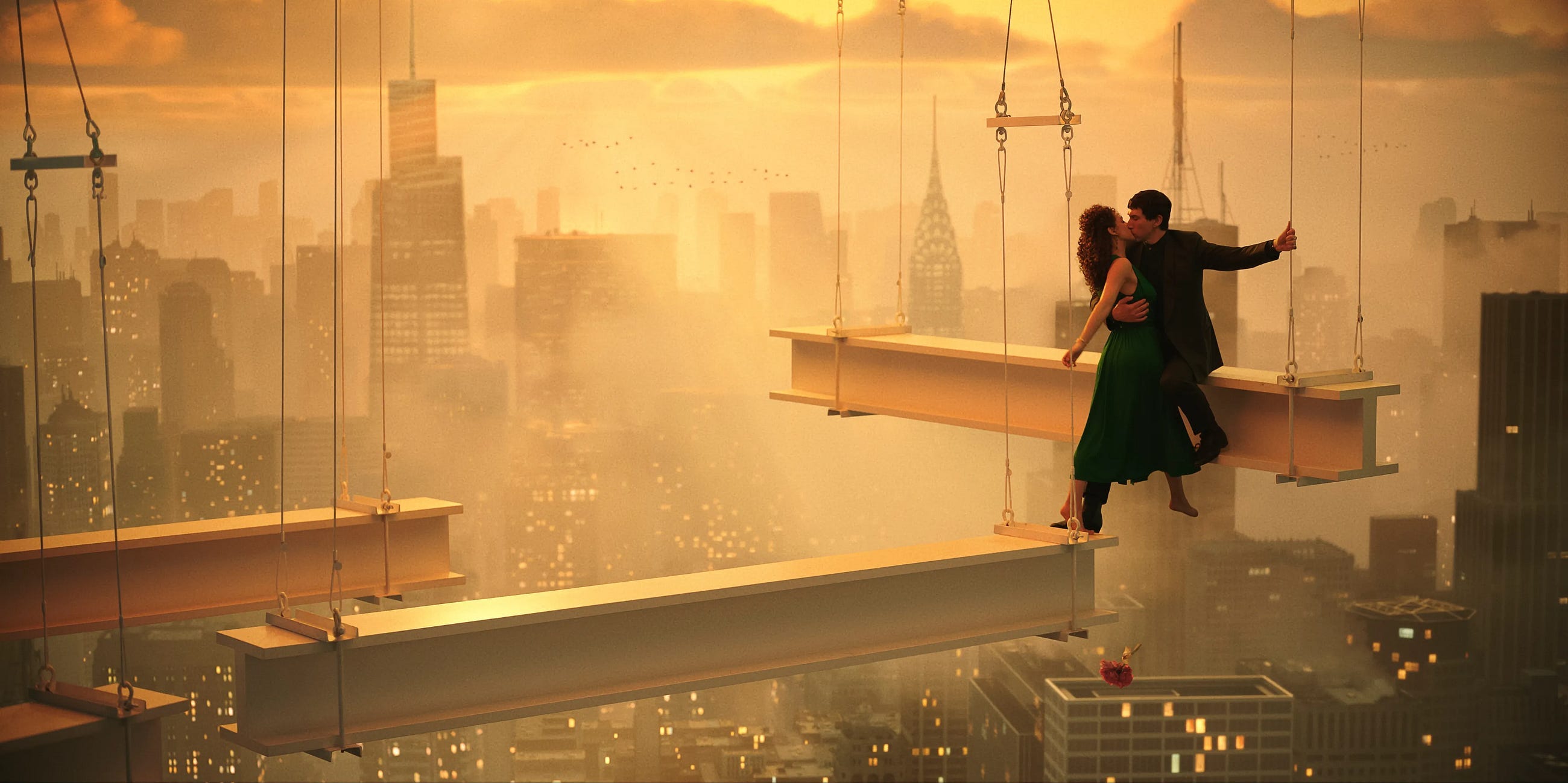
I have a theory that the longer a project hangs in the back of its creator’s mind, the worse it becomes. Years and years of development means more backstory gets written and more themes find their way in. The project swells and bloats until it becomes an attempt to create an ‘Artwork of Everything,’ and the task of making it becomes less one of creation and more a matter of judicious editing.
And if that creator has a name like Francis Ford Coppola, who is writer, producer, and director of the film Megalopolis, and is bankrolling much of the film himself — well, what editor is going to tell him it has become a sprawling mess?
We are told Megalopolis has been a forty-year passion project for Coppola, and it has all the hallmarks of a film trying to be about everything. Unfortunately, its arthouse sensibilities fail to make up for its questionable storytelling and acting — the two things that lead your audience into your big ideas. They are also the two things that Coppola had complete control over.
[Mild spoilers ahead]

The film centres around Cesar Catilina [Adam Driver], the genius inventor of “megalon” — a malleable substance that can be used to build quite literally anything, and which also seems to manipulate gravity and time. Cesar wants to use this miracle substance to rebuild the city of New Rome (an alternate present-day New York) into a place where everyone is equal.
This proposed city of Megalopolis will respond and adapt to the needs of its citizens, and although the idea is never expressed clearly, we are left to assume that greed and crime will fall by the wayside when the struggle for property is removed. A good, if vague, start.
Cesar is opposed in these utopian goals by New Rome’s Mayor Cicero [Giancarlo Esposito], who stands in for the conservative old guard — refusing change, believing in rule by power — and also by Cesar’s own cousin, Clodio Pulcher [Shia LaBeouf], a scenery-chewing, villainous playboy, eventually drawn to the role of rabble-rousing populist politician after being spurned as heir by his father.
Cesar is further shackled by the tragic and controversial death of his wife and a blooming love affair with the mayor’s daughter, Julia [Nathalie Emmanuel], who starts as a troublemaking party girl but abruptly pivots to become Cesar’s protégé and lover.
One of the film’s many title cards declares that this story is a “fable.”
The implication is two-fold. One: There is a lesson we are supposed to learn here. Perhaps the lesson is that society ignores great genius at its peril, or that good rich people will win out over bad rich people. It’s difficult to say. But, two: this title card reminds the audience that Coppola’s film is not to be taken realistically — that it obeys the laws of folk tales and has no need of pesky naturalism.
And perhaps it does not. But declaring the film a fable does not excuse Coppola from the laws of good storytelling.
Most of the film’s roles are little more than caricatures. We walk out of the theatre feeling no closer to its lead than we did going in. Yes, Cesar suffered because of the death of his wife. Yes, he suffered upon discovering what happened to her body. Yes, he is subjected to a manufactured scandal.
But in the end, Cesar remains the same. He is still the genius, still the Great Man, now redeemed by the love of a good woman — one of the many, many tired tropes that weigh down the story and its lofty ideas.
There are many more.
The film is peppered with shots of the bedraggled yet beautiful children of the city’s underclass peering mournfully through chain link fences as Cesar speaks to them from on high.
There is Cesar himself — the very cliché of the solitary genius out to change the world against great odds. It is the same story that the likes of Elon Musk and Mark Zuckerberg have been trying to sell us on for years.
True to her Shakespearean near-namesake, Julia is caught between her father and her lover. The script hints that she might be brilliant in her own right, but we are never shown any real examples. We can only assume this based on a few words of technobabble she offers early on, inspiring Cesar to bring her into the fold and make her his right-hand woman.
But the minute Cesar declares that Julia is his love, his inspiration, and his reason for continuing, she begins to fall into the cliché of muse-to-the-genius. Cesar gets his mojo back, and Julia? Julia gets to be pregnant.
The baby, of course, is a trope in its own right — a stand-in for future generations, which Coppola makes sure to hammer home more than once.
Clodio was meant to take the role of a populist wrecking-ball, manipulating the anger of the disenfranchised for his own political gain. And if there had been any attempt at character development at all, this might have worked. But the character is simply ridiculous. Instead, the party-boy-cum-politician is so cartoonishly villainous that he may as well have tied Julia to the train tracks while twirling a handlebar moustache.
Finally, the inclusion of the crashing Russian satellite (because even in New Rome, they still worry about Russia) is a glaring deus ex machina. New Rome is collapsing — the pieces are all in place. And yet, the finale cannot move forward without this unrelated disaster occurring at exactly the right moment.
![Julia [Nathalie Emmanuel] watches as Cesar [Adam Driver] visualises his new city from the rooftop, in Megalopolis. PHOTO: Courtesy of Lionsgate](https://substackcdn.com/image/fetch/$s_!hon5!,f_auto,q_auto:good,fl_progressive:steep/https%3A%2F%2Fsubstack-post-media.s3.amazonaws.com%2Fpublic%2Fimages%2F667360d8-b302-4940-8b81-a2f3c0a1db43_2000x1055.jpeg "Julia [Nathalie Emmanuel] watches as Cesar [Adam Driver] visualises his new city from the rooftop, in Megalopolis. PHOTO: Courtesy of Lionsgate")
Overall, the actors clomp woodenly through their lines as if it were a table-read, and their odd interpretations are rendered all the more baffling when you recall that Coppola is both director and writer. Surely, if anyone knows how the lines were meant to sound, it is Coppola.
Driver, who I normally consider a decent actor, looks lost here. And I can’t blame him. In lieu of a rich complexity, Cesar Catilina swings between grandstanding, jaded stoicism, anguished madness, and sad-boy angst. A person may indeed have all these qualities, but we are given no context in which to understand the twists in his character.
Nathalie Emmanuel does her best, considering the unfair material she’s been given. She succeeds in having a genuine presence, even as the script demands that her character dwindle into wan clichés of motherhood by the end.
The only reasonable character, by a narrow margin, is Mayor Cicero, who — rather than ending up a defeated villain — finally accepts that he might be wrong and joins his family in Cesar’s new city. Esposito puts in the most believable performance of the film.
There are so many other characters here who serve little or no purpose. Cesar’s mother — who is mad or perhaps just suffering from dementia — is distant and cold to him. Why? We never really learn. His chauffeur and right-hand man, Fundi Romaine [Laurence Fishburne], seems equally purposeless other than to contribute a few lines of narration.
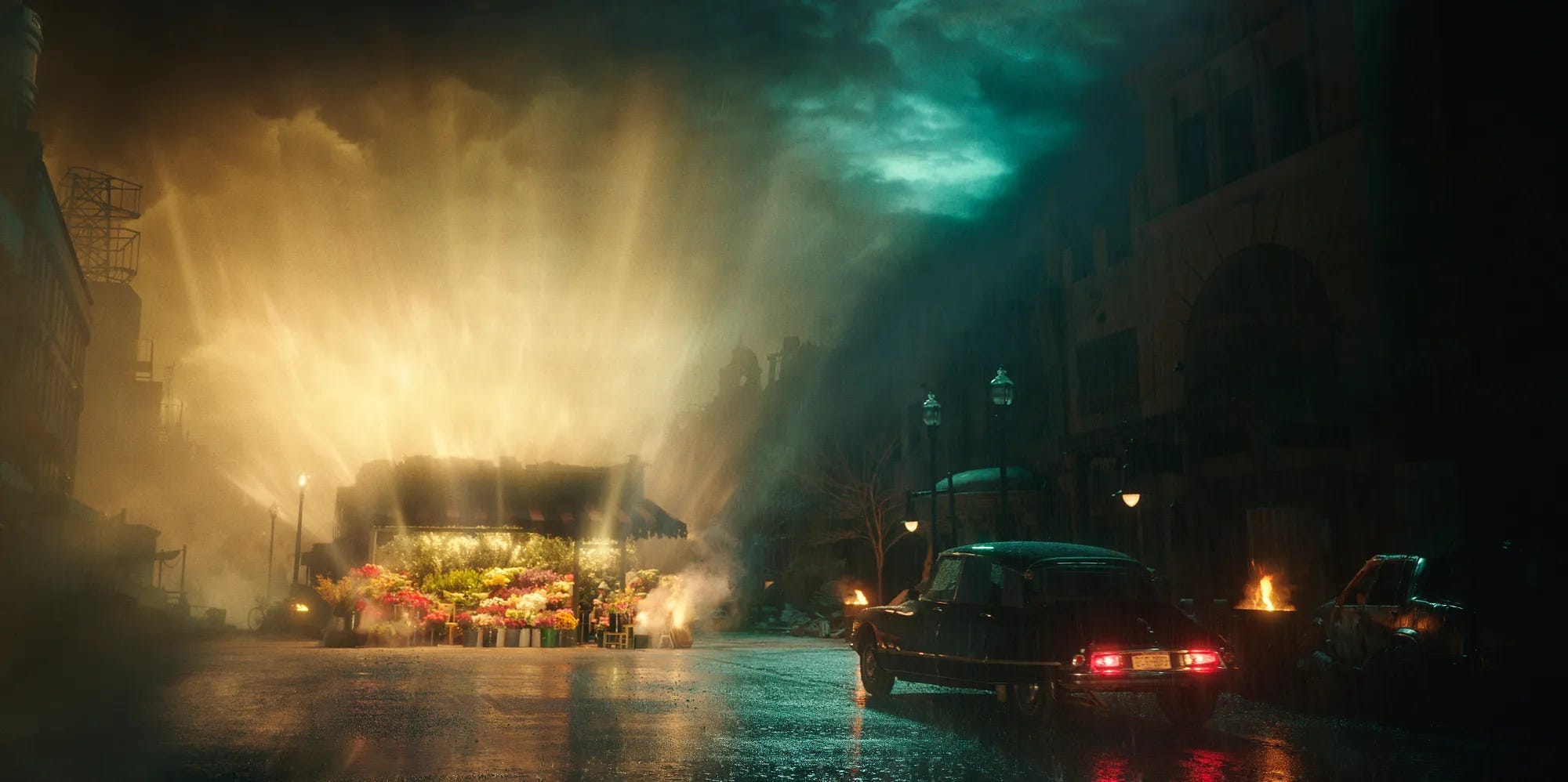
At least part of the reason I felt so burned by this film is that the trailer is a work of art. When you combine all the best of the film’s gold-tinged set pieces, it looks visionary. The film does, indeed, have some beautiful moments — the kind of moments that make you want to love it.
But in the theatre, the swirling mix of imagery from the Roman Empire, Roman deities, art-deco design, and 1950s film techniques all seem to battle one another.
In one scene, Cesar is driven through the rough part of town, where enormous statues of Justice and other deities seem to be alive, but sick and dying, slumping against buildings or chained to the ground. It is a wonderful, surreal touch, and I was fascinated. This alone — this living city making itself known, whether real or imagined — could have carried the film into interesting new territory. But it is forgotten in the melee of competing ideas and forms.
Other surreal moments arrive: Mayor Cicero at his desk, sinking into a floor of sand; an urban florist lit in an unearthly glow. But these feel less like genuine themes and more like scattershot moments inserted to wow the audience.
I did not hate the use of practical effects and old-school film techniques. But at times, you can practically see the soundstage, and there is one particularly laughable scene in which Cesar and Julia rapidly ascend his building in an open lift, staring into one another’s eyes. The scene could have induced a giddy vertigo, heightening the sense of these characters falling in love. But a hokey green-screen effect renders it comical. The effect is so egregious that you can’t help but believe that it’s deliberate. But for what possible reason?
![Mayor Cicero [Giancarlo Esposito] sinks, in Megalopolis. PHOTO: Courtesy of Lionsgate](https://substackcdn.com/image/fetch/$s_!8ac3!,f_auto,q_auto:good,fl_progressive:steep/https%3A%2F%2Fsubstack-post-media.s3.amazonaws.com%2Fpublic%2Fimages%2F968350b8-bb7c-49fa-b0a1-46bf633103e4_2000x1000.jpeg "Mayor Cicero [Giancarlo Esposito] sinks, in Megalopolis. PHOTO: Courtesy of Lionsgate")
Each time I consider it, I am struck by the feeling that Megalopolis has been stuffed with forty years’ worth of collected ideas and characters, and Coppola wants to showcase them all. I can’t prove it, of course, but the film’s sheer indecision makes a pretty good case.
Coppola cannot decide whether to emulate the grandeur of Fritz Lang’s Metropolis (a film that Megalopolis nods toward so frequently that it threatens to break its own neck) or whether to venerate the production values of the 50s and 60s. Even the film quality seems to vary from shot to shot, unable to decide whether to lean into CGI or use shaky green screens. It can’t settle on whether New Rome is a sprawling, mythical city with its own Roman-inspired mythology and iconography, or a modern-day America replete with confederate-flag-waving yahoos and documentary shots of 9/11.
There are big, big messages sitting in all this debris, screaming at us to notice them: The grand claim that civilisation is a withering branch on the tree of Homo sapiens. The notion that the ownership and organisation of our living and working spaces could be the key to an equal and just society. The repeated refrain that utopia is a conversation. The criticism of political shortsightedness that ignores our long-term future.
All of these make great themes, and might have made for a great film. But when the characters are flat and cartoonish, when the film is so busy trying to dazzle with costuming but leaves the sets feeling flat and half-baked, when the score is so corny that it sounds like a Mel Brooks film, the big ideas get lost in the noise.
I wanted to love this movie. I really did. And it has moments where you can almost see the film that could have been. But Megalopolis is so uneven and inconsistent that even my best intentions couldn’t make me love it. ️◾️
No posts
Comments
Nothing yet. Say the first thing.
Sign in to join the conversation.