

In the deluge of reviews in the arts pages, you would think it was a prize-fight.
Turner and Constable: Rivals and Originals may as well have been called “Turner vs Constable” for the number of critics declaring a winner. The surprise might be that in almost all cases, the winner has been Constable. And almost despite myself, I came away feeling the same. In just about every historical way, Turner is the giant. Yet, Constable seems to be having his moment two centuries later.
But I suspect there is more to it than just the love of an underdog. To approach the show like a competition is to fall into exactly the paradigm that Tate Britain is trying to subvert (while also riding on its coattails).
Everyone loves a juicy rivalry: Shakespeare and Jonson, Hemingway and Faulkner, Oasis and Blur. And the historical winner often seems obvious. Turner is a legend. His name is now an adjective for any sufficiently awe-inspiring sky, and he is the namesake for one of the most prestigious art prizes in the world. And when Mike Leigh made a film about Turner’s life, John Constable was relegated to the role of frustrated gadfly, circling the periphery of Turner’s genius.
The tension between these painters, rooted in a few salacious clashes, has been passed down and magnified by posterity. Tate Britain houses an entire wing of Turner’s works, and there, hidden in a room at the very back, is their selection of Constable’s paintings. Even in their permanent collection, he is displayed as if he were little more than a counterpoint — forever attached to Turner, forever inferior, forever eclipsed.
But in this exhibition, the two are treated as equals, and it is fitting that the show opens with a large work by each artist selected to look as similar in composition as possible and yet still show their differences.
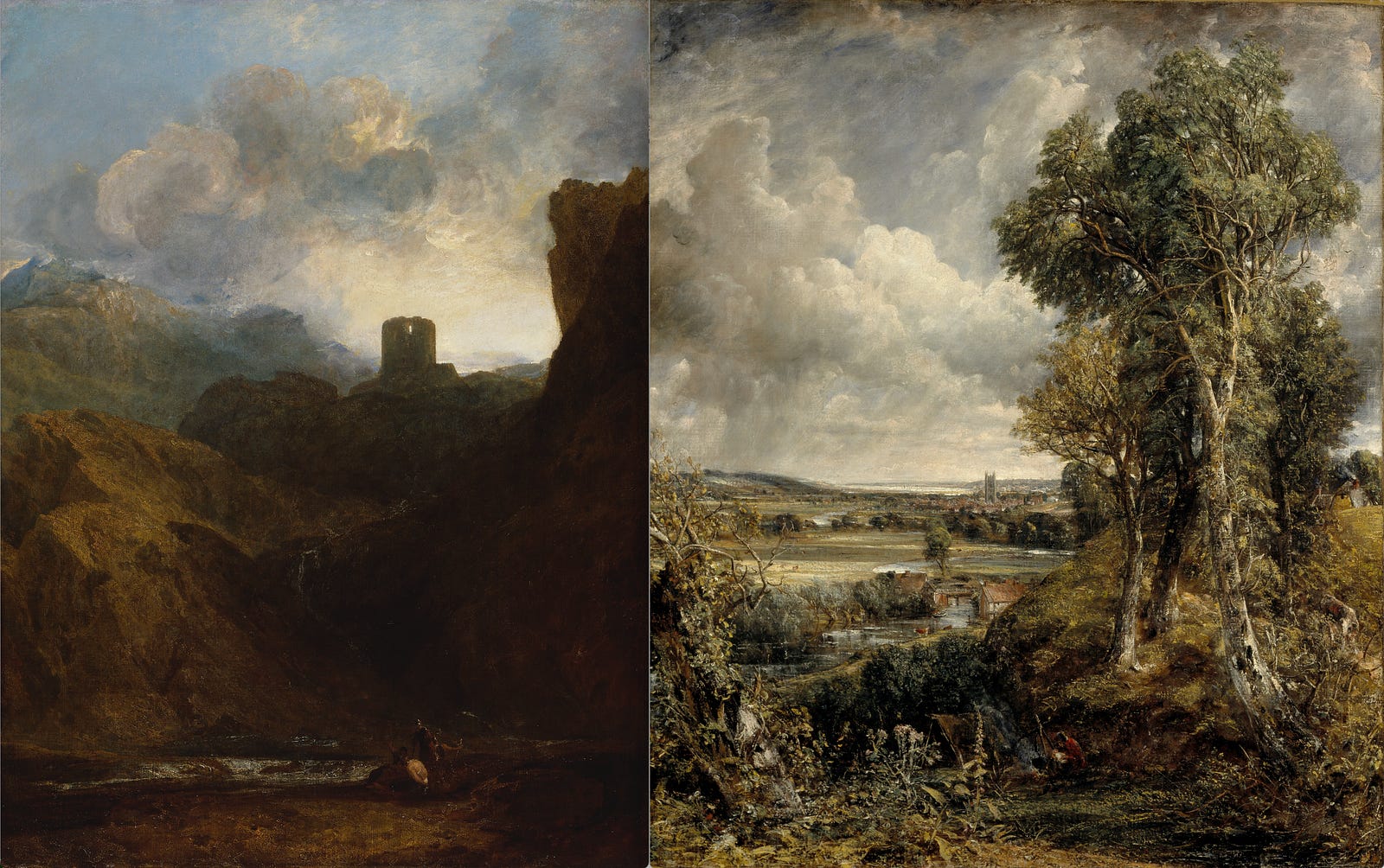
I surprised myself (and perhaps a few other attendees) by uttering an audible “Wow!” when I first looked at Constable’s Dedham Vale. Compared to the flat romantic wash of Turner’s Dolbadern Castle, North Wales, Constable’s nature leaps from the canvas with its wild and vibrant greenery, its earthy realness. This would have been even more shocking to Victorian audiences, who were used to landscapes being little more than the glossy background to heroic, classical, or religious themes.
From this introduction, the show takes a more standard chronological approach, taking the two artists through their youth — their early works and first successes. And it gives space to each painter, taking turns rather than setting up direct comparisons, relaxing the viewer’s competitive impulses.
Of course, the real benefit of a show like this is not only the curation, but the opportunity to see works you might never have otherwise seen. And there are several.
Turner’s lost painting, The Rising Squall, Hot Wells, from St Vincent’s Rock, Bristol, was painted when he was only 17, yet already has all of the dramatic hallmarks of his style. His signature was only discovered on the canvas after conservation work this year, and the piece has not been seen in public since 1858. We also get Turner’s controversial Juliet and her Nurse, which relocated Shakespeare’s protagonist to St Mark’s Square in Venice, much to the consternation of some critics. It has not been shown publicly since 1836. And then, there is Constable’s The White Horse — one of the first works to draw him into critical comparison with Turner. It was last shown in the UK in 2006.
If the conditions for rivalry are overlapping careers, comparable status, and competition for audiences, then the two artists were always destined to collide. Born within a year of each other, Turner and Constable were the same age, but moved in different circles. But when Constable, at 57, was finally elected to the Royal Academy — an honour Turner had already held for thirty years — the battle truly began.
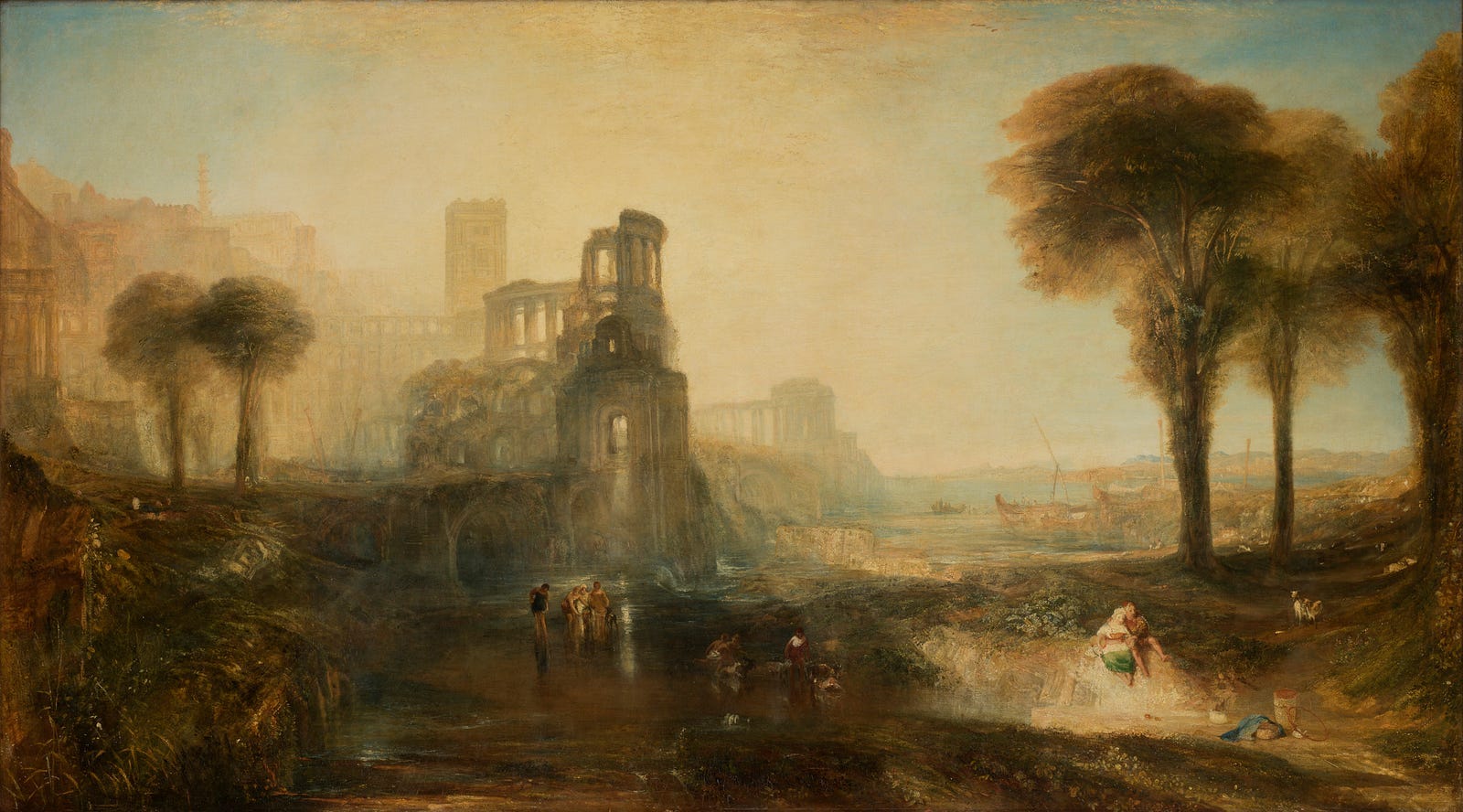
In an 1831 exhibition, Constable found himself a part of the committee that decided the position of works on the Academy’s crowded walls. He took advantage of the opportunity and placed his own large painting, Salisbury Cathedral from the Meadows, next to Turner’s work, Caligula’s Palace and Bridge, reportedly sending Turner into a rage.
A year later, Turner would rise to the occasion as they were again displayed together. Constable’s Opening of the Waterloo Bridge made liberal use of vibrant red highlights, stealing attention from Turner’s largely blue-grey sea painting, Helvoetsluys. And whether as a reply, a satire, or a mea culpa, Turner arrived in the gallery, painted a red splodge onto his own painting, then quickly worked it into a buoy floating in the froth — a decision that not only went down in infamy, but improved the painting enormously.
What is interesting to note here is that Royal Academy paintings were hung mere inches apart, filling the wall from floor to ceiling. It was a tangled collage of works, and painters struggled to have their work noticed among the others. Like today’s social media feeds, the artists had to learn to grab attention. This, as much as any personal animosity, pushed both Turner and Constable to improve their work, to be seen, to be reported upon. And where the Tate show succeeds remarkably well is in revealing the importance of the critics, who were forever picking sides.
The viewer walks through these landscapes, witnessing Turner and Constable become more and more themselves, honing their styles. And at the same time, we’re given the words of the critics who supported one painter while undermining the other, adding pressure. The rivalry may have had teeth in real life, but it was far more fierce in the press than between the two men themselves.
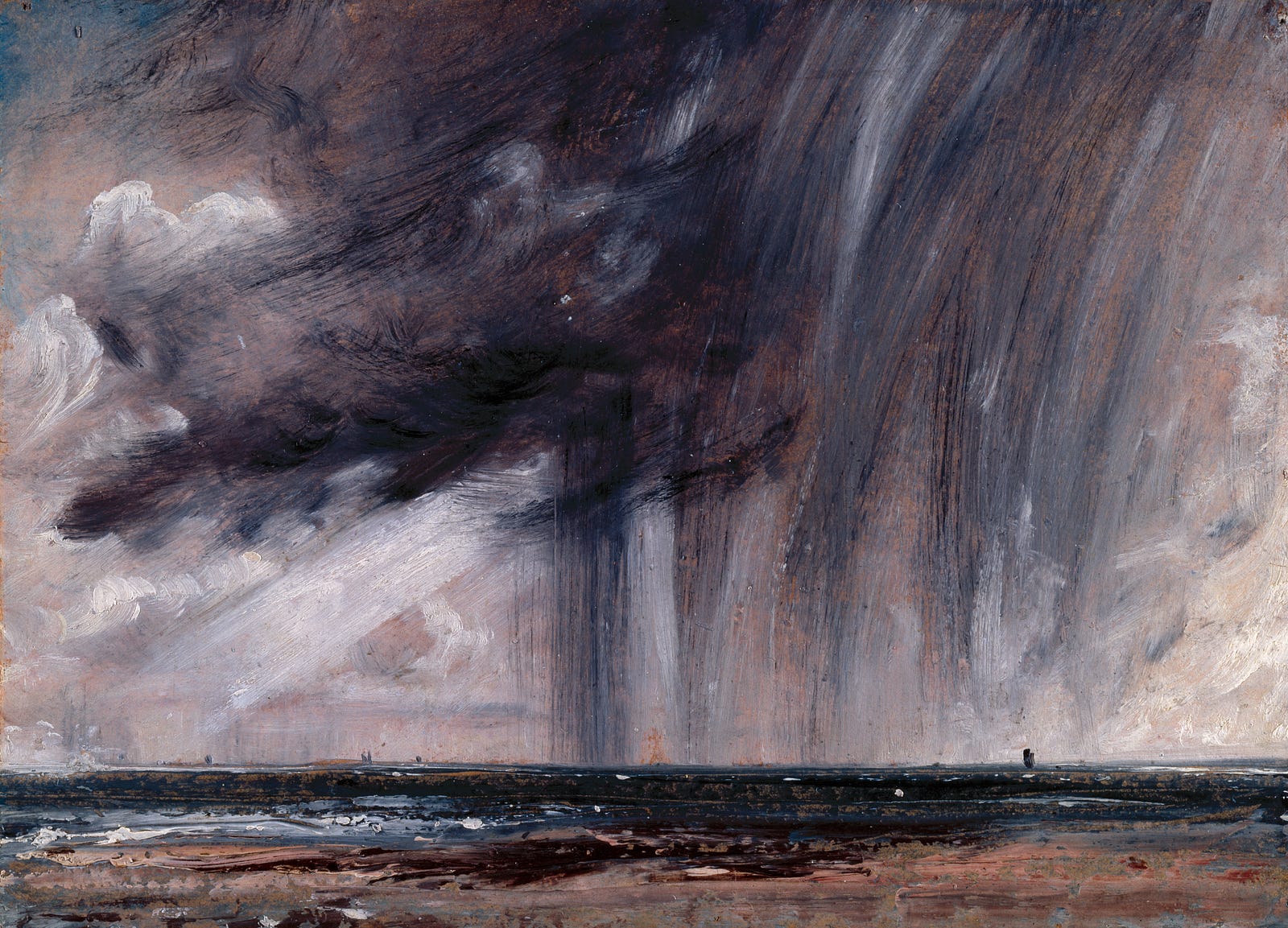
The show is so successful in its comparisons that the more you come to know the two artists, the less alike they seem. And the curation is careful to highlight the sense of two contemporaries following forking paths. Turner remains a classical painter at heart with his historical and heroic scenes, while Constable stays largely in the countryside, painting workers and horses and dogs. As the two age, Turner is forever staring into the sun, the hazy glow of his paintings getting brighter and brighter until all contrast is pushed into the corners. Constable goes the opposite direction, his heavy brushwork bespeckled with the white highlights critics called “Constable’s snow,” even his skies becoming darker and more textured.
So, is Constable finally taking his place in Turner’s hazy sun? Or should we simply lay the rivalry to rest? The two artists are, as the Literary Gazette called them in 1841, “Fire and water.” Sky and earth. The sublime and the terrestrial, each painter pushing his own work to its limits, while pushing the art itself to new limits. And as you follow these forking paths, you can see the immense impact of both figures on modern and contemporary art. The seeds of impressionism and realism. And the inevitable push against the constraints of the past.
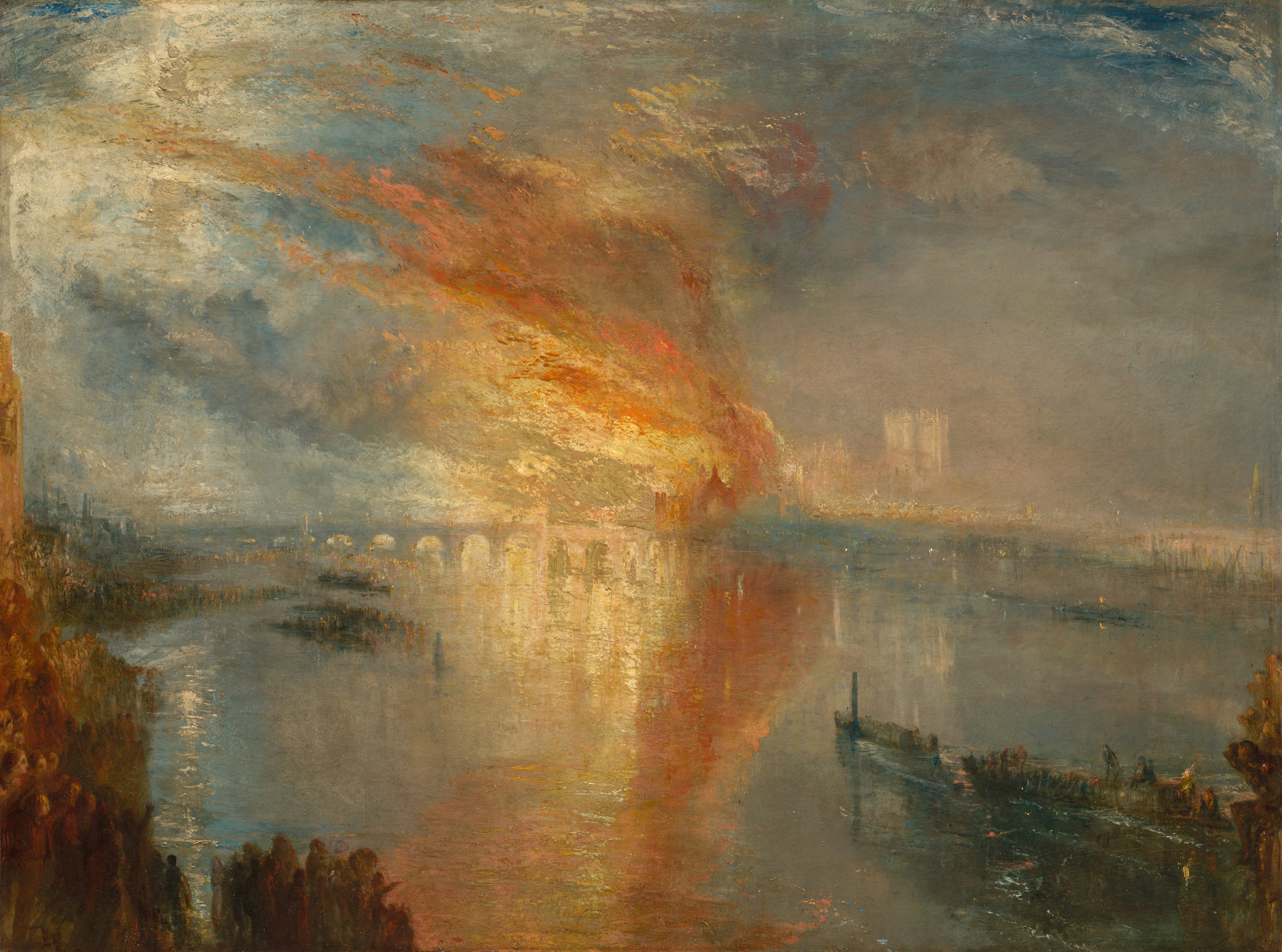
For me, there are too many awe-inspiring moments from both artists to declare a winner: Turner’s glowing piece, The Burning of the Houses of Lords and Commons, 16 October, 1834; Constable’s small but jaw-dropping watercolour, Stonehenge; the eerie vortex of Turner’s Shade and Darkness — The Evening of the Deluge; and the brilliant chaos of Constable’s A Cottage at East Bergholt. The gallery overflows with moments of genius.
Put simply, Turner’s work will always make an impact; it has that shimmering otherworldliness that draws us toward the sublime. But if Constable is not the victor, he is, at least, the dark horse — the artist we paid little attention to, who set up his easel in the fields and imbued the world he found there with grandeur.
Perhaps in this exhibition, he finally gets the breathing space he never quite found on the Royal Academy walls. ◼︎
Turner and Constable: Rivals and Originals runs from 27 November to 12 April, 2026, at Tate Britain, Millbank, London. It is open daily from 10:00 - 18:00. Tickets available at tate.org.uk.
Other arts to see in London this month:
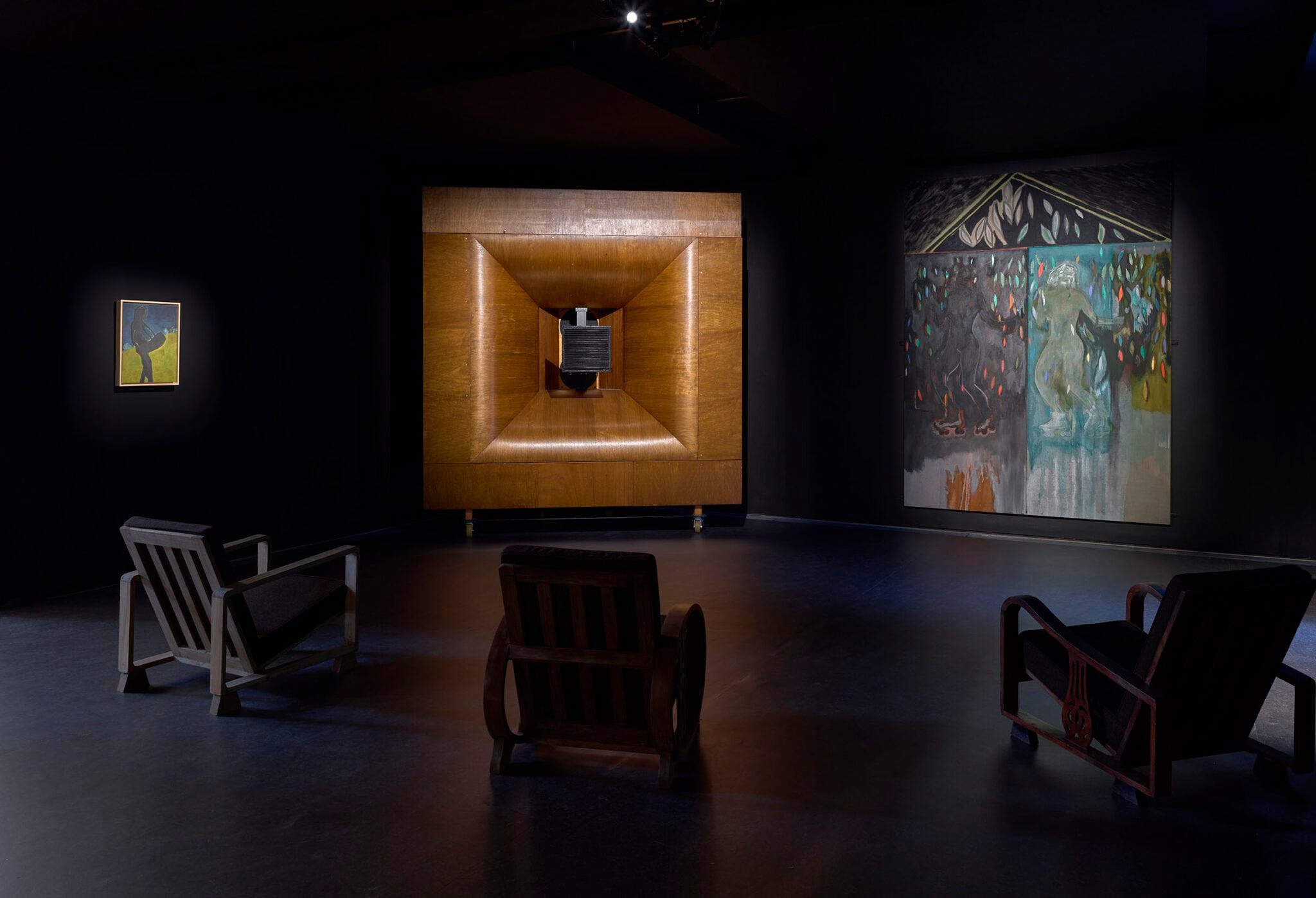
Peter Doig: House of Music
Doig’s unsettling artworks are combined with an immersive soundscape. At Serpentine South, until 8 February 2026.
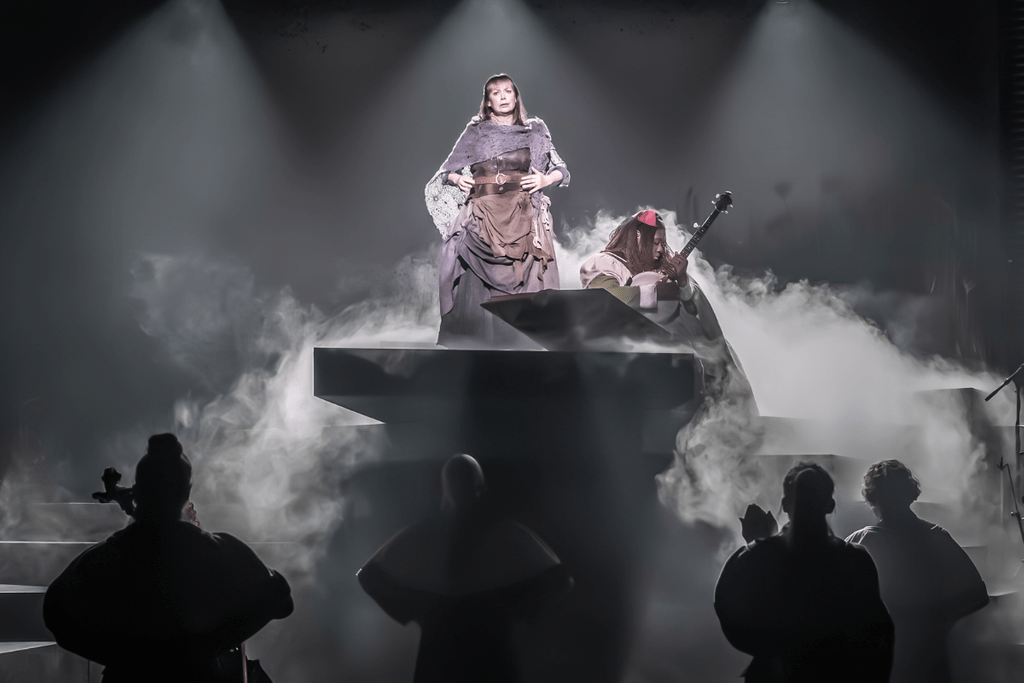
Coven
“A scorching new musical based on England’s most notorious witch trials.” This is everything a small musical production should be. By turns, hilarious, dark, and downright rebellious. Music and lyrics by Rebecca Brewer and Daisy Chute that hit the mark.
At Kiln Theatre, Kilburn High Road, until 17 January 2026.
Art + London is a reader-supported publication. To receive new posts and support my work, consider becoming a free or paid subscriber.
Comments
Nothing yet. Say the first thing.
Sign in to join the conversation.