
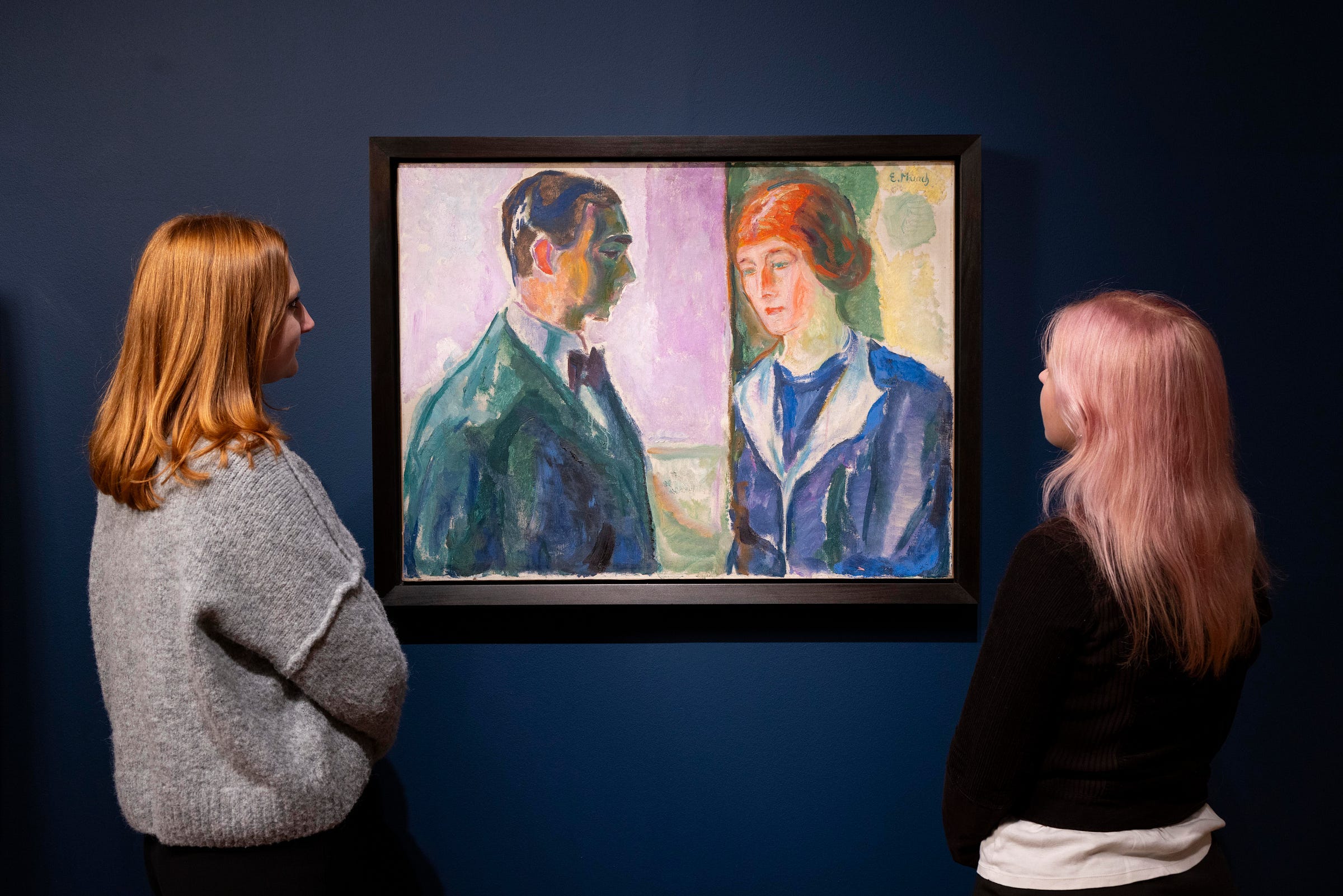
On occasion, seeing a familiar painter through the lens of the National Portrait Gallery can be a strange experience. Particularly if that painter isn’t known for doing portraits.
Edvard Munch’s most enduring work, The Scream, has the kind of pop-culture recognition that rivals works like the Mona Lisa and Van Gogh’s Sunflowers. Most people view Munch as a Post-Impressionist and Symbolist painter first — a painter of emotional and mystical themes. And much has been made of his tortured psyche and illnesses — his breakdown, his alcoholism, his angst and paranoia. This is, after all, the man who gave us paintings with titles such as Anxiety, Separation, and Despair.
Munch has often been portrayed as an isolated man, obsessed with illness, emotional strife, and death. But this new portrait exhibition — the first of its kind in Britain — isn’t designed to be an overview of Munch. Instead, it looks at his developing style through six decades of work, and reveals a painter who is less isolated and angst-ridden.
Instead, Munch is an artist at the centre of a vibrant and quickly changing art scene stretching from Norway to France to Germany. And seeing the people around Munch through his eyes — from family to friends, bankers to bohemians — lends the artist a tempered and more human light.
In opening the show, its curator, Alison Smith, said, “Many of our lenders who came over from Scandinavia did actually confess that this aspect of his art, even in Norway, is not that well known.”
Admittedly, seeing Munch at the NPG without his more iconic works feels a little like watching a play from the wings — you witness the story and get glimpses into its production, but you miss the action from the audience’s perspective. That said, having works like Vampire or Dance of Life on display would detract from the message that the National Portrait Gallery is trying to send — that the sitter’s life and experience is part of the story of the portrait. And thus, it is also part of the artist’s story.
The show is divided into four sections, which are also roughly chronological — his early years, in which he painted family members and was heavily influenced by Scandinavian and Norwegian Romanticism; then, a shift, as he moved to Paris and became influenced more by Impressionist and Post-Impressionist work; his introduction to the Symbolists and bohemian painters of Paris and Berlin; and finally his mature stage, when his work became looser and more colourful, even in his portraits.
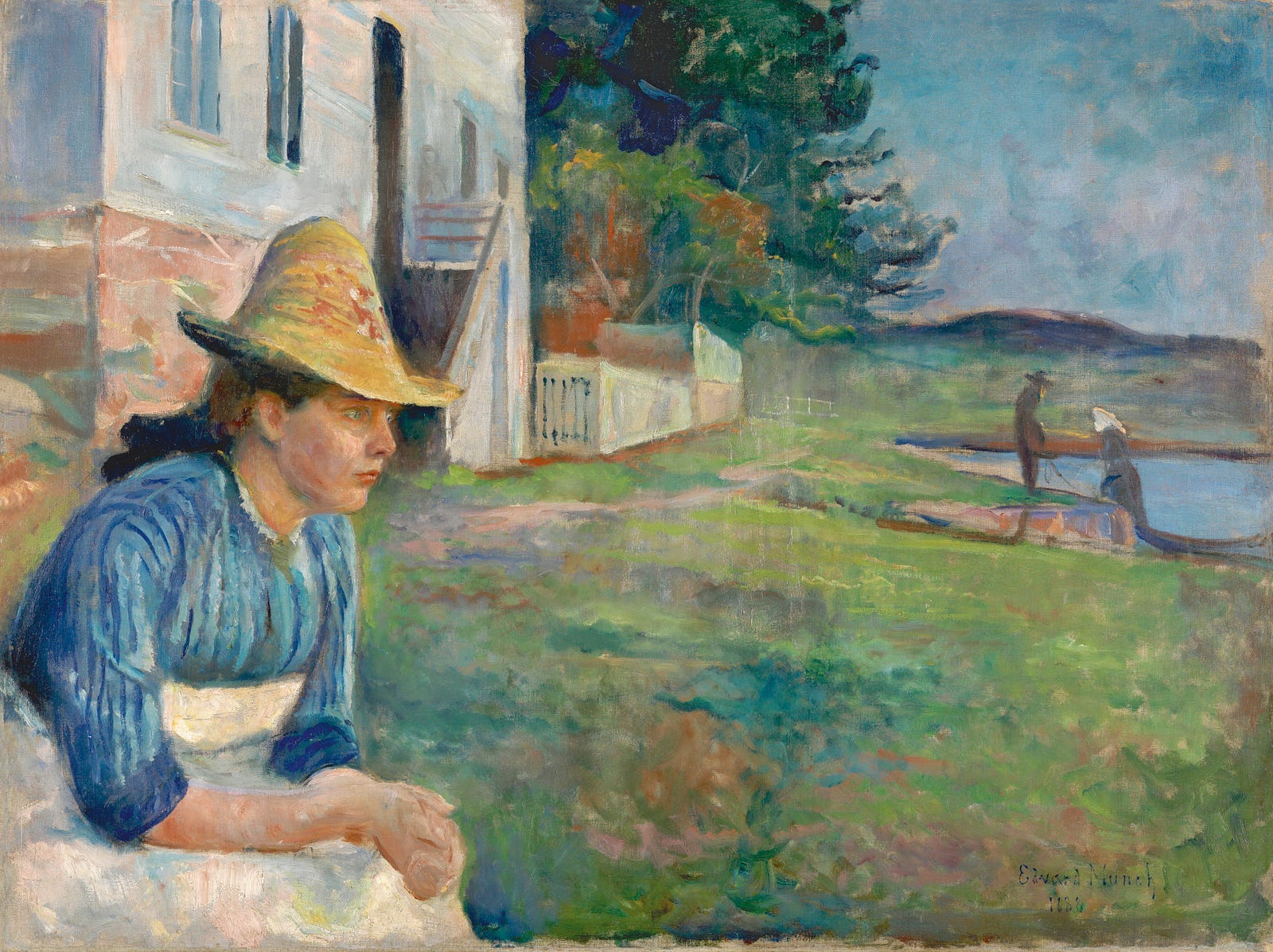
Hints of Munch’s Symbolist leanings pop up throughout the show, even in his older work. In an 1888 painting of his sister Laura, who spent much of her life in and out of hospitals with schizoaffective disorder, we see her staring vacantly into the distance while two people, ghostly and near-translucent, stand in the background. These are not quite the eerie figures of his later works, but precursors — they shift uneasily between symbols of Laura’s isolation and figments of her illness.
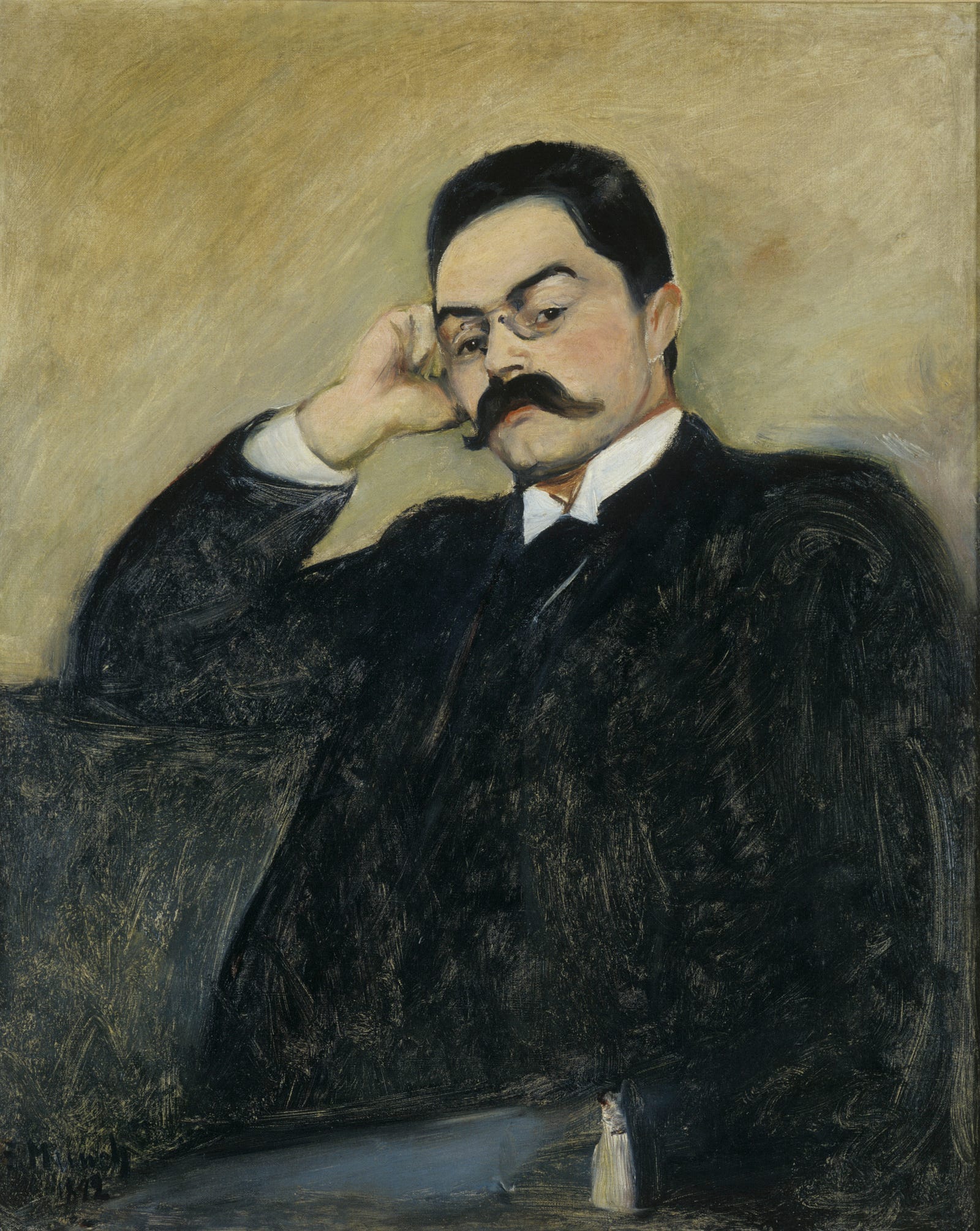
Perhaps most striking is the portrait of Thor Lütken, painted in 1892 — only a year before The Scream, and close to the same time as Munch’s Madonna and Vampire. The piece was rediscovered only recently, having been in the private ownership of Lütken’s descendants and sold in 2022. This is the first time it has been shown in the U.K.
It is the stern portrait of a man — Munch’s lawyer, but also a friend. His expression is serious, almost off-putting. Yet, close up, hidden in Lütken’s sleeve, is what seems to be a landscape with two figures, one in ghostly bridal white, the other in black. Love and death, some have said, although the real meaning is still debated and is unlikely to be answered with any certainty.
The exhibition is also an opportunity to see Munch’s lithograph titled The Brooch — a portrait of the English violinist Eva Mudocci. It is one of his better-known works, and an image that I’ve associated strongly with him since my introduction to Munch in a 1996 exhibition at the Art Gallery of Ontario. Seeing it again — the lithograph traced directly onto the stone before printing, the lines thrumming with passion, the face an exclamation mark above the titular brooch — it brought back everything I loved about Munch on first discovering his work.
However, the exhibition’s triumph is the wall filled with six larger-than-life, full-length portraits. Solemn and heroically posed, these paintings are the men Munch called his “lifeguards” or his “guardians.” In one way or another, each of them supported Munch and helped him get where he was going.
But what is most interesting is that Munch kept each of these portraits for himself.
One features the writer and art critic Jappe Nilssen, who was instrumental in championing Munch’s painting. Munch called him his “glorious hero,” although, somewhat ironically, Nilssen was unhappy with the result of his heroic image, claiming that Munch “could easily have painted a more beautiful portrait.”
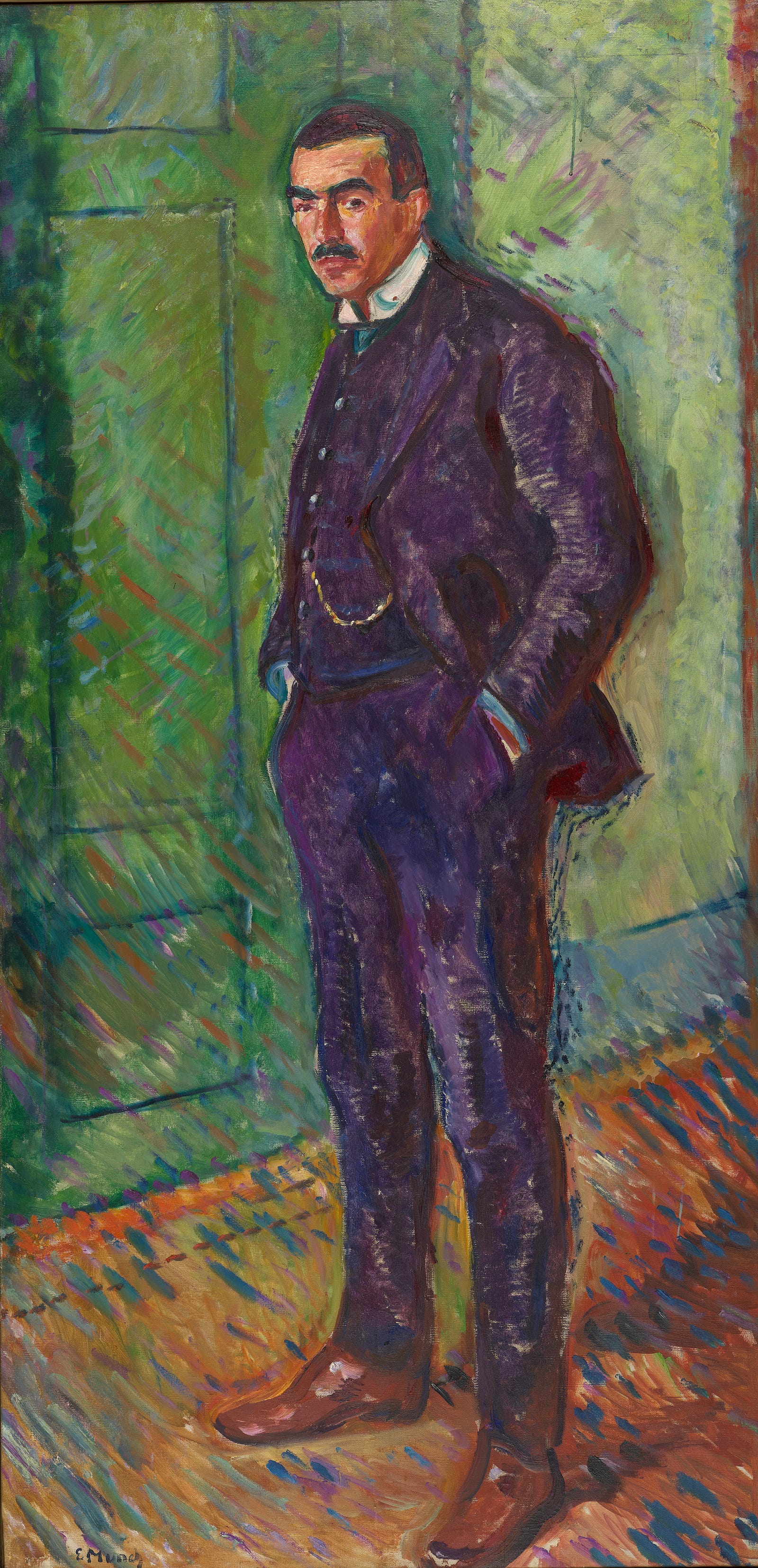
An unfinished painting of Munch’s patron Ernest Thiel stands in the middle of the room. This work, according to another of his subjects, the economist and writer Christian Gierløff, was never finished because something about Thiel himself had so frustrated Munch that he put his fist through the canvas as Thiel stood agape.
Munch placed these large portraits on view in his studio, where he could have access to his ‘guardians’ whenever the real person wasn’t available. While ill-health and neurological issues may have consumed the painter throughout his life, he was also surrounded by the goodwill of those who helped him through it — a side of Munch that is rarely talked about.
“This exhibition invites you to look at him in a slightly different way,” Smith explained, “while accepting that the Munch we all know and love is still there at the heart of it.”
And it’s true. While this may not be the ideal introductory exhibition for those unfamiliar with Munch, viewing so many of his portraits together — from his early impressionist work, through the angst of his Symbolist work, and into the surprisingly colourful canvases of his later years — gives him a life beyond his preoccupation with the mystic and mythic.
Like the figures hovering in Thor Lütken’s sleeve, the Munch we know and love still lurks in the wings. ◼︎
“Edvard Munch Portraits” is showing at the National Portrait Gallery in London until 15 June, 2025.
No posts
Comments
Nothing yet. Say the first thing.
Sign in to join the conversation.