
Reading
Over the last ten years or so I’ve built up a fairly extensive library of books about the Paleolithic, Neolithic, Bronze and Iron ages, ancient mythologies, parietal and portable art, specific caves I have visited/want to visit, shamanism and animism, and lovely chonky-bendy paperbacks with Xena the Warrior Princess on the cover and titles like THE GREAT COSMIC MOTHER. The latter type of book belongs in a genre called archaeomythology, which is exactly what it sounds like, and is probably a reasonable description of the genre I’m working in, too.
My fascination with the Paleolithic started when I was a kid, reading Clan of the Cave Bear by Jean M. Auel. I didn’t know that there were several sequels over the years, which is good, because the sequels are absolutely throbbing with lurid cave sex which would probably have traumatised twelve-year-old me. Or at least given me some extremely unrealistic expectations for the future.
Apparently, Jean Auel was told to add all the cave sex by her publisher. Maybe because detailed descriptions of flint toolmaking, leather and fur work, plant medicine, firekeeping, hunting, and a main character who is cast out of a Neanderthal tribe and thrown upon the unreliable mercy of humans (while she also maintains a telepathic link with a cave lion she’s tamed) would have been a bit boring? Auel famously based her descriptions of Paleolithic life and crafts on the research available at the time, so her descriptions likely relate to reality to some extent. Maybe not the lion taming and Stone Age sexual practices. I think she probably just made those up.
Thinking
It was about ten years ago that I first read The Mind in the Cave by David Lewis-Williams, which is what sparked the next and still-ongoing iteration of my obsession with the Paleolithic. In that book he argues—to reduce it to its absolute basics—that cave art is the product of brains under the influence of hallucinogenic plants. I’m not completely convinced.
I am sure that entheogens were used widely by humans (and maybe especially by artists) throughout prehistory and history as they are to this day. I’m certainly not discounting their influence on art. But I think we underestimate the power of simply engaging with darkness, silence, and ritual. Maybe because we barely, if ever, even experience these things anymore.
But imagine living in nature as a part of nature yourself. Imagine living in wonder, seeing the world around you alive with spirit. Living in a time that isn’t linear, but cyclical. A time of no progress, only death and birth, darkness and light, dreaming and waking over and over. Or maybe there is no dream, because it is all a dream, and the deeper secrets are a dream within the dream, a subterranean world with its own language of signs. Imagine sitting beside the fire, with a grandmother telling stories as she weaves by flamelight, under a sky where a billion stars can be seen blazing in velvet black. Every night, your whole life, a grandmother is telling stories by the fire. Sometimes you’re the grandmother. Sometimes there is singing, drumming, the warmth of your breath inside a mask, the instinctive steps of the dance.
That’s pretty mind-altering stuff all on its own. I think we overestimate the role of magic plants and fungi and toads because we, as a people in general, don’t remember how to get into visionary states without them. But imagine you are that alive. And you’re crawling on hands and knees through a narrow tunnel in a cave, and the cave is sacred, it’s the womb of the great cosmic mother, it’s a portal to another world deep inside the earth… You’re probably going to be tripping out your gourd even if all you’ve taken since 1996 is a couple of paracetamol and a lager shandy.
Someone asked whether my cave art project would involve entheogens and my answer was an emphatic no. Apart from anything else, it would be a legal and regulatory nightmare. But I also want to uncover how we can experience inner worlds, altered consciousness, and the sacred spirit in nature using only our own human senses and ancient spiritual technologies like drumming, dreaming, and storytelling. I believe experiences in other worlds and times are integral to our human nature.
Making
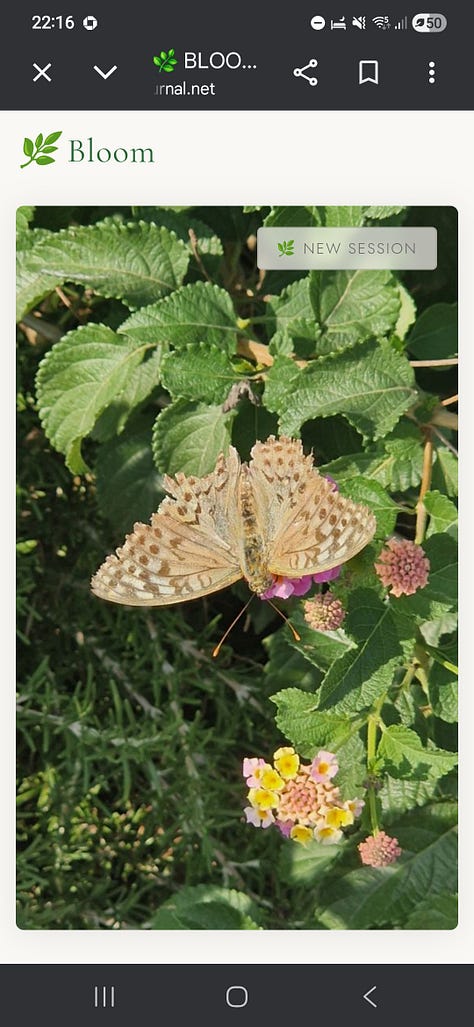
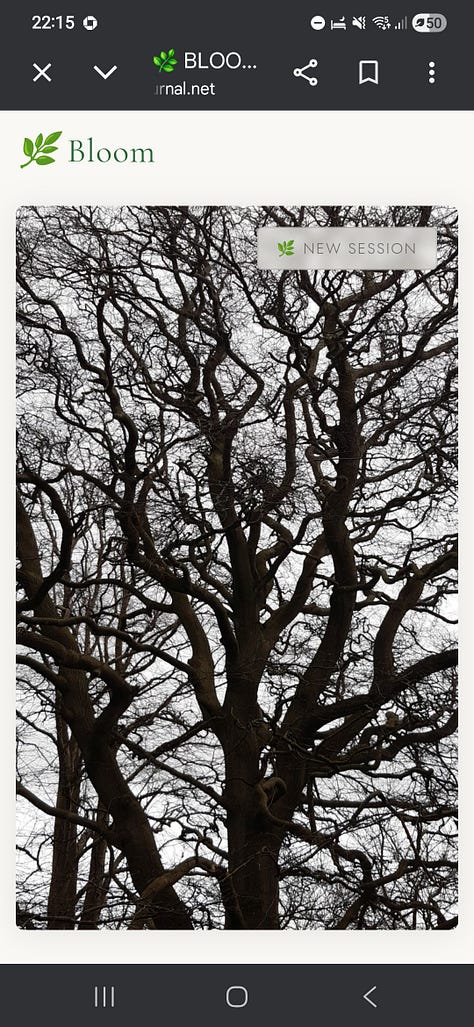
I made some little webapps. Well, I’d already made Bloom but this week I made it a million times better. It works on your phone now as well as laptop. There’s some general blurb about it here if you’re interested, but essentially the point is to write a little journal and then poof! Disappear it. As you write, a nature image gradually appears in place of your words. All the images are my own photos (about 450 of them) taken on my travels in Wales, Scotland, England, Ireland, Germany, Croatia, Finland, Sweden, Denmark, and France in the last six years or so.
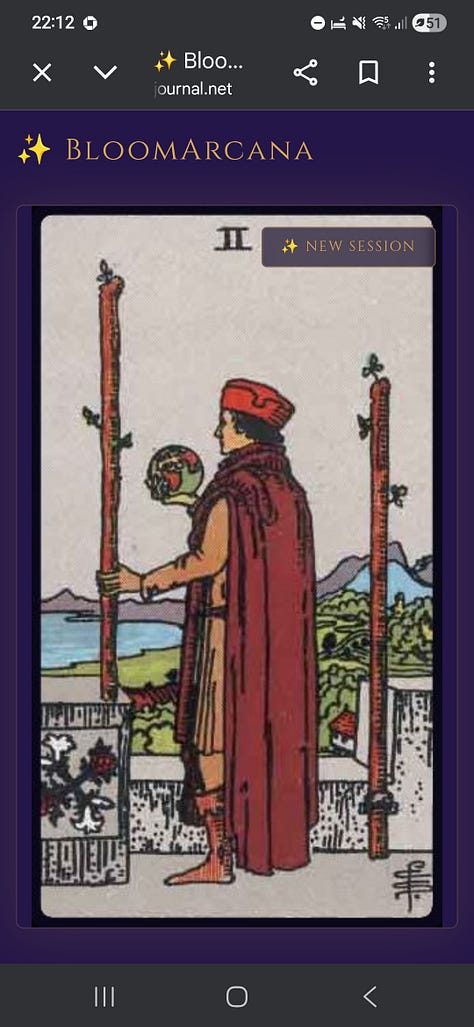
The other webapp is BloomArcana, which is more like a ritual or maybe even a spellmaking version of Bloom. You write about whatever you like, addressed to whatever gods, spirits, or mental constructs you choose, and when the time’s up, you release your words and reveal a message from the tarot. I’ve been using it every day and it keeps being both surprising and constructive.
Both apps are helpful for clearing your mind before sleep, or if you’re feeling anxious, or if you’re doing some kind of journalling practice like Nicole Sachs’ ‘journalspeak,’ or even if you’re doing something like ‘morning pages’ where you don’t need to keep anything you’ve written. (You could copy and paste your words before the time’s up if you accidentally write something brilliant.)
Anyway, they’re free. Anonymous. You don’t have to sign in or up to anything. Nothing you write is saved, or ever even seen by anyone except you.
Honestly, I think these apps are lovely, but at the moment I appear to be almost alone in my love for them. It turns out that pretty much everything I make is a bit odd and deeply uncommercial. I don’t know why I say ‘it turns out’ as if I’m remotely surprised by that. Sometimes it’s like I don’t even know me at all.
Doing
I’m on a housesit in south-west London at the moment so I’ve had to take up temporary membership of the Fulham branch of Puregym, which is just not as good as the one in Rhyl. And it’s not because I’m the only person there who looks like she’s never had so much as a walk-on role in Made in Chelsea. Well, not only because of that. It’s also not as spacious, clean, or friendly as my gym.
Having said that, there are blessedly fewer mirrors in the Fulham branch. Last week in my home gym I caught sight of my reflection several times. It took me a while to realise who I was reminding myself of. Dear Reader, in my weightlifting belt and knee sleeves, I resemble no one so much as Miss Trunchbull from Roald Dahl’s Matilda. “Are you a pig, Amanda?” I shall demand of the next minor celebrity hogging the squat rack.
Press the heart to show you care. And if you want to show you really care, subscribe. If you already subscribe, consider how much more fun it would be to pay a few quid for this newsletter. And if you already pay, I don’t know what to say except wow. You are exceptional. And (almost) unique in this world. And so ridiculously good-looking, too.
Comments
Nothing yet. Say the first thing.
Sign in to join the conversation.