
I just finished watching Love Story on my flight to Hong Kong and was struck by the scene of Carolyn Bessette-Kennedy and JFK Jr. in their apartment when she brings home a bucket of chicken, and how powerful the image of the bucket was.
It prompted me to write a case study on why KFC returned to the bucket of chicken this summer after ditching the iconic image.
Around 2021, the company decided the bucket belonged to another era. Heavy, bone-in, family-sized, built for a sit-down dinner fewer people were having.
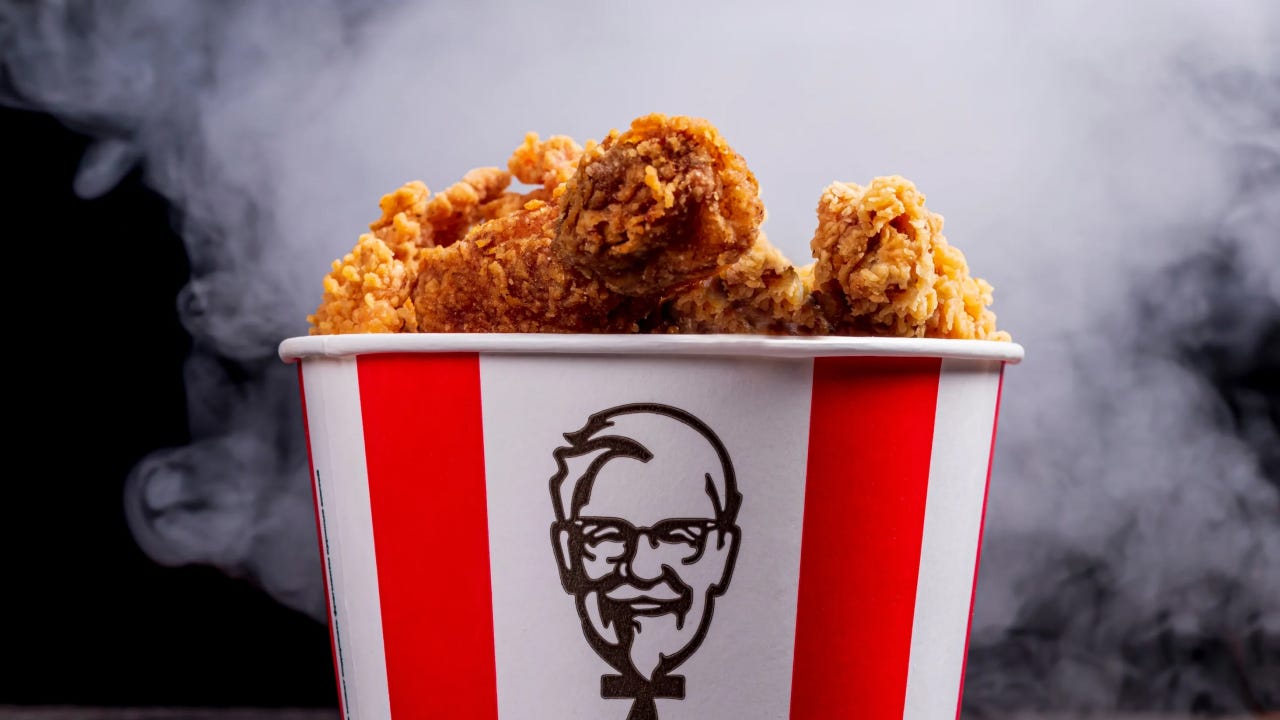
Meanwhile, Popeyes was winning the sandwich wars, Raising Cane’s had built a cult on tenders, and Wingstop was selling individual portions. So KFC chased the format war, launched a sandwich, leaned into boneless, and let the bucket recede into being one item on a crowded menu. In copying its competitors, KFC lost sight of what made it different from them.
U.S. sales fell 5.2% in 2024 and 4.6% in 2025, with six consecutive quarters of declining same-store sales. Between July 2025 and July 2026, 312 U.S. restaurants closed permanently, roughly 7.6% of the domestic footprint.
The average KFC now does $1.35 million a year against Popeyes at $1.8 million. That $450,000 gap across roughly 3,600 locations is about $1.6 billion a year, or somewhere near $8 billion over the period.
KFC has been passed by Chick-fil-A, Popeyes, Raising Cane’s, and Wingstop. Barclays looked at 76 restaurant chains and found none had lost more share in its own category than KFC, which held roughly 15% of U.S. chicken sales five years ago. Popeyes grew system sales 71% over that window. KFC managed 17%.
While researching the iconic bucket, I learned that the Colonel did not invent it. Pete Harman did, the man who opened the first KFC franchise in Salt Lake City in 1952. Five years after he opened the franchise, Sanders called to ask whether he wanted 500 paper buckets another franchisee had bought from a traveling salesman. Harman took them, filled each with 14 pieces of chicken, five rolls, and a pint of gravy, and then began selling them to housewives as a way to put a full family dinner on the table without spending the evening cooking. The bucket caught on, not because the food was delicious, but because by adding a salad and vegetable side, he gave women the opportunity for a night off.
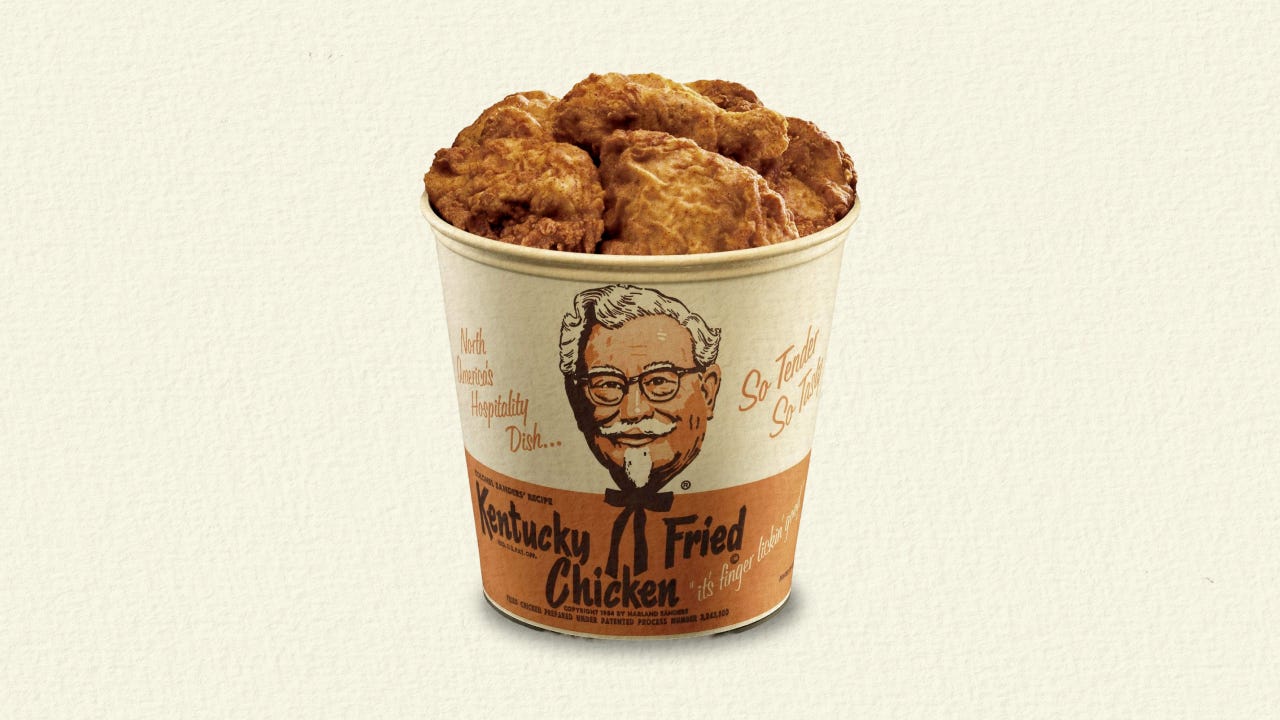
That is why the bucket became the most recognizable packaging in fast food, and why the original now sits in the Smithsonian.
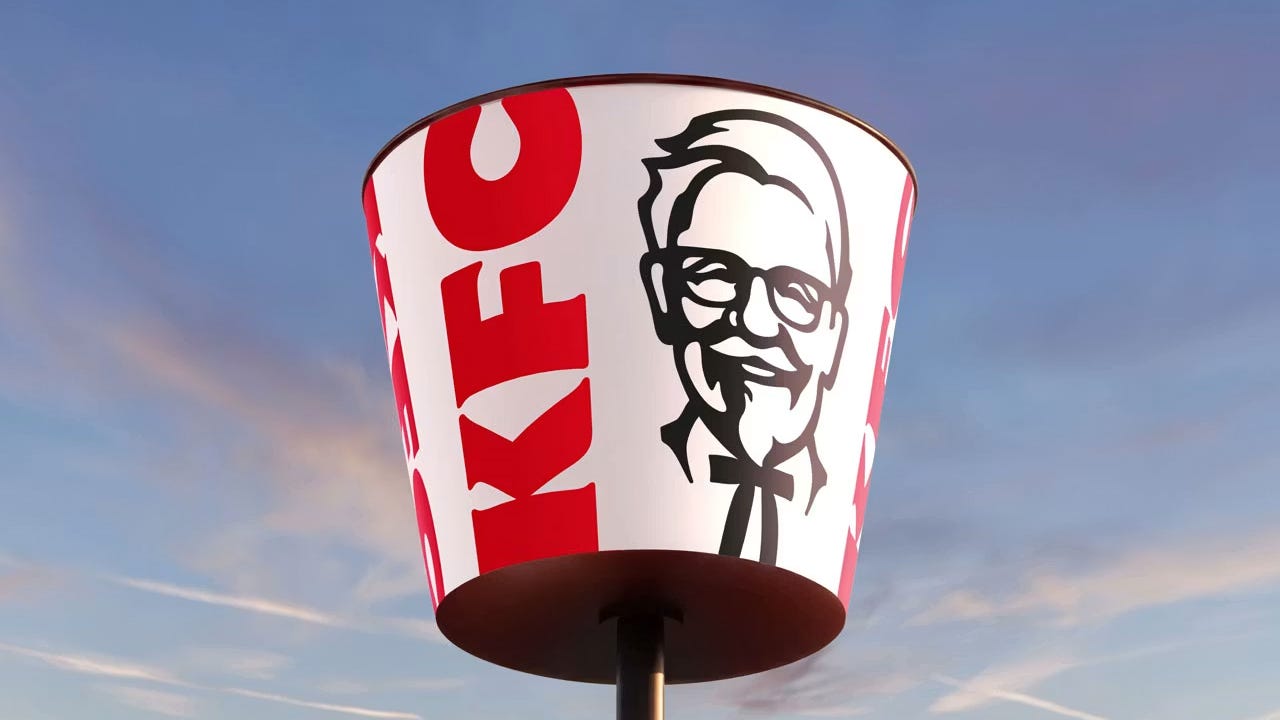
The rebrand moves the bucket from packaging to the central design system, running across restaurants, communications, digital, and apparel. JKR, the marketing agency KFC hired, describes the goal as building a world customers can step into. They called the campaign “Bucketverse.”
It is an original example of world-building. The bucket carried the Colonel’s face, the red and white stripes, the occasion, and the promise of the evening off, all in a bucket sitting on a family’s table.
The Colonel is back in the advertising, and the comeback campaign is giving away free buckets to win customers back. The asset they walked away from is now the thing they are paying to put back in people’s hands.
The principle behind this is mental availability: the likelihood that your brand comes to mind the second someone decides to buy. It is not the same as awareness, because plenty of people are aware of brands they never think of when it counts.
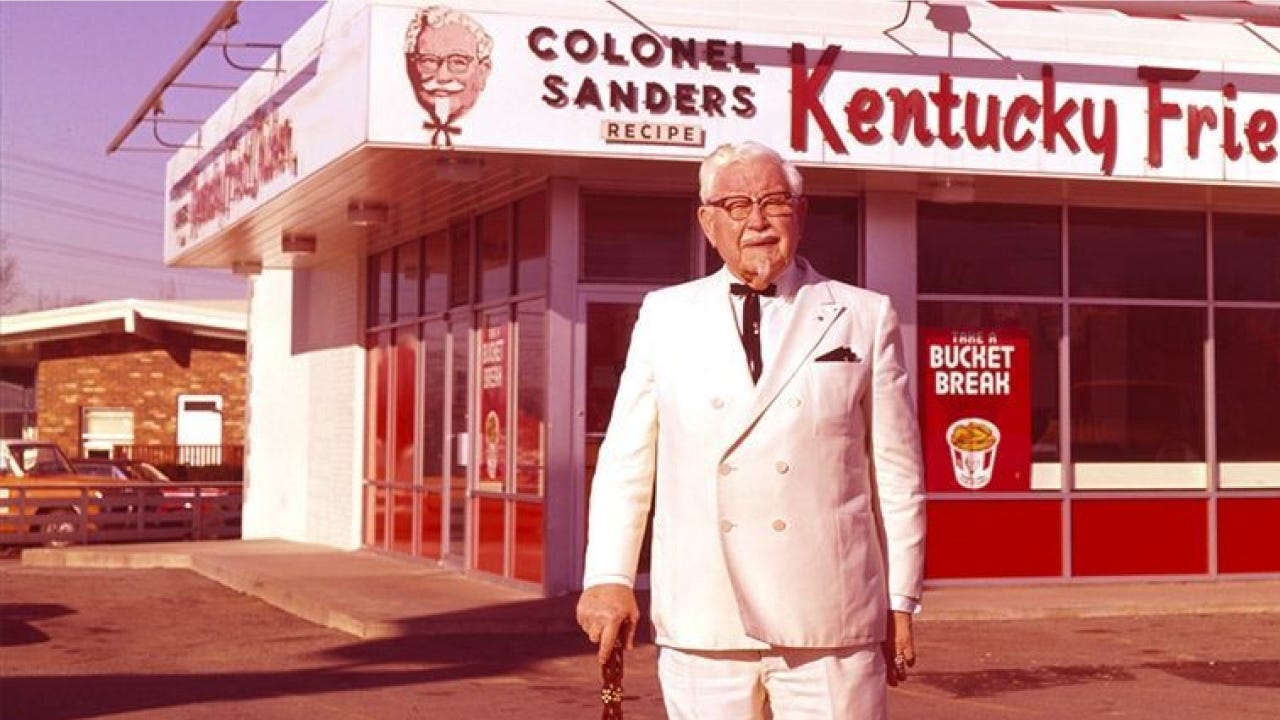
Mental availability runs on distinctive assets: the shapes, colors, and characters people recognize before reading a word. Other examples include the McDonald’s arches, Tiffany’s blue box, the Coca-Cola bottle, and Louboutin’s red soles. These are shortcuts in memory built through decades of repetition, and they get you chosen before any conscious comparison happens. Lose the asset, and you lose the shortcut; a brand without a shortcut has to compete on price and features every single time against companies that are better at both.
The clearest evidence that this was a branding problem, not a chicken problem, is what happened everywhere else. In the first half of 2025, KFC’s sales outside the U.S. rose 7% while domestic sales fell 5%, with every major international market growing, including China at 5%, Europe at 7%, and Latin America at 11%. The difference between markets is that international markets never stopped selling the bucket.
Find your mental shortcut before you chase anyone else’s.
Identify the one asset that is genuinely only yours and understand what it sells. Harman’s bucket sold a woman her evening back, not chicken, and confusing the product for the promise is how a company retires the promise because the product looks dated. Once you find your mental shortcut, consistently market around it without rotating it out. Distinctive assets compound with repetition and disappear from memory without it.
Thanks for reading,
Xx Camille
—
Want my team on your brand? Book a call here with Third Eye Insights, my international brand strategy and creative agency.
Apply my frameworks and teachings to your own brand with my Masterclass and Social Media & Brand Planners
Get the Friday debrief: Join my newsletter here for weekly inner circle content that keeps you winning.
Comments
Nothing yet. Say the first thing.
Sign in to join the conversation.