
Two and a half weeks ago, Gucci spent ten million dollars on a fashion show during cruise season, the most ignored moment on the fashion calendar. Editors do not cover cruise, and consumers do not track it (unless it’s Blazymania). Brands typically use Cruise to clear inventory between seasons. So the obvious question is: why would a brand in the middle of ten consecutive quarters of declining revenue put its biggest commercial bet of the year on a format nobody is paying attention to?
The answer is world-building, and Gucci’s understanding of the brand is a lagging indicator.

On Saturday, May 16th, Gucci shut down Times Square. Not a section of it, Broadway between 46th and 48th Streets, every digital billboard in sight turned into a live stream on over 50 screens. The invite guests received was not an address. It was a replica of a gold key in a leather sleeve, a reference to the Gucci Galleria, the private room above the Fifth Avenue flagship where the brand received its most coveted clients when it opened its first store outside Italy in New York in 1953.
Gucci’s revenues fell 14.3 percent in the first quarter of 2026 to 1.35 billion euros, marking the brand’s tenth consecutive quarterly decline. Revenue was down 22 percent for the full year 2025, and Kering posted a net loss of 29 million euros, against a 1.02 billion euro profit the year before. Gucci is roughly 40 percent of Kering’s revenues, which means the entire group is riding on whether Demna can reverse the slide.
This is the context that makes the show worth studying. Gucci did not spend ten million dollars in Times Square because they had a marketing budget to burn. They spent it because revenue follows desire, and desire has to be built before the next quarter shows up…which is exactly why this is worth studying.
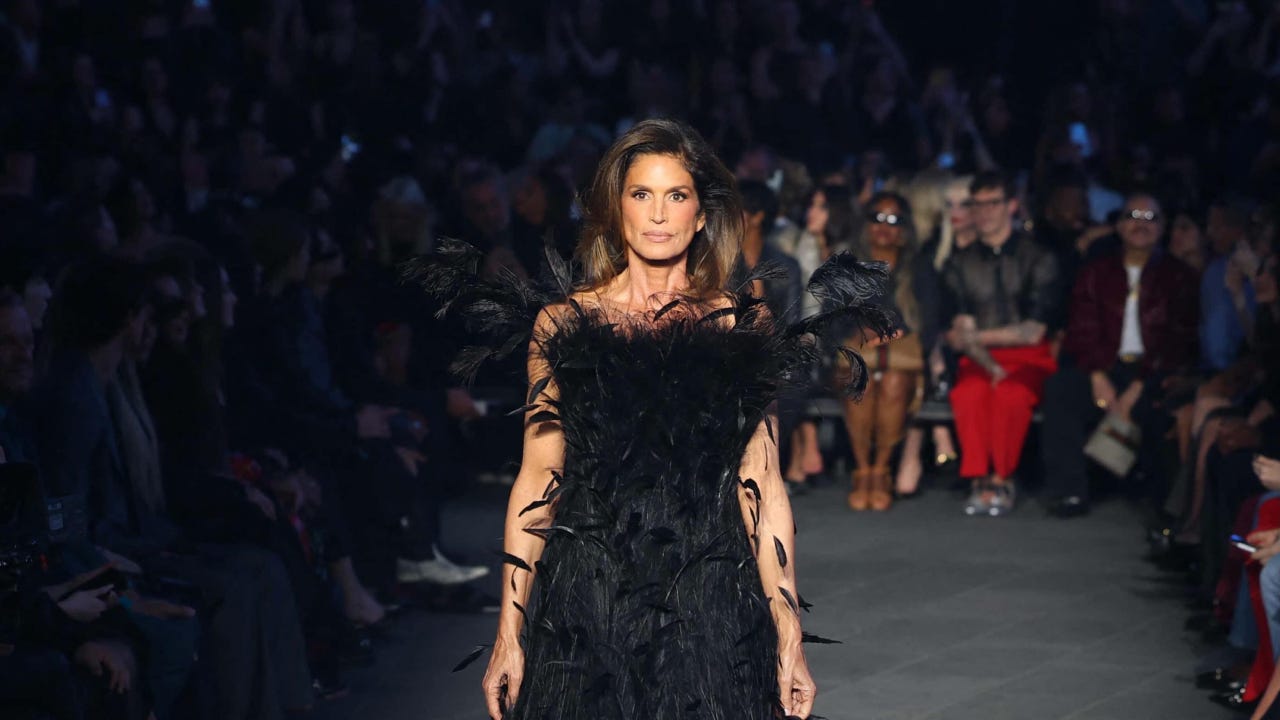
Before a model walked, Demna ran AI-generated advertisements across fifty screens, including Gucci Life longevity supplements, Gucci Pets accessories, and Gucci Acqua water. Some of the products were real, most were fictional, but all of them felt plausible. Sixty-three models then walked Times Square in the Cruise 2027 collection, called GucciCore. Paris Hilton opened, Tom Brady walked, and Cindy Crawford closed. The show included notable guests like Kim Kardashian, Mariah Carey, Lindsay Lohan, and Anna Wintour, who all sat front row. After the show, guests moved to Gucci Mansion on Madison Avenue, four floors running simultaneously, a tarot reader, Alix Earle on a treadmill in heels, chicken nuggets topped with caviar, and a club downstairs.

The fictional product billboards underscore Gucci’s thesis. Demna was not showing the fashion crowd what Gucci makes; he was showing everyone in Times Square what Gucci could be.
Cruise was the right format because the attention economy rewards investment where competition is lowest. At fashion week, every brand is fighting for the same eyeballs, the same headlines, and the same critics. The return on a dollar spent in Milan or Paris is diluted by the noise of every other house spending against you. Cruise has none of that competition, which means every dollar Gucci spent in Times Square bought more attention than the same dollar would have in February.
This is the lesson founders miss. You do not get more lift by spending more; you get more lift by spending where nobody else is spending. Find the lowest stakes moment in your category and put your biggest investment behind it. The gap between expectation and execution is where brand mythology gets made, and the gap is widest where attention is cheapest.
The Tiger short film with Spike Jonze, the La Famiglia lookbook, the Milan runway debut, and the Times Square cruise show are not, individually, what shifts a brand’s trajectory. What shifts the trajectory is the accumulation, the way these moments stack on top of each other and compound into a cultural lift over time.
This is the move every brand that has lost the cool factor has to make. You cannot rebuild relevance with a single hit; you build it through repeated spikes that signal to the market the brand is worth paying attention to again. Each individual moment looks like marketing spend that did not convert in the quarter it was spent, whereas the accumulation across quarters is what actually pulls the brand back into the conversation.
Most founders measure brand investment against the quarter it was spent in, see no return, and pull back, which is exactly the wrong move. Gucci is doing the opposite, spending into the decline because they understand that the brand is a lagging indicator and compounding is the strategy.
Let me know what your thoughts were on the cruise show. I am a bit delayed in getting to this piece, as I have been caught up in my free time, getting ready to launch my physical planner set, a two-part system designed to help you map out your brand and social strategy using the same structure I use with the leading brands at my agency. The planner is officially live today at 12:30 EST, and you can get on the list here. There are only 500 available!
Xx Camille
—
If you want to listen to our podcast episodes, head to Art of the Brand on all streaming platforms.
If you are interested in working together or hiring Third Eye Insights, my international strategy + creative firm, click here.
Comments
Nothing yet. Say the first thing.
Sign in to join the conversation.