
Do you know someone who’s currently job searching? The Art of Finding Work is free, so feel free to share it with them.
In Part 1, I answered five of the ten most common job search questions readers ask me. I discussed how to get noticed, why finding your tribe is better than applying online, how entitlement turns off employers, and why a cover letter is essential.
This final installment focuses on real-world execution. Here are my pragmatic answers to the remaining five of the 10 most common questions from readers wondering why recruiters and hiring managers are ignoring them.
No amount of tweaking your resume and LinkedIn profile will get you interviews unless you refine your value proposition and audit your digital footprint.
First, ensure every statement on your resume and LinkedIn profile answers: How does this save or make money? If your accomplishments aren’t directly tied to bottom-line impact, rewrite them until they are.
Second, check your digital footprint. Google your name, audit your social media and forum comments, and review your online presence. Address damaging posts, risky comments, or a total lack of online visibility, which can be equally damaging, by:
Deleting inflammatory, political, or unprofessional posts.
Publishing high-value LinkedIn posts twice daily that analyze current trends in your industry and profession.
Asking former colleagues for LinkedIn recommendations highlighting your work ethic.
Investing in a privacy or data-removal service such as DeleteMe, Incogni, or Optery.
No.
The persistent belief in an "ATS-friendly" resume is a self-serving myth perpetuated by predatory resume writers and self-proclaimed career coaches who sell resume templates to desperate job seekers. Essentially, an ATS (Applicant Tracking System) is a digital filing cabinet.
Here’s how ATSs are set up and used:
Information filing: When you submit your resume, the ATS reads it and organizes your information into digital folders.
Customization rules: Every company uses its ATS differently. Company A might program its ATS to hide anyone with less than 10 years of experience, while Company B might program its ATS to rank applicants by how often certain keywords appear.
Human decision: Real people—recruiters and hiring managers—review the sorted files, scan your resume, and decide if you’re worth interviewing.
Regarding instant auto-rejections, those aren’t algorithmic cruelty; they’re knockout questions. A rapid rejection email means you said “no” to a baseline requirement, such as work status, travel, or a required licence.
Learn how ATS software works on Jobscan.co. Don’t waste time trying to outsmart a basic database. Connecting with hiring decision-makers is a far better strategy than uploading your resume into an overflowing ATS.
Labelling yourself an “introvert” is a self-imposed limiting belief. Business is a contact sport. Avoiding human interaction by hiding behind a psychological label guarantees career stagnation.
Reframe your interactions so they feel like a reverse transaction. When meeting someone for the first time, ask yourself: How can I help this person?
Instead of pitching yourself, uncover where you can add value by asking low-pressure questions such as:
“What’s keeping you busy these days?”
“What are you working on right now that you’re excited about?”
“What’s the trickiest thing on your radar right now?”
“What’s sucking up all your time right now?”
“What’s the biggest topic everyone in your field is arguing about right now?”
When hiring, the easiest "Yes!"s are when you know and understand the person.
Your personal brand is what people know and assume about your credibility, reliability, and track record. In today’s hyper-connected world, word of mouth spreads instantly, and reference checks are used to verify your reputation.
Additionally, you need to consider your visibility. Exceptional skills and experience are useless if nobody knows you exist. Doing great work in isolation is like screaming your qualifications into a pillow. Never underestimate this truth: Networking and visibility are how you bridge the gap between being accomplished and being hired.
Trust is the ultimate currency, but it only pays off if people know you exist. You can’t fake a personal brand, nor can you build one in the shadows. You establish it by staying visible in professional communities, delivering above-average results, sharing your expertise, and proving you get sh*t done.
Employers aim to reduce hiring risks.
Bad hires entail financial and morale costs, including wasted salary and training, as well as the need to start over. Generative AI has amplified hiring risk, with fraudsters flooding the job market with fake candidates and applicants inflating their qualifications. Today, every job seeker sounds the same, submitting flawless cover letters and exaggerated work histories that crumble under questioning.
Understandably, employers are hesitant to hire someone who talks a good game but fails in practice; hiring managers and recruiters no longer believe “hype.” Employers are looking for candidates who can demonstrate their competence and how they will increase profitability, not smooth talkers.
Bonus:
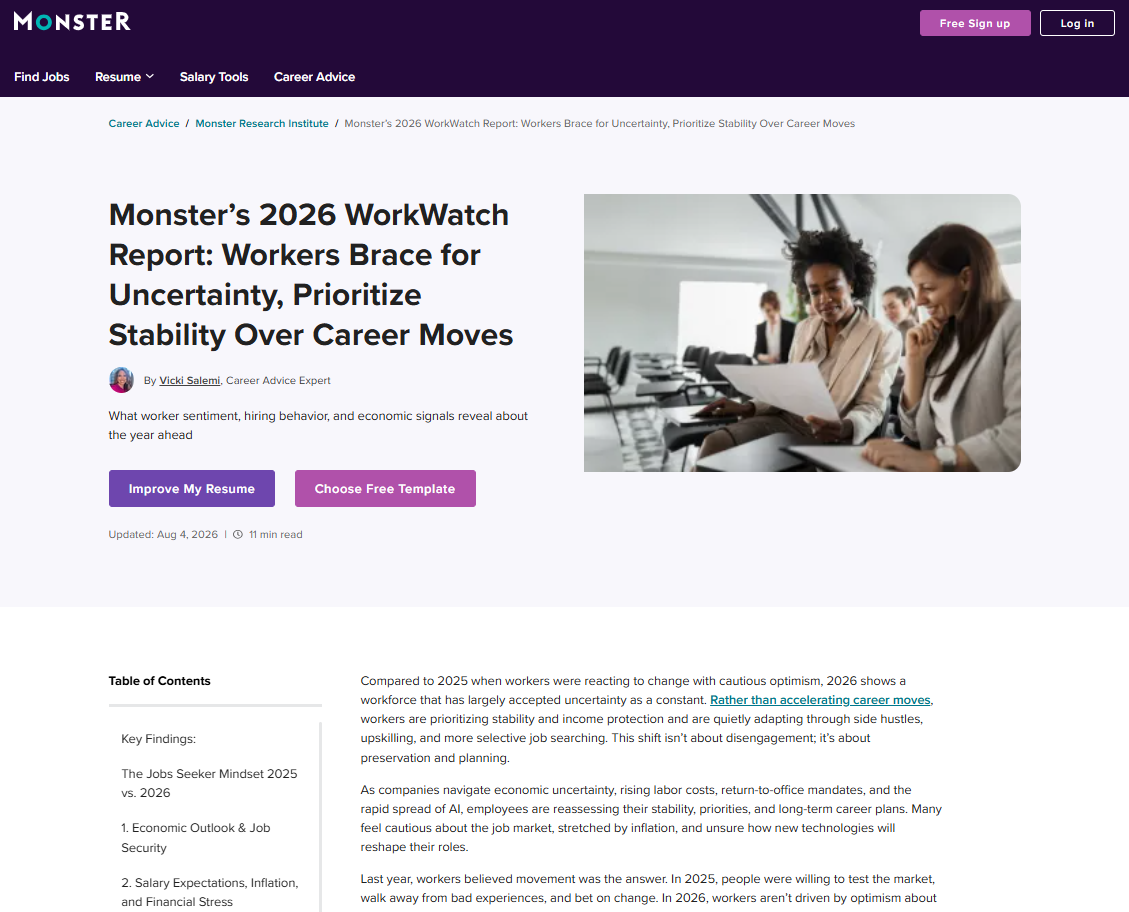
The job market landscape is changing rapidly, and it’s not for the faint of heart.Monster’s 2026 WorkWatch Report confirms that the job market is bracing for significant uncertainty. Workers are now prioritizing stability over career jumps. In fact, only 43% of workers are planning to job search in 2026, a sharp drop from 93% just last year, and 52% believe nationwide layoffs are likely to increase.The message: Knowing what is on the near horizon, how you prepare for what many are saying is inevitable is entirely your responsibility. Read the full report 👇(
Questions, comments, advertising inquiries? Want to be a guest blogger? Contact me: artoffindingwork@gmail.com.
If you’d like to connect, my social media accounts are:
No posts
Comments
Nothing yet. Say the first thing.
Sign in to join the conversation.