
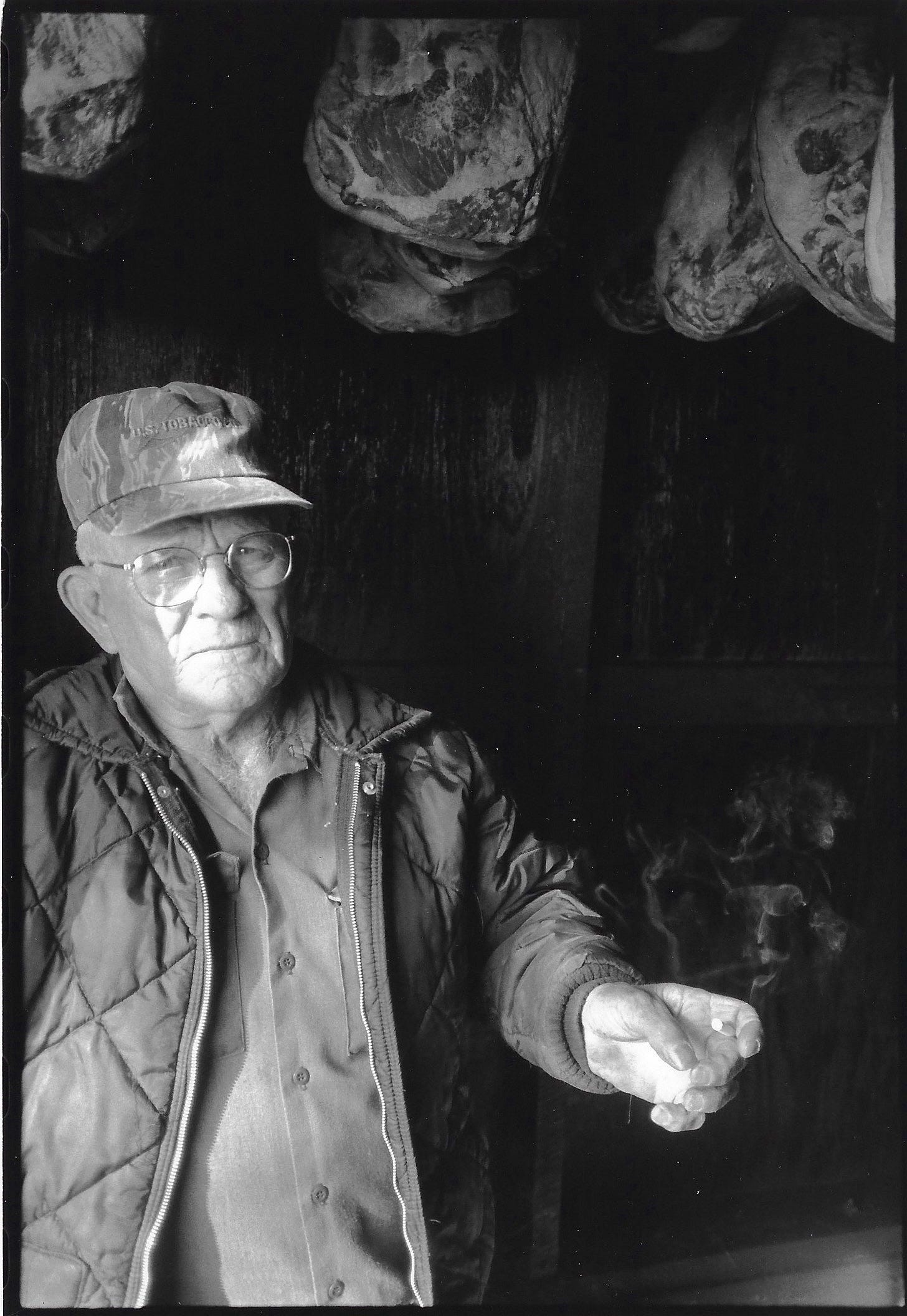
Once upon a time, when I was first learning about Southern country ham and had a lot to say about it, I wrote about Tiny Guier, who was a farmer and a champion ham-curer outside Cadiz in Trigg County, Kentucky. Back then, when I would call to place an order, my non-Southern accent would lead to questions about whether or not I understood the hams were salty, cured initially by burying them in salt, not at all like the hams in other parts of the US. (Pumped hams, they’re called sometimes, because the brine is quickly pumped into them.) Southern country ham always used to be boiled, and that’s what I did. “Boil” is the word used, but really it’s poaching, and it took five or six hours. The hams were generally cut long, meaning that they had more hock than they do now, and to hold a ham I borrowed an enormous pot from a friend whose family had owned a large restaurant. I didn’t realize that the raw hams could be sliced paper-thin, prosciutto-style; eventually I switched to doing that. Most of the places I visited or bought hams from in several Southern states have since closed or, in one or two cases, changed hands, and the number of farms that cure hams has shrunk. Trigg County, where Tiny Guier lived, kept an especially strong tradition of curing and smoking hams on farms. It still holds a ham festival complete with a ham judging each year in October.
Comments
Nothing yet. Say the first thing.
Sign in to join the conversation.