
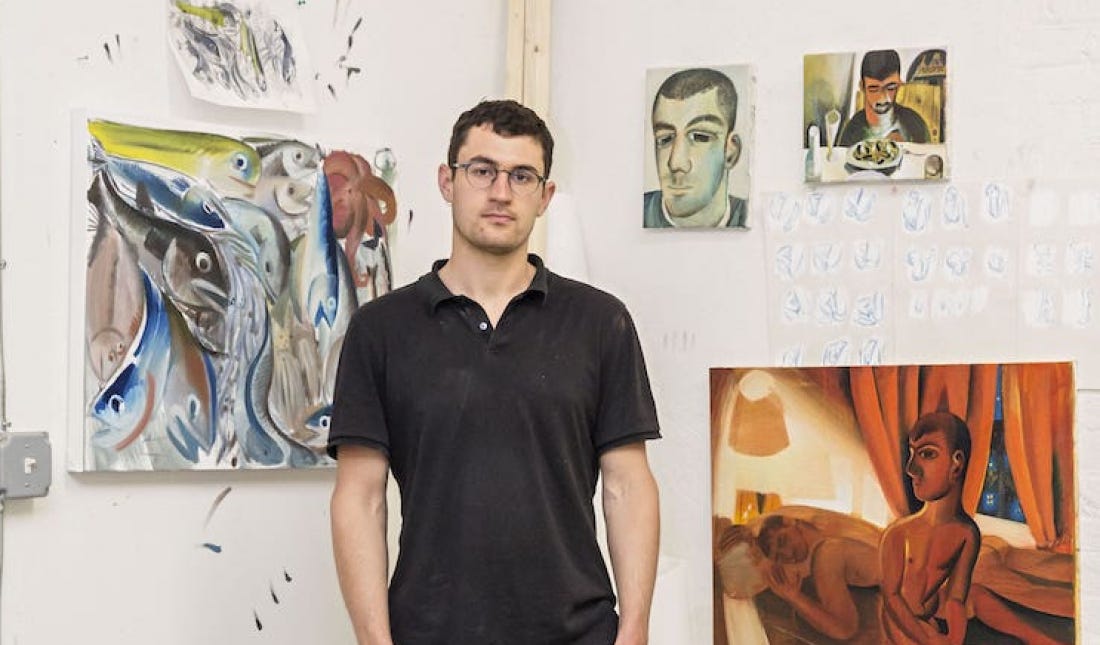
Louis Fratino (Maryland, 1993) is one of the most compelling painters of his generation working within contemporary figuration. Trained at the Maryland Institute College of Art, his work has quickly gained international recognition for its nuanced approach to the body, intimacy, and queer experience through a deeply personal lens. Across painting, drawing, and works on paper, Fratino has built a visual universe in which everyday life takes on an almost meditative intensity.
At a time when contemporary painting often oscillates between the conceptual and the spectacular, his work stands as a quiet—yet deeply resonant—reminder that intimacy remains a radical territory. Rather than relying on visual excess, Fratino turns toward the tactile, the emotional, and the domestic.
In just a few years, he has developed a highly recognizable pictorial language: soft bodies, organic lines, and scenes charged with emotional intimacy. His paintings frequently depict male couples, domestic interiors, or portraits that seem suspended in time. His work openly engages with art historical traditions. One can trace the influence of Henri Matisse in his use of color and formal reduction, as well as echoes of David Hockney in his treatment of the male body and intimate space. Yet Fratino does not simply quote these references—he reworks them through a contemporary queer perspective.
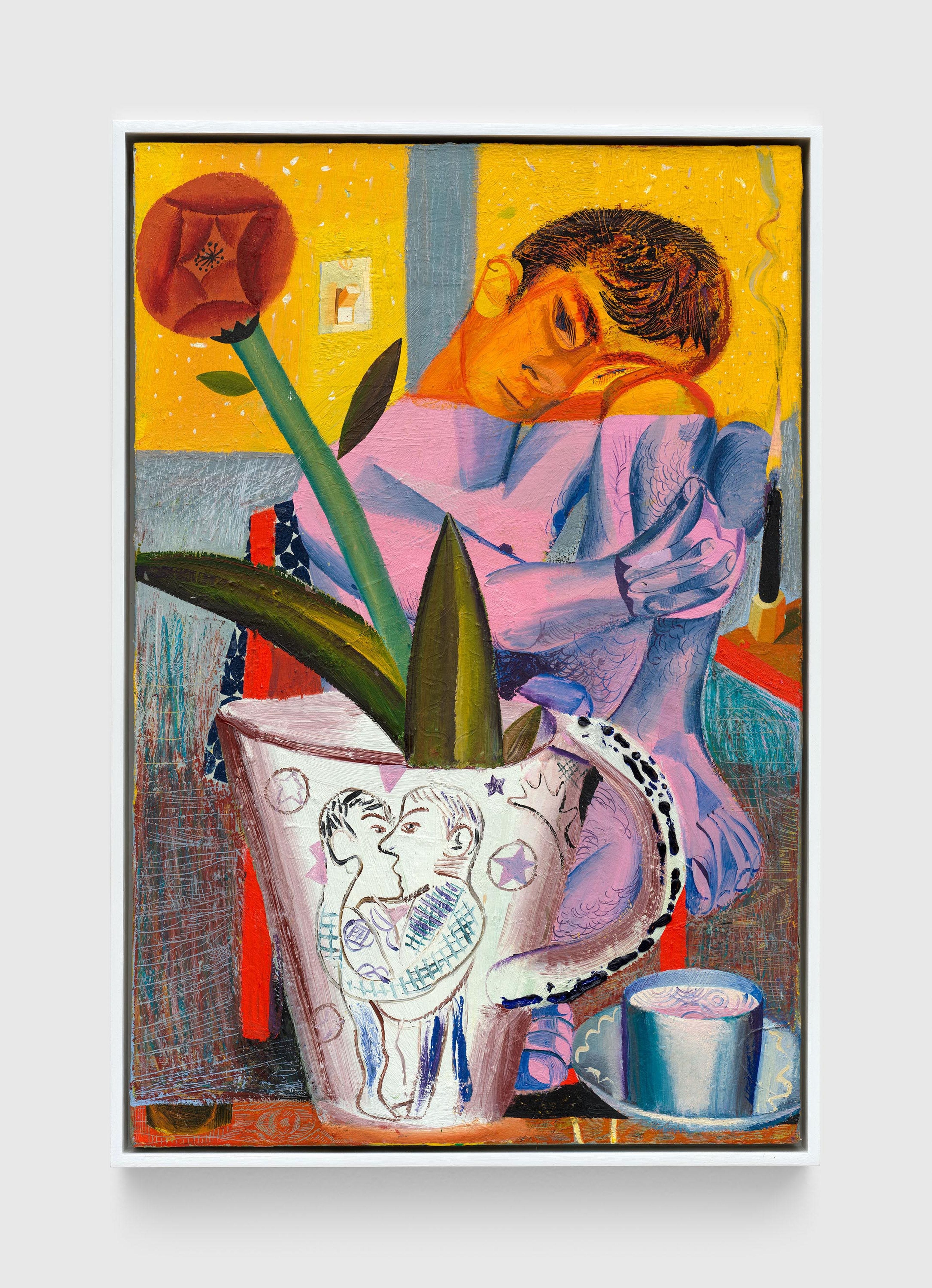
There is also a distinctly material quality to his painting. As he has noted, he is drawn to works that feel “crusty, thick, and bodily,” as if the painting does not merely depict the body but embodies it. This physicality enhances the sense of proximity: these are not distant images, but presences.
Although his scenes may appear calm or even nostalgic, they carry an undeniable political dimension. Fratino paints queer bodies with naturalness—without dramatization or exoticization. In this seemingly simple gesture lies a form of resistance: presenting queer love and domestic life as inherently worthy of attention, without the need for justification. His figures are not idealized in the classical sense; they are real bodies, with weight, texture, and vulnerability. Skin, folds, and relaxed postures all contribute to a sense of intimacy rarely found in normative representations of desire.
His work is deeply tied to lived experience. Many of his scenes originate from specific memories; as he has explained, his practice often emerges from personal recollections that painting allows him to extend. Painting becomes less a means of representation than a way of remaining—a way of lingering within moments, holding them against the passage of time.
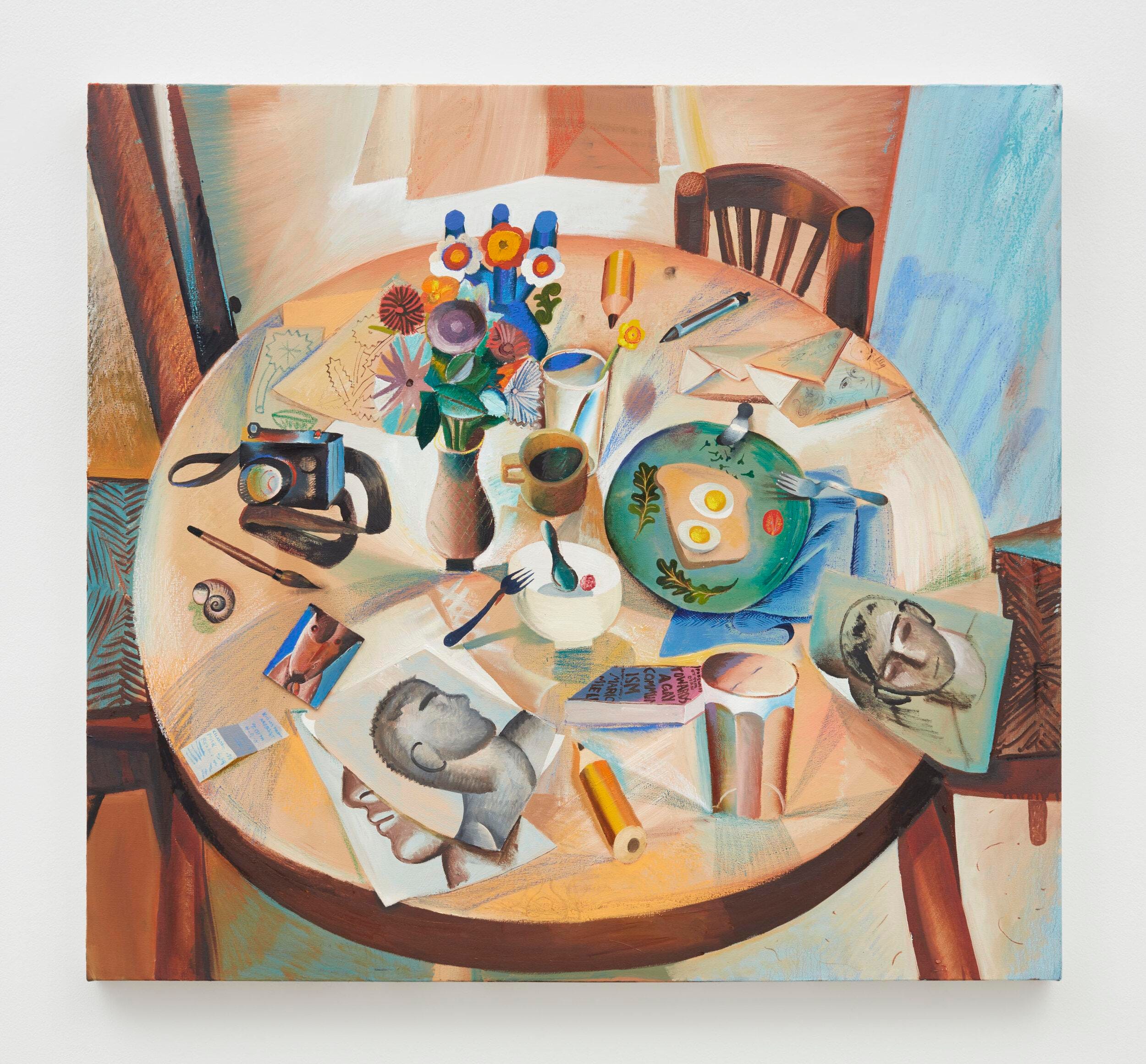
Beyond painting, Fratino incorporates literary and personal references into his work. Books, letters, and suggestive scenes appear throughout his compositions, pointing toward broader narratives. In this sense, his practice is not only visual but also narrative: each painting feels like part of a larger, intimate, and fragmentary story. His affinity with writers such as James Baldwin has often been noted—not as a direct influence, but in the way both explore identity, desire, and belonging by moving from the personal toward the universal.
“My work is mostly derived from things that happen at home,” he has said. This statement captures the core of his practice. His domestic scenes—a man reading, a couple resting, a reclining body—are not incidental; they are the site where a narrative is constructed in which queerness exists within the everyday, rather than outside of it. In an era defined by hyperconnectivity and visual saturation, Fratino moves in the opposite direction: toward slow, quiet, almost private images. Against the speed of the present, his painting proposes a pause.
That pause is also ethical. Fratino has suggested that, if there is a philosophy in his work, it lies in living intensely and remaining open to experience. This openness translates into images that do not impose meaning, but instead hold it gently.
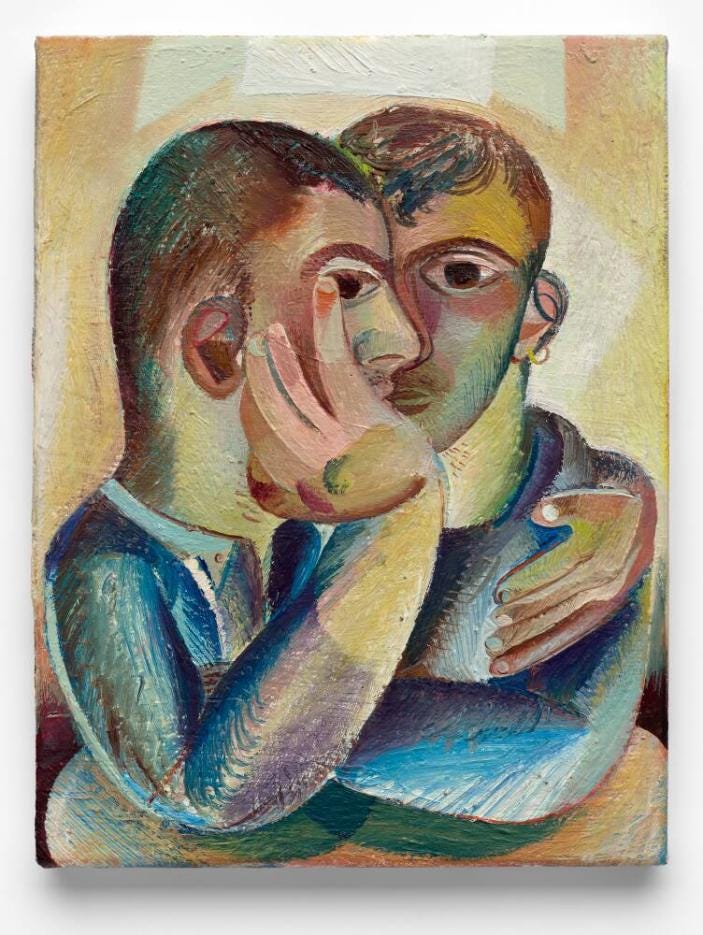
Perhaps one of the most compelling aspects of his work is its relationship to art history. Fratino employs the language of modernism—its forms, its visual economy, its approach to color—to articulate something long excluded from that canon: that tenderness matters. In his paintings, desire is neither spectacular nor dramatic; it is close, everyday, even quiet. And precisely for that reason, it is powerful. There is an honesty in his work that resonates directly with the viewer. As he has noted, the more genuine and honest one is, the more people respond.
Louis Fratino belongs to a generation of artists redefining figuration through personal experience. His work does not shout; it whispers. And within that whisper lies a particular strength: the ability to render the intimate, the vulnerable, and the deeply human visible. In a world that constantly pushes toward spectacle, his painting offers something rarer: a pause, a close gaze, and the possibility of inhabiting—if only briefly—the lives of others.
No posts
Comments
Nothing yet. Say the first thing.
Sign in to join the conversation.